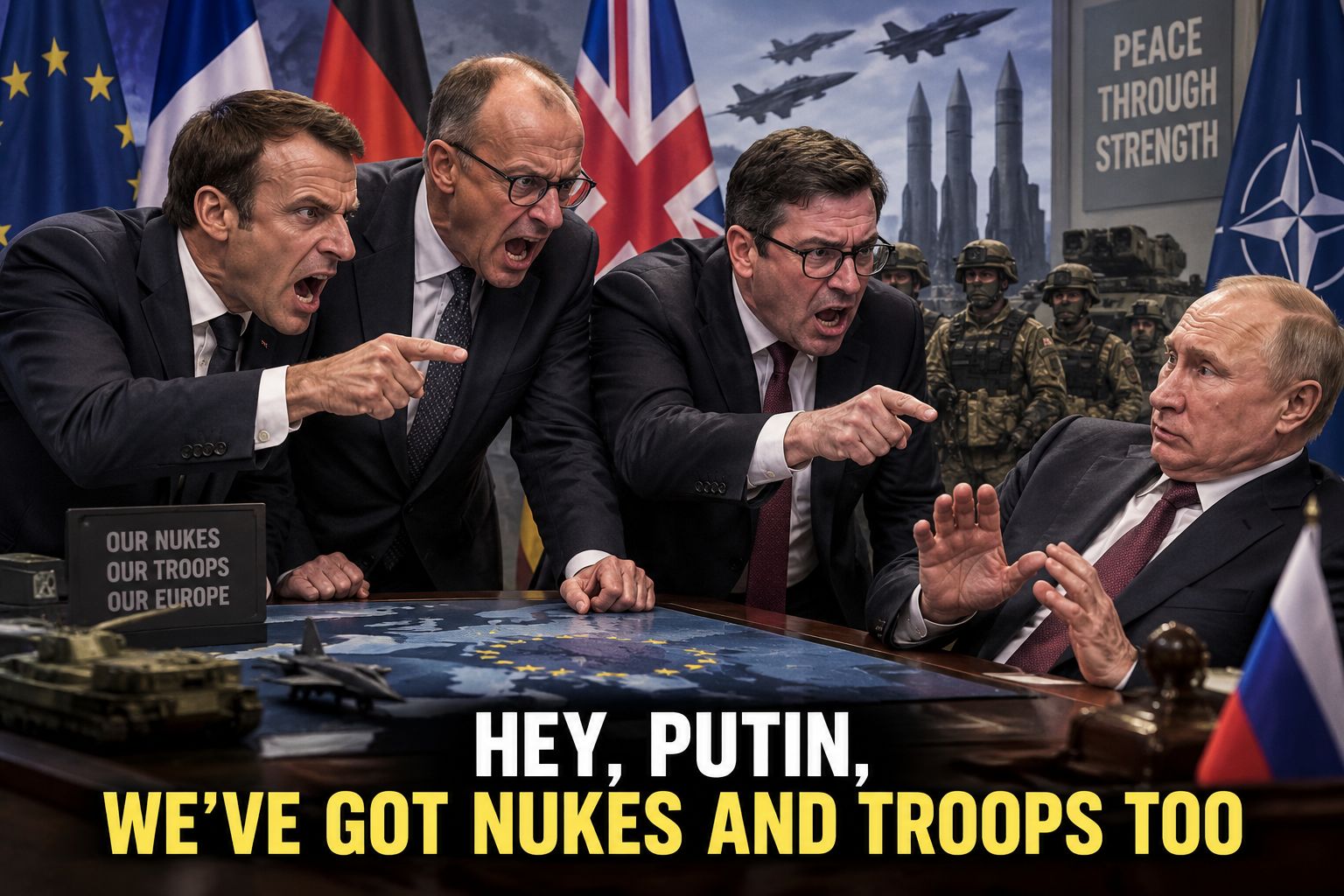
Former Russian diplomat Boris Bondarev has delivered an extraordinarily harsh assessment of Europe’s response to Vladimir Putin. His language is deliberately provocative, and some of his prescriptions are dangerously escalatory. But the central question he raises deserves serious attention: what happens when deterrence exists on paper but your opponent does not believe you are willing to use it?
Bondarev knows the Russian diplomatic system from the inside. He worked for Russia’s Foreign Ministry from 2002 and served at Russia’s mission to the United Nations in Geneva. In May 2022, he resigned publicly in protest against Russia’s invasion of Ukraine.
In a new interview with Czech news outlet Aktuálně.cz, Bondarev argues that Moscow does not regard Europe as a serious strategic actor. His description is brutal. According to him, the Kremlin sees Donald Trump’s team as a collection of “funny clowns,” while Europeans are “sad clowns” who talk, obstruct and complain but are unwilling to accept the costs necessary to influence events.
His language may be insulting. The underlying warning is harder to dismiss.
Putin understands power
Bondarev rejects the idea that another round of negotiations, another diplomatic mission or another carefully worded statement will persuade Putin to abandon his objectives in Ukraine.
His argument is essentially that Putin does not interpret restraint in the same way European governments do. Europeans may regard restraint as responsible statecraft. Moscow can interpret the same behavior as evidence that escalation works.
Bondarev therefore believes Europe would have to become an indispensable military actor before Moscow would treat it as an indispensable diplomatic one. He goes so far as to suggest deploying a European force of roughly 100,000 troops to Ukraine. He also advocates sabotage inside Russia and asks why Europeans expect Ukrainians to bear almost all the direct risks themselves.
Those proposals would carry enormous risks and should not simply be accepted because they come from a former Russian diplomat. Direct European combat operations against Russia could dramatically increase the danger of a NATO-Russia confrontation.
But Bondarev’s broader criticism is worth separating from his most extreme prescriptions.
Europe has enormous economic, technological and military resources. Yet Russia has repeatedly used sabotage, cyberattacks, disinformation and other forms of hybrid pressure against European countries. Bondarev argues that Europe’s response has often failed to convince Moscow that such behavior will impose sufficiently serious consequences.
The nuclear question Europe dislikes discussing
The most controversial part of Bondarev’s argument concerns nuclear weapons.
Russia repeatedly invokes its nuclear arsenal when Western support for Ukraine approaches boundaries Moscow wants to protect. Bondarev believes this works because European governments become frightened by Russian nuclear rhetoric while rarely emphasizing their own nuclear deterrent.
France and Britain possess nuclear weapons. NATO additionally benefits from the enormous American nuclear arsenal. Yet Bondarev asks a simple question: if Europe never signals that its nuclear deterrent matters when Russia threatens nuclear escalation, what exactly is that deterrent supposed to deter?
He argues that Europeans should remind Moscow explicitly that nuclear deterrence works in both directions. Otherwise, Putin can invoke nuclear war whenever conventional pressure becomes uncomfortable and expect Europeans to retreat.
There is an important distinction here. Nuclear deterrence does not mean casually threatening to launch nuclear weapons. In fact, reckless nuclear rhetoric can make everyone less safe. The purpose of deterrence is precisely to prevent their use by convincing an adversary that catastrophic escalation cannot produce a favorable outcome.
Bondarev’s criticism is that Russia loudly communicates one half of that equation while Europe barely communicates the other.
Europe cannot outsource its security forever
Perhaps Bondarev’s strongest argument is not really about nuclear weapons at all. It is about dependency.
For decades, much of Europe could maintain relatively modest military capabilities because the United States ultimately guaranteed its security. Russia’s invasion of Ukraine shattered the assumption that major conventional war in Europe belonged permanently to history.
Meanwhile, Europeans have depended heavily on Ukrainians themselves to contain Russia militarily.
Bondarev considers this arrangement unsustainable. In his formulation, Europeans pay Americans to protect them and Ukrainians to die defending the European security order.
That formulation is intentionally cruel, but it identifies a genuine strategic problem. A continent of hundreds of millions of people, containing some of the world’s largest economies and most technologically advanced states, should possess the capacity to defend itself.
European rearmament therefore should not be understood simply as helping Ukraine. It is ultimately about Europe becoming capable of protecting Europe.
Russia’s strength is not something to admire
There is another danger Bondarev identifies. When democratic governments appear incapable of responding decisively to crises, authoritarianism can begin to look attractive.
Russia projects strength. It acts quickly, tolerates enormous costs and disregards democratic constraints. Far-right and populist movements can then point toward Moscow and present authoritarian decisiveness as an alternative to supposedly weak liberal democracy.
But Russia’s apparent decisiveness comes at an enormous price: repression, censorship and the absence of meaningful democratic accountability. As Bondarev puts it, Russia possesses strength, but little else.
Democracy should not have to become authoritarian to compete with authoritarianism.
It does, however, have to demonstrate that democratic institutions can make difficult decisions.
Bondarev goes too far — but Europe should listen
Calling European leaders “impotent” does not constitute a strategy. Sending 100,000 European soldiers into Ukraine or conducting sabotage inside Russia could produce consequences far beyond anything Bondarev acknowledges in the interview. Nuclear signaling, especially, must be handled with extraordinary caution.
Nevertheless, dismissing his entire argument because its most dramatic elements are dangerous would be a mistake.
His central warning is persuasive: deterrence fails when the opponent stops believing in it.
Europe does not need to imitate Putin. It does not need to threaten nuclear war every week or abandon democratic restraint. But it does need credible military power, a much greater capacity to defend itself, stronger responses to Russian hybrid operations and a clear understanding that diplomacy works best when it is backed by capabilities.
Peace is not maintained simply by wanting peace.
Sometimes it survives because the potential aggressor knows exactly what war would cost him.
Leave a Reply