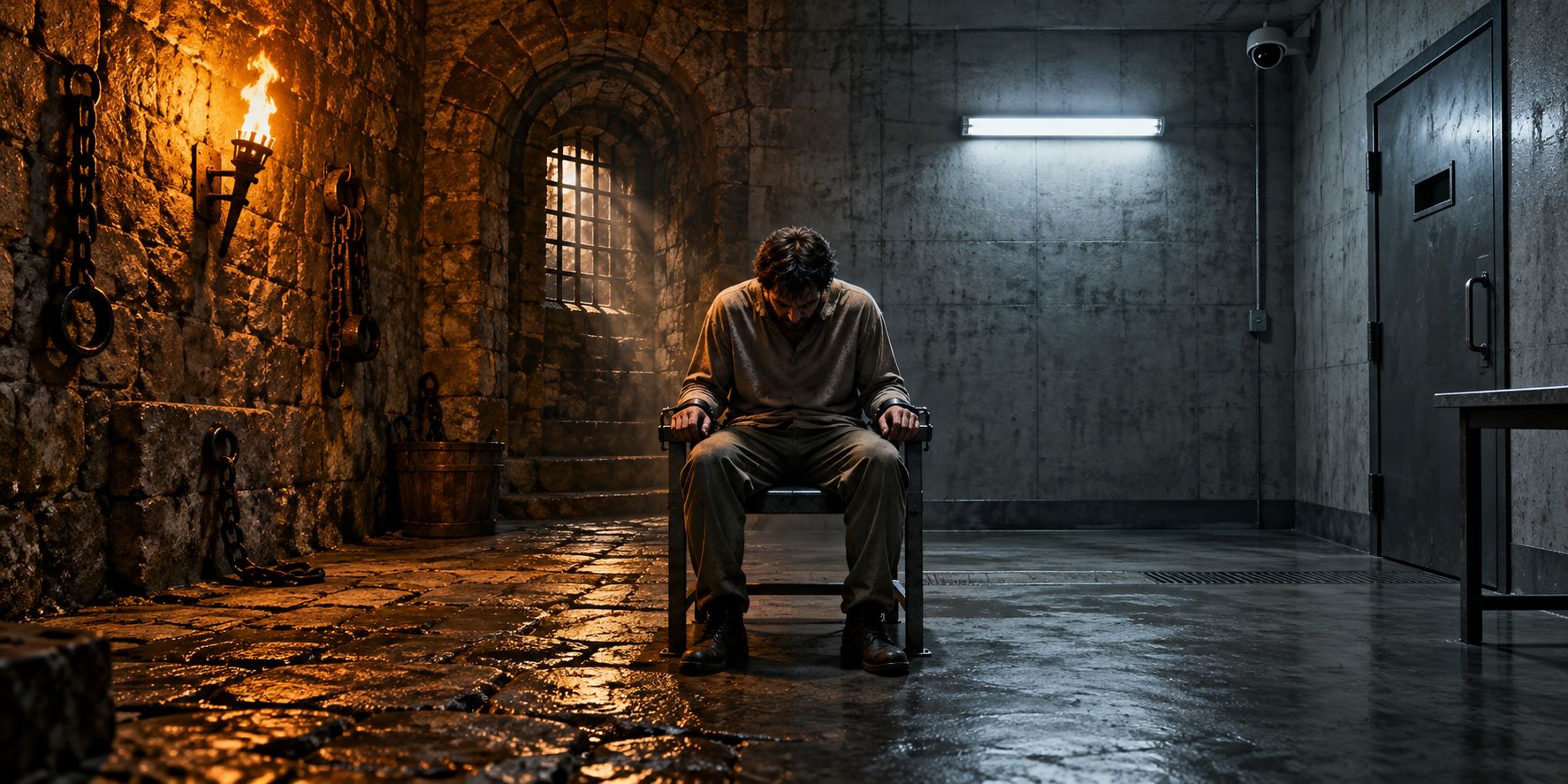
Electric shocks, rape, simulated drowning, mock executions and beatings. We associate torture with medieval dungeons and brutal dictatorships, yet it remains part of the modern world. Scientific progress has given humanity extraordinary powers without ensuring that those who exercise power treat others humanely.
Could more people be suffering torture today than at any previous point in history? The possibility deserves serious consideration. However, no reliable evidence establishes it as a fact. The world’s enormous population makes an unprecedented number of victims possible, while secrecy and incomplete historical records prevent a trustworthy comparison.
Most people live in countries with documented torture
A majority of humanity lives in countries where human rights organizations have documented torture or other ill-treatment. This is a conclusion drawn by combining population figures with country reporting, rather than a published global victim count. India, China, the United States, Indonesia, Pakistan, Nigeria and Brazil alone account for slightly more than half of the world’s population.
The evidence spans political systems and continents. Amnesty International has documented torture in China’s Xinjiang detention system, custodial torture in India and the torture of a protester in Indonesia. Human Rights Watch has also documented police torture in Pakistan.
Meanwhile, Amnesty has reported torture in American immigration detention facilities and Nigeria’s police custody. Its reporting on Brazil includes convictions of police officers for torture committed against residents of poor neighborhoods. These findings concern different periods and circumstances; they do not suggest that every country uses torture equally or that every government responds to it in the same way.
Living in a country with documented torture does not mean personally experiencing it. Nevertheless, the geographical reach matters. Torture cannot honestly be dismissed as a practice confined to a handful of isolated regimes.
Were the Middle Ages worse?
Medieval Europe provides a powerful image of cruelty, but imagery cannot substitute for measurement. From the late twelfth and thirteenth centuries, judicial torture became established in parts of continental Europe. Courts used it to obtain confessions under legal systems that placed exceptional weight on confessions and eyewitness testimony. The practice continued into the early modern period.
This distinction matters because many practices popularly labeled “medieval” continued long after the Middle Ages. European states dismantled judicial torture through reforms concentrated in the eighteenth and early nineteenth centuries. Its history does not fit a simple division between a barbaric medieval world and an enlightened modern one.
There is nevertheless a significant difference in legal status. Courts once openly authorized torture in parts of Europe. Today, international law prohibits it, and the Convention against Torture rejects war, political instability and public emergencies as justifications. That represents genuine legal progress, even when governments violate the principle.
But neither legal acceptance in the past nor legal prohibition today establishes how many people suffered. We lack comparable worldwide victim counts for medieval societies and the present. Moreover, Europe’s experience cannot stand in for the history of the entire planet.
Modernity did not end organized cruelty
The twentieth century also undermines any comforting story of steady progress. Nazi Germany’s Gestapo used torture during interrogations, while the concentration camp system subjected prisoners to torture, deprivation, forced labor and extreme violence. Modern institutions and administrative capacity coexisted with deliberate brutality.
Yet even extensively documented atrocities do not provide a simple global benchmark. A regime’s cumulative victims over many years cannot be compared directly with people tortured during one year today. Nor can every war death, prisoner or forced laborer automatically become an entry in a torture total. Overlapping categories still require careful distinctions.
To establish an all-time record, researchers would need consistent definitions, comparable time periods and sufficiently complete evidence from across the world. We do not have that foundation. The historical record reveals immense cruelty, but it does not offer a reliable ranking of every era.
A smaller percentage could still mean more victims
Population changes the arithmetic dramatically. The United Nations estimated that humanity numbered 8.2 billion in 2024, with further growth expected. Against that population, even a small rate of torture could produce a vast number of victims.
Consider an illustration, not an estimate. If 0.1 percent of a population of one billion experienced torture during a year, that would mean one million victims. If 0.02 percent of a population of eight billion experienced it, the total would reach 1.6 million. The rate would be five times lower, but the number of victims would be higher.
Therefore, asking whether humanity tortures a greater proportion of people differs from asking whether it tortures more people overall. Both questions matter. However, population growth alone cannot answer either one: we also need to know how frequently torture occurs.
The suffering we cannot count
Between January 2009 and May 2013, Amnesty International received reports of torture and other ill-treatment by state officials in 141 countries. This demonstrated the breadth of the problem, but it did not establish a global victim total. The figure also covers other ill-treatment and must not be presented as a current count for 2026.
Amnesty explained why measurement is so difficult. Governments conceal abuse, and victims may be unable or afraid to report it. The organization warned that reliable country-by-country statistics were unavailable and that changes in reported cases required caution. More reports can reflect better documentation; fewer reports can reflect more effective concealment.
The possibility remains that more people experience torture today than ever before. But possibility is not proof, and exaggeration would weaken an argument already supported by extensive evidence of abuse.
We do not need a historical record to recognize a moral catastrophe. The relevant achievement would be protecting people from torture, investigating their allegations and holding perpetrators accountable. Being less cruel than some previous century would offer little comfort to someone enduring it now.
Leave a Reply