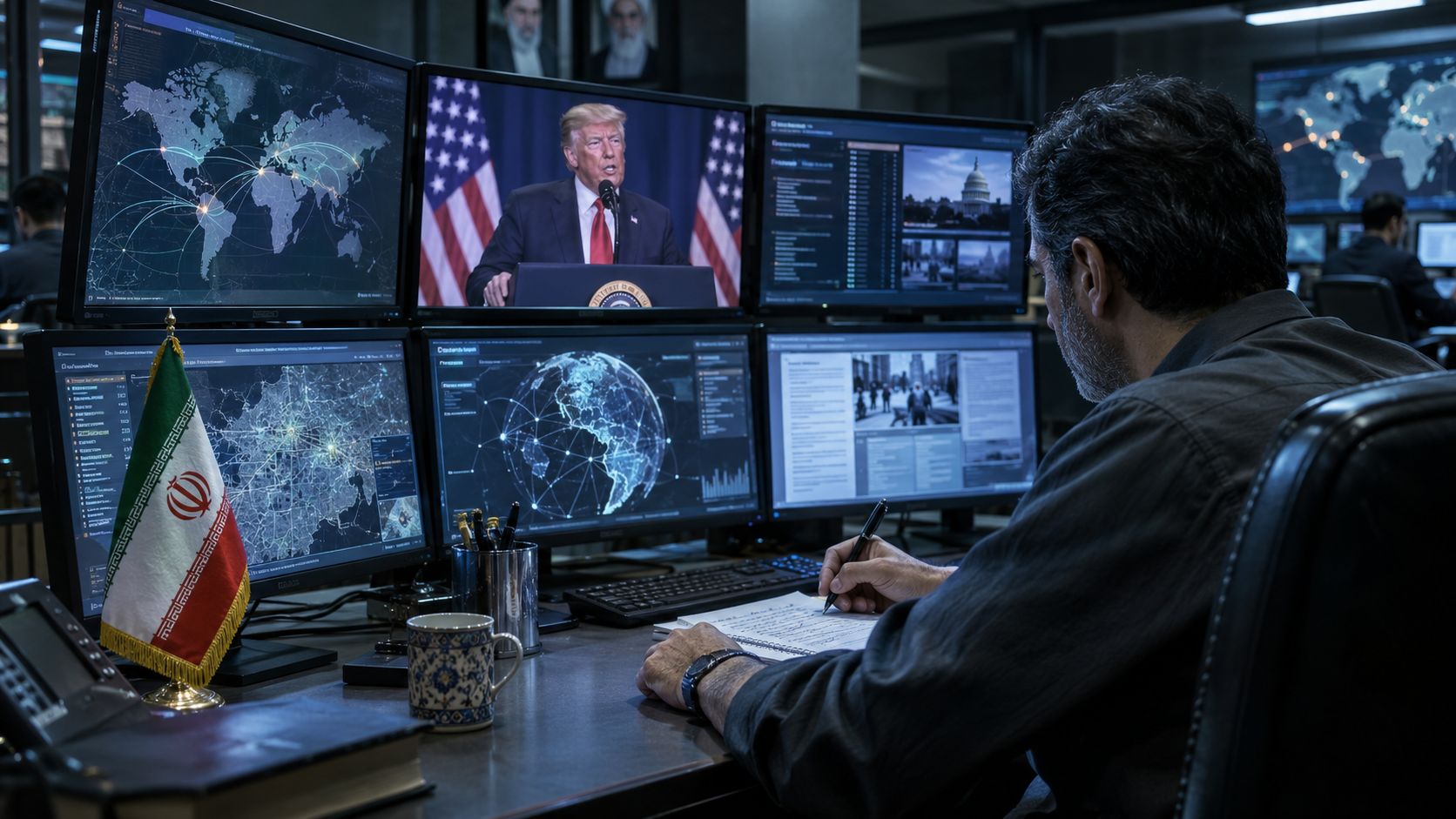
Donald Trump wanted Iran’s rulers overthrown. His gamble risks intensifying a threat that could follow him long after the war ends: people within Iran’s security apparatus who regard his death as an objective worth pursuing. These are no wannabe terrorists. The threat includes trained operatives with state backing, access to money, technology, and international networks, and years of experience in covert operations.
A war without a quick exit
When he announced military operations on February 28, 2026, Trump urged Iranians to seize control of their government after the American assault. Nearly nine months later, the conflict remained unresolved. On November 19, he pushed discussion of possible renewed major strikes into the new year. Military superiority had failed to produce a swift political conclusion.
The strategic difficulty is that Iran’s rulers have powerful reasons to resist a humiliating surrender. Their calculations involve regime survival, regional influence, military deterrence, and credibility within their own security establishment. Concessions that appear to reward an attempt to overthrow them could encourage further pressure and undermine their authority. Negotiation remains possible, but an agreement they can present as preserving their position is easier to accept than public capitulation. These pressures help explain why the confrontation can drag on despite its enormous costs.
Thousands of trained personnel
For Trump, however, the consequences may extend well beyond negotiations, military deployments, and political embarrassment. The more personal danger comes from the institutions behind the Iranian leadership: intelligence services, military organizations, and networks with experience operating abroad.
Their scale matters. A British parliamentary intelligence report published in 2025 put personnel in Iran’s Ministry of Intelligence and Security in the low tens of thousands. It estimated the Revolutionary Guards’ Quds Force alone at between 5,000 and 15,000 personnel. These are estimates from before the current war, and they cannot establish today’s surviving strength. They nevertheless demonstrate the institutional depth of the apparatus Trump confronted.
Thousands of people with security backgrounds belong to these organizations. How many personally want Trump dead is unknown. What is documented is that operatives connected to the Iranian state have pursued assassination schemes in which Trump was a target or an intended target.
On November 17, Asif Merchant received a 27½-year prison sentence for an Iranian-directed plot to arrange political assassinations in the United States. According to the Justice Department, Merchant admitted working for the Revolutionary Guards and believed Trump would be the ultimate target. The stated motivation included revenge for the 2020 killing of Qassem Soleimani. This history matters because the threat predates the current war; further confrontation risks deepening an existing desire for retaliation.
Money, technology, and talent
Iran also has the resources of a large country behind its institutions. Its population is approximately 92 million. That population cannot be equated with support for the regime or hostility toward Trump. It does, however, illustrate the scale of the society from which the state recruits specialists and draws resources.
Its security organizations have access to funding, technology, intelligence networks, and technical expertise. Sanctions and military damage constrain those capabilities, but they do not automatically eliminate them. A weakened state can remain dangerous, particularly when some of its institutions have spent decades developing the capacity to act beyond its borders.
There is also an awkward thought for a president so confident in his own abilities: some of them are smarter than Trump in terms of IQ, in a broader sense, talents, creativity. Their abilities are reinforced by specialist training, institutional experience, and the combined work of entire teams. Presidential self-confidence offers no guarantee of superior judgment against that collective expertise.
A threat without an expiration date
Trump is, of course, protected by a formidable security and intelligence apparatus of his own. The disruption of assassination plots demonstrates that those defenses can work. Iranian capabilities also have limits, and several specific warnings about Iranian plans to kill him have remained uncorroborated by American intelligence officials. A serious assessment must distinguish a demonstrated threat from every alarming allegation made in its name.
Even so, the possibility of a lasting threat deserves attention. Institutions can preserve grievances, priorities, and operational knowledge through changes of personnel. A diplomatic agreement could reduce the danger without necessarily extinguishing every motive for revenge. The end of Trump’s presidency would not, by itself, settle those grievances either.
Attempting to overthrow a regime therefore carries consequences that cannot be measured only in destroyed military facilities or announcements of victory. Trump risks intensifying the hostility of experienced people with access to state resources and the patience to think beyond the next news cycle. He may eventually declare the confrontation over. He cannot unilaterally decide that everyone determined to retaliate has finished with him.
Trump should be seriously worried—and unusually attentive during his security briefings. It might be time to make listening great again.
Leave a Reply