Even enormously intelligent people, notably James Sidis, expressed their doubt about intelligence quotient. So you want to tell me that a person is more intelligent in every possible manner? Does a manager with IQ of 140 have better performance than a manager with IQ of 130? I have heard highly intelligent people saying pretty stupid things. People with lower IQs may perform better on some tasks than their more intelligent counterparts. Even people with lower IQs may be smarter in a broader sense. So how come this has become one of the most statistically significant concepts in humanities and an inseparable part of mainstream science?
Because it is not everything but it is nearly everything. Having IQ of 50, 60, 70, 85, 100, 115, 125, 130, 145, 150 or 160+ drastically predict your life attainment. Assembling blocks won’t make you smarter of course, however, these tasks are the product of factor analysis which is a science of itself and your IQ is measured by it.
There are extremely significant correlations of median average IQ and given professions (Schmidt Hunter 2004). The more prestigious and cognitively demanding the higher the median average arises. And there are also minimum requirements for each profession. Yes, we have elite lawyers with IQ 90, but there are just a few of them. The median is – predictably- very high.
This also applies to your performance in the job environment, your income, morbidity and mortality.
The concept of g factor is the very ability to solve very general problems. When you can put only two things in your head simultaneously you won’t be a mathematician, engineer and so on (and the real geniuses can put, for example, 100 things in their head simultaneously while working with them). Your short-term and working memory (these two do overlap) have some limits. So either you have to be really quick to resolve the problem until the things disappear from the mentioned memories or your memories must be very long. It same goes with logic, it’s not some random logic, it is logic measured by factor analysis.
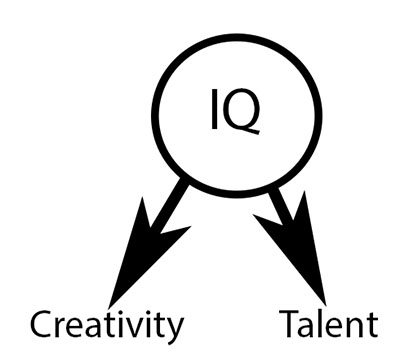
What the g factor is about:
Talent (it is connected with IQ)
Creativity (ditto)
Mastering some crafts (manual crafts, stock trading, piano playing)
What the g factor is not about:
Having some concrete knowledge (you already have that knowledge, but your smarter counterparts (on average) would have understood it quickly and have been able to develop it better than you)
And when we are talking about the Nobel Prizes (excluding literature and peace) those are prizes given to people with stratospheric IQs. We are talking about IQs of 150 (1/2330), 160 (1/31560), 170 (1/652 598) and 180 (1/20 696 863). You have to have more than perfect genetics and environment. They call this dumb luck! Even highly intelligent people (130 or so) cannot even think about receiving this price in those above-mentioned spheres.
They also say every 5 IQ points is crucial in fields like programming, mathematics, physics, engineering, science and so on.
We have naturally a specific personality (for example, the overachievers) that destine us to a specific socioeconomically place. But your IQ plays a decisive role.
When researching successful people (for example, businessmen), traits like mental resilience, stability, ambitiousness, hard-working mentality or talent appeared. And guess what was the key? Yes, the g factor (IQ).
We should also notice that IQ tests are not exhaustive, so your IQ may be measured at certain points, yet the excluded tasks may be in different ranges.
Some people – and sadly psychologists – believe we have multiple intelligences. This is not just a lie, but it is completely illogical. Intelligence is a general ability and it (the g factor) also arises among the proposed different intelligences. It should be noted the theory of multiple intelligences has no support from mainstream psychology.
Source: IQ Comparison Chart
Leave a Reply