Arguably one of the most statistically significant concepts in humanities, the g factor (the product of it is intelligence quotient; IQ), is divided into two parts: performance (fluid) and verbal (crystallized).
Each of these parts, measured by a statistical tool specially developed for it (factor analysis), is connected somehow to creativity, talents, latent inhibition and psychomotorics.
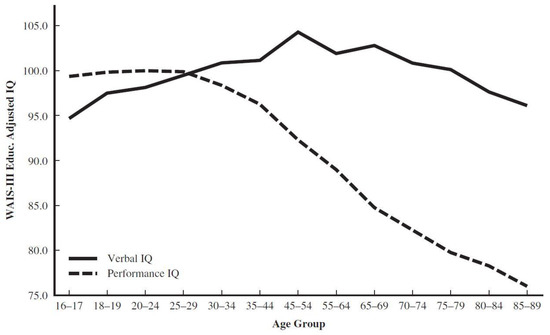
To simplify it, the performance part is basically how we learn things and the verbal part is what we have learned. And the performance part has steady decline.
If you wanted to learn something and you postpone it, hurry up, it may be late.
“It begins in the mid-20s and continues steadily until it reaches more than 30 points in the late 80s (a peak of 101 at 20–24 versus 70 in old age),” Allan S. Kaufman’s Intelligence 101 reads.
So if you are used to have an IQ of 120 (both parts equal) you must prepare it will decline by around 5 points every ten years since 45 years old (the decline is apparent in the vast majority of cases). Thus, your performance IQ will be 90 when you are in your late 80’s. Your grandmother can cook the same meals she was used to all her life, however, cannot learn to cook new ones.
And since IQ is connected with the ability to make scientific discoveries (both basic and applied research) you will find few scientists that made their discoveries later on in their lives. The performance IQ is crucial to new scientific discoveries.
If you have a performance IQ of 150 (one in 2030 people) then it declines to 130 later on. And as we know you must have stratospheric intelligence to make discoveries. This reminds me of famous scientist Kevin F. Nash whose intelligence was so high that its decline caused by schizophrenia didn’t affect his brilliant thinking (or he didn’t have the decline).
The peak of the performance part is around 20 years of life. This is the part of life you are most intelligent and a lot of scientists make their discoveries right in this period. The verbal part peaks in 45 years of life and then declines a bit.
Leave a Reply