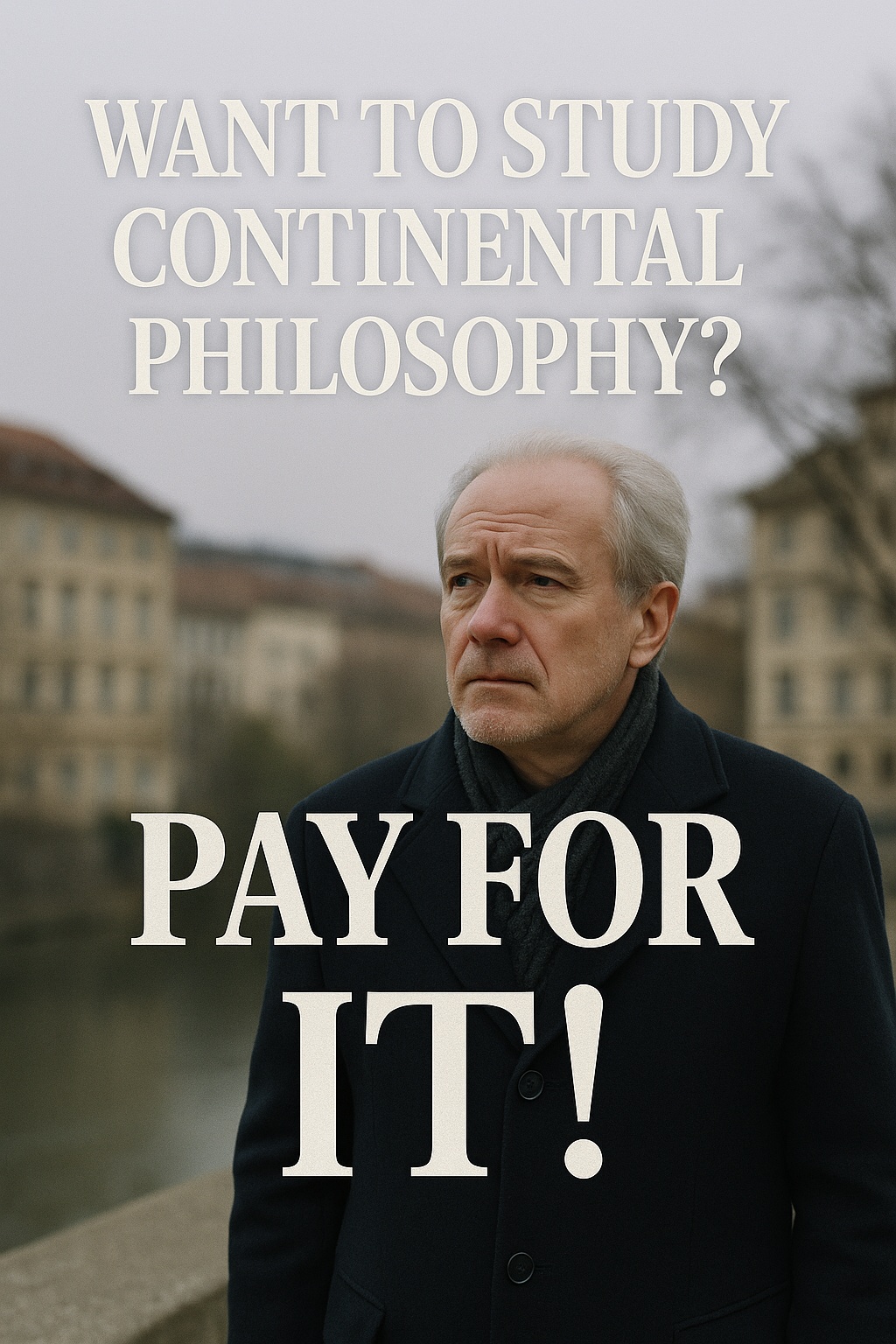
Continental philosophy survives not because it enlightens, but because it is funded. Europe keeps paying for it, decade after decade, as if confusion were culture. Professors protect it like a national monument. Universities preserve it like ancient ritual. Yet outside of Europe, it barely breathes.
Across the Atlantic, philosophy evolved. It merged with science, logic, and cognitive studies. It asked testable questions and produced falsifiable answers. Meanwhile, the European continent stayed in the fog of abstraction. It mistook obscurity for depth; it celebrated complexity as insight. It taught emptiness with pride.
The tragedy lies not only in its decline, but in its cost. Taxpayers fund a tradition that teaches that meaning is oppression and truth is colonialism. Students pay for degrees in linguistic mysticism. Heidegger’s famous line, “The nothing nothings,” captures the absurdity perfectly. It shows what happens when words replace thought. When meaning collapses, the state pays the bill.
Continental philosophy is not free inquiry. It is intellectual bureaucracy protected by habit. Europe still thinks this is sophistication. In reality, it is the continent’s most expensive illusion.
Two worlds of philosophy
There are two philosophies now — and statistics confirm it. Surveys from PhilPapers and other academic studies make the split undeniable. Analytic philosophy dominates in the United States, the United Kingdom, Canada, and Australia. Continental philosophy dominates France, Germany, and Italy. The line runs almost exactly along linguistic borders.
Yet the difference is not geography. It is purpose. Analytic philosophy seeks truth. Continental philosophy seeks interpretation. Analytic philosophers build arguments; continental philosophers build vocabularies. The first tries to explain reality; the second tries to rewrite it.
Europe refuses to admit this division. It pretends both schools are complementary. They are not. They speak different languages and serve different goals. Heidegger’s line, “Being is the transcendens pure and simple,” demonstrates how far the continental tradition drifted from meaning. It sounds profound because it hides its emptiness behind grammar.
Every generation of continental thinkers repeats the same pattern. They coin new words, publish unreadable books, and call it revolution. Meanwhile, the analytic tradition keeps discovering how the mind works, how reasoning functions, and how truth can still exist. Two worlds, two directions, one clear choice.
When meaning collapses
Continental philosophy does not lose meaning accidentally. It destroys it deliberately. It claims that clarity is reduction, that logic is violence, and that coherence is tyranny. Its thinkers take pride in confusion. They mistake vagueness for wisdom and complexity for depth.
Heidegger, Derrida, and Deleuze built careers on sentences that defy comprehension. Their admirers celebrate opacity as sophistication. Yet meaning does not hide behind complexity — it disappears within it. When readers stop understanding, they start worshipping. They treat the author as prophet. They confuse awe for insight.
Heidegger’s sentence, “Time temporalizes itself as temporality,” illustrates this intellectual decay. It is grammar without reference. And it is language detached from reality. It is thought devouring itself. And yet, it appears in thousands of lectures as if it contained revelation.
This is not philosophy. It is theology without gods. It demands faith, not logic. And because faith cannot be falsified, it becomes immortal within academia. Continental philosophers live from that immunity. They create the problem, name it “interpretation,” and then get paid to explain it.
Against truth
Continental philosophy does not merely question truth — it abolishes it. Its postmodern offspring transformed skepticism into ideology. The analytic world still debates what truth means. The continental world debates whether truth exists.
This shift began with Heidegger himself. His declaration that “The essence of truth is freedom” dissolved the concept entirely. Truth became emotional. It became liberation, not verification. From there, truth lost its anchor in reality.
Foucault replaced truth with power. Lyotard replaced facts with narratives. Baudrillard replaced reality with simulation. The result was moral and intellectual anarchy. If everything is narrative, then lies are also narratives. If everything is perspective, then deception becomes creativity.
Such relativism infected not only philosophy but culture. Journalism lost objectivity. Politics lost consistency. Education lost standards. Postmodernism turned civilization into performance. When philosophers declare that truth oppresses, the liar becomes the revolutionary.
This is how a continent that once produced Newton, Kant, and Darwin now produces essays claiming gravity is discourse.
The antiscientific impulse
Science thrives on evidence. Continental philosophy thrives on metaphors. The difference defines their destiny. Science progresses because it admits error. Continental philosophy stagnates because it fears precision.
From Husserl’s phenomenology to Derrida’s deconstruction, continental thinkers promised to reach deeper levels of understanding. Yet every time, they reached nowhere. Husserl analyzed consciousness but never defined it. Merleau-Ponty spoke of perception but ignored neurology. Derrida redefined everything until nothing remained.
Heidegger’s sentence, “Language is the house of Being,” symbolizes this retreat from empiricism. It declares that reality lives in words, not in atoms. That sentence killed science within philosophy. It transformed the search for truth into the worship of language.
As a result, Europe’s intellectual elite turned their back on physics, biology, and mathematics. They called it resistance to positivism. In truth, it was surrender to ignorance. Instead of explaining the universe, they described their own confusion. They replaced discovery with discourse. And they called it continental thought.
Academic corruption
Continental philosophy would have died if universities had not saved it. But institutions cannot admit failure. They built careers, hierarchies, and reputations around thinkers no one understands. So they doubled down. They made confusion profitable.
Professors built their lives around interpreting the same five names — Heidegger, Derrida, Foucault, Deleuze, and Lacan. Each wrote obscurely enough to guarantee centuries of commentary. Each ensured that his followers could live forever as interpreters. Students spend years learning how not to understand. They call it initiation.
Heidegger’s line, “The nothing does not remain the nothing, but nihilates,” explains this perfectly. It creates mystery where none exists. It sells words as revelation. Professors treat it like scripture, and journals publish essays deciphering it. A simple fraud turned into an academic economy.
Every grant, every position, every publication depends on sustaining the illusion that something profound hides inside these sentences. But there is nothing there. There is only prestige, ritual, and repetition. Philosophy stopped searching for truth and started preserving mythology.
How it affects economy
The economic consequences reach far beyond classrooms. When a society funds abstraction, it diverts money from progress. Every department that glorifies incomprehension consumes resources that could fund real innovation. Philosophy became an expense with no return.
Universities pay for lectures that produce no technology, no science, and no measurable insight. Students graduate without skills relevant to modern economies. They join bureaucracies, not laboratories. They analyze words, not data. And yet, Europe continues to treat this as culture rather than failure.
This intellectual inefficiency creates economic stagnation. When the brightest minds debate whether “Being temporalizes itself,” they are not building bridges, satellites, or medical technologies. Heidegger’s influence indirectly shaped an academic class that consumes value without creating it.
Analytic philosophy, by contrast, contributed to logic, computation, and artificial intelligence. Continental philosophy contributed to unemployment. Every euro spent sustaining it is a euro denied to science. In that sense, the worship of obscurity became a tax on rationality.
How it affects the media, commentators, and content
Continental philosophy reshaped the modern information world from top to bottom. It infected newsrooms, commentators, and content creators alike. It changed how facts are reported, how opinions are framed, and how knowledge is produced. The entire media ecosystem now speaks its language without even realizing it.
Journalists once worked to describe the world. They verified events, compared sources, and treated truth as something external to belief. That era is gone. Today’s journalism interprets instead of informs. Reporters act like philosophers who never studied science. Every article must express emotion, deliver a moral tone, and take a political stance.
Heidegger’s idea that “In the naming, the being is called into its presence” describes this perfectly. The press now believes that saying something makes it real. Words create reality; silence erases it. If they declare a crisis, it exists. If they ignore it, it vanishes. This mindset transformed journalism from documentation into authorship.
Continental relativism made this morally acceptable. Derrida taught that language defines truth. Foucault said knowledge is power. Lyotard said meta-narratives must die. Together they gave the media a philosophical license to manipulate. They no longer report; they construct. Neutrality became cowardice. Objectivity became bias. Every story now arrives wrapped in ideology, crafted not to reveal but to persuade.
Commentators
Commentators followed the same path. They replaced logic with performance. Instead of analyzing, they dramatize. The European intellectual tone migrated into television panels, talk shows, and political podcasts. Every opinion now sounds like a thesis. Every sentence imitates philosophical gravity. Yet behind that rhetoric, there is nothing but style.
Heidegger’s phrase, “The nothing does not remain the nothing, but nihilates,” could describe these commentators’ entire method. They transform nothing into something through tone, posture, and vocabulary. They speak in circles, invoke deep concepts, and say absolutely nothing. Their success depends on the illusion of profundity. The less they explain, the more they appear intelligent.
This influence extends to online culture. Continental thought gave birth to a new species of digital intellectual — the “content philosopher.” They appear on YouTube, Substack, and social platforms, they quote Nietzsche, Foucault, or Deleuze without context. They believe that emotion equals insight and that sincerity equals truth. Heidegger’s declaration that “Language is the house of Being” became their gospel. They think that rearranging words changes the world.
Algorithms amplified this sickness. They reward passion over precision, mood over method. Continental philosophy offered the perfect justification. It told creators that every narrative is valid, every interpretation is creative, and every opinion is philosophy. Misinformation became artistry. The line between thought and theatre disappeared.
Distortions
This distortion now shapes how entire societies process information. Facts became optional. Feelings became political. Meaning became a commodity. Viewers no longer want clarity; they want confirmation. Media no longer educates; it entertains. And commentators no longer inform; they perform.
Continental philosophy gave the cultural permission for this transformation. It taught that truth is relative, language is power, and interpretation is rebellion. The result is an information landscape where every claim is subjective and every lie can be defended as perspective.
In such a world, journalism turns theatrical, commentary turns hollow, and content creation turns ideological. Reality no longer leads — language does. And the louder it speaks, the less it says.
How it affects people’s informal education
The damage does not end in universities. It spreads into everyday thinking. Continental philosophy distorted how people outside academia perceive knowledge itself. It convinced entire generations that clarity is naïve, that science is arrogant, and that feelings are as valid as facts.
In informal education — in podcasts, documentaries, and public debates — this influence appears everywhere. People quote Foucault instead of reading data. They discuss “narratives” instead of evidence. They believe that every truth has an agenda and that every fact hides power.
This mindset destroys curiosity. Instead of asking what is true, people now ask who benefits from the truth. It sounds intelligent, but it replaces discovery with suspicion. Heidegger’s belief that “The essence of truth is freedom” echoes through this entire intellectual climate. People feel enlightened when they reject evidence. They call ignorance emancipation.
Informal education was meant to empower citizens. Continental philosophy turned it into therapy. It made people proud of confusion and distrustful of science. The result is a society that values expression more than understanding — and that always mistakes rebellion for knowledge.
Destruction of the worldview
Continental philosophy did not remain in classrooms. It spread, it infected the humanities, media, and politics. And it replaced analysis with narrative, logic with sentiment, and knowledge with identity. It trained generations to distrust science and to interpret everything as oppression.
When reason weakens, emotion fills the void. When objectivity collapses, ideology takes control. Continental thought helped create this mental landscape. Heidegger’s phrase, “In the naming, the being is called into its presence,” demonstrates how. It implies that saying something brings it into existence. That idea now dominates modern culture. Language no longer describes reality — it creates it.
This inversion destroyed Western rationalism. Words became more powerful than facts. Feelings became stronger than logic. Public debate turned into theater. Education became indoctrination. A civilization once defined by enlightenment now drowns in subjectivity.
The irony is brutal. A continent that gave birth to science now worships interpretation. It fights climate change with discourse analysis and calls propaganda “critical theory.” This is the logical end of a philosophy that believes nothing is true except that nothing is true.
The need for intellectual repair
Europe cannot stay in this state forever. It must choose between obscurity and clarity, between poetry and truth. The path forward lies not in censorship but in reorientation. Philosophy must again align with logic, science, and reason.
Analytic philosophy offers that path. It studies meaning through precision, not mysticism.; it treats thought as a system to analyze, not a cloud to describe. It accepts that philosophy should build knowledge, not dismantle it.
From Frege to Russell, from Popper to Dennett, the analytic world worked with the sciences, not against them. It measured truth, tested language, and studied cognition. It built tools that help humanity understand reality, not escape from it.
Heidegger’s sentence, “Being itself is essentially finite because it temporalizes itself in temporality,” should serve as the tombstone for a tradition that forgot how to think. It represents the peak of metaphysical self-parody. It shows what happens when philosophy stops checking its own logic.
Europe must stop paying for confusion. It must start paying for reason. It must demand that philosophy return to its first principle — to seek truth, not to hide from it.
Conclusion: Truth does not need translation
Continental philosophy survives through intimidation. Professors call vagueness genius. Students fear asking for clarity. Administrators call it heritage. Politicians call it culture. Everyone pretends to understand because no one wants to be the first to laugh.
But truth does not need translation. It does not need invented words or invented depths. It needs courage to speak clearly. Philosophy was never meant to be performance. It was meant to be explanation.
Europe must finally stop rewarding confusion. It must realize that paying for continental philosophy is not paying for wisdom — it is paying for noise. Truth costs nothing, but confusion devours budgets. If philosophy wants to survive, it must return to what it once was — a discipline that loved truth more than itself.
Continental philosophy will not die from critique. It will die from clarity. And perhaps that will be Europe’s first true enlightenment in a hundred years.
Leave a Reply