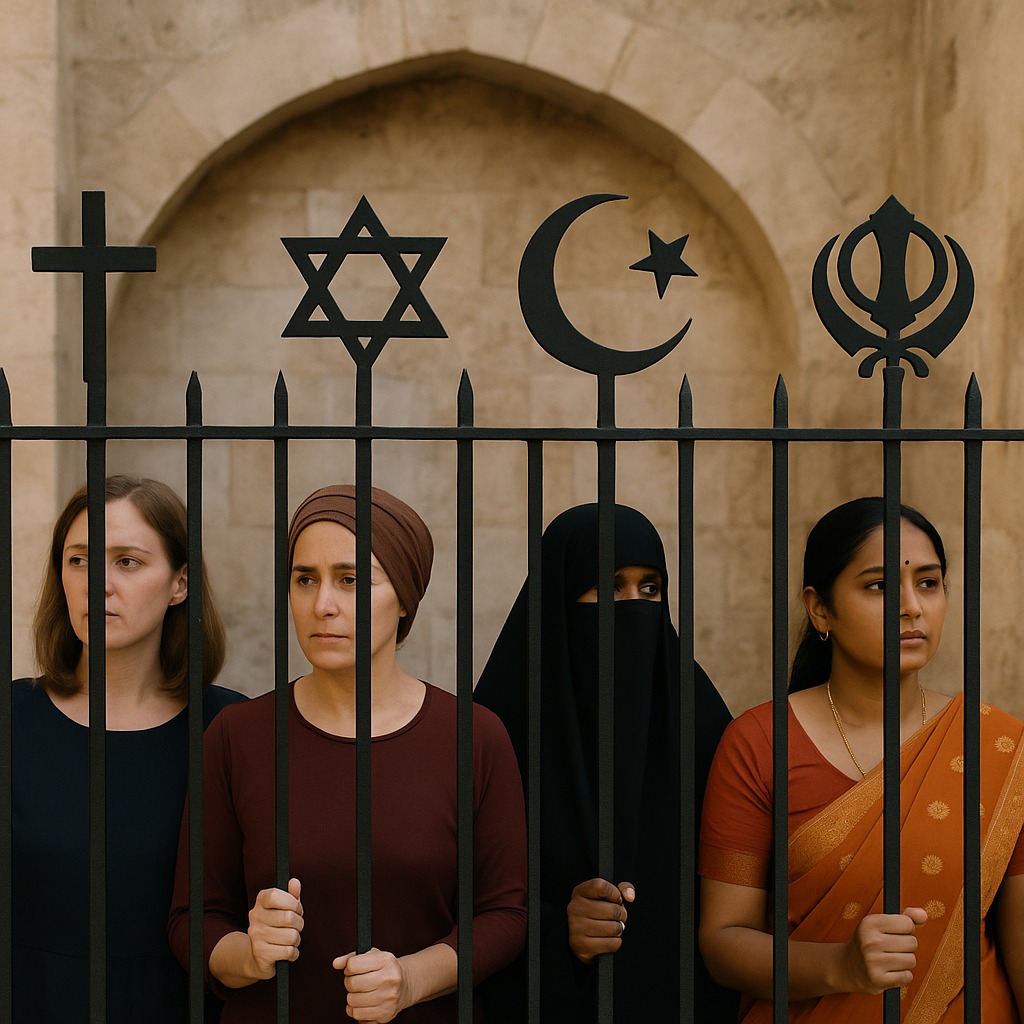
Religious traditions have shaped civilizations, guided morality, and provided meaning for centuries. Yet in conservative religious communities, those same traditions often reduce women to instruments of obedience. They are praised as mothers and caretakers but denied autonomy, education, and voice. The result is a system that calls itself moral but thrives on control.
In such settings, women’s rights are not denied openly but wrapped in sacred language. Submission becomes virtue. Silence becomes devotion. Modesty becomes holiness. The appearance of protection hides a deeper purpose — to keep power in male hands. Across faiths, women are told their purpose is divine, while their rights are dismissed as rebellion. But despite this oppression, resistance grows. From churches to mosques to temples, women challenge the doctrines that define their servitude and reclaim their place in the moral order of humanity.
The origins of female subordination in religion
The subjugation of women began long before modern religions took shape. In early agrarian societies, men controlled land and lineage. Religion sanctified that hierarchy. Ancient scriptures written by male scribes turned economic dependency into divine law. The woman became the symbol of temptation, impurity, or submission — Eve punished for curiosity, Sita for devotion, Mary for purity.
Religions thus inherited the patriarchal systems from which they were born. What began as social control hardened into theology. Obedience to men became obedience to God. For thousands of years, this formula allowed faith to justify injustice while calling it order.
Religious justifications for inequality
Every conservative faith claims that gender hierarchy is natural. Leaders insist women must obey men to maintain moral balance. They warn that equality threatens family and faith. Words like “tradition,” “virtue,” and “protection” are used to conceal domination.
This reasoning turns morality into fear. To question authority becomes sin. To think independently becomes arrogance. Across traditions, the same pattern repeats: patriarchy disguised as piety. Whether under Christian purity culture, Islamic modesty codes, or Hindu purity laws, the goal remains the same — to make women doubt their own worth.
Christianity — submission as salvation
In fundamentalist Christian circles, women are told that obedience brings holiness. The doctrine of “biblical womanhood” defines virtue through submission to husbands and church authority. Many denominations forbid women from teaching, leading, or preaching.
Yet within Christianity, rebellion has always existed. From medieval mystics to modern theologians, women have demanded that scripture speak for equality. They argue that Christ never called for silence but compassion. Modern Christian feminists reinterpret the Bible through justice, not obedience. Still, resistance meets hostility. Churches cling to male dominance, mistaking hierarchy for holiness.
Judaism — between law and modernity
Orthodox Judaism maintains strict boundaries for women through halacha. The laws regulate modesty, ritual purity, and even divorce. A woman cannot remarry unless her husband grants a “get,” creating lifelong captivity for many.
Yet Jewish feminists fight back through knowledge. They study Torah, lead services, and reinterpret law from within. In Israel and beyond, their activism forces change. Some synagogues now include women as leaders and legal scholars. The balance between faith and modern rights remains tense but evolving.
Islam — control through morality and honor
In many conservative Muslim societies, religion justifies control over women’s bodies and movements. The concept of honor binds female behavior to family reputation. Veiling, segregation, and moral policing become tools of obedience.
Still, Islamic feminism grows. Scholars reinterpret Quranic verses, showing that Islam once empowered women in trade, education, and politics. Their struggle is dangerous — reformers face threats, exile, and death. Yet across Iran, Saudi Arabia, and Afghanistan, women resist quietly. They study in secret, organize online, and teach their daughters that faith and freedom are not enemies.
Hinduism — caste, purity, and patriarchy
In Hindu tradition, women’s worth is measured by purity and obedience. Ancient customs made them bear the burden of male honor. Widowhood, menstruation, and caste laws dictated their position. Although many oppressive practices have been banned, their shadow lingers in rural India.
Indian feminists challenge both patriarchy and caste. They invoke Hindu goddesses as symbols of power, reclaiming mythology from priestly control. Figures like Savitribai Phule transformed education and rights for women and the lower castes. Through them, feminism becomes both spiritual and revolutionary.
Sectarian isolation — life under total control
In ultra-religious sects like the Amish or Haredi communities, isolation preserves patriarchy. Education is restricted, the internet is forbidden, and women are raised to obey from birth. The result is a world where freedom is unknown, not merely denied.
Leaving means losing family and community. Many stay because exile feels worse than oppression. Yet cracks appear. Women secretly read banned books or connect with outsiders online. Every escape becomes an act of moral rebellion — proof that faith can imprison, but not extinguish reason.
Psychology of submission and fear
Religion binds not only through law but through emotion. It teaches women to equate obedience with love and independence with sin. Fear of hell, guilt, and social exile keeps many silent. Psychologists describe this as learned helplessness — when repeated control erases the sense of agency.
But repression never kills thought entirely. The mind resists contradiction. When women feel faith contradict justice, they begin to question. Doubt grows quietly, and that doubt becomes the seed of freedom.
Feminism’s challenge to faith
Feminism emerged as a revolt against centuries of religious patriarchy. It revealed that sacred texts were written by men for men. By declaring that “the personal is political,” feminists exposed how religion extended power into the home, the body, and the soul.
Religious feminists now walk a narrow path. They face rejection from both atheists and believers. Yet their work bridges two worlds. By reinterpreting faith through equality, they preserve spirituality without submission. They remind humanity that divine love cannot depend on obedience to men.
The economic cost of suppression
When women are excluded from work and education, entire economies stagnate. In conservative religious communities, women perform unpaid labor that sustains families but brings no independence. Economists call it invisible work — essential yet unrewarded.
Societies that restrict women lose enormous potential. Productivity declines, poverty deepens, and innovation slows. The doctrine of male breadwinning keeps women dependent, reinforcing control. Economic dependency becomes moral leverage: a woman who earns is “rebellious,” a woman who depends is “virtuous.” The cost is not only personal but national — whole societies remain trapped in poverty to preserve male pride.
The societal stagnation
Inequality poisons society. Communities that silence women also silence progress. When girls cannot study, nations lose scientists, teachers, and thinkers. Hierarchy replaces merit. Loyalty matters more than intelligence. The result is stagnation — social, cultural, and intellectual.
Worse, inequality teaches domination. A man raised to believe women are inferior carries that belief into politics and business. The home becomes a microcosm of tyranny, and the entire nation adopts its rhythm. Patriarchal religion thus breeds authoritarian culture — submission at every level, from family to state.
The moral contradiction
Conservative religion claims to protect morality, yet it often hides corruption. Leaders who condemn sin protect abusers. Institutions that preach purity tolerate violence at home. The very faith that demands virtue sustains hypocrisy.
This contradiction erodes both religion and society. Fear replaces respect, and guilt replaces conscience. When morality becomes a weapon, true ethics disappear. The community becomes outwardly pious but inwardly decayed.
The turning point — education and economy
Every movement toward equality begins with education. Literate women question myths. Skilled women manage their own lives. Financial independence becomes moral independence. Once women earn, obedience loses its meaning.
This shift terrifies religious hierarchies. It weakens the clergy’s authority and disrupts traditional families. Yet wherever education spreads, poverty falls and tolerance grows. Women’s empowerment is not rebellion — it is survival. And the societies that resist it slowly collapse under their own rigidity.
The general outcome — progress through resistance
Suppressing women’s rights leads to poverty, ignorance, and decline. A civilization that silences half its population cannot innovate or endure. Over time, rigid faith collapses under external pressure — by modernity, by globalization, or by the awakening of its own believers.
Conversely, when women gain equality, the entire community rises. Health improves, corruption falls, and education spreads. Families become partners, not hierarchies. Even religion becomes gentler, more human, and more ethical.
But progress always faces backlash. Clerics claim equality destroys virtue. Politicians exploit fear to win followers. Yet their panic proves how powerful the change already is. Every woman who learns, works, or speaks freely weakens a thousand years of silence.
The role of world’s government agencies
International institutions cannot remain silent while millions of women live under religious subjugation. The oppression of women is not an internal cultural matter — it is a violation of universal human rights. When religion becomes a shield for abuse, global responsibility begins.
World governments, the United Nations, and international NGOs must confront this issue with the same seriousness as political oppression or war crimes. They should stop treating gender inequality as a cultural sensitivity and start seeing it as a systemic injustice. The right to education, bodily autonomy, and economic participation are not Western privileges but human essentials.
Diplomatic relations must include conditions for gender rights. Trade agreements and development funds should reward nations that guarantee women’s freedoms and penalize those that enforce religious subordination. The same principle that fights child labor or torture must apply to gender discrimination.
Furthermore, global agencies should support underground educators, feminist journalists, and dissident women’s networks in closed religious societies. Protection programs for exiled activists, scholarships for girls fleeing theocracy, and secure digital platforms for anonymous reporting can save lives and preserve dignity.
No progress can occur if governments keep negotiating with patriarchal regimes while ignoring their crimes against women. Silence becomes complicity. The global order must understand that every time a woman is denied education or freedom in the name of faith, civilization itself steps backward.
A just world demands that belief never outweigh basic human rights.
Conclusion
The suppression of women in conservative religious communities is not only a moral tragedy but an economic and civilizational one. It destroys potential, wastes intelligence, and perpetuates fear. The pattern is universal: where women are denied freedom, society decays. Where women rise, the whole culture revives.
No divine law justifies inequality. It is not faith that enslaves women — it is the fear of losing power. When that fear fades, religion can finally evolve into what it was meant to be: a search for truth, not a weapon of control.
The fate of every conservative society rests on one question — whether it keeps half its population silent or lets them speak. The answer will decide not only women’s future but humanity’s.
Leave a Reply