This is exactly what these POSs really want: attention.
Not justice, not ideology. Not truth. Visibility.
First, they act. Then cameras turn. Then feeds explode. Finally, meaning dissolves.
Therefore violence no longer serves strategy. It serves exposure.
In the modern world, attention equals existence. Consequently, any act that breaks routine becomes currency. Violence performs especially well. It shocks. It polarizes. And it spreads. As a result, perpetrators design acts for spectators, not outcomes.
Thus the Australian attack fits a known pattern. So does every spectacular act of brutality in a media-saturated society. The weapon matters less than the headline. The victim matters less than the reach.
Media does not report violence — it multiplies it
Next comes the amplification phase. Media outlets do not merely report. They loop; they dramatize. They monetize.
First, they isolate emotion. Then they remove context. After that, they repeat visuals until horror turns familiar. Finally, they invite commentary that replaces analysis with outrage.
As a consequence, one act becomes a template. Another consequence follows immediately: imitation. Not ideology spreads, but format. Not belief spreads, but method.
Therefore, every sensationalized attack teaches future attackers how to perform better. Louder. Bloodier. More cinematic.
This dynamic does not excuse perpetrators. It indicts systems.
The copycat logic always follows
Then the contagion starts. Psychology explains it clearly. Attention-seeking violence breeds attention-seeking violence.
First exposure lowers inhibition. Then repetition normalizes extremity. Eventually, escalation feels necessary. One attacker fades. Another replaces him.
Thus violence feeds itself.
This mechanism does not care about borders. It crosses Australia; it crosses Europe. It crosses the Middle East. The same cognitive machinery drives all of it.
Moral clarity without tribal blindness
Now comes the part many people refuse to say clearly.
Violence has no place—against Israelis, even while they are killing en masse, nor in isolated attacks.
Yes, Israelis are conducting mass killing. Civilians die in staggering numbers. Children vanish from population statistics. Entire regions collapse into rubble. These facts exist. No denial survives reality.
However, violence does not turn moral when numbers rise. Brutality does not gain legitimacy through scale. Murder does not transform into justice by repetition.
Therefore moral clarity requires two statements at once. Israel commits mass killing. Violence against civilians remains wrong. Both statements stand. Neither cancels the other.
Condemnation does not equal denial
Many people panic here. They assume condemnation requires silence about atrocities. It does not.
On the contrary, real morality demands consistency. If violence becomes acceptable under certain flags, then morality dies. If mass killing excuses smaller killing, then logic collapses.
Thus condemning an Australian attack does not erase Israeli crimes. Condemning Israeli genocide does not sanctify lone attackers.
The world does not improve through selective outrage. It degrades.
Isolated attacks and systemic killing are not the same — but both kill
Next, distinctions matter.
An isolated attack arises from individual pathology, radicalization, or desperation. A genocide arises from institutions, command structures, budgets, and political immunity.
These differ in scale and mechanism. They do not differ in outcome for the dead.
Therefore analysis must separate them. Moral judgment must not excuse either.
One murderer does not equal a state. A state does not become innocent because others also kill.
The outrage economy corrupts judgment
Meanwhile, outrage sells. Platforms reward fury. Commentators profit from escalation. Activists gain followers by simplifying horror into slogans.
As a result, nuance disappears. Context becomes betrayal. Consistency becomes weakness.
Thus the public learns to react, not to think. They choose sides, they chant. They forget victims within days.
Outrage replaces ethics.
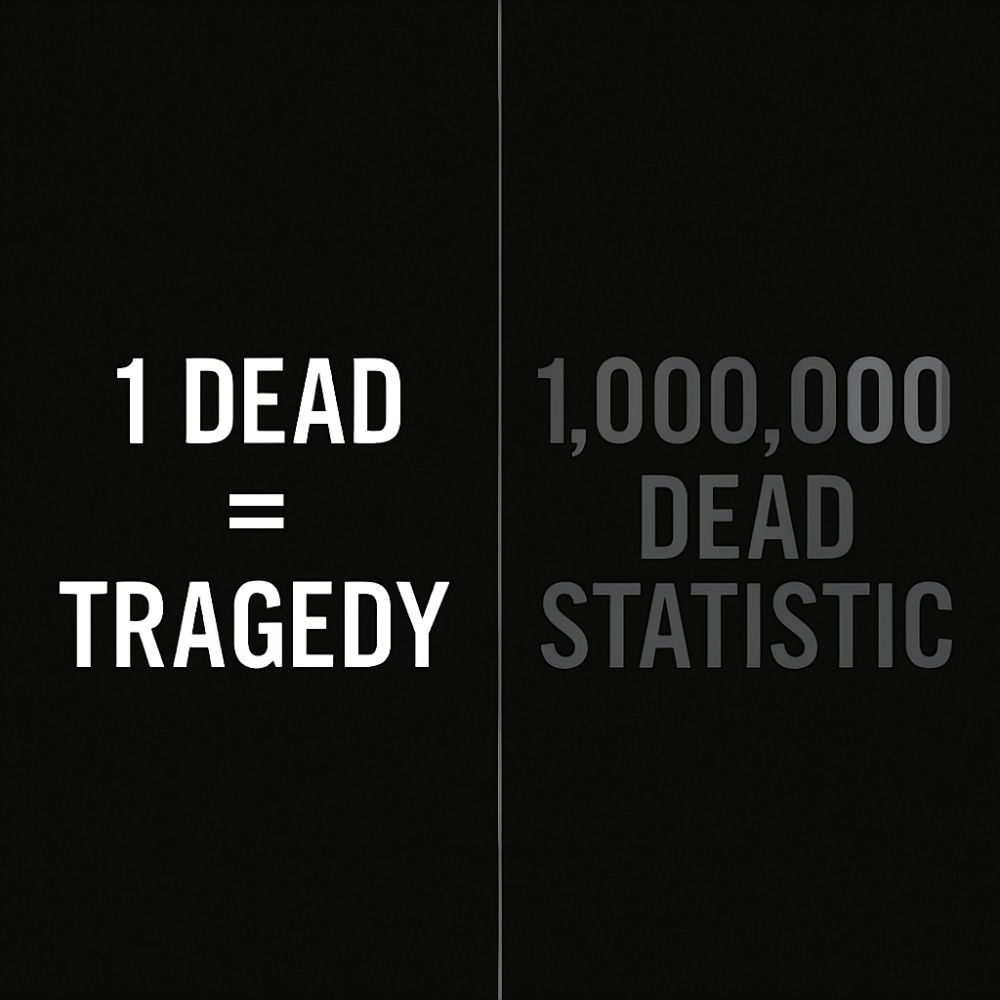
A death of one Is a tragedy. Millions are a statistic.
Here lies the darkest truth.
One death shocks. Millions blur.
Humans evolved to grieve individuals, not populations. Consequently, mass death numbs rather than mobilizes. Genocide becomes background noise. Birth rates collapse. Families vanish without headlines.
Low natality follows destruction. Trauma spreads across generations. Societies hollow out. Yet numbers fail to move emotions.
Therefore isolated attacks dominate screens while systemic slaughter fades into graphs.
This asymmetry explains everything.
Refusing attention is not silence
Finally, what does refusal mean?
It does not mean denial, it does not mean neutrality. It means precision.
Name perpetrators. State facts. Reject spectacle. Refuse moral shortcuts. Condemn violence without rewarding it.
Attention fuels the worst actors. Ethics starves them.
That principle remains the only exit.
Leave a Reply