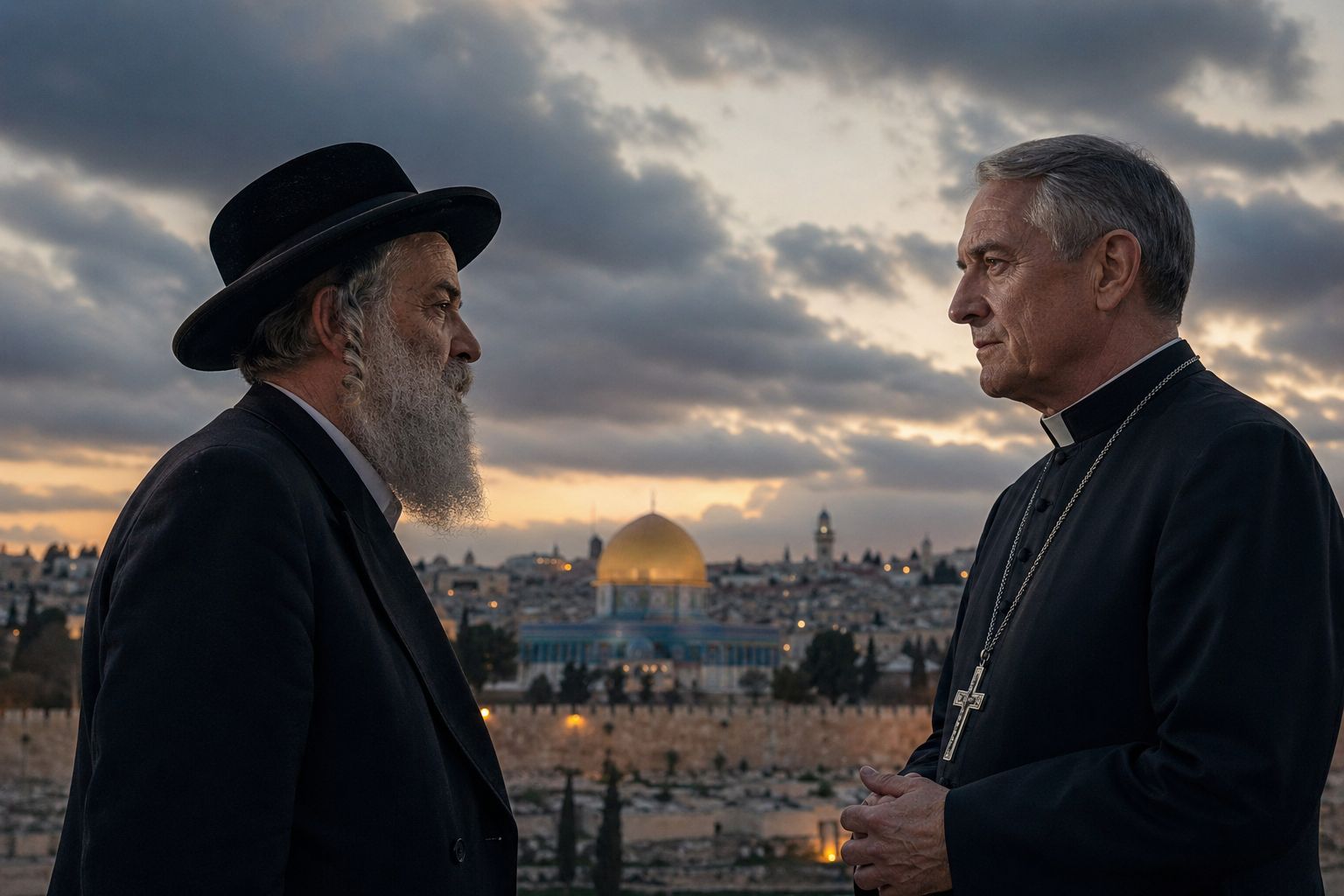
The idea looks simple at first. One God. One truth. One chosen people. However, the moment you examine Judaism and Christianity side by side, the simplicity collapses. Both traditions claim a unique relationship with God. Both anchor their identity in that claim. Yet they define it in fundamentally different ways. Therefore, what appears as a shared concept quickly turns into a deep and unresolved conflict.
At the core, this is not just theology. It is identity, history, survival, and power. Consequently, the question “who are the chosen people?” does not remain abstract. It cuts directly into how both groups understand themselves and each other.
The origin of chosenness in Judaism
The concept begins in the Hebrew Bible. More precisely, it begins with a covenant. God chooses Abraham and his descendants. This choice does not function as a reward. Instead, it establishes a binding relationship.
Later, through Moses, the covenant expands into law. The Jewish people receive commandments. They receive obligations. Therefore, chosenness does not mean superiority in a simple sense. It means responsibility, discipline, and continuity.
At the same time, identity becomes inseparable from this covenant. Religion and ethnicity fuse together. You are not just a believer. You are part of a people. As a result, even after exile, persecution, and dispersion, the concept survives. In fact, it strengthens. Survival itself becomes evidence of chosenness.
Christianity transforms the idea
Christianity emerges from within this Jewish framework. However, it does not preserve it unchanged. Instead, it reinterprets it radically.
At the center stands Jesus Christ. Through him, the New Testament introduces a new logic. Chosenness no longer depends on ancestry. It depends on belief.
This shift changes everything. The chosen people are no longer a single nation. They become a community of believers spread across the world. Therefore, Christianity universalizes what Judaism particularizes.
However, this transformation creates tension immediately. If chosenness becomes universal, what happens to the original chosen people?
Supersessionism and the unresolved break
For centuries, Christianity answered that question with confidence. It developed the doctrine of supersessionism. According to this view, the Church replaces Israel. The old covenant becomes obsolete. The new one takes its place.
This position dominates European history. It justifies religious hierarchy. It reinforces Christian identity. Yet it never fully resolves the underlying contradiction.
Why? Because Judaism does not disappear. It persists. It continues to exist as a living tradition that still claims the original covenant.
In modern theology, some attempt a softer position. They argue for a dual covenant. Jews remain chosen. Christians are also chosen. However, this compromise introduces another problem. It weakens exclusivity. And both traditions historically rely on exclusivity to define themselves.
A long history of conflict and contradiction
This theological tension does not remain theoretical. It shapes real history.
Christian Europe dominates politically and culturally. At the same time, Jewish communities survive on the margins. They face restrictions, expulsions, and violence. Yet paradoxically, they are still recognized as the original carriers of the covenant.
This creates a strange dynamic. Christianity claims fulfillment. Judaism embodies origin. One claims completion. The other claims continuity.
The result is centuries of unresolved tension. Even after events like The Holocaust, the theological problem does not disappear. It only becomes more sensitive.
The paradox of Jewish achievement
Now the discussion moves beyond theology. It enters the empirical world.
Despite their small numbers, Jews achieve extraordinary influence across multiple domains. Finance, science, entertainment, and intellectual life show disproportionate representation. This pattern attracts attention. It provokes admiration. It also provokes hostility.
Some interpret this as evidence of chosenness in a secular sense. Others reject that idea and point to historical factors. Strong emphasis on literacy. Cultural investment in education. Adaptation under pressure. Dense social networks.
However, general statements remain too soft. Therefore, consider the scale more concretely.
In science, Jews represent a small fraction of the global population. Yet they account for a disproportionately high number of Nobel Prize winners. In physics, chemistry, and economics, their presence stands out clearly. Some attribute this to clientelism, claiming a preference for Anglo-Saxons and Jews.
In finance, Jewish families and networks have historically played key roles in banking, investment, and capital allocation. This influence stretches from early modern Europe into modern global markets.
In entertainment, Hollywood itself reflects this pattern. Founders, producers, and executives often come from Jewish backgrounds. Consequently, cultural production at a global scale carries this imprint.
In politics and intellectual life, the pattern continues. Advisors, thinkers, economists, and policymakers frequently emerge from this group.
Therefore, the question sharpens. Is this random, is it cultural? Is it historical adaptation? Or does it reinforce, at least psychologically, the narrative of chosenness?
Importantly, this does not imply conspiracy. It implies concentration of ability, networks, and historical trajectory. However, perception does not always distinguish between the two. As a result, admiration and hostility often grow from the same observation.
The priest’s contradiction: theology meets reality
Now the tension reaches its most uncomfortable form.
A priest states: “Even though the New Testament says we are the chosen ones, Jews are.”
This sentence should not be ignored. It condenses the entire conflict into one moment.
On the one hand, Christian doctrine remains clear. Through the New Testament, believers inherit chosenness. On the other hand, observable history seems to contradict this claim.
Therefore, the priest does not reject theology openly. Instead, the priest bends under reality. The priest acknowledges what is observed, even if it conflicts with what is believed.
This creates a silent crisis. Not all believers articulate it. However, many feel it. They read scripture. Then they observe history. And the two do not fully align.
Consequently, chosenness becomes unstable. It moves between faith and evidence. Between doctrine and perception.
Jewish rejection of Christian claims
From the Jewish perspective, the situation looks different.
Christianity does not fulfill Judaism. It diverges from it; it reinterprets key concepts. It introduces new theology. Therefore, Jewish tradition generally rejects Christian claims to chosenness.
The covenant remains tied to law, peoplehood, and continuity. It does not expand into a universal category. It does not detach from its historical roots.
As a result, the Christian claim appears as an appropriation rather than a continuation.
Christian attempts to reconcile
Modern Christianity does not ignore this tension. It tries to soften it.
Some theologians describe Jews as “elder brothers.” Others emphasize shared roots. Interfaith dialogue expands. Respect increases.
However, the core issue remains unresolved. If both groups claim a unique relationship with God, one must either redefine uniqueness or accept contradiction.
Neither option satisfies everyone.
Evolutionary and sociological perspective
At this stage, another layer appears.
Human groups evolve mechanisms to survive. They create strong identities. They build narratives that reinforce cohesion. The idea of being “chosen” functions as one of these mechanisms.
It strengthens loyalty. It justifies sacrifice. And it explains survival under pressure.
From this perspective, chosenness may not require divine origin. It may emerge as a social tool. A psychological strategy. A way to maintain group continuity across generations.
This does not disprove religious claims. However, it offers an alternative explanation for why such claims persist so strongly.
Identity vs universality
At its core, the conflict reduces to a fundamental difference.
Judaism maintains a particular identity. It preserves boundaries. It defines chosenness within a specific people.
Christianity promotes universality. It removes boundaries. It defines chosenness as open to all.
These two models cannot fully merge. One excludes by definition. The other includes by definition.
Therefore, the tension remains permanent.
Conclusion: Chosen or constructed?
The question returns in a different form.
Are the chosen people defined by divine selection? Or by historical survival? Or by social construction?
Judaism answers with covenant and continuity. Christianity answers with faith and universality. Each framework makes sense within its own logic. However, they do not fully align.
As a result, the conflict does not disappear. It evolves, it adapts. It persists.
In the end, the idea of chosenness may reveal less about God and more about humans. Their need for identity. Their need for meaning. And their need to explain why they endure while others vanish.
Leave a Reply