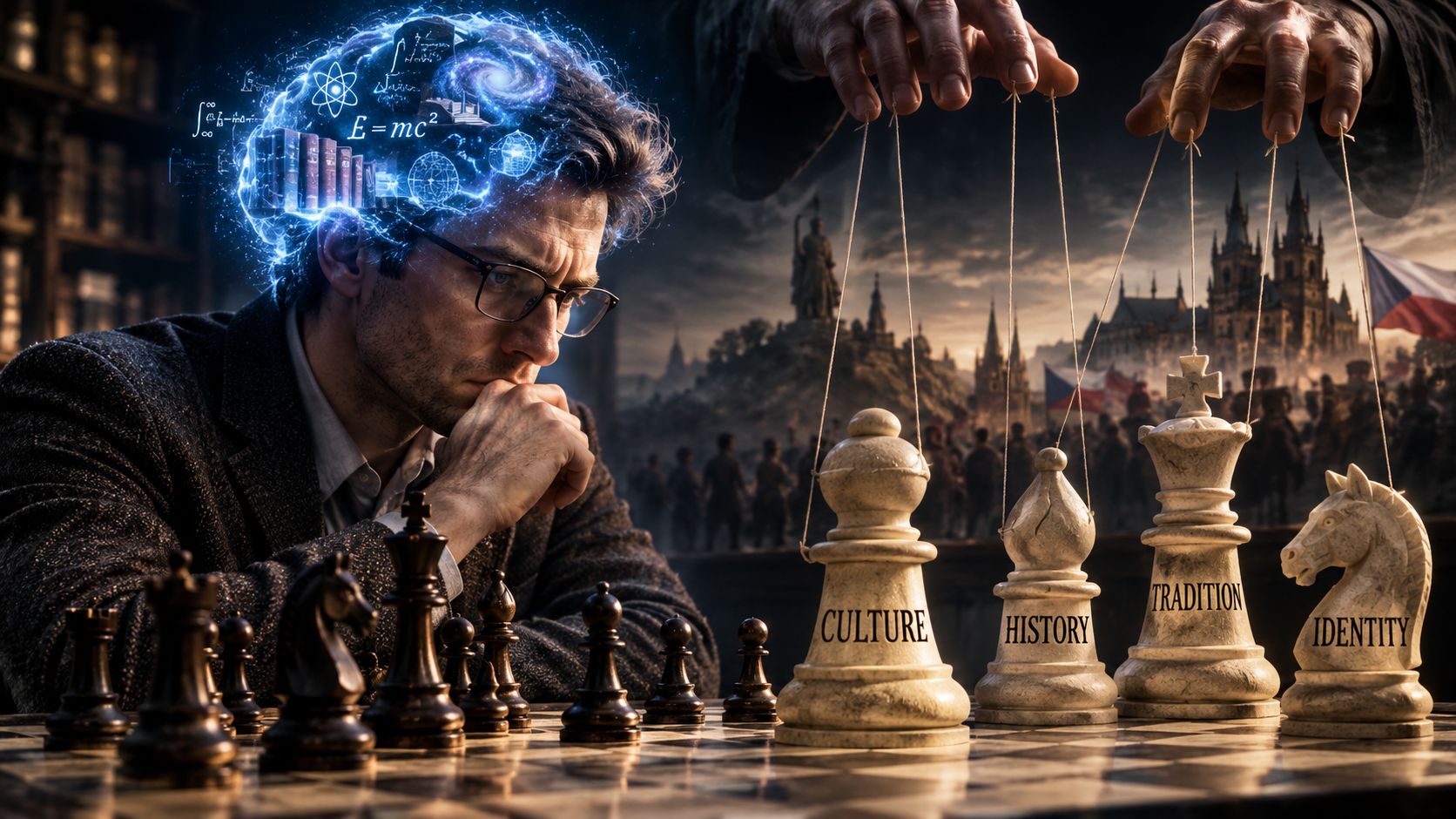
The title lies. The title is deliberately misleading. It is not about me.
I do not have an IQ of 150. My IQ stands several standard deviations below that level. Instead, I am writing about someone else. An IQ of around 150 appears in roughly one person out of three thousand. Consequently, very few people ever know someone like that.
I do.
The person I have in mind studied mathematical physics. He is a polyglot. He possesses an enormous vocabulary. His memory is exceptional. Moreover, he has educated himself far beyond university. He reads constantly. He understands mathematics, physics, history, economics, philosophy, psychology, and many other disciplines. Above all, he is not merely intelligent according to an IQ test. He is genuinely smart in the broader sense of the word.
Most people would probably expect someone like that to make outstanding political decisions.
Life is rarely that simple. For years, I have asked myself one question. Does intelligence automatically lead to better political judgment? Or does something even stronger shape the way we see the world?
I believe the answer is obvious. This time, it involved an analytic philosophy professor.
Only a tiny number of people in the Czech Republic possess such deep knowledge of analytic philosophy. Years of study sharpened his reasoning. He understands logic at a level most people never reach. He analyzes arguments with extraordinary precision. He notices contradictions almost instantly. But he votes very badly.
IQ matters. Culture matters as well. Neither can fully explain political behavior on its own. Instead, they constantly interact. Sometimes intelligence overcomes cultural habits. Sometimes culture overwhelms intelligence. Very often, even brilliant minds remain prisoners of ideas they absorbed long before they became adults. That realization surprised me. However, it also explains many things that once seemed completely irrational.
Intelligence has limits
People often assume that highly intelligent individuals naturally recognize bad policies, weak arguments, or dishonest politicians. Intelligence certainly helps. A gifted person usually learns faster. He identifies contradictions more easily. He understands complicated problems. Furthermore, he can process enormous amounts of information without becoming overwhelmed. Nevertheless, intelligence has limits.
Every child grows up inside a particular society. Every family teaches certain values. Every nation creates historical myths. Every school emphasizes some ideas while neglecting others. Consequently, culture influences us long before we begin to think independently.
An IQ test cannot measure that influence. Likewise, a university diploma cannot erase it.
For that reason, two equally intelligent people may develop completely different political beliefs despite possessing almost identical cognitive abilities. That point deserves much more attention than it usually receives.
Eastern Europe and intelligence

A surprisingly large number of Western Europeans still underestimate Eastern Europeans. They often assume that countries in the East produce less educated or less intelligent people. Reality looks different.
Average IQ estimates across Europe remain remarkably similar. Czechia stands close to many Western countries. Therefore, intelligence alone cannot explain why different societies often reach different political conclusions. Something else must play an important role. Culture immediately comes to mind.
History comes to mind as well. Institutions matter too.
Every generation inherits certain habits. Every generation also inherits political expectations.
Consequently, two societies with very similar average intelligence may still think very differently about government, economics, or public life. That should not surprise us. Human beings never develop inside laboratories. We develop inside cultures.
Education does not solve everything
Many people believe university education automatically produces wiser voters. I have never shared that opinion.
Knowledge and wisdom are not the same thing. An outstanding engineer may know almost nothing about constitutional law. A brilliant chemist may never study political institutions. Likewise, a world-class mathematician may spend little time thinking about corruption, lobbying, democratic accountability, or public administration.
Expertise rarely transfers automatically from one discipline to another. I know many highly educated people. Several studied during the communist era, when admission to universities remained far more selective than today. They worked hard. They earned demanding degrees. Their intelligence has never been in doubt.
I know it is mere anecdotal evidence but nearly all university-educated people vote for corruption in the Czech Republic.
Intelligence does not immunize us against political culture
Those two examples changed the way I think about intelligence. For years, I assumed that exceptionally intelligent people would naturally recognize the same political problems that I recognized. I expected them to identify corruption more quickly. I expected them to become more skeptical of concentrated power. I expected them to question political narratives more often than average voters.
Reality proved much more complicated.
Intelligence certainly helps people solve difficult problems. It helps them recognize patterns. It allows them to process enormous amounts of information. It often improves analytical thinking. Nevertheless, intelligence does not erase everything that came before it.
Culture remains. Family remains. Historical experience remains. National identity remains.
Social expectations remain.
Consequently, even brilliant minds interpret politics through a cultural lens. That realization explains something that once puzzled me. People frequently debate whether intelligence determines political preferences. Some argue that smarter people naturally make better political choices. Others claim intelligence has almost no influence at all.
I disagree with both extremes. IQ matters. Culture matters. Neither works alone.
The two constantly interact. Sometimes intelligence encourages people to question traditions. At other times, culture shapes the very assumptions that intelligence later defends. An exceptionally bright person may therefore construct remarkably sophisticated arguments without ever questioning the cultural foundations beneath them.
That possibility deserves far more attention than it usually receives.
What if my fellow citizens were similarly-minded
Czechs let their economy be defrauded by oligarchs, they didn’t demand any prosecution; then they let politicians steal to eye-strikingly so they wanted correction by voting for an “anti-corruption” oligarch.
If my fellow citizens (and I hate to live in a national-state, I am pro global-government) had the same mind, the circus show would be over.
I would hire the best detectives to investigate former scandals, forcing many people to leave the country to some place where they cannot be prosecuted.
My aim would be to force oligarchs, crooks, lobbyists, movers-and-shakers, banks and last but not least our beloved super-rich families to be as far from politics as they can be. Therefore, the exact opposite of what we have now.
Sometimes I genuinely wonder whether I even share the same political culture as many of my fellow citizens. I grew up in the Czech Republic. I speak Czech. I understand Czech history. I know the country’s achievements. I also know its disappointments. Nevertheless, I occasionally feel as though I approach politics from a completely different perspective. That does not mean I believe everyone should share my opinions. Democracy would lose its meaning if everyone thought alike. However, I often ask myself one simple question. Why do people with similar intelligence, similar education, and access to similar information reach completely different conclusions about the future of their own country?
IQ versus culture
How much does IQ influence political decisions? Quite a lot. How much does culture influence political decisions? Also quite a lot. The mistake begins when people assume one completely outweighs the other.
A higher IQ generally improves abstract reasoning. Highly intelligent people usually learn faster, detect contradictions more easily, understand statistics better, and recognize logical fallacies more often than average. Therefore, IQ undoubtedly affects political thinking. I have little doubt about that.
However, culture shapes something equally important. It shapes what we consider normal. It shapes whom we trust. It shapes our moral intuitions. It shapes our historical memory. It even shapes which political questions we consider worth asking. Those influences begin in early childhood and continue throughout life. Consequently, intelligence often operates inside a framework that culture established years earlier.
Germany offers an interesting example. German political culture places considerable emphasis on institutional stability, the rule of law, and historical responsibility. Scandinavian countries developed somewhat different traditions. They generally place exceptionally high value on social trust, transparent public administration, and broad political consensus. Those attitudes did not emerge because Germans or Scandinavians possess dramatically higher IQs than the rest of Europe. Average cognitive ability across much of Europe remains broadly similar. Instead, history, institutions, education, and political culture shaped different expectations about government and public life.
The same principle applies elsewhere. Two countries may display very similar average IQs while producing remarkably different political outcomes. Likewise, two exceptionally intelligent individuals may disagree profoundly because they interpret politics through different cultural lenses.
That realization changed the way I think about intelligence. For years, I believed sufficiently intelligent people would naturally reach similar political conclusions after examining the same evidence. Today, I no longer believe that. Intelligence helps us analyze information. Culture often determines how we interpret it.
Perhaps that explains why I know people whose intelligence I genuinely admire, yet whose political conclusions surprise me every single time. Their reasoning is sophisticated, their knowledge is immense. Their arguments are carefully constructed. Nevertheless, we often begin from completely different assumptions about society, power, institutions, and human nature.
Ultimately, intelligence does not replace culture. It works through culture. That may be one of the most underestimated facts in political psychology.
Leave a Reply