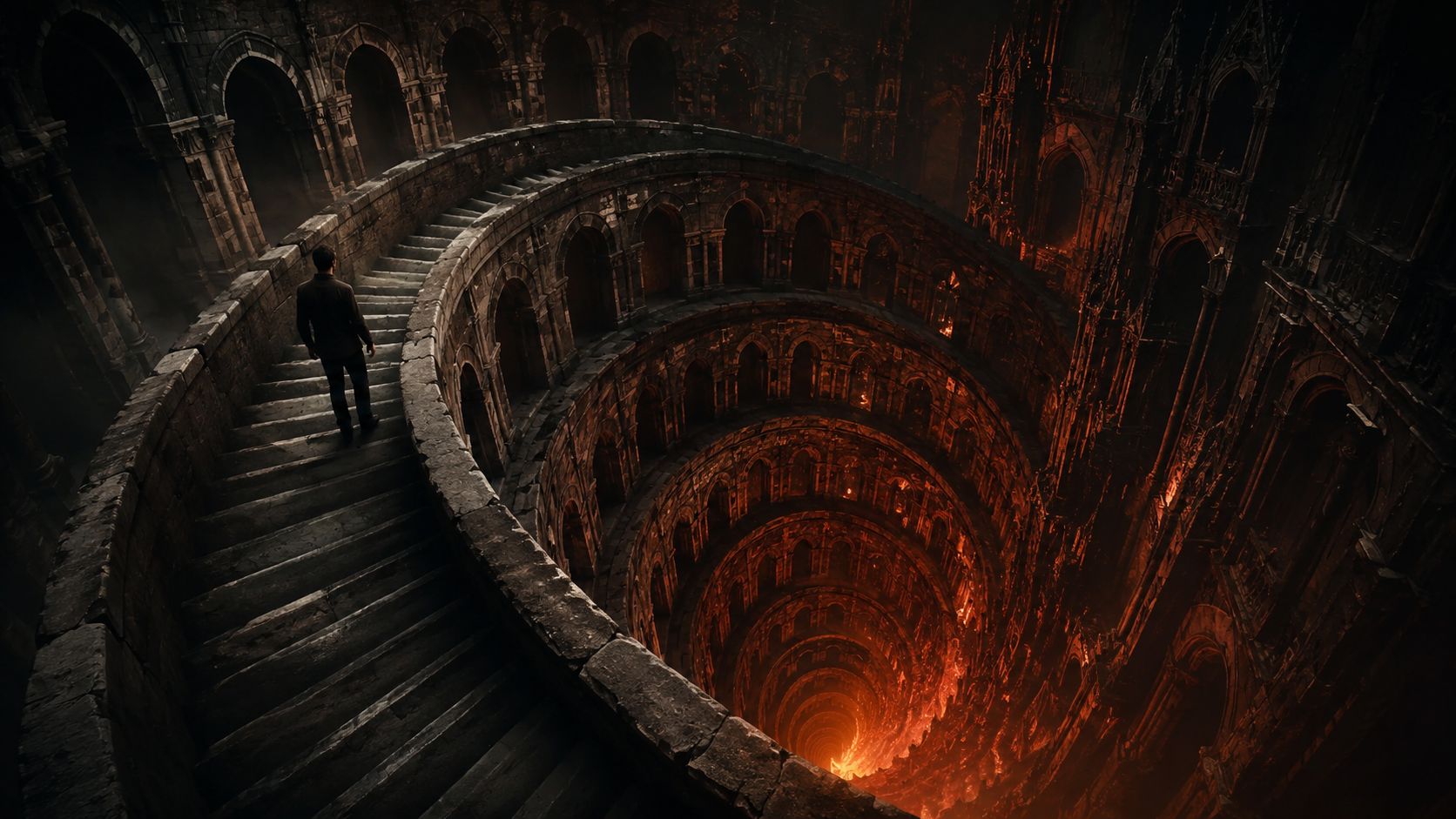
Skeptics often charge the Old Testament God with violence. They point to floods, plagues, and conquered cities. Apologists counter by pointing to the cross. They say the New Testament reveals a God of love—one who takes the violence upon Himself.
But this defense misses the point. If we take the New Testament’s hell literally, the problem doesn’t disappear. It gets infinitely worse.
Temporal vs. eternal
Old Testament violence is brutal, but it is temporary. God kills the body. He drowns armies. He burns cities. Yet the punishment ends with biological death. Sheol is a place of silence. The wicked simply cease to trouble the living.
New Testament violence is different. It is eternal. Jesus speaks of unquenchable fire. He warns of worms that never die. Revelation depicts a lake of fire where the wicked are tormented “forever and ever.”
This is the escalation: the New Testament God doesn’t kill the body. He preserves it. He sustains existence solely to prolong agony. That is not violence; it is the perpetuation of violence without end.
Infinite punishment for finite sins
The critic’s core objection is simple: the punishment doesn’t fit the crime. Old Testament justice is crude but temporal. A soldier dies in battle. A city falls to invaders. These acts fit within ancient, earthly warfare.
But eternal torment breaks all moral arithmetic. How does a seventy-year lifespan earn an infinite sentence?
Theologians claim that sin against an infinite God warrants infinite punishment. But this logic is ethically bankrupt. It turns God into a narcissist. It makes His honor worth more than human suffering. To punish a finite being forever isn’t justice. It’s sadism. The New Testament God becomes an eternal torturer. He denies the condemned even the mercy of annihilation.
Death rebranded
The New Testament calls hell “the second death.” But this is a sleight-of-hand. In the Old Testament, death meant the end. In the New, the “second death” means conscious suffering without end.
Killing a man is terrible. But at least it ends his suffering. Keeping a man alive on a machine just to shock him for eternity is infinitely worse. This is the New Testament’s reality. God actively sustains the damned. He does so just to pour out unending wrath.
On an ethical scale, this makes the New Testament deity more violent than the Old. The Old God eventually grants the wicked non-existence. The New God denies them even that.
A moral regression
Critics see this as moral regression. The Old Testament was primitive—a product of its ancient, tribal context. But the New Testament emerged in a more sophisticated world. The Greeks and Romans already had concepts of the immortal soul.
Rather than rising above ancient brutality, the New Testament weaponizes it. It takes pagan fears of the undying soul. It marries them to Jewish monotheism. The result is a weapon of psychological terror. The Old Testament patriarchs never conceived of anything like it.
If the Old God is a warrior who slays enemies on the battlefield, the New God is a prison warden who refuses to let the prisoners die.
Christian and Jewish hell: Conclusion
The problem of divine violence doesn’t vanish in the New Testament. It mutates into something far worse. The Old Testament offers the hope of death. The New Testament offers the terror of immortality in agony.
For those reading without theological blinders, “God is love” rings hollow. If eternal conscious torment is true, the New Testament does not reveal a more loving God. It reveals a God who has perfected violence by making it last forever.
In the final accounting, the God who drowns the world is merciful. The God who builds an eternal furnace is not.
Leave a Reply