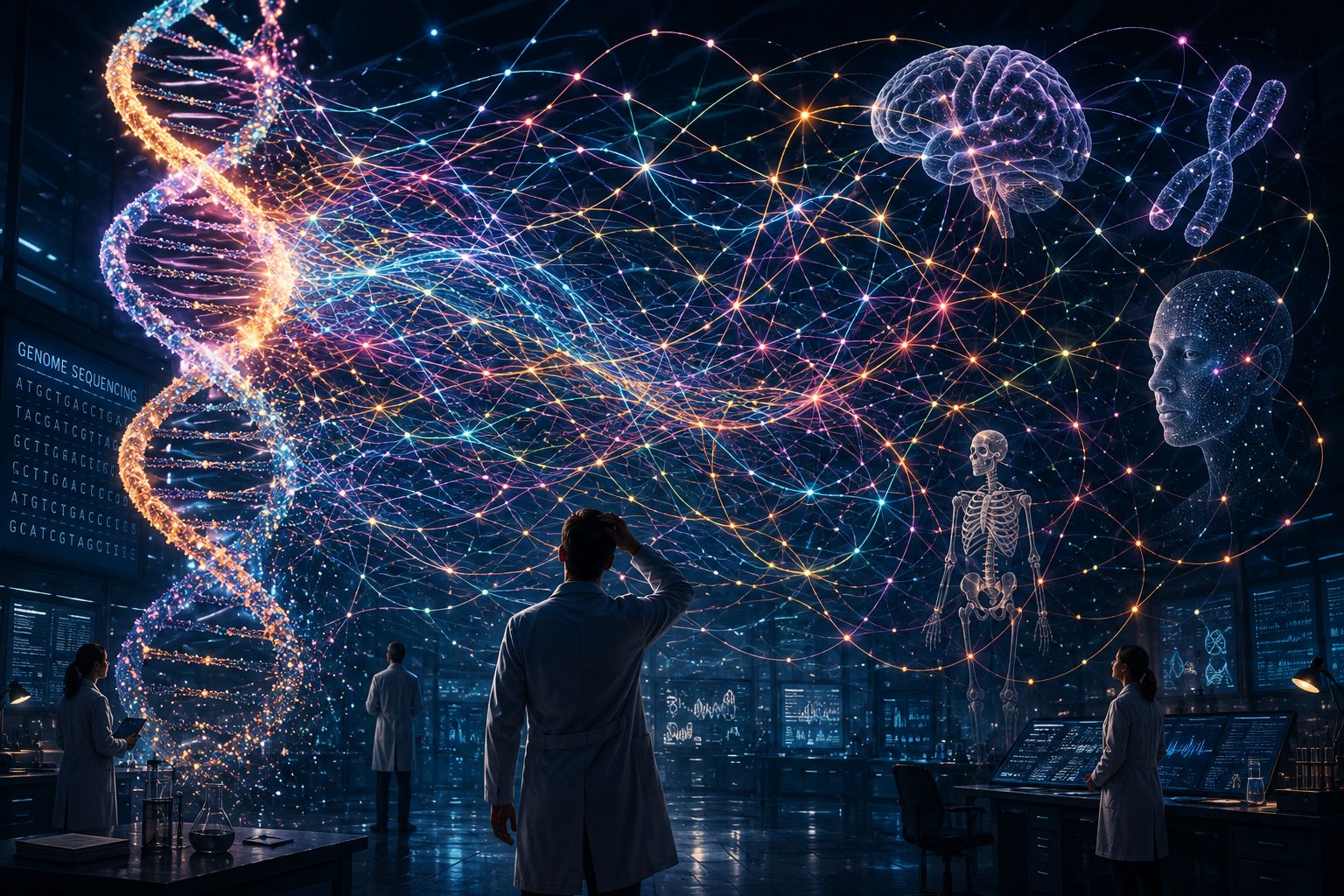
Genetic research has become extraordinarily powerful. Scientists can sequence an entire human genome. They can compare millions of genetic variants between people. They can identify regions of DNA associated with schizophrenia, depression, height, facial structure, intelligence, and countless other characteristics.
Nevertheless, finding genetic differences does not mean understanding them.
We often imagine genes as individual commands. Gene 1 causes one effect. Gene 2 causes another. Add them together, and the final result appears. Some school textbooks unintentionally encourage this picture because simple examples make genetics easier to explain.
Human biology rarely works in such a convenient way.
A gene may influence a trait only when several other genes create the correct conditions. Another gene may suppress its effect. A third may amplify it. Meanwhile, a fourth may redirect the entire biological process toward a different outcome. The environment can then alter which genes become active, when they become active, and how strongly cells follow their instructions.
As a result, scientists may know that particular genes matter while remaining unable to explain what their combination will produce.
Gene 1 does not act alone
Imagine that gene 1 slightly increases the activity of a particular brain receptor. We might assume that a person carrying this genetic variant will therefore have more active receptors.
However, gene 2 may control whether the receptor reaches the surface of the brain cell. Gene 3 may influence the production of the chemical that activates it. Gene 4 may break that chemical down. Gene 5 may determine how strongly the cell responds once the receptor receives a signal.
The effect of gene 1 therefore depends on the others.
It may produce a measurable result when combined with gene 3. The same variant may have almost no effect when gene 4 becomes unusually active. In another person, gene 6 may compensate for the entire process. Furthermore, an infection during pregnancy, severe stress during childhood, drug use, hormonal changes, or ordinary random differences in brain development may alter the system once again.
Scientists call interactions between genes epistasis. However, giving the problem a name does not solve it. Detecting such interactions across the human genome remains extremely difficult because the number of possible combinations becomes unimaginably large.
Suppose researchers examine only 1,000 relevant genetic variants. They must already consider almost half a million possible pairs. Once they investigate combinations of three, four, or ten variants, the number becomes enormous. Human genomes contain millions of variable sites, while biological systems also change over time.
Genetics therefore does not resemble a list of independent instructions. It resembles a vast network in which every component may alter the behavior of many others.
We have found genes associated with schizophrenia
Schizophrenia provides one of the clearest examples.
Researchers have identified many regions of the genome associated with an increased risk of schizophrenia. The disorder has a substantial hereditary component, and it occurs more frequently among close relatives of affected people. Nevertheless, scientists have not discovered one ordinary schizophrenia gene that explains most cases.
Instead, schizophrenia has a highly polygenic architecture. Many common genetic variants contribute extremely small amounts of risk, while some rare mutations and larger chromosomal changes can have stronger effects. Even these discoveries explain only part of the complete biological process.
A person may carry hundreds or thousands of risk-associated variants without developing schizophrenia. Another person may develop the disorder despite having a lower calculated polygenic risk. Researchers have even identified people who appear to carry considerable genetic risk but also possess genetic factors associated with resilience.
This should not surprise us.
The variants do not simply accumulate like coins in a jar. Some probably influence the formation of synapses. Others affect immune activity, brain development, calcium signaling, neurotransmission, or the regulation of other genes. A variant may matter only during a particular stage of fetal development. Another may become important during adolescence, when the brain reorganizes many of its connections.
Furthermore, two variants may strengthen each other. A third may weaken both. The influence of another may depend on an environmental exposure that never occurs.
We can therefore identify statistical associations without reconstructing the complete chain of causes. We know that particular areas of the genome participate in schizophrenia. Yet we still cannot look at most healthy newborns, read their DNA, and reliably determine who will later develop the disorder.
Depression produces an even less orderly picture
Depression also runs in families, and genetics contributes to vulnerability. However, major depressive disorder does not represent one biologically uniform condition.
Two patients may receive the same diagnosis for very different reasons. One suffers from overwhelming sadness and guilt. Another mainly experiences an inability to feel pleasure. A third sleeps almost constantly, while a fourth barely sleeps at all. Some lose their appetite. Others gain weight. Several recover after one episode, whereas others experience depression repeatedly for decades.
It would be surprising if one simple genetic mechanism produced all these patterns.
Large studies have associated many genetic variants with depression. Nevertheless, each common variant usually changes risk only slightly. Researchers also continue to debate how much broad diagnostic studies reveal about severe clinical depression, since a short questionnaire and a psychiatrist’s detailed diagnosis do not necessarily identify the same biological phenomenon.
Once again, the difficult question concerns interaction.
A genetic variant may increase sensitivity to stress but cause no illness in a stable environment. Another may affect sleep, which then changes emotional regulation. A third may influence inflammation, while a fourth changes the brain’s response to social rejection. None alone must produce depression.
Even the environment does not act independently of genetics. The same traumatic event can produce severe depression in one person, temporary distress in another, and little measurable effect in a third. Conversely, genetic differences may influence which environments people enter, how others respond to them, and how strongly they remember negative experiences.
Depression therefore does not result from genes plus environment in a simple equation. Genes affect responses to the environment, while environments affect gene activity. Both processes unfold across an entire life.
Czech and German populations show another problem
The same complexity appears when we compare neighboring European populations.
Czechs and Germans are not two sharply separated biological groups. Their populations have lived beside one another for centuries. Bohemia contained large German-speaking communities, while migration, marriage, trade, war, and changing borders repeatedly moved people across Central Europe.
Genetic studies accordingly find extensive similarity between Czechs and Germans. Research using ancestry-informative markers has described the Czech Republic, Germany, France, and the Netherlands as genetically similar Central and Western European populations. Other research also finds a close affinity between Czech, Austrian, and German samples.
Nevertheless, many Central Europeans believe that they can sometimes distinguish a German from a Czech by appearance alone.
You can tell apart the majority of Czechs and Germans
They may associate some German faces with higher cheekbones, a more triangular head or face, and greater width around the middle of its height. Meanwhile, they may perceive a different average combination of features among Czechs. These impressions do not apply to every person. Plenty of Germans look conventionally Czech, plenty of Czechs look German, and many individuals could plausibly come from almost anywhere in Central Europe.
Yet complete overlap does not necessarily mean identical averages.
Two populations can share nearly all their genetic variation while differing slightly in the frequencies of thousands of variants. Each difference may be tiny. However, facial appearance emerges from the combination of many dimensions: cheekbone position, jaw shape, forehead width, nasal structure, eye spacing, soft tissue, body fat, skin, hair, and the relative proportions between them.
The observer does not consciously measure these characteristics. The brain combines them into a general impression.
Still, this ability is unreliable. Hairstyle, clothing, age, expression, body weight, regional ancestry, and expectation can all influence the judgment. Anyone who already knows which person is Czech and which is German may also imagine stronger differences than actually exist.
The important point does not depend on proving that every Czech can recognize every German. It lies in how small population-level differences can emerge from an extremely complicated genetic system despite enormous genetic overlap.
There is no gene for a German-looking face
Suppose one facial variant slightly increases cheekbone projection. It will not necessarily create visibly higher cheekbones.
Another variant may broaden the face. A third may influence skull growth during childhood. A fourth may change the distribution of facial fat. A fifth may affect the growth of the jaw. Hormones, nutrition, dental development, sex, age, and prenatal conditions will modify the result.
The first variant could make cheekbones appear prominent in a narrow face but almost invisible in a broad one. It might produce one effect in combination with gene 3 but not with gene 4. If gene 5 changes the jawline, the whole face may look triangular even though none of the genes directly contains an instruction for a triangular face.
Facial appearance therefore emerges from proportions and relationships.
Modern studies have linked many genetic regions to parts of facial shape. However, researchers still cannot reconstruct a person’s face perfectly from DNA. The identified variants influence different facial segments, often with small effects, while much of the complete developmental system remains unexplained.
The face also develops as one connected structure. Changing the growth of the upper jaw can influence the nose. Altering the width of the skull can change how other features appear without modifying them directly. A broad cheekbone structure may make the eyes seem closer together even when the actual distance remains unchanged.
Genes do not design each feature separately. They participate in a developing organism.
Labrador dogs reveal how genes can block other genes
A simpler example appears in Labrador retrievers.
Their coat color depends partly on interactions between different genes. One genetic location helps determine whether the dog produces black or brown pigment. However, another location controls whether that dark pigment reaches the hair.
A dog can carry variants for black pigment and still appear yellow because another gene blocks the pigment’s deposition in the coat. The first gene has not disappeared. Its potential effect remains present in the genome, but the second gene prevents us from seeing it.
This represents a relatively simple form of epistasis.
Human mental illness involves a vastly more difficult version of the same principle. Instead of two important genetic locations influencing coat color, thousands of variants may affect interacting pathways in a developing brain. Researchers must also account for different cell types, different stages of life, and countless environmental influences.
If two genes can already complicate the color of a dog, thousands of genes can produce a biological puzzle beyond intuitive human understanding.
The same DNA variant can produce different outcomes
Genetic effects also depend on genetic background.
Scientists may discover that a particular variant increases the risk of an illness in one population. However, the same association may become weaker in another population. This does not necessarily mean that the original finding was false.
The surrounding variants may differ.
Genes sit on chromosomes beside other genetic sequences. People often inherit groups of nearby variants together. Consequently, a marker discovered in one population may merely accompany the genuinely causal variant. In another population, historical recombination may have separated them.
Moreover, the biological effect itself may depend on variants elsewhere in the genome. A protective variant common in one population may reduce the harmful effect. Another population may carry a different combination of regulatory genes.
This creates a serious problem for polygenic risk scores. A score developed mainly from one ancestry group may predict outcomes less accurately in another because variant frequencies, inherited combinations, and genetic relationships differ.
Even when the same genes matter, they do not always operate within the same genomic context.
Genes can regulate genes that regulate other genes
Another source of complexity comes from genetic regulation.
Only part of the genome directly provides instructions for building proteins. Much of it helps control when, where, and how strongly other genes operate. A regulatory variant may therefore affect several genes at once. Those genes may then alter the activity of dozens of additional genes.
The consequences can spread through an entire network.
Furthermore, one gene may produce several different versions of a protein. Different tissues may use different versions. A gene may operate strongly in the fetal brain, weakly in the adult brain, and differently again during inflammation or extreme stress.
Researchers may identify a schizophrenia-associated variant in a region that does not manufacture a protein at all. Instead, the region may regulate another gene located some distance away. That gene may influence several cell types, but only during a narrow developmental period.
Finding the location therefore marks the beginning of the investigation, not its end.
Random development also matters
Genes and environments still do not explain every difference.
Biological development contains an element of randomness. Cells divide, migrate, specialize, and form connections through processes that do not unfold identically every time. Small early differences can produce larger later consequences.
Identical twins provide the clearest demonstration. They begin with almost the same inherited DNA, yet they do not develop perfectly identical brains, personalities, fingerprints, faces, or medical histories. One identical twin can develop schizophrenia while the other does not.
Different experiences explain part of this divergence. Epigenetic changes explain another part. However, random events during development probably contribute as well.
A genome does not describe a finished human being. It creates a set of biological processes that construct one.
Artificial intelligence may find patterns we cannot understand
Machine learning may eventually predict some complex traits more accurately than humans can.
An artificial intelligence system could examine millions of variants and detect combinations that repeatedly accompany schizophrenia, depression, or particular facial structures. It may notice that gene 1 matters when genes 3, 7, and 19 occur together, unless gene 4 is present or a particular environmental condition changes the pathway.
However, better prediction does not automatically produce understanding.
A system might calculate risk with impressive accuracy while remaining unable to translate its result into a simple biological explanation. Its model could depend on millions of weighted relationships that no scientist can summarize in an ordinary sentence.
We would then face a strange situation. We could know more while understanding less.
The machine might correctly predict an outcome, yet humans might still be unable to explain why this combination of genes produced schizophrenia in one individual, resilience in another, and depression in a third.
The genome is not a readable blueprint
People often describe DNA as a blueprint. The metaphor helps explain inheritance, but it also misleads us.
A building blueprint specifies where each wall, window, and door should go. The components do not normally negotiate with one another. A window does not suppress a staircase. A door does not change its function because of the weather during construction.
Genes behave differently.
They switch one another on and off. They compete, cooperate, compensate, and respond to signals. Their effects change across tissues and stages of life. The environment alters their activity, while their activity influences how the organism responds to the environment.
The genome resembles a set of rules for an evolving system more than a plan of a finished body.
This explains why we can identify genes associated with schizophrenia without fully understanding schizophrenia. It explains why depression can remain genetically influenced yet biologically heterogeneous. It also explains how neighboring populations can overlap overwhelmingly while still displaying subtle average differences that people sometimes believe they recognize.
The information exists inside the genome. However, information alone does not equal explanation.
We have learned to read the letters. We have identified many of the important passages. Nevertheless, we still struggle to understand the grammar, the context, and the countless ways in which every sentence changes the meaning of the others.
Those fit naturally after the section on facial appearance. I would not just add a few sentences; I would make them parallel examples that reinforce your central thesis.
Height is not the sum of a few genes
Height looks simple.
Tall parents usually have tall children. Short parents usually have short children. The trait is highly heritable, so it might seem that scientists should easily identify the responsible genes.
Reality is far more complicated.
Genome-wide studies have already linked thousands of genetic variants to human height. Each usually contributes only a tiny effect. One variant may add less than a millimeter. Another may matter only in combination with dozens of others. Nutrition, hormones, childhood illnesses, and prenatal development then influence the final result.
However, the real challenge is not the number of genes.
One variant may stimulate bone growth, but another may simultaneously reduce the sensitivity of growth plates to growth hormone. A third may affect calcium metabolism. A fourth may regulate when growth plates close during puberty. The same height-associated variant may therefore produce different outcomes depending on the rest of the genome.
Researchers can explain much of the genetic contribution to height statistically. Nevertheless, they still cannot fully describe how thousands of interacting biological pathways build a skeleton centimeter by centimeter.
A person does not become 185 centimeters tall because one gene instructed the body to reach exactly that height. The final result emerges from an enormous network of interacting developmental processes.
Intelligence may be the most complex trait of all
If height is complicated, intelligence is almost certainly even more so.
Modern genetic studies suggest that cognitive ability is influenced by thousands of genetic variants. Yet no scientist has discovered an “intelligence gene.” Individual variants usually explain only an extremely small fraction of the overall variation.
This should not surprise us.
The human brain contains roughly 86 billion neurons connected by hundreds of trillions of synapses. Every stage of its development depends on thousands of biological processes. Genes regulate neuron production, migration, synapse formation, myelination, neurotransmitters, energy metabolism, and countless other mechanisms.
Each process depends on many additional genes.
The interactions quickly become overwhelming. One genetic variant may improve memory only when another variant enhances synaptic plasticity. A third may compensate for both. Meanwhile, prenatal nutrition, exposure to toxins, education, childhood stress, infections, sleep quality, and random developmental events continue modifying the system.
The result is a biological network of staggering complexity.
Scientists have become increasingly successful at identifying genetic variants associated with educational attainment and cognitive ability. However, identifying statistical associations does not mean understanding how the brain transforms DNA into reasoning, language, creativity, or abstract thought.
Artificial intelligence may eventually recognize patterns that humans cannot even describe. It may correctly identify combinations of thousands of genetic variants that predict cognitive performance. Yet even then, researchers may still struggle to explain why those particular combinations produce that outcome.
This illustrates one of the greatest paradoxes in modern genetics.
We know more than ever before about the human genome. Yet the more information we collect, the more we discover how little we understand the extraordinary complexity of its interactions.
Conclusion
The Human Genome Project was often portrayed as the moment when we would finally understand ourselves. Scientists would read our DNA, identify the genes responsible for diseases and human traits, and medicine would enter a new era.
The project certainly transformed biology. We can now sequence an entire human genome in days. We have identified countless genetic variants associated with schizophrenia, depression, intelligence, height, facial appearance, and thousands of other characteristics.
Yet an unexpected problem emerged.
Finding the genes turned out to be much easier than understanding them.
Each new discovery revealed additional layers of complexity. Genes regulate other genes. They cooperate, compete, and compensate for one another. Their effects change throughout development and depend on countless other variants, environmental influences, and even random biological events.
The genome is therefore not a simple instruction manual. It is an intricate, dynamic system whose components constantly interact. We have learned to read many of its letters and words, but we are still far from understanding its grammar.
Modern genetics has not shown that DNA is simple.
It has shown that life is far more complex than we ever imagined.
Leave a Reply