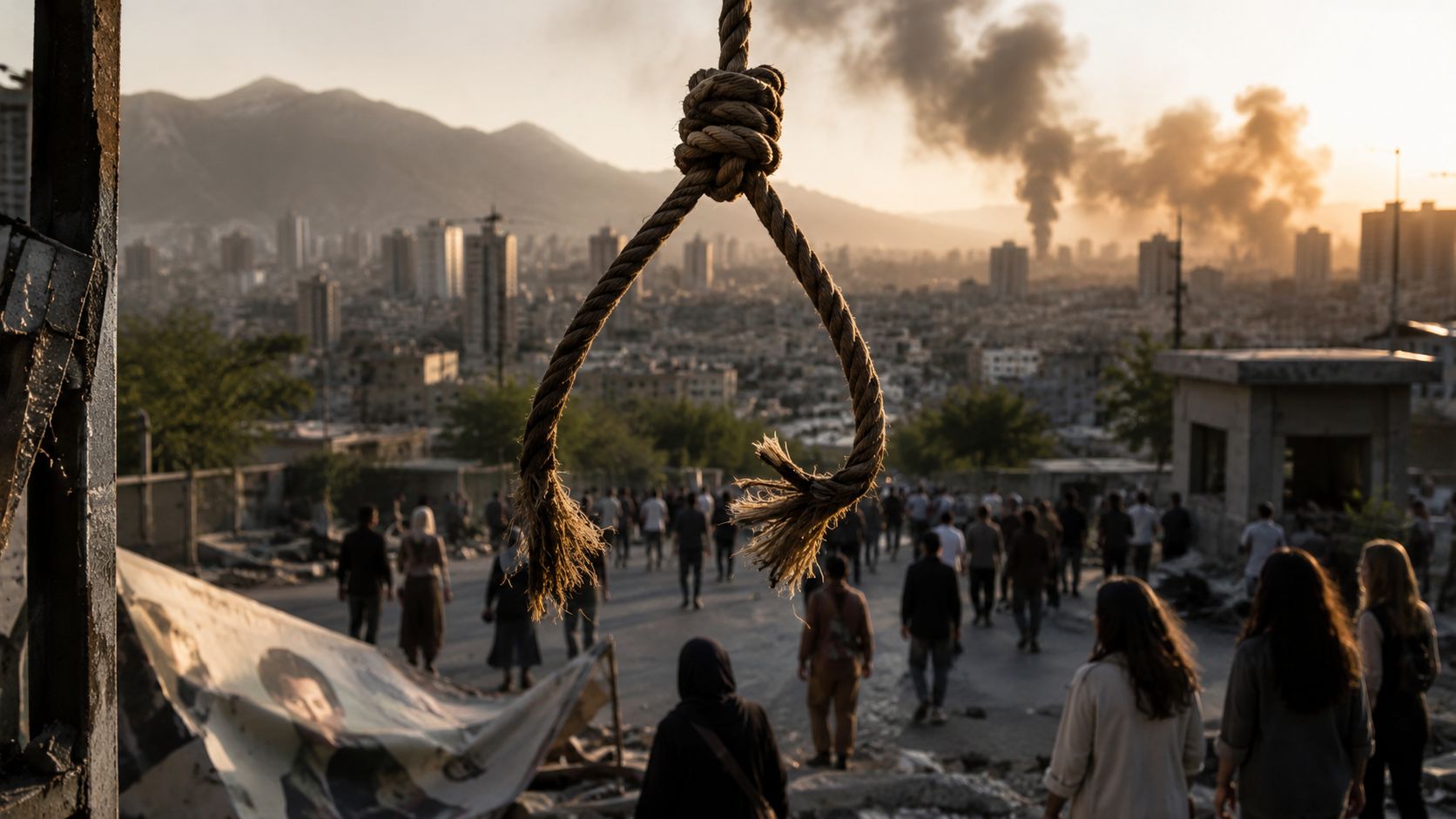
There are many ways to discuss Iran. We can talk about nuclear weapons, uranium enrichment, Israel, the Persian Gulf, oil, sanctions, Russia, China, the United States and the balance of power in the Middle East. These subjects dominate international coverage because governments naturally view Iran primarily through the lens of geopolitics.
For once, put all of that aside.
Imagine Iran not as a square on the geopolitical chessboard but as a country of more than 90 million human beings. Ask a much simpler question: would their lives become better if the Islamic Republic disappeared?
At first sight, the answer seems obvious. The Iranian state has imprisoned dissidents, suppressed demonstrations, discriminated systematically against women, enforced compulsory veiling, tortured prisoners and employed the death penalty on an extraordinary scale. Amnesty International says that Iranian authorities executed more than 2,159 people during the first nine months of 2025 alone, already exceeding the 972 executions it recorded for the whole of 2024. The organization described the accelerating use of capital punishment as part of a broader assault on the right to life and noted its use as an instrument of political repression.
Iraq, Libya, Afghanistan
Yet history gives us an uncomfortable warning. Removing a brutal government and creating a humane society are two completely different achievements.
The United States discovered this in Iraq. Libya demonstrated it again. Afghanistan supplied another variation of the same lesson. Destroying a regime can take weeks. Constructing legitimate institutions capable of peacefully governing millions of people can take decades.
Iran therefore presents two terrible possibilities rather than a simple contest between good and evil. The Islamic Republic can survive and continue repressing its population. Alternatively, the regime can collapse without a viable political order ready to replace it.
The second outcome might eventually produce democracy. It could also produce something considerably worse.
What the Islamic Republic does to its own people
Any serious discussion must begin by refusing to sanitize the government that currently exists.
Iran’s human-rights record extends far beyond restrictions that Western observers might vaguely describe as “religious conservatism.” Amnesty International reports systematic unfair trials, torture and other ill-treatment, arbitrary use of the death penalty, discrimination against women and girls, persecution of minorities and repression of dissent. The organization says executions reached their highest level since 1989.
Women provide some of the most disturbing examples.
In 2014, Iran executed Reyhaneh Jabbari. She had been convicted of murdering Morteza Abdolali Sarbandi, a former intelligence ministry employee. Jabbari acknowledged stabbing him but maintained that he had attempted to rape her. Human Rights Watch documented serious concerns surrounding the investigation and judicial process and called for her death sentence to be overturned before Iran ultimately hanged her.
The details matter because this should not be reduced to the simplistic claim that Iranian law automatically executes every woman who kills an attempted rapist in self-defence. Jabbari’s self-defence account was disputed by the prosecution. The fundamental problem is that a state was prepared to impose an irreversible punishment after proceedings that generated profound concerns about their fairness.
Then there was Zeinab Sekaanvand.
She was married at 15. According to Amnesty International, she said her husband subjected her to physical and verbal abuse and that her brother-in-law repeatedly raped her. She sought help from authorities, but her complaints were not properly investigated. Arrested at 17 in connection with her husband’s killing, she was convicted following what Amnesty described as a grossly unfair trial. Iran executed her in 2018.
These are not merely stories about capital punishment. They reveal what happens when gender inequality, authoritarianism, an inadequate justice system and the death penalty intersect.
Activism itself can become dangerous
Political dissent adds another dimension.
After the Woman, Life, Freedom uprising began in 2022, Iranian authorities unleashed a massive crackdown. Amnesty documented unlawful killings, severe beatings and the use of firearms against demonstrators and bystanders, including children. Years later, accountability for those abuses remained virtually nonexistent.
The death penalty has become part of this machinery of intimidation.
Mojahed Kourkouri, associated with the Woman, Life, Freedom protests, was executed in June 2025 following proceedings Amnesty described as a sham trial involving torture and forced confessions. A month later, Amnesty reported the secret executions of political dissidents Behrouz Ehsani and Mehdi Hassani after another grossly unfair process.
The pattern has continued. In July 2026, UN experts condemned death sentences imposed on 12 young men for participating in the January 2026 protests and called for the sentences to be quashed.
Women who challenge the political and social order have faced arbitrary detention, flogging, prosecution and potentially capital punishment. Amnesty reported in 2025 that women’s-rights defenders, journalists, singers and other activists had increasingly been targeted as authorities attempted to suppress the movement that emerged around Woman, Life, Freedom.
This is therefore not an abstract disagreement over whether Iran should become friendlier toward Washington or less hostile toward Israel. An Iranian woman imprisoned for demanding equality does not need a lecture about the balance of power in the Persian Gulf. She needs her rights.
That brings us to regime change.
Surely almost anything would be better
There is an emotionally compelling argument for saying yes.
Remove the Islamic Republic and you remove the ideological structure responsible for compulsory veiling, religious policing, revolutionary courts and much of the institutional repression associated with the current political system.
A secular democratic Iran could abolish compulsory veiling. It could introduce meaningful judicial independence, prohibit torture, protect political opposition, recognize greater equality between men and women, strengthen minority rights and abolish or dramatically restrict capital punishment.
Iran possesses many characteristics that make such a future conceivable. It has a large urban population, an educated population, a substantial diaspora, a long tradition of political activism and millions of citizens who have repeatedly demonstrated that they do not passively accept the ideological demands of the Islamic Republic.
The extraordinary courage displayed during the Woman, Life, Freedom protests should destroy the caricature of Iranians as a population naturally suited to theocracy.
They are not their government.
Nevertheless, believing that Iranians deserve democracy is different from believing that foreign militaries can manufacture it for them.
The United States and Israel have not produced regime change
External pressure has repeatedly demonstrated its limitations.
Sanctions can damage an economy. Bombs can destroy military facilities. Intelligence operations can kill commanders. Cyberattacks can disrupt infrastructure. Governments can arm enemies, isolate officials and destroy military capabilities.
None of these things automatically creates a democratic government.
The current confrontation has demonstrated the distinction particularly starkly. Despite devastating American and Israeli attacks on Iran’s military and political leadership in 2026, the Islamic Republic has not simply disappeared. Chatham House noted after the opening attacks that the system had considerable experience regenerating itself under pressure and warned that external military pressure did not automatically create a viable political alternative.
The problem can be summarized brutally: you can kill a dictator from the air. You cannot build an independent judiciary from the air.
You cannot bomb a functioning parliament into existence.
A missile cannot create trusted police forces, political parties, constitutional legitimacy, independent media or agreement among competing opposition movements.
Those things require institutions.
The Saddam Hussein lesson
The United States demonstrated the difference between defeating a government and constructing a state with extraordinary clarity in Iraq.
Saddam Hussein presided over a murderous dictatorship. Removing him ended that dictatorship. Neither statement is particularly controversial.
What followed is the problem.
The destruction of the existing political order created an enormous vacuum. State institutions were weakened or dismantled. Armed groups competed for influence. Sectarian violence exploded. Insurgency spread. Al-Qaeda in Iraq emerged, and the political and security conditions created during those years eventually contributed to the rise of ISIS.
The moral accounting therefore becomes much more difficult than asking whether Saddam Hussein deserved to remain in power.
He did not.
The relevant question was whether the mechanism used to remove him produced something better for the human beings living there.
Regime change must ultimately be judged by that standard.
Libya provides an even darker warning
Muammar Gaddafi was another dictator whose disappearance initially looked like liberation.
His government collapsed in 2011 after an uprising supported by NATO intervention. Yet Libya did not seamlessly transform into a liberal democracy. Rival governments, militias, armed factions and foreign powers competed for control.
The state itself fragmented.
That distinction is essential for Iran. There is a profound difference between destroying the Islamic Republic and destroying Iran’s capacity to function as a state.
The first may be desirable.
The second could be catastrophic.
Iran is not Iraq or Libya
Still, historical analogies can become intellectually lazy.
Iran is neither Iraq nor Libya.
It has a much stronger sense of national identity, a long history of centralized government, substantial administrative institutions, major cities, universities, industries and a sophisticated civil society. Iran existed as a recognizable political civilization long before the Islamic Republic and will exist after it.
Consequently, regime collapse would not automatically mean state collapse.
This distinction gives Iran a potentially better starting position than Libya had in 2011. Even analysts warning about regime change emphasize that Iran possesses more cohesive state institutions than Iraq did when the United States invaded in 2003.
However, those institutions also create another problem.
One of the strongest is the Islamic Revolutionary Guard Corps.
What happens to the Revolutionary Guards?
Imagine that the Supreme Leader disappears, the clerical establishment loses control and millions of Iranians celebrate in the streets.
What happens the following morning?
Who controls the military bases, who controls prisons, who controls police stations? And who controls the borders, who controls ballistic missiles? Who controls energy infrastructure? Who controls the enormous commercial interests associated with the Revolutionary Guards?
These questions sound less inspiring than chants about liberation, but they determine whether revolutions succeed.
The IRGC is not simply a collection of soldiers protecting several government buildings. It is deeply embedded in Iran’s political, military and economic system. Chatham House has described it as effectively a military-industrial complex with enormous influence throughout the country.
If the clerical leadership collapsed while the Revolutionary Guards remained cohesive, Iran might not become democratic at all.
It could simply exchange a clerical dictatorship for a military one.
The turbans could disappear while authoritarianism survived.
The opposition has another problem
Who replaces the government?
This question remains remarkably difficult to answer.
Iran’s opposition contains monarchists, republicans, liberals, secularists, leftists, ethnic movements, former regime insiders and numerous organizations operating abroad. They agree considerably more about what they oppose than about what should replace it.
Reuters has described the opposition as deeply fragmented. Reza Pahlavi remains the most internationally recognizable monarchist figure, but the extent of his support inside Iran is difficult to establish. The People’s Mujahedin has its own deeply controversial history and limited domestic presence, while Kurdish, Baluchi and other minority movements pursue priorities that do not always correspond with those of Persian nationalist opposition groups.
That fragmentation does not mean democracy is impossible. Democracies are supposed to contain competing political movements.
The danger comes earlier.
Before political disagreement can become democratic competition, everyone must agree on the rules under which they compete.
That means accepting elections even when you lose them.
It means accepting constitutional limitations; it means refusing to settle political disagreements with armed militias.
It means agreeing that today’s political enemy has the right to become tomorrow’s government.
Those habits are much harder to establish than removing statues.
The greatest danger is the vacuum
Suppose the Islamic Republic suddenly collapsed.
Several power centers might emerge simultaneously. Revolutionary Guard commanders could control different military assets. Opposition politicians abroad could declare transitional authorities. Protest movements inside Iran could establish competing councils. Minority organizations might demand autonomy. Former officials could attempt to preserve parts of the old state. Foreign governments would inevitably support their preferred factions.
Even people who overwhelmingly agreed that the Islamic Republic had to disappear could disagree violently about what came next.
Republic or monarchy?
Centralized state or greater regional autonomy?
How secular should the constitution be?
What happens to former Revolutionary Guards?
Should senior officials face criminal trials?
Should lower-level regime employees receive amnesty?
Who writes the constitution? And who organizes the first election? Who controls the country until that election takes place?
Every unanswered question creates an opportunity for someone carrying a gun to provide an answer.
Revenge could become another human-rights disaster
There is another uncomfortable possibility.
A revolution against a government responsible for decades of repression creates millions of legitimate grievances.
Families have lost relatives. Protesters have been tortured. Women have been beaten. Political prisoners have spent years behind bars. People have been executed following grossly unfair proceedings.
If the regime collapsed, demands for justice would be overwhelming.
Justice would be necessary.
Revenge would be dangerous.
The new Iran would immediately face a fundamental test: whether it treats members of the old regime according to principles radically different from those employed by the Islamic Republic itself.
Mass executions of Revolutionary Guards, judges, prison officials and government supporters might satisfy understandable anger. They would also reproduce the principle that political transitions are settled through killing.
A democratic Iran would need trials for those credibly accused of serious crimes, accompanied by due process, independent courts and individual rather than collective responsibility.
Otherwise, the revolution could begin by imitating the regime it overthrew.
Foreign intervention makes legitimacy harder
This is where the United States and Israel face an inherent contradiction.
Both can weaken the Iranian government militarily. Neither can give its preferred successor domestic legitimacy.
Indeed, excessive foreign involvement could do precisely the opposite.
Iranian opposition to the Islamic Republic does not automatically translate into support for American or Israeli military intervention. National identity can coexist perfectly well with hatred of one’s government.
A person can despise the Revolutionary Guards and still become furious when a foreign missile destroys a building in his city.
A woman can reject compulsory veiling and simultaneously reject the proposition that a foreign government should determine Iran’s political future.
A dissident can want the Supreme Leader gone without wanting his country bombed.
Foreign powers therefore risk converting a conflict between Iranians and their government into a conflict between Iran and outsiders. Once that happens, nationalism can provide an unpopular government with something repression alone cannot produce: a reason for otherwise hostile citizens to rally around the state.
Bombing can weaken the very people it is supposed to liberate
This creates one of the strangest paradoxes of externally driven regime change.
Military attacks intended to weaken an authoritarian government can simultaneously weaken civil society.
This danger is not merely theoretical. After the US and Israeli attacks on Iran began on 28 February 2026, Amnesty International reported that Iranian authorities used what they called “wartime conditions” to intensify domestic repression. More than 6,000 people were arbitrarily arrested, including protesters, journalists, lawyers, human-rights defenders, dissidents and members of ethnic and religious minorities. Authorities also accelerated prosecutions, including cases carrying the death penalty, while Amnesty documented concerns about enforced disappearances, torture, forced confessions and grossly unfair trials. By late May, at least 39 people had been executed on politically motivated charges since the attacks began. The war therefore illustrates a disturbing paradox: foreign military pressure intended to weaken an authoritarian regime can also provide that regime with an opportunity to intensify repression against its own population.
Wars close universities. They destroy businesses; they interrupt communications. And they displace families. They make ordinary political organizing dangerous. Governments introduce emergency measures, intensify surveillance and accuse dissidents of collaborating with the enemy.
Meanwhile, people who would normally protest against their rulers begin worrying about food, electricity, relatives and whether another missile is coming.
The authoritarian state possesses bunkers, weapons, intelligence agencies and organized chains of command.
Civil society possesses people.
In prolonged warfare, the first can sometimes survive better than the second.
But doing nothing has consequences too
None of this should become an argument for accepting the Islamic Republic indefinitely.
That would produce another moral absurdity.
Whenever intervention produces terrible consequences, the temptation arises to conclude that non-intervention must therefore be humane. It is not necessarily so.
Doing nothing is also a decision.
Every year that the current political system survives is another year in which political prisoners can be tortured, women can be punished for resisting compulsory veiling, protesters can be imprisoned, dissidents can face execution and minorities can remain subject to systemic discrimination.
The status quo has victims.
They should not disappear from our calculations simply because their deaths occur gradually rather than during a spectacular war.
This is precisely why the Iranian question is so difficult.
There is no morally neutral option.
The best regime change would be Iranian regime change
If Iran is ever to make a durable transition toward democracy, the strongest possibility would be one in which Iranians themselves become the principal political actors.
Foreign governments can help.
They can document abuses, they can sanction individuals responsible for repression, they can support uncensored communications. And they can provide refuge to persecuted activists. They can support independent Persian-language journalism, they can preserve evidence for future prosecutions. They can pressure Tehran over executions and political prisoners.
What they cannot successfully manufacture is Iranian political legitimacy.
A democratic government ultimately needs Iranians to believe that it belongs to them.
That is particularly important after 1979. The Islamic Republic itself emerged from a revolution against an authoritarian monarchy. That revolution demonstrates another uncomfortable truth: overthrowing an oppressive political system does not guarantee that its replacement will be less oppressive.
Iran has already conducted this experiment once.
It should not have to conduct it again.
What would determine whether regime change succeeds?
The decisive factor would probably not be how quickly the existing leadership fell. It would be how much of the functioning state survived the transition.
Police forces would have to continue protecting ordinary citizens while being separated from political repression. Civil servants would have to keep electricity networks, hospitals, water systems and government departments operating. Military units would need to remain under centralized authority. Political prisoners would have to be released without prisons simply being turned over to angry crowds.
Most importantly, the security apparatus would have to fragment politically without fragmenting militarily.
That is an extraordinarily difficult balance.
If everyone remains loyal to the existing leadership, the revolution fails.
If every armed unit becomes independent, the state fails.
Successful transition lies somewhere between those two outcomes.
A humane transition would need functioning institutions
Revolutions produce dramatic photographs. Democracies are built through considerably less photogenic activities.
Someone must write electoral laws; someone must establish an independent electoral commission; someone must determine the powers of the presidency and parliament. And someone must protect judges from political interference.
Also, someone must guarantee freedom of religion and freedom from religion.
Someone must decide how the rights of Kurds, Baluchis, Arabs, Azeris and other communities will be protected.
Someone must ensure that women who fought against the Islamic Republic do not discover that another group of men has simply decided what women are permitted to do.
These institutional questions matter more to Iran’s long-term future than the identity of whichever politician gives the first victory speech in Tehran.
Would executions stop?
Under the best scenario, yes.
A democratic Iranian government could impose an immediate moratorium on executions, commute existing death sentences and eventually abolish capital punishment. Political prisoners could be released. Revolutionary courts could disappear. Torture could be investigated. Compulsory veiling could end. Women could receive greater legal equality.
Iran could experience one of the greatest expansions of individual freedom in the modern Middle East.
That possibility should not be dismissed as naïve.
Neither should it be treated as inevitable.
Under another scenario, the Revolutionary Guards could preserve enough power to establish a new authoritarian order; under another, rival political and military factions could compete violently. Under yet another, prolonged instability could generate popular demand for a new strongman promising security.
People terrified by chaos sometimes surrender freedoms that they fought decades to obtain.
The choice is not dictatorship or invasion
Perhaps the greatest mistake in debates about Iran is the assumption that only two policies exist.
Either tolerate the Islamic Republic forever or destroy it militarily.
That is a false choice.
The international community can oppose the Islamic Republic’s human-rights abuses while remaining deeply skeptical of externally imposed regime change. One can support Iranian protesters without pretending that Washington can choose Iran’s next government. One can condemn executions without supporting a war that might kill thousands more people.
Most importantly, one can hope for the end of the Islamic Republic while fearing the manner in which that end occurs.
Those positions are not contradictory.
They follow from taking human life seriously.
Iran does not need another experiment conducted on Iranians
For governments outside Iran, regime change can become an abstraction.
Politicians discuss strategic opportunities. Military planners discuss targets. Analysts discuss power vacuums. Television panels discuss winners and losers.
Iranians would live with the consequences.
If the Islamic Republic survives, they will continue living under a system that has demonstrated an extraordinary willingness to imprison, torture and execute its own citizens.
And if it collapses peacefully and functioning institutions survive, Iran could experience an extraordinary political transformation.
If it collapses violently and the state fragments with it, millions of people who deserve liberation could instead inherit chaos.
That is why the central question should not be whether the Islamic Republic deserves to survive.
A government that systematically represses its citizens does not acquire moral legitimacy merely because replacing it is difficult.
The better question is this:
Can the regime end without Iran collapsing with it?
Reyhaneh Jabbari cannot be brought back. Neither can the protesters who have been killed, prisoners who have been executed or countless people whose lives have been damaged by repression. Preventing future abuses requires political change.
But preventing future victims also requires remembering the lessons of Iraq, Libya and other collapsed authoritarian systems.
The humane objective is therefore not simply regime change.
It is regime change followed by something better.
Iran’s tragedy is that the first objective is enormously difficult, while the second is harder still.
Leave a Reply