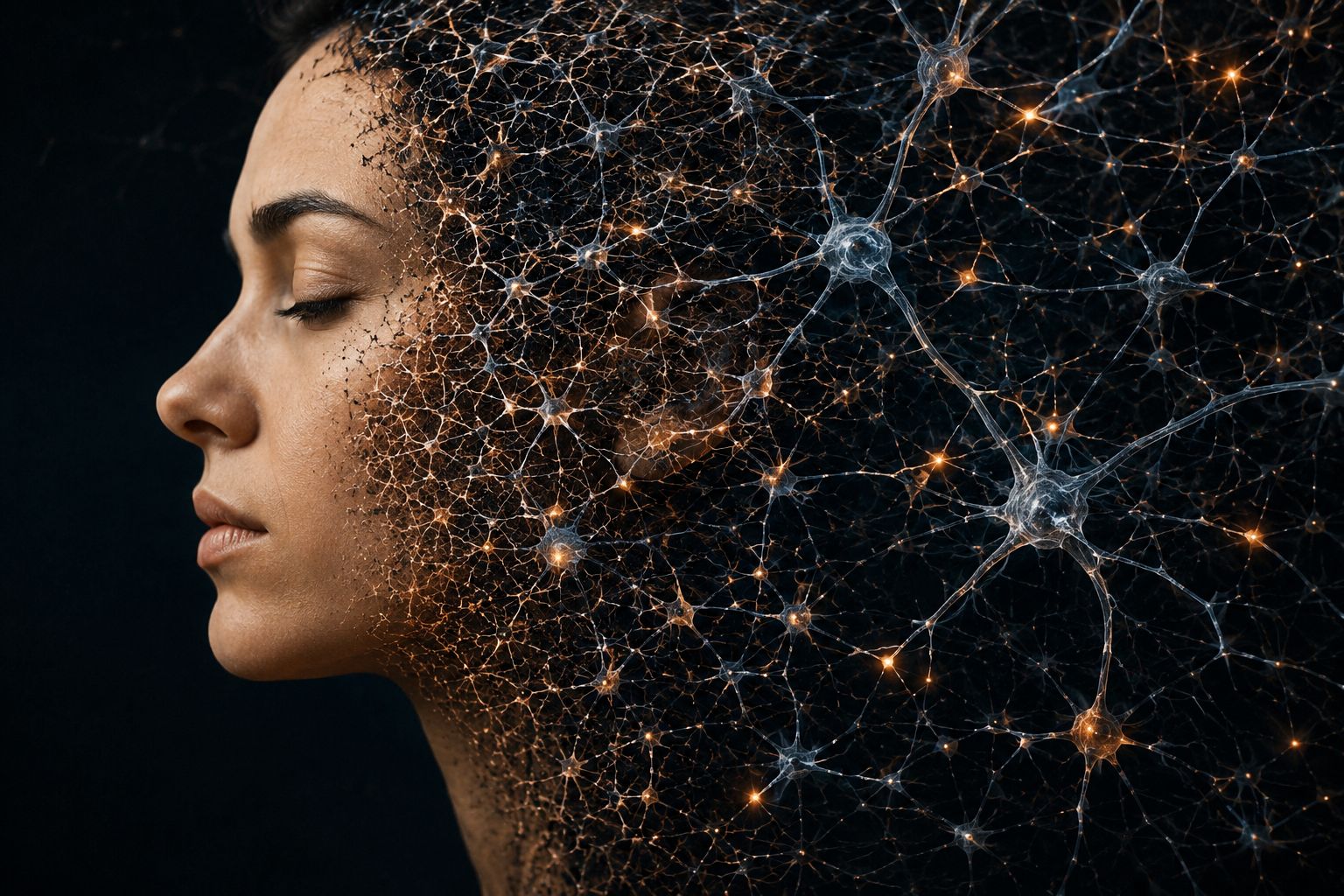
We wake up every morning with an extraordinarily convincing impression. There is someone inside our heads. There is a “me” observing the world, making decisions, remembering yesterday and planning tomorrow.
That impression is so powerful that questioning it can sound absurd. Yet neuroscience gives us little reason to believe that a separate self exists behind the machinery of the brain.
There is no tiny observer sitting somewhere inside your skull watching your experiences unfold. There is no immaterial executive issuing commands to your neurons. There is no independent agent standing outside the causal machinery of the brain and deciding what it should do.
There is a brain.
More specifically, there are roughly 86 billion neurons, enormous numbers of supporting cells and trillions of connections participating in constantly changing patterns of electrochemical activity. Somehow, this biological machinery produces consciousness.
What we call “me” is what some of that machinery feels like from the inside.
Where exactly is the self?
Suppose we take the existence of an independent self seriously. Where should we look for it?
The frontal lobes? The thalamus? The hippocampus? The default mode network? Somewhere between them?
Neuroscience has discovered structures involved in memory, attention, emotion, language, decision-making, bodily awareness and self-referential thought. It has not discovered a central observer to whom all these processes report.
That absence creates a version of the old homunculus problem. If there were a little observer inside the brain interpreting everything presented to it, we would have to explain how that observer itself perceived and decided. Would it need another observer inside its own head?
The explanation would simply move the mystery one level deeper.
A much simpler possibility is that there is no central observer.
Conscious experience emerges from distributed neural processes. Different systems process vision, sound, bodily sensations, memories, emotions and expectations. Their interaction creates an integrated experience that appears to belong to a unified individual.
The unity is real as an experience. That does not require a separate metaphysical entity producing it.
Change the brain and you change “you”
Perhaps the strongest argument against an independent self comes from a simple observation: alter the brain and you can alter virtually everything we associate with the person.
Damage particular brain systems and memory can disappear. Damage others and language can collapse. Neurological disease can transform personality, impulse control, emotional responses or the ability to recognize familiar people.
Drugs can change mood, perception and judgment. Anesthetics can apparently eliminate ordinary consciousness temporarily. Electrical or magnetic stimulation can influence perceptions, movements and decisions. Hormones, sleep deprivation, disease and psychoactive substances can all modify what a person thinks and feels.
The relationship is extraordinarily intimate.
If an independent self exists separately from the brain, why does manipulating biological tissue so reliably manipulate the supposed self?
The materialist explanation requires no additional entity. Your memories are encoded through brain processes. Your personality depends on brain processes. Your preferences depend on brain processes. Your ability to deliberate depends on brain processes.
Change those processes sufficiently and you change the person.
Destroy them completely and there is no established scientific evidence that the person continues somewhere else.
The brain does not need a CEO
We often imagine decision-making hierarchically because human organizations work that way.
A company has employees and a chief executive. A country has institutions and a government. An army has soldiers and commanders. It therefore feels intuitive that the brain must also have somebody in charge.
But biological systems do not necessarily work like corporations.
Individual neurons follow local electrochemical processes. They receive signals, integrate inputs and influence other cells. No neuron understands the organism. No individual cell needs to know that the organism is choosing coffee rather than tea.
Complex behavior emerges from interactions among simpler components.
We already accept this principle elsewhere in biology. An ant colony can display sophisticated collective behavior without an ant sitting in headquarters directing every worker. The immune system can respond to threats without a microscopic general commanding its cells.
Brains take emergent complexity to an extraordinary level.
Billions of interacting cells can produce perception, language, planning, imagination and eventually a system capable of constructing a model of itself.
That model is what we experience as the self.
Evolution built the self for other people
Why does the illusion of a unified “I” feel so extraordinarily convincing?
The answer may lie less in our interaction with the physical environment than in our interaction with other human beings.
Humans evolved as intensely social animals. Survival and reproduction depended heavily on navigating relationships with other members of the group. Our ancestors had to cooperate, compete, form alliances, detect deception, remember favors and betrayals, establish reputations, anticipate other people’s behavior and understand their own position within complicated social hierarchies.
In such an environment, modeling other minds became enormously valuable.
You need to know who is trustworthy. Who is angry with you? Who owes you something? Who might become an ally? Who remembers what you did yesterday? What does another person believe about you? What will happen to your reputation if you behave selfishly when everyone is watching?
But sophisticated social cognition creates another computational problem. If the brain constructs models of other people as persistent agents with intentions, desires and histories, it also benefits from constructing a similar model of itself.
The brain therefore does not merely process hunger, fear, attraction or pain. It organizes behavior around a socially intelligible protagonist: me.
I did this yesterday. I promised her that. He dislikes me. They respect me. I should not do this because somebody might see me. I want others to think of me in a particular way. I was humiliated before and do not want it to happen again.
This persistent self-model would have been enormously useful in the intensely social world of our ancestors.
Reputation as a factor
Reputation alone creates powerful evolutionary pressures for such machinery. Humans live among other humans who remember behavior. A person who steals, cheats, cooperates, shares, lies or keeps promises can acquire a reputation that affects future cooperation, mating opportunities, alliances and access to resources.
To manage a reputation, the brain must represent not only other people but also itself as seen by other people.
That may help explain why human consciousness is so obsessed with the self.
We continuously compare ourselves with others. We imagine what other people think about us. We rehearse conversations that have already happened. We anticipate criticism that has not happened yet. We feel shame about past behavior while completely alone. We construct elaborate stories explaining why we behaved as we did.
Much of this makes sense when the self is understood as a product of social evolution.
Even conscience can be viewed partly through this lens. Social rules become internalized until the brain can simulate the judgment of other people without those people actually being present. The group, in a sense, gets reconstructed inside the individual brain.
Language
Language probably intensified this process dramatically. Once humans could describe themselves and others symbolically, the self could become a narrative extending across decades.
“I was that child.”
“I did that yesterday.”
“I am this kind of person.”
“I will be the same person tomorrow.”
The resulting autobiographical self feels like a permanent entity moving through time. Yet it may instead be a continuously updated model assembled by the brain from memory, social information, bodily signals, expectations and language.
This does not mean that evolution suddenly invented agency when humans appeared. Other animals clearly distinguish their own actions from events around them, pursue goals and make decisions. The evolutionary foundations of agency are much older than humanity.
What became extraordinary in humans was the sophistication of the self-model.
Our ancestors did not merely need to act. They needed to understand other agents, predict how those agents perceived them and maintain their own identities across immensely complicated networks of cooperation, competition, kinship, friendship and status.
The “I” may therefore feel like the center of the universe inside our heads because, for a highly social primate, maintaining a model of that “I” was extraordinarily useful.
Evolution did not need to create an immaterial self.
It only needed to create a brain capable of representing one.
Free will feels obvious
The same problem appears with free will.
At this moment, you may feel that you could stop reading this article. You could continue. You could stand up. You could open another browser tab.
It certainly feels as though an independent agent is selecting among possibilities.
But what makes the selection?
Your decision must arise from something.
Perhaps you continue reading because the article interests you. Perhaps you stop because you are bored. Perhaps another thought enters consciousness and distracts you.
Where did those preferences and thoughts come from?
You did not choose your genes. You did not choose the brain with which you were born. You did not choose your early environment. You did not choose every experience that subsequently modified your nervous system.
More importantly, you cannot consciously choose a thought before the thought occurs to you. To choose it, you would already have to think it.
The regress becomes unavoidable.
Decisions still exist
Rejecting libertarian free will does not mean that humans never make decisions.
Of course we make decisions.
The mistake is imagining that the decision requires a metaphysically independent decision-maker separate from the biological process producing it.
A computer performs calculations without requiring a ghost inside the processor. A brain can evaluate alternatives without requiring a ghost inside the skull.
When you compare two job offers, neural systems represent expected rewards, risks, memories, social consequences and future possibilities. These processes interact until behavior emerges.
That process is deliberation.
Saying that neurons made the decision does not mean that “you” did not make it. It means that you are the neural system doing the deciding.
The distinction disappears once we stop treating the self and the brain as separate things.
Neuroscience has not completely solved consciousness
There is an important limit to this argument.
Science does not yet possess a complete explanation of consciousness.
We can identify neural correlates of conscious states and study what happens when consciousness changes or disappears. Yet the fundamental question remains: why should particular physical processes produce subjective experience at all?
Why should electrochemical activity feel like anything?
This is one of the deepest unresolved problems in science and philosophy.
But ignorance does not establish dualism.
Throughout history, unexplained phenomena have repeatedly attracted supernatural explanations. Lightning once required gods. Disease required spirits. Biological complexity required direct creation.
Scientific uncertainty about consciousness does not provide evidence that an immaterial soul exists.
The responsible position is simpler: we know that consciousness depends profoundly on brain function, while we do not yet fully understand how brains generate it.
What about the soul?
The traditional religious alternative faces an even greater explanatory problem.
Suppose there is an immaterial soul containing your true identity.
What does it actually do?
If memory belongs to the soul, why can brain injury destroy memory? If personality belongs to the soul, why can neurological disease alter personality? If moral judgment belongs to the soul, why can damage to particular brain regions alter judgment and inhibition?
And if consciousness belongs primarily to an immaterial soul, why does anesthesia reliably switch ordinary conscious awareness off by interfering with brain chemistry?
The soul hypothesis does not solve the mystery. It adds another mysterious entity and then requires an explanation of how that entity interacts with physical neurons.
Materialism may leave consciousness incompletely explained. Dualism leaves consciousness incompletely explained and adds another unexplained thing.
Your brain constructed a story
Human consciousness does something remarkable: it continuously organizes information into narratives.
We remember selected pieces of our past. We interpret our behavior. We imagine future versions of ourselves. We explain our decisions after making them. We maintain beliefs about what kind of person we are.
From this stream emerges autobiography.
“I was born there.”
“I believe this.”
“I love these people.”
“I chose this career.”
“I regret doing that.”
“I want this tomorrow.”
These statements connect events across decades into the apparent story of one persistent protagonist.
Yet even this continuity depends on memory. Severe disruption of memory can radically fragment the autobiographical self. Neurodegenerative diseases can gradually dismantle parts of the personality that relatives once considered inseparable from the person.
The self is therefore not an indivisible object.
It is an ongoing construction.
An illusion can still matter
Calling the self an illusion does not mean that human beings are meaningless.
Money is partly a social construction, yet losing all your money can have very real consequences. Nations are constructed categories, yet governments exercise enormous power. Languages consist of collectively maintained systems of symbols, yet the sentence you are reading communicates information.
Similarly, the constructed nature of the self does not make suffering unreal.
Pain hurts because a conscious system experiences it. Happiness matters because conscious systems experience it. Love, fear, pleasure, grief and hope remain psychologically real regardless of whether an immortal observer sits behind them.
Indeed, abandoning the metaphysical self can strengthen rather than weaken concern for conscious creatures.
What ultimately matters is not an invisible soul. It is experience.
Responsibility without metaphysical freedom
The disappearance of libertarian free will also forces us to reconsider morality.
If behavior arises from genes, brain development, environment, learning and immediate circumstances, hatred becomes less intellectually defensible.
A violent offender should still be prevented from harming others. Society still needs laws, incentives and consequences. But punishment need not be justified through metaphysical vengeance against a soul that supposedly created itself.
We can instead ask practical questions.
How can we prevent another crime? Can this person be rehabilitated? What conditions increase violence? Which interventions reduce recidivism? How can potential victims be protected?
Consequences themselves become part of the causal environment influencing future behavior.
Determinism therefore does not eliminate criminal justice. It changes its justification.
The objective becomes harm reduction rather than cosmic retribution.
There is no ghost in the machine
Human beings desperately want to be more than matter.
We imagine souls, spirits, immortal consciousness and autonomous selves standing outside physical causation. Perhaps that intuition itself is another product of the remarkable machinery evolution constructed inside our skulls.
But we should distinguish what feels intuitively true from what evidence actually establishes.
Everything we know about human cognition points overwhelmingly toward the brain.
Memory changes when the brain changes. Personality changes when the brain changes. Perception changes when the brain changes. Judgment changes when the brain changes. Consciousness changes when the brain changes.
There is no compelling scientific evidence for another entity hiding behind these processes.
There is no little person watching the neurons.
There is no ghost pulling biological levers.
There is just an astonishing network of living cells that, after billions of years of evolution, became complicated enough to perceive the universe, remember its past, imagine its future—and experience itself as “me.”
The illusion may be among evolution’s greatest achievements.
But the network is what we are.
Source: 250 Arguments for Atheism (Jan Bryxí; 2025; page 54)
Leave a Reply