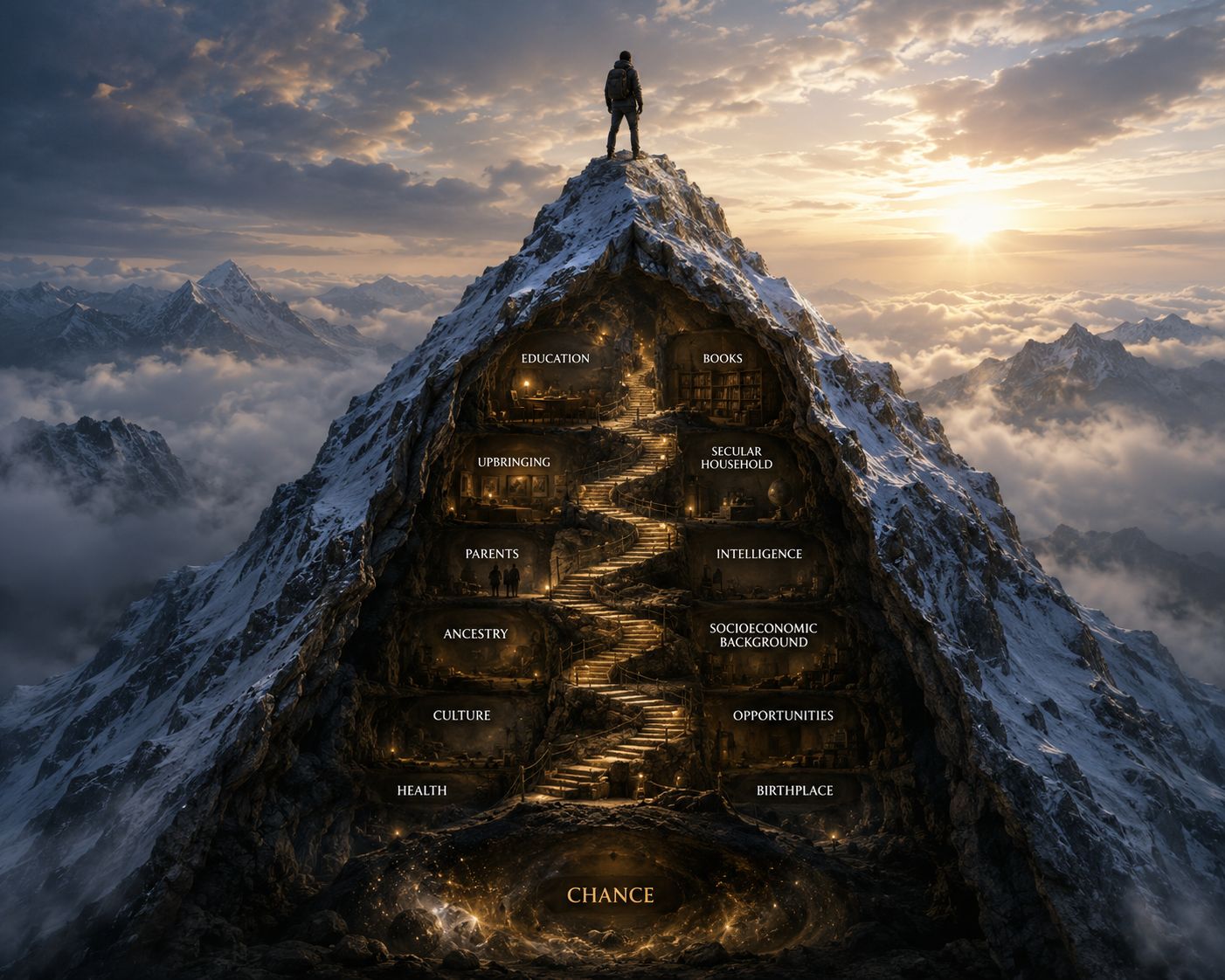
Every successful person enjoys hearing that they deserve everything they have achieved. Society constantly celebrates hard work, intelligence, discipline, determination, and perseverance. Those who become wealthy are often called self-made. Great scientists are praised for their brilliance. Successful entrepreneurs are admired for their vision. Writers are congratulated for their talent. At the same time, people who fail are frequently told that they simply did not work hard enough or make the right decisions. This narrative is deeply comforting because it suggests that our lives are largely under our own control. It tells us that we are the authors of our own destiny. The more I have studied psychology, neuroscience, genetics, evolution, and philosophy, however, the more impossible this belief has become for me to maintain.
This is not an exercise in false modesty. Nor is it an attempt to deny my own achievements. Not everyone could have written a book such as 250 Arguments for Atheism or spent years producing extensively researched articles on science, religion, philosophy, politics, and psychology. Such work requires at least some intelligence, curiosity, persistence, access to information, and thousands of hours of reading. I invested an enormous amount of time into acquiring that knowledge. Yet the obvious question is not whether I worked hard. The real question is why I became the kind of person who was capable of working that hard in the first place.
Winning several lotteries at the same time
The answer is uncomfortable because almost none of it was my own doing.
Long before I made my first conscious decision, I had already won several lotteries. The first was geographical. I happened to be born in the Czech Republic. Had I instead been born in Afghanistan, North Korea, rural India, or many other parts of the world, you would almost certainly never be reading this article. My education would have been different. My opportunities would have been different. The people surrounding me would have been different. Even the questions that occupy my mind today might never have occurred to me. We like to imagine that ideas arise purely from our own intellect, but they are heavily shaped by the environment in which that intellect develops. Birthplace influences almost every aspect of our future long before we are capable of choosing anything ourselves.
All of the lotteries
The second lottery was my family. Both of my parents possessed high intelligence (superior intelligence range) and met while attending a relatively prestigious high school. I never selected my genes. I never chose the structure of my brain, my memory, my curiosity, or my capacity to process complex information. Those characteristics were simply handed to me. Modern behavioral genetics leaves little doubt that intelligence has a substantial hereditary component, even though education and environment also play major roles. The same is true for many personality traits, including openness to experience, conscientiousness, impulsivity, emotional stability, and countless other characteristics that influence success throughout life. None of us deserves praise or blame for the biological foundation upon which our lives are built because none of us had any say in receiving it.
China and medieval education
Education shaped my life just as profoundly. I attended ordinary Czech schools that introduced me to science, history, mathematics, literature, and critical thinking. Many people around the world never receive such opportunities. Educational systems differ enormously in quality and philosophy. Some encourage questioning. Others reward memorization and conformity. Many Chinese intellectuals themselves criticize aspects of their own educational system which is unable to make new Bill Gates or Elon Musk because they believe it discourages creativity and independent thought despite producing excellent examination results. India likewise contains both outstanding schools and institutions that struggle to teach even basic subjects. Those differences matter because education influences not only what we know but also how we think. A child repeatedly encouraged to ask questions develops differently from one repeatedly taught never to challenge authority.
Perhaps the greatest intellectual privilege of my childhood was something I barely appreciated at the time. Before I was able to read scientific papers, books, and articles in English, I already had access to numerous Czech non-fiction books. They introduced me to evolution, astronomy, biology, psychology, history, and philosophy. By the time English opened the doors to international literature, I already possessed a framework that allowed me to understand increasingly difficult material. Learning is cumulative. Every book makes the next one easier to understand. Every new concept creates connections with hundreds of older ones. Knowledge compounds in much the same way that money grows through compound interest. Someone who begins reading serious non-fiction at the age of twelve will often possess an enormous advantage over someone who first encounters such material at the age of thirty, even if both people are equally intelligent.
Secular household
Another privilege was far less obvious but perhaps even more influential. I grew up in a secular household. Nobody ever told me that doubting religious claims was sinful. Nobody warned me that questioning sacred texts could lead to eternal punishment. Nobody discouraged me from reading books that criticized religion or defended atheism. My conclusions were not predetermined, but my environment gave me the freedom to explore competing ideas without fear. Had I instead been born into a deeply religious family in another part of the world, there is a good chance that I would sincerely defend beliefs that I reject today. Like billions of other people, I would almost certainly believe that my worldview resulted entirely from careful reasoning, even though it had been heavily influenced by the circumstances of my birth.
My civil name at Freethinkers International
This realization has profoundly changed the way I view other people. Whenever I see someone registering at Freethinkers International under a nickname because revealing their real identity could expose them to persecution, social exclusion, or even physical danger, I do not think they are weaker than I am. I think they were dealt a different hand. They may have grown up in an authoritarian country. They may have been surrounded by religious extremism. They may never have received the educational opportunities that I enjoyed. They may have spent their entire lives fearing consequences that I have never had to consider. It is easy to congratulate ourselves for being courageous when courage costs us very little. It is much harder to appreciate how fortunate we were simply to be born into circumstances where asking difficult questions carried relatively little risk.
Another privilege concerns ancestry. The relationship between genetics, ancestry, and intelligence remains one of the most controversial subjects in psychology, and researchers continue to debate many aspects of it. Whatever conclusions future science eventually reaches, one fact is beyond dispute. Nobody chooses the population into which they are born. Even if every measurable difference between human populations ultimately proved to be entirely environmental, it would still remain something that individuals never selected. Hatred based on ancestry therefore makes no moral sense. Whether someone is born white, black, Asian, or anything else is every bit as accidental as being born left-handed or tall. Chance is not an achievement.
The unearned lottery of ancestry
Research has reported statistical differences in measured cognitive outcomes among populations, although the causes remain heavily debated and are likely to involve both genetic and environmental factors.
For centuries, such observations were weaponized to justify slavery, colonialism, and unspeakable cruelty. The mere mention of group differences can feel like a dog whistle for racial hatred. But the empirical evidence is what it is, and ignoring it for the sake of comfort is not a virtue. Acknowledging that such statistical variances appear to exist is not an endorsement of racial hate. It is simply a description of a biological and environmental reality that we do not yet fully understand. The crucial point, which must be shouted from the rooftops, is that these findings—whatever their ultimate cause—have no moral or ethical implications whatsoever.
Oppose racial hate
Far from being a Nazi or harboring racial hatred, I find that the science of human racial differences reinforces the very opposite conclusion. Let us assume, for the sake of argument, that every measurable difference between races is entirely genetic. What would that mean? It would mean that the physical and cognitive characteristics that define who we are were determined by a roll of the genetic dice that occurred thousands of generations ago, shaped by the brutal and indifferent forces of climate, geography, and natural selection.
It would mean that my being born white, with whatever genetic inheritance that entails, was not an achievement. It was an accident. A cosmic coin flip. I did not earn my ancestry. I cannot take credit for it. And I certainly cannot derive a sense of superiority from it, any more than I could take pride in being born tall or with a particular eye color.
Hate, therefore, based on a trait that no one selected makes no moral sense. Whether someone is born white, black, Asian, or anything else is every bit as accidental as being born left-handed or nearsighted. Chance is not an achievement, and it is certainly not a justification for contempt. If anything, the possibility that our cognitive capacities are influenced by our genetic ancestry only strengthens the argument against bigotry. It shows that the differences we obsess over are not markers of moral worth but simply variations on a shared human theme.
The differences help our understanding
The racist who despises another group for its perceived intellectual inferiority is, in effect, hating someone for winning a different genetic lottery than their own. This is not just morally repugnant; it is intellectually incoherent. We should study these differences to better understand human biology and to help every individual—regardless of their background—reach their full potential. But we must never, ever use them as a justification for prejudice, persecution, or the denial of dignity. Our moral obligation is to treat every person as an individual, not as a representative of a statistical average, and to recognize that their worth as a human being is independent of the genetic hand they were dealt.
Socioeconomic background
Privilege extends far beyond intelligence, education, or religion. Socioeconomic background shapes nearly every opportunity we receive. Children born into stable families usually have access to better nutrition, safer neighborhoods, higher-quality schools, more books, more encouragement, better healthcare, and stronger social networks. Those advantages accumulate over decades. By contrast, poverty often creates obstacles that have nothing to do with laziness or intelligence. A child cannot choose whether their parents read to them, whether they have a quiet place to study, or whether they must worry about tomorrow’s meal instead of tomorrow’s examination. We nevertheless judge adults as though they all began the race from the same starting line.
The more I reflected upon these privileges, the less convinced I became that I truly deserved credit for becoming the person I am today. Certainly, I made choices. I spent evenings reading while others watched television. I devoted countless hours to research instead of entertainment. Yet even those decisions raise another question. Why was I the kind of person who enjoyed reading? Why was I naturally curious? Why did I experience satisfaction from learning rather than boredom? Why did I become fascinated by science, philosophy, and free thought while someone else developed a passion for business, sport, religion, or art? The deeper I examined those questions, the more every answer pointed backwards, toward influences that existed long before I was aware of making decisions.
That realization eventually forced me to confront one of the oldest questions in philosophy. Do we actually possess free will, or are we merely experiencing the consequences of factors that we never chose in the first place?
The philosophy of free will
The realization that almost every important aspect of my life resulted from circumstances beyond my control naturally led me to one of philosophy’s oldest questions. Do we actually possess free will? Or is it merely one of humanity’s most convincing illusions?
For centuries, philosophers understood free will in a fairly straightforward way. If you could somehow rewind the universe to precisely the same moment, with every atom occupying exactly the same position, would you still be capable of making a different decision? Most people instinctively answer yes. We constantly experience the feeling that we could have chosen another path. We regret past decisions because we believe alternatives genuinely existed. We congratulate ourselves for making wise choices and criticize others for making foolish ones. The entire legal system, much of religion, and even everyday conversations assume that people could have acted differently.
Science has gradually made that assumption increasingly difficult to defend.
Neuroscience
Modern neuroscience views the brain as an extraordinarily complex physical system. It consists of roughly 86 billion neurons, each communicating with thousands of others through electrical impulses and chemical signals. Those neurons are not magical entities existing outside the laws of nature. They obey the same physical principles as every other object in the universe. Each neuron occupies a particular state at every moment. That state depends on its previous state, which itself resulted from an earlier one. The chain never begins with a conscious decision. Instead, it stretches backwards through your childhood, your genes, your prenatal development, and ultimately to events that occurred long before you were born.
Take something as simple as your favorite meal. Why do you prefer pizza over sushi, or tea over coffee? Most people answer that they simply like the taste. Yet that explanation immediately raises another question. Why do you like that taste? You did not consciously design your taste buds. Neither did you choose the neural circuits that interpret flavors as pleasant or unpleasant. Your experiences during childhood influenced them. Your culture influenced them. Even repeated exposure changes what people enjoy eating. The preference feels personal because it exists inside your own mind, but that does not mean you freely created it.
Like and dislike
The same logic applies almost everywhere we look. Why do you enjoy one genre of music but dislike another? Why do you admire one politician while your neighbor supports someone completely different? Why does one person love mathematics whereas another cannot stand it? Why do you find one novel fascinating while your colleague gives up after twenty pages? Why are you interested in free thought? Why do you trust science? Why do you dislike your boss? None of these questions can honestly be answered by saying, “I simply decided to.” Every answer points toward previous causes. Some are genetic. Others arise from family, education, culture, friendships, traumatic experiences, random encounters, or thousands of other influences acting together throughout a lifetime.
Even personality itself appears remarkably resistant to conscious control. Some people naturally seek novelty. Others avoid risk. Some become anxious over relatively minor problems, while others remain calm during genuine crises. A child does not wake up one morning and deliberately decide to become introverted, conscientious, optimistic, or impulsive. These characteristics gradually emerge from a combination of biology and experience. Later they influence almost every decision that person will ever make. Ironically, even the determination to improve oneself depends heavily on personality traits that were not consciously selected.
Philosophy
Many philosophers recognized this problem as scientific knowledge accumulated. Brain imaging demonstrated that decisions are often preceded by measurable neural activity before people become consciously aware of making them. Psychology repeatedly showed that human judgment can be influenced by factors we never notice. Genetics revealed substantial hereditary influences on intelligence and personality. Evolutionary biology explained many behavioral tendencies as products of natural selection rather than deliberate choice. One discovery alone did not eliminate traditional free will. Together, however, they painted an increasingly uncomfortable picture.
Faced with this growing body of evidence, many philosophers adopted a different strategy. Rather than defending the traditional understanding of free will, they began redefining it. Instead of asking whether we could genuinely have chosen differently under identical circumstances, they argued that free will simply means the ability to decide.
Changing the definition of free will
Changing the definition of a word does not solve the original problem. It merely changes the subject. Imagine asking whether dragons exist, only to be told that dragons are now defined as large lizards. The answer becomes trivial because the original question has quietly disappeared. Something similar has happened in much of the free will debate. The question people have asked for thousands of years was never whether humans make decisions. Of course we do. The real question was whether we are the ultimate authors of those decisions. That is a far more difficult claim to defend.
Some people attempt to rescue free will by appealing to quantum mechanics. They argue that if the universe is not completely deterministic, genuine freedom somehow returns. I do not see how that follows. Suppose a tiny random quantum event influences one of your neurons, which in turn slightly changes your decision. Did randomness suddenly make the decision yours? I do not think so. A choice determined entirely by previous causes is not traditionally free. Neither is a choice partly influenced by chance. Determinism leaves no room for libertarian free will, but neither does indeterminism. One replaces control with necessity. The other replaces it with randomness. Neither creates an independent mind standing outside the laws of nature.
Libertarian free will
This is why I increasingly struggle to understand belief in libertarian free will. Every serious explanation offered by neuroscience, psychology, genetics, and evolutionary biology points toward causes rather than spontaneous self-creation. Every neuron has a previous physical state. Every physical state has its own causes. Thoughts emerge from brains, and brains themselves are products of biology continuously interacting with the environment. We may not yet understand every detail of consciousness, but introducing an uncaused decision-maker explains nothing. It simply places a mysterious entity between cause and effect without showing how it operates.
For me, the more fascinating question is not why people behave differently. That part is relatively easy. We differ because our brains differ. The truly fascinating question is why we continue believing that those differences somehow escaped the very causes that created them. That belief feels natural. It even feels obvious. Yet history repeatedly reminds us that intuition is often a poor guide to reality. The Earth feels stationary even though it moves through space at astonishing speed. Solid objects appear perfectly still despite being composed of particles in constant motion. Likewise, our choices feel completely free, even if every one of them is the product of an unimaginably complex chain of causes stretching far beyond our awareness.
The consequences of determinism
Whenever I explain this view, someone usually reaches the same conclusion. “If free will does not exist,” they ask, “why should anyone be responsible for anything? Should we simply release criminals from prison? Should we stop rewarding hard work? Should we abandon morality altogether?” Those questions sound persuasive because they assume that responsibility requires ultimate free will. I do not believe it does. Society existed long before neuroscience, and it will continue to exist regardless of which philosophical theory ultimately proves correct.
Imagine a dangerous criminal. If that person repeatedly assaults others, society has the right to imprison them. Not because they magically created themselves out of nothing and therefore deserve suffering in some cosmic sense, but because imprisonment protects innocent people and discourages similar behavior in the future. The purpose of justice should not be revenge. It should be protection, deterrence, rehabilitation whenever possible, and compassion whenever appropriate. A deterministic universe does not eliminate consequences. In fact, consequences become even more important because they are themselves causes. Laws influence behavior. Education changes behavior. Rewards change behavior. Punishments change behavior. Every action becomes another link in the endless chain of cause and effect.
Responsibility without free will
The same reasoning applies to praise. Congratulating a child for studying does not require belief in metaphysical free will. Encouragement increases the likelihood that the child will study again. Parents, teachers, and employers constantly shape future behavior through positive reinforcement. They are influencing brains that continue to learn throughout life. Nothing about determinism prevents that process. If anything, it explains why it works. Human beings respond to incentives because incentives become part of the network of causes influencing future decisions.
Recognizing this distinction completely changed the way I look at successful people. Society loves stories about self-made billionaires, brilliant scientists, celebrated athletes, and famous writers. Their achievements are often extraordinary, and they deserve admiration for what they accomplished. Yet admiration should not become worship. Elon Musk did not choose the brain with which he was born. Bill Gates did not select his childhood curiosity, mathematical ability, or family environment. Steven Pinker did not consciously design the intelligence that allowed him to become one of the world’s best-known cognitive scientists. The same principle applies to every Nobel Prize winner, every Olympic champion, and every bestselling author. They certainly worked hard, but the capacity to enjoy that work, to remain disciplined, to recover from failure, and to think in particular ways was itself largely the product of factors beyond their control.
Different circumstances
Exactly the same logic applies to people who struggle. A teenager raised by abusive parents, educated in underfunded schools, surrounded by crime, and constantly exposed to stress begins adulthood under profoundly different circumstances from someone born into a stable, educated, and financially secure family. We often compare the outcomes while forgetting that the starting points were never remotely equal. It is comforting to believe that everyone has an equal opportunity to succeed because it makes the world appear fair. Unfortunately, reality is far more complicated. Some people begin the race several hundred meters ahead of everyone else, while others begin with broken legs. Telling both groups simply to run faster ignores almost everything that science has taught us about human development.
This realization has made me substantially less judgmental than I once was. When I encounter religious believer, political extremists, or people who hold opinions that seem irrational to me, my first question is no longer, “Why are they so foolish?” Instead, I ask, “What chain of experiences produced this worldview?” Were they raised in an authoritarian family? Did they grow up surrounded by propaganda? Were they rewarded throughout childhood for obedience rather than curiosity? Did they experience trauma? Were they never exposed to alternative ideas? None of these explanations automatically make a belief correct, but they often make the believer understandable.
Being an atheist as no achievement
The same applies in the opposite direction. I no longer congratulate myself for becoming an atheist, a secularist, or a supporter of free thought as though I personally invented those convictions. They emerged from an unusual combination of biology, education, books, culture, personality, and countless chance encounters. Had I been born elsewhere, to different parents, in another century, or under another political system, I might sincerely defend ideas that I currently criticize. That possibility is deeply humbling because it reminds me that my beliefs are not floating independently above the physical world. They are products of it.
This is precisely why I call privilege a curse. At first glance, privilege appears entirely positive. Better education, supportive parents, financial stability, intellectual curiosity, access to books, and the freedom to question authority undoubtedly improve a person’s chances of success. Yet they also destroy the comforting illusion that success belongs entirely to us. Once you realize how many advantages you received before making your first conscious decision, genuine arrogance becomes difficult to sustain. You stop asking why you deserved those opportunities because the honest answer is painfully simple. You did not. They happened to you.
Consequences
Many people find this conclusion depressing. I find it liberating. If nobody ultimately authored themselves, then there is less reason for hatred and more reason for compassion. We can still oppose dangerous ideas. We can still imprison violent criminals. We can still criticize harmful behavior and celebrate remarkable achievements. None of that changes. What changes is our attitude. We stop imagining that human beings exist independently from the countless biological and environmental forces that shaped them. We begin seeing individuals as the products of extraordinarily complex histories rather than isolated decision-makers who simply chose to become who they are.
Perhaps future discoveries will reveal that our understanding of consciousness is incomplete. Science has surprised humanity many times before, and intellectual humility requires acknowledging that possibility. Nevertheless, based on everything we currently know about genetics, neuroscience, psychology, and evolution, I find the traditional concept of free will increasingly difficult to defend. Every year the evidence points more strongly toward causes rather than uncaused choices. The mystery lies not in why our decisions have explanations, but in why we ever believed they did not.
For me, that realization has transformed the way I view both myself and others. I no longer see my books, articles, or ideas as monuments to individual greatness. I see them as the outcome of an extraordinarily unlikely sequence of fortunate events that began decades before I was born. My parents. My country. My education. The books I happened to read. The teachers I happened to meet. The language I happened to learn. The secular environment in which I grew up. The opportunities I never earned but nevertheless received. Remove only a handful of those circumstances, and this article would almost certainly never have existed.
Why free will feels real
If free will is an illusion, an obvious question follows. Why does it feel so convincing? Why does almost every person experience themselves as an independent decision-maker capable of choosing between alternatives?
The answer may lie in evolutionary psychology. Evolution does not produce organisms that perceive reality perfectly. It produces organisms that survive and reproduce. Accuracy is valuable only when it improves survival. In many situations, useful beliefs matter more than perfectly accurate ones. Human perception is full of shortcuts that helped our ancestors navigate the world. We perceive the Sun moving across the sky even though the Earth rotates beneath our feet. We experience solid objects as rigid despite the fact that they consist mostly of empty space occupied by rapidly moving particles. Likewise, our brains may have evolved to experience decisions as freely chosen because that perception helped our ancestors function more effectively.
Personal agency
A strong sense of personal agency offers several evolutionary advantages. Individuals who believe their actions influence the future are more likely to plan, solve problems, compete for resources, and persist after failure. A hunter convinced that success depends partly on his own efforts is less likely to give up after several unsuccessful attempts. Parents who believe they can influence their children’s future may invest more time and energy in raising them. Groups whose members accept personal responsibility are often better able to coordinate, enforce social norms, and punish individuals who repeatedly violate them. Whether or not libertarian free will exists, believing that choices matter may have increased reproductive success throughout human evolution.
Our conscious mind also sees only a tiny fraction of what the brain is doing. Modern neuroscience increasingly suggests that countless unconscious processes evaluate information, retrieve memories, generate emotions, predict outcomes, and prepare actions before those processes enter conscious awareness. By the time we become aware of making a decision, much of the underlying computation has already occurred. Consciousness therefore experiences the finished product rather than observing the entire process that created it. It naturally feels as though a single conscious self authored the decision because it has no direct access to the billions of neural events that preceded it.
Adaptation
Evolutionary psychology also suggests that the feeling of a unified self may itself be an adaptation. Human beings constantly explain their own behavior to family members, friends, allies, and strangers. We justify our actions, defend our reputations, make promises, negotiate, cooperate, and assign responsibility. Experiencing ourselves as coherent individuals with stable intentions may have made these complex social interactions easier. The brain therefore constructs a continuous narrative about who we are and why we acted as we did. That narrative is enormously useful, but usefulness should not automatically be confused with objective reality.
None of this proves that free will does not exist. Evolutionary psychology often proposes plausible explanations that remain difficult to test directly, and scientific humility requires acknowledging that limitation. Nevertheless, these mechanisms demonstrate that the feeling of free will is exactly what we would expect to evolve, even if every decision ultimately emerged from biology interacting with the environment. The experience of freedom therefore cannot, by itself, serve as evidence that libertarian free will is real. Human intuition has misled us many times before, and the feeling of conscious authorship may simply be another example.
Conclusion
The older I become, the less impressed I am by the idea of the self-made individual. Every important part of my life points in the opposite direction. I did not choose to be born in the Czech Republic rather than in North Korea or rural Afghanistan. I did not choose parents with high intelligence who valued education. I did not choose to grow up in a secular household where questioning authority was encouraged rather than condemned. I did not choose to have access to books that gradually built the intellectual foundation upon which I later wrote articles and books. I did not choose the personality that made reading more enjoyable than watching television, nor the curiosity that pushed me toward science, philosophy, and free thought. Even my socioeconomic background gave me opportunities that millions of equally capable people never receive.
That realization inevitably leads to the question of free will. If our intelligence, personality, talents, interests, values, and opportunities are all shaped by biology and environment, where exactly does the completely independent decision-maker hide? Neuroscience increasingly explains human behavior through physical processes occurring inside the brain. Genetics explains why people differ before they are even born. Psychology demonstrates how profoundly our experiences influence our decisions. Whether the universe ultimately proves to be deterministic or partly indeterministic, neither picture seems capable of producing the libertarian free will that philosophers debated for centuries. Determinism leaves no room for it, while randomness cannot create genuine authorship either.
Humility
Far from making me arrogant, these conclusions have had exactly the opposite effect. They have made me more humble. They have made me less judgmental. When I encounter someone who grew up under religious indoctrination, political propaganda, poverty, poor education, or social oppression, I no longer ask why they failed to become the person I became. I ask what circumstances prevented them from doing so. Likewise, when I meet brilliant scientists, entrepreneurs, or writers, I admire their achievements without imagining that they somehow created themselves from nothing. They worked hard, but the ability to work hard was itself another unearned gift.
The same reasoning also destroys every rational foundation for racism, nationalism, and countless other forms of prejudice. Nobody chooses their ancestry, birthplace, genes, parents, or childhood. Even if science eventually explains more about population differences than it does today, those differences would still be accidents of birth rather than personal achievements. Praising someone for their ancestry is as irrational as hating someone for theirs. Both mistake luck for merit.
Why intuition is not evidence
Some readers will reject these conclusions because the experience of choosing feels undeniable. I understand that intuition. I experience it as well. Yet history repeatedly reminds us that reality often differs from appearance. The Sun does not orbit the Earth simply because it seems to. Solid objects are not truly solid simply because they feel that way. Likewise, our decisions may feel completely free while actually emerging from billions of neurons obeying the laws of nature, each state arising from the one before it.
Perhaps future discoveries will force us to revise this picture. Science has surprised humanity many times before. Until that day comes, however, I find it increasingly difficult to believe that we are the ultimate authors of ourselves. We are the products of an unimaginably complex interaction between genetics, biology, education, culture, history, and chance.
That is why I call privilege a curse. It gives us opportunities that others never receive, but it also strips away the comforting illusion that we earned everything we have become. The more we understand the causes that shaped us, the harder it becomes to feel superior to others and the easier it becomes to replace arrogance with humility and hatred with compassion. In the end, that may be the most valuable lesson determinism has to offer.
Leave a Reply