When Donald Trump ordered the US intervention in Venezuela and Nicolás Maduro was captured in January 2026, one obvious question emerged: Would the lives of ordinary Venezuelans actually improve?
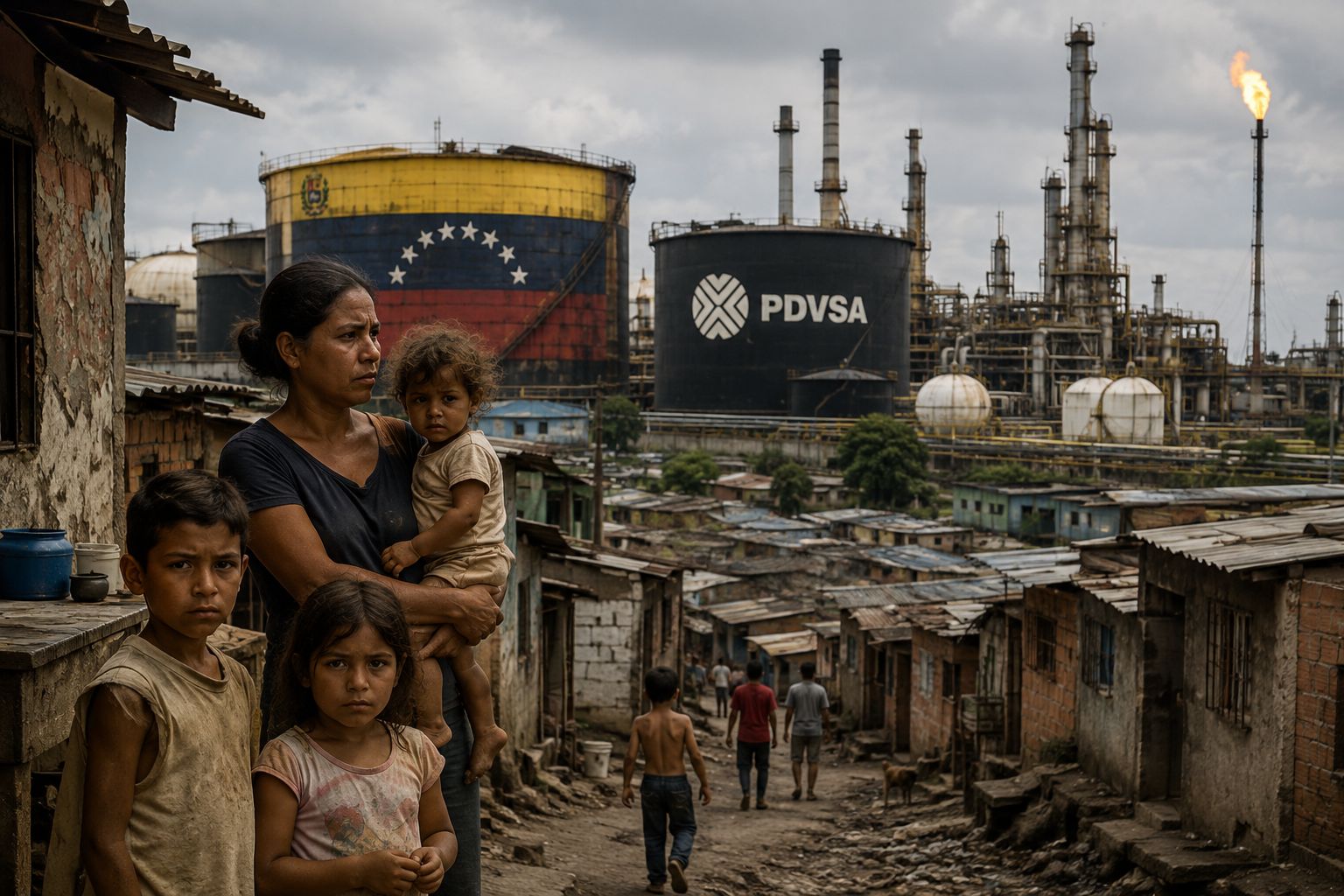
Maduro presided over an economic and humanitarian catastrophe. Millions fled the country. Poverty became widespread, healthcare deteriorated, basic services failed, and years of economic mismanagement, corruption, authoritarian government, and foreign sanctions compounded one another.
Nearly eight months after Maduro’s removal, however, the answer is complicated.
Trump cannot reasonably be blamed for creating Venezuela’s humanitarian crisis. He inherited it. There are even reasons to think his policies could eventually help revive the Venezuelan economy, particularly through oil investment and the partial opening of the country’s dysfunctional energy sector.
But there is little evidence so far that the intervention has produced a dramatic improvement in everyday living conditions. Millions of Venezuelans still need humanitarian assistance, extreme poverty remains widespread, and June’s catastrophic earthquakes have made an already terrible situation substantially worse.
The real test of Trump’s Venezuela policy therefore comes now.
Trump inherited a catastrophe
Any assessment of post-Maduro Venezuela has to begin with what existed before Trump intervened.
Venezuela’s humanitarian collapse developed over many years. Economic mismanagement and corruption under Maduro played major roles, while US and other international sanctions aggravated the crisis. An estimated 7.9 million Venezuelans left the country between 2015 and 2024, according to The New Humanitarian.
By the beginning of 2026, nearly eight million people remaining inside Venezuela needed humanitarian assistance. Healthcare and other essential services were already severely damaged.
That matters enormously when judging Trump.
It would be misleading to look at Venezuela’s poverty, hunger, collapsing infrastructure, or dysfunctional hospitals today and conclude that they resulted from the January US intervention.
Most of the underlying disaster predates it.
Maduro disappeared, but Maduro’s system did not
The political transformation was also much less complete than the dramatic capture of Maduro might suggest.
After US forces seized Maduro, his vice president, Delcy Rodríguez, became interim president. Much of the existing Chavista political structure remained intact, although Washington acquired extraordinary leverage over the government and the country’s most important economic asset: oil.
That produced a strange post-Maduro Venezuela.
Maduro was gone, but there was no immediate transition to a completely new democratic government. Instead, Rodríguez remained in Caracas while Washington increasingly influenced the country’s economic direction.
The US also began controlling the sale of significant quantities of Venezuelan oil.
Trump has repeatedly emphasized how much money the arrangement has generated. By this summer, reports estimated that the United States had collected around $13 billion from Venezuelan oil sales.
That creates an uncomfortable question.
Where is the recovery?
Millions still need help
The humanitarian numbers remain grim.
Before the June earthquakes, the European Commission reported that approximately 7.9 million Venezuelans needed humanitarian assistance. Around 56% of the population lived in extreme poverty, while roughly 40% experienced moderate to severe food insecurity.
Those are extraordinary figures.
Inflation continues to erode purchasing power. Millions struggle to obtain adequate healthcare, food, clean water, and other essential services. PAHO says that, despite some modest improvement in macroeconomic indicators before the earthquakes, millions continued to have difficulty accessing basic necessities.
In other words, removing Maduro did not suddenly repair more than a decade of economic destruction.
Nor could it realistically have done so in several months.
Then nature made everything worse
Any simple comparison between Maduro’s Venezuela and Trump’s post-Maduro Venezuela runs into another enormous problem.
On June 24, two powerful earthquakes devastated northern Venezuela.
Thousands were killed. Tens of thousands were injured or displaced. Homes, health facilities, transportation infrastructure, and essential services were damaged.
The disaster struck a country whose humanitarian infrastructure was already extraordinarily fragile.
The UN humanitarian response subsequently expanded its target from 5.5 million to 6.2 million people, while humanitarian organizations struggled with a massive funding gap.
The World Food Programme says it has reached around 300,000 people with assistance since the earthquakes and needs $80 million to sustain and expand its response.
Therefore, deteriorating humanitarian indicators after June cannot simply be attributed to Trump’s policies either.
A natural disaster of this magnitude would have been devastating under virtually any government.
Has Trump improved anything?
There are reasons not to dismiss Trump’s approach entirely.
The administration has loosened some restrictions connected with humanitarian assistance. Washington also provided $386 million in post-earthquake assistance, according to reporting by The New Humanitarian.
More importantly, Trump’s strategy could fundamentally change Venezuela’s oil industry.
That matters because Venezuela possesses the world’s largest proven oil reserves, yet years of mismanagement, underinvestment, sanctions, political instability, and deterioration of infrastructure prevented the country from exploiting them efficiently.
Opening the sector to massive investment could eventually generate jobs, government revenue, foreign currency, and economic growth.
That possibility became considerably more important on August 29.
Trump’s enormous oil gamble
Trump has now announced what he calls the “biggest oil deal in world history.”
Under the agreement, a new company would develop 17 Venezuelan oil fields containing approximately 65 billion barrels of reserves. The United States would hold a 55% operational share, while estimates presented around the agreement suggest it could eventually generate almost $100 billion in investment and $209 billion in tax revenue for Venezuela.
Those numbers are potentially transformative.
If tens of billions of dollars genuinely flow into Venezuela, oil production expands, workers find employment, government revenue rises, infrastructure is rebuilt, and ordinary Venezuelans ultimately receive some of the benefits, Trump’s intervention could eventually be judged very differently from how critics predicted in January.
But there is one enormous word in that sentence:
If.
Oil projects take years. Venezuela’s infrastructure needs enormous investment. Foreign companies remember previous expropriations and political instability. The country’s institutions remain deeply problematic.
And promised investment is not the same thing as improved living standards.
Where did the oil money go?
There is also a legitimate criticism of Washington’s existing arrangement.
The US has reportedly collected billions of dollars from Venezuelan oil while Venezuela continues to experience extraordinary humanitarian needs. The New Humanitarian reported in July that Washington had provided no concrete public explanation of where roughly $13 billion in collected Venezuelan oil revenue had gone or how much Venezuela itself would ultimately receive.
ABC similarly reported that despite Washington’s considerable control over Venezuelan finances, there had not yet been significant material improvements in the country’s economy or living standards.
This does not prove that Trump’s policy has failed.
Eight months is far too short to rebuild an economy that deteriorated over more than a decade.
But if Washington effectively controls billions generated from Venezuelan natural resources, it becomes increasingly difficult to argue that the welfare of Venezuelans is somebody else’s problem.
Control creates responsibility.
Trump may eventually have a success story
There is nevertheless a scenario in which post-Maduro Venezuela becomes one of Trump’s unexpected foreign-policy successes.
Imagine Venezuela several years from now.
Oil production has increased substantially. Foreign investment has returned. Inflation has stabilized. Government revenues have risen. Hospitals and electricity infrastructure are being rebuilt. Venezuelan refugees are returning because they can once again make a living at home.
If that happens, critics of Trump’s intervention will have to acknowledge it.
Removing an authoritarian ruler and helping transform a devastated economy into a functioning one would constitute a significant achievement, regardless of someone’s opinion of Trump himself.
But we are nowhere near being able to declare that outcome today.
It could also go badly wrong
There is an opposite possibility.
Venezuela could become economically dependent on Washington while remaining politically authoritarian. American companies and the US government could receive enormous benefits from Venezuelan oil while comparatively little wealth reaches ordinary Venezuelans.
In that scenario, Maduro would be gone but the underlying political structure would remain, accompanied by a new foreign patron controlling much of the country’s most valuable resource.
Critics have already described the emerging relationship in quasi-colonial terms. ABC reported that some experts regard Venezuela as effectively becoming an American protectorate.
Whether that characterization proves fair will depend largely on what happens next.
The metric should be Venezuelans
Trump’s Venezuela experiment should ultimately be judged by something much simpler than Trump’s speeches, Maduro’s downfall, oil-company profits, or geopolitical victories.
Are Venezuelans better off?
Can they afford food?
Can they obtain medicine?
Do hospitals function?
Does electricity work reliably?
Are wages sufficient to live on?
Can people criticize their government without fearing imprisonment?
Are millions of Venezuelans eventually willing to return home?
Those questions matter more than whether Washington or Caracas declares the intervention a success.
For now, the verdict has to remain provisional.
Trump inherited Venezuela’s humanitarian catastrophe rather than creating it. His intervention has not yet demonstrably solved it. But the opening of Venezuela’s oil economy gives his administration a genuine opportunity to help turn the country around.
If Venezuela becomes substantially richer while Venezuelans remain desperately poor, however, the experiment will have failed the people it was supposedly meant to help.
And with Washington now exercising enormous influence over both Venezuela and its oil, Trump will increasingly own the outcome.
Leave a Reply