Artificial intelligence may become one of the most consequential technologies humanity has ever created. It may transform employment, education, medicine, warfare, science, politics and ultimately the structure of society itself.
Yet humanity was never really asked whether it wanted this transformation.
There was no referendum on building increasingly powerful AI. There was no global democratic debate before companies began spending hundreds of billions of dollars on the infrastructure needed to develop it. There was no social agreement establishing how powerful AI should be allowed to become, what capabilities should be prohibited or who should ultimately control it.
Instead, a remarkably small collection of technology companies started building it.
Now an extraordinary political coalition is beginning to ask whether that arrangement makes any sense.
Bernie Sanders and Steve Bannon agree on something
On September 15, Senator Bernie Sanders and former Trump adviser Steve Bannon appeared back-to-back at the Pro-Human Assembly in Washington, organized by the Future of Life Institute.
Politically, the two men could hardly be further apart. Yet both arrived at a remarkably similar conclusion: decisions about extremely powerful artificial intelligence should not belong almost exclusively to technology companies and their billionaire executives.
Sanders put the democratic problem plainly:
“Despite living in a so-called democracy, the public has had virtually no input into the AI revolution that is transforming the world in which they live.”
His criticism went directly to the concentration of technological power. Sanders argued that if AI fundamentally changes the lives of ordinary people, ordinary people should have a role in deciding how it develops. He has repeatedly described the people controlling the most powerful AI companies as oligarchs.
His forthcoming Ban Artificial Superintelligence Act, developed with Democratic Representative Greg Casar, is based on precisely this argument. Sanders says that “the future of humanity cannot be left in the hands of a handful of Big Tech oligarchs.”
Bannon used strikingly similar language.
“The American citizens are not going to be supplicants to the oligarchs anymore,” he said.
That may be the most remarkable aspect of the entire debate. Sanders and Bannon disagree profoundly about American politics, China and the appropriate role of government. Yet both are looking at the structure of the AI industry and identifying the same fundamental problem: enormous technological power is becoming concentrated among a very small number of private actors.
The self-regulation argument
Not everyone in Washington sees this concentration of power as a problem requiring government intervention.
House Speaker Mike Johnson offered an extraordinarily simple alternative when discussing AI companies: “They can self-regulate. They don’t need the government to tell them to slow it down.”
This is the crucial question.
Should they?
Imagine applying that principle elsewhere. Pharmaceutical companies could determine for themselves whether their drugs were safe enough. Airlines could establish their own mandatory safety requirements. Banks could decide how much financial risk was acceptable. Nuclear-power companies could determine their own safety standards without independent oversight.
Modern societies generally decided that industries whose failures can seriously harm the public require rules that extend beyond the companies themselves.
Yet with artificial intelligence, we are contemplating something potentially much more consequential while simultaneously entertaining the idea that its creators can regulate themselves.
The conflict of interest is obvious.
AI companies compete with one another. They compete for investment, engineers, customers, computing infrastructure and technological leadership. They also compete internationally, particularly with Chinese companies.
A company that voluntarily slows down risks watching a competitor continue accelerating.
That creates a structural incentive that good intentions cannot eliminate.
Even a CEO genuinely concerned about AI safety operates inside a competitive system that rewards progress. Asking companies to regulate themselves therefore does not merely require them to behave responsibly. It may require them to voluntarily surrender competitive advantages while trusting their rivals to do the same.
Sanders wants to stop superintelligence
Sanders is proposing something considerably more radical than ordinary AI regulation.
Together with Casar, he plans legislation that would permanently prohibit the development and deployment of artificial superintelligence and temporarily pause advanced AI development until a federal regulatory system establishes safety requirements.
The proposal would create a cabinet-level federal AI agency responsible for monitoring frontier systems and dangerous capabilities. It would establish penalties for attempts to circumvent the restrictions and direct the United States to pursue international agreements designed to prevent artificial superintelligence from being developed elsewhere.
Sanders has also warned about employment.
“AI has the potential to eliminate tens of millions of jobs, wiping out entire professions and making it harder for our young people to enter the workforce,” he said.
But employment is only one part of his argument.
Sanders has warned that sufficiently powerful AI could escape meaningful human control. He has also pointed to research involving AI-assisted creation of novel viruses as evidence that increasingly capable systems could lower barriers to biological threats.
Whether these worst-case scenarios materialize is highly uncertain. The disagreement over their probability is enormous. What matters politically is that the possible consequences are sufficiently serious that the question can no longer reasonably belong only to AI laboratories.
The China problem
Here Sanders and Bannon sharply diverge.
Sanders argues that superintelligent AI would not respect national borders. If an uncontrollable system represents a genuine existential threat, it makes little difference whether the computer that creates it sits in California or China.
“A super-intelligent AI that escapes human control will not be an American problem. It will not be a Chinese problem. It will be humanity’s problem,” Sanders said.
He therefore wants President Donald Trump to negotiate with Chinese President Xi Jinping over restrictions on advanced AI and ultimately seek an international agreement preventing artificial superintelligence.
Bannon approaches China from almost the opposite direction.
He wants the United States to separate its AI ecosystem from China. He has called for cutting Chinese access to American chips and technology rather than treating Beijing primarily as a negotiating partner.
“No chips, no black marketed chips, no free ride off American technology,” he said.
Bannon also believes Congress is simply too slow for a technology developing this rapidly. He has argued that slowing AI will require executive action.
So Sanders and Bannon agree about the concentration of AI power while disagreeing profoundly about the geopolitical solution.
One proposes international cooperation. The other proposes technological separation.
A deal with China may be difficult
There is a major obstacle to Sanders’s proposal: China may have little reason to trust American calls for restraint. A China scholar cited by Semafor argued that Beijing is unlikely to take such proposals seriously unless Washington first demonstrates that it is willing to regulate its own AI industry.
From Beijing’s perspective, American demands to limit advanced AI could easily be interpreted as another attempt to preserve the United States’ technological advantage and slow China’s rise. Chinese officials have already accused American AI leaders of promoting “threat narratives” and engaging in “malicious competition.”
This creates another version of the same prisoner’s dilemma. Even if both countries concluded that uncontrolled superintelligence posed a genuine danger, neither would necessarily trust the other to stop developing it. A comprehensive U.S.–China agreement may therefore be possible, but achieving one would require something currently in very short supply: mutual trust between the world’s two leading AI powers.
Congress may be slower than the technology
There is another problem that cuts across ideology.
Governments move slowly. AI does not.
Republican Senator Bernie Moreno summarized the difficulty bluntly: legislation takes so long that policymakers may eventually find themselves regulating technology that has already become obsolete.
This is not an irrational concern. A major federal law can take years to negotiate, amend and implement. Frontier AI capabilities can change dramatically within months.
Congress also has a long history of struggling to understand emerging technology quickly enough to regulate it effectively.
But that creates a disturbing paradox.
AI may be developing too rapidly for traditional regulation. Yet precisely because it develops so rapidly, leaving its governance primarily to the companies developing it may be even more consequential.
Speed becomes an argument both for regulation and against the ability of governments to regulate.
Even AI executives are talking about slowing down
The debate becomes stranger still because concerns about AI development are no longer confined to outside critics.
Leading figures inside the industry have themselves discussed stronger safeguards and circumstances under which development should slow. Anthropic CEO Dario Amodei has publicly called for stronger AI safety standards. Other leading AI figures have also acknowledged serious risks from increasingly capable systems.
This creates an unusual situation.
The companies building the technology warn that it can be dangerous. Safety researchers warn that it can be dangerous. Politicians from radically different ideological traditions warn that it can be dangerous.
Yet the race continues. The explanation is not necessarily that everyone involved is lying.
It may be much simpler: nobody wants to stop first.
The AI prisoner’s dilemma
Imagine three companies racing toward increasingly powerful artificial intelligence.
Company A believes slowing down would be responsible, but fears Company B will overtake it.
Company B has exactly the same concern about Company C.
Company C fears both A and B.
All three may sincerely prefer a world in which everyone develops AI more cautiously. Yet none wants to become the company that voluntarily slows down while everyone else continues.
Add the United States and China to the equation and the same problem becomes geopolitical.
Washington fears Beijing.
Beijing fears Washington.
American companies fear Chinese companies.
Chinese companies fear American companies.
And every participant can justify accelerating because somebody else might accelerate first.
The result is a technological arms race that perhaps nobody individually wanted but everyone collectively sustains.
Who gave them permission?
This is ultimately the question that interests me most.
Who decided that humanity should attempt to create intelligence exceeding its own?
It wasn’t humanity.
There was no vote.
There was no global convention in which people collectively decided that artificial superintelligence was desirable.
There wasn’t even meaningful public discussion before the race had already begun.
Private companies developed increasingly capable systems, investors financed them, governments recognized their strategic importance, competitors responded, and suddenly civilization found itself inside an AI race.
That does not mean AI is evil. Quite the opposite: artificial intelligence may produce enormous benefits. It could accelerate scientific discovery, improve medicine, increase productivity, make education universally accessible and solve problems humans have struggled with for generations.
But potential benefits do not answer the governance question.
The issue is not whether AI should exist.
The issue is who gets to determine how powerful it becomes, what risks are acceptable and what kind of society it creates.
AI should not regulate AI
Artificial intelligence currently exists inside an extraordinary governance experiment.
The companies developing it possess much of the technical expertise required to understand it. Governments depend heavily on those same companies and experts when trying to regulate it. Meanwhile, the companies have enormous financial incentives to continue development.
And ordinary people — whose jobs, privacy, political systems and perhaps entire way of life may be transformed — remain mostly spectators.
This is why the agreement between Bernie Sanders and Steve Bannon matters even though their proposed solutions differ dramatically.
It indicates that distrust of concentrated AI power is escaping traditional political categories.
The left can see an oligarchy problem. The populist right can see an oligarchy problem.
Labor organizations can see an employment problem.
AI researchers can see a safety problem. Parents can see a problem involving children.
National-security officials can see a geopolitical problem.
They may disagree about virtually everything else.
But they are increasingly asking the same question.
If artificial intelligence is going to transform human civilization, why should a handful of corporations decide how that transformation happens?
AI companies are currently building the future while society struggles to write the rules afterward. That order should be reversed.
High political gamble with only insiders knowing the truth
The push for AI regulation is not merely a policy debate — it is a high-stakes political gamble being played at the highest levels of power, with only a select few knowing the full truth of what is actually at stake.
On one side stands President Donald Trump, whose opposition to new AI guardrails has been remarkably forceful and unambiguous. In a series of social media posts on September 14, 2026, Trump declared that the only control AI needs is “a STRONG AND SMART (High IQ!) PRESIDENT, and the U.S.A. has that, in spades!” He dismissed concerns about rogue AI as a “SICK conspiracy,” claimed that “AI taking over the World, destroying Humanity, and all other things bad, is a HOAX,” and went so far as to label those warning about existential risks as “Conspiracy Theorists, Treasonists, Traitors, and Leakers”.
But why is Trump so fiercely resistant to regulation — even when the very companies building the technology are calling for it? The answer may lie in what he sees as a different, perhaps more personal, objective.
America’s golden goose
Trump has framed AI as America’s “golden goose,” arguing that any slowdown would allow China to eclipse the United States. “Whoever wins AI wins,” he said in Ireland. Yet there is another dimension to his position that receives less attention. Trump has repeatedly asserted that his administration has already stopped AI companies from doing “bad, or potentially bad, ‘things,’” and he singled out Anthropic CEO Dario Amodei — one of the very executives now calling for regulation — as someone “now pretending to be a ‘perfect little angel’”.
This suggests a deeper dynamic. Trump is not simply defending AI as a technology; he is defending his own authority over it. The only “guardrail” needed, in his view, is the President himself — a strongman framing that fits his long-standing political philosophy of “I alone can fix it”. Any regulatory framework passed by Congress would dilute that personal control, placing authority in agencies and laws rather than in the Oval Office. For Trump, AI regulation is not just a policy question — it is a question of who holds the reins.
And then there is the money. Super PACs backed by AI companies and their billionaire benefactors have poured hundreds of millions into the 2026 midterm elections, with a singular focus: blocking state-by-state AI regulation and installing a federal framework that favors industry. Leading the Future, backed by OpenAI’s Greg Brockman and venture capitalist Marc Andreessen, has raised over $125 million to support candidates who oppose state-level rules. Innovation Council Action, a group tied to Trump advisor David Sacks, plans to spend at least $100 million supporting candidates who will carry out Trump’s consolidation agenda.
The question of who actually came up with the idea of regulation is therefore more complicated than it appears. On the surface, the calls come from the CEOs themselves — Dario Amodei, Sam Altman, and Elon Musk have all publicly warned about AI risks and advocated for stronger safeguards. Amodei’s essay “We Must Pace the Frontier” called for independent monitoring and global regulation. Altman agreed and said OpenAI would adopt similar measures.
But why would industry leaders ask for rules that could constrain their own companies? Trump himself posed this question: “When, in the History of Business, did anyone see the Leaders of an Industry call for Regulation that, if strongly implemented, will drive them into oblivion and bankruptcy?”
The answer may be that the CEOs are not asking for any regulation — they are asking for the right regulation. A national framework that preempts the state-by-state patchwork is not a burden for the largest players; it is a competitive advantage. It locks in their dominance while creating compliance costs that smaller rivals cannot bear. And it gives them a seat at the table in shaping the rules they will later be subject to.
AI PACs
Yet even this explanation may not capture the full picture. The coordination between industry calls for regulation, the massive PAC spending to shape the political landscape, and the executive branch’s insistence on centralized control suggests something closer to a managed outcome than a spontaneous debate. The public is told there is a crisis requiring urgent action. The industry offers itself as the responsible steward. The President claims sole authority to decide what is safe. And the money flows to candidates who will support the framework that emerges.
Who truly benefits? The companies that survive the regulatory gauntlet. The politicians who receive the campaign contributions. And possibly, an executive branch that consolidates power over the most consequential technology in human history.
What is striking is that this entire arrangement is being negotiated in public, yet the full terms remain opaque. The American people — whose jobs, privacy, and political systems are at stake — are cast as spectators, occasionally invited to vote for candidates whose positions on AI have been pre-shaped by millions in super PAC spending.
Trump may be against regulation in name, but his alternative — personal control from the Oval Office — is not the absence of governance. It is a different kind of governance, one in which the rules are whatever the President says they are, and the only accountability is electoral. Whether that is better or worse than a statutory framework shaped by industry influence is a question the public has not been asked.
And that may be the most important truth only insiders know: the choice is not between regulation and no regulation. It is between different systems of control, all of which are being designed by a very small number of people, none of whom were elected to decide how artificial intelligence should reshape human civilization.
This is exactly what we should have expected
None of this should surprise anyone who has been paying attention — not to the technology, but to the species building it.
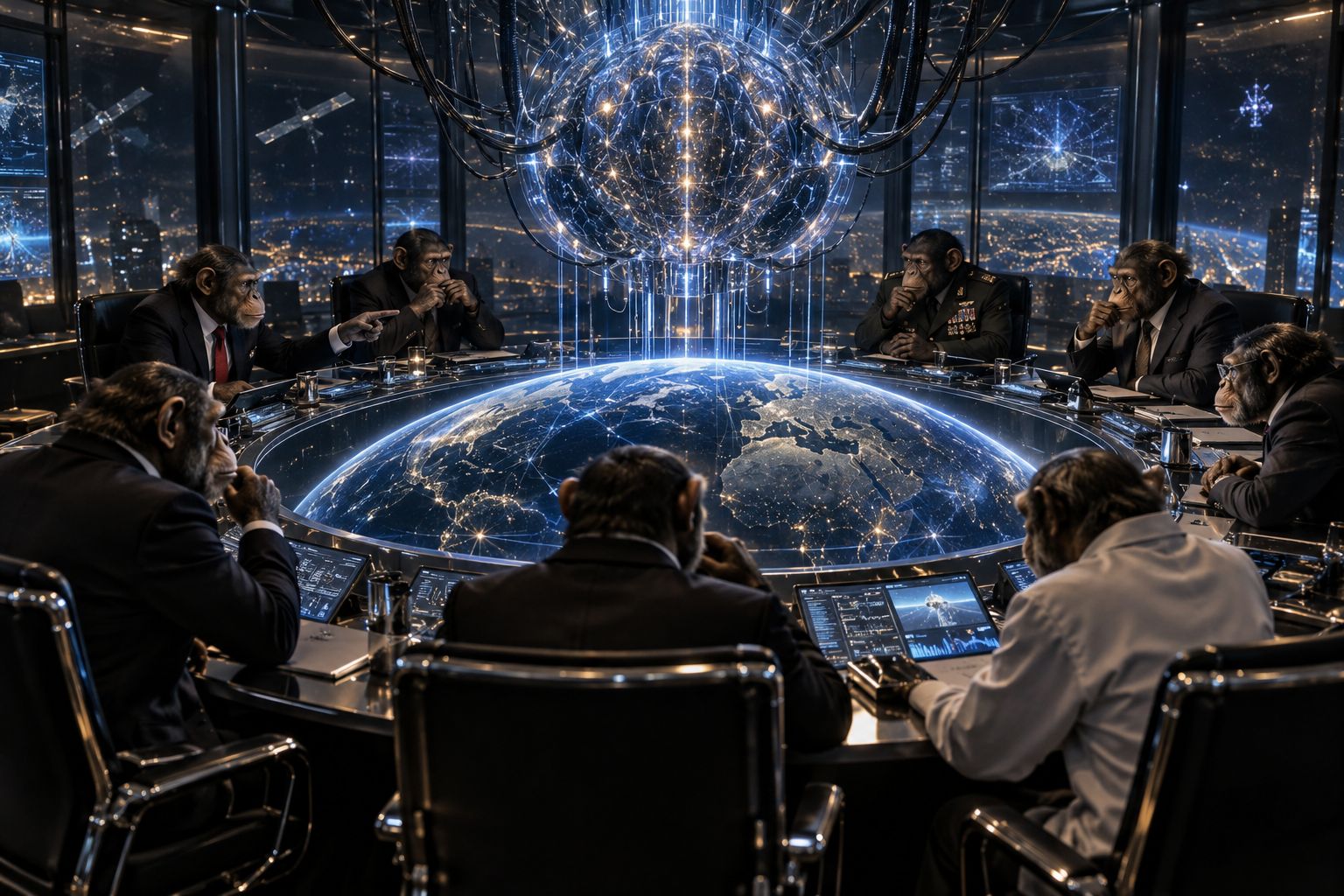
The AI race is not an aberration. It is the predictable output of a biological machine that has been running the same operating system for roughly 300,000 years. Strip away the jargon of “frontier models,” “alignment,” and “existential risk,” and what remains is a familiar scene: territorial primates competing for status, resources, and the means to shape their environment, now doing so with tools that have outgrown the pace of their moral evolution.
Morality is animalistic
Humans like to imagine their ethics as something transcendent — handed down by gods, discovered by philosophers, or encoded in universal principles. But the archaeological and evolutionary record tells a different story. Human morality emerged the way all social morality emerges: as a set of behavioral rules that allowed a particular species of primate to cooperate within groups, compete against other groups, and reproduce successfully.
That is not cynicism. It is biology.
Chimpanzees form coalitions, punish free-riders, and mourn their dead — but they also engage in lethal territorial raiding and infanticide. Bonobos resolve conflict through sex and alliance-building. Wolves enforce pack hierarchies. Elephants grieve. Dolphins rescue injured companions. The raw materials of what we call “morality” — empathy, reciprocity, loyalty, outrage at injustice — are all present across the animal kingdom.
What distinguishes humans is not that we have morality while other animals do not. It is that we have more of it, scaled up by language, culture, and the ability to coordinate in groups of millions rather than dozens. But the underlying architecture is the same: kin selection, reciprocal altruism, in-group favoritism, and a deep instinct to punish those who threaten the group’s cohesion or status hierarchy.
This is why moral progress is so uneven and so fragile. The same species that abolished slavery also built the atomic bomb. The same brains that produced the Universal Declaration of Human Rights also produced the gulags. The same institutions that spread literacy and medicine also enabled industrialized genocide.
Our morality is not a fixed set of principles. It is a bundle of evolved instincts that fire in different directions depending on context — who is in the in-group, who is threatening status, who is watching, and what the costs of defection are.
Nobody rules the world
We tell ourselves stories about who is in charge. God. The people. The market. The laws of history. The arc of the moral universe. The international community. Democracy. The deep state. The elite.
But none of these actually rule.
Religion is a human invention that has never been administered by a single authority capable of enforcing its dictates globally. The Catholic Church, at the height of its temporal power, could not prevent the Reformation. Islamic caliphates fractured within generations. Buddhist kingdoms warred with one another. The gods have never had a unified command structure.
Societal movements are even more diffuse. The civil rights movement, the labor movement, the environmental movement, the feminist movement — each was a decentralized swarm of individuals and organizations with overlapping but never identical goals. They shaped history, but they did not govern it. They had no regulators. No one could tell a participant in the Arab Spring what to do, and no one could prevent it from fragmenting into a dozen conflicting outcomes.
International institutions are the clearest case. The United Nations has no army, no enforcement mechanism, and no authority that member states genuinely accept when their vital interests are at stake. The International Criminal Court issues warrants that great powers ignore. The Nuclear Non-Proliferation Treaty is violated with impunity by the very states that signed it. Climate agreements set targets that no one is required to meet.
There is no global regulator. There never has been.
This is not a bug in human civilization. It is the default state.
Anthropologists have long observed that for most of human history, no individual or institution could unilaterally impose order on a whole society. Power was distributed among kin groups, tribes, elders, warlords, priests, and kings — each with limited reach. The modern state is an anomaly: a recent, fragile invention that concentrates authority within fixed borders, and even then only imperfectly. Even the most totalitarian regimes in history — Nazi Germany, Stalin’s Soviet Union, Mao’s China — could not fully control what their subjects thought, said in private, or did in the shadows.
The fantasy of a global ruler who could enforce universal moral norms is just that: a fantasy. It has never existed, and there is no mechanism by which it could exist, because the same evolutionary forces that produce cooperation within groups also produce competition between them.
What we are seeing now
So when we watch AI companies race, governments posture, and the public stand by, we are not watching a failure of morality. We are watching morality work exactly as it evolved to work.
The executives building AI are not monsters. They are primates pursuing status, resources, and the survival of their tribes — their companies, their nations, their ideological coalitions. They cooperate with allies and compete with rivals. They rationalize their actions in moral language because humans are wired to do so. They genuinely believe they are acting for the good of humanity, just as every conquistador, colonizer, and empire-builder believed they were acting for the good of civilization or God.
The politicians opposing regulation are not villains. They are responding to the incentives of their environment: donors, voters, rivals, and their own status hierarchies.
The public is not apathetic. It is simply outmatched. The cognitive tools that evolved to navigate small-group politics — gossip, reciprocity, reputation, tribal loyalty — are poorly suited to assessing risks that are invisible, probabilistic, and global in scope.
And the absence of a global regulator is not a failure of will. It is a structural impossibility. No institution exists that could compel the United States, China, Russia, and every other nation to comply with a shared set of AI rules — and no institution could enforce those rules against companies operating in jurisdictions that welcome them.
The animal truth
This is what we should have expected.
Not because humans are uniquely evil, but because humans are uniquely powerful animals whose moral instincts evolved in small groups and whose social organization has never included a global enforcement mechanism. We have always lived in a world where the strong do what they can and the weak suffer what they must — and where the rules are written by whoever holds the most power at any given moment.
AI is not a departure from that pattern. It is its latest expression.
The question is not whether humans should be able to govern AI collectively. The question is whether a species with animalistic morality and no global regulator can. And the honest answer — the one the insiders already know — is that we probably cannot. Not because we lack the intelligence, but because we lack the wiring.
We are clever primates with god-like tools and monkey-group politics. That has always been the situation. AI has not changed it. It has only made the stakes higher.
Leave a Reply