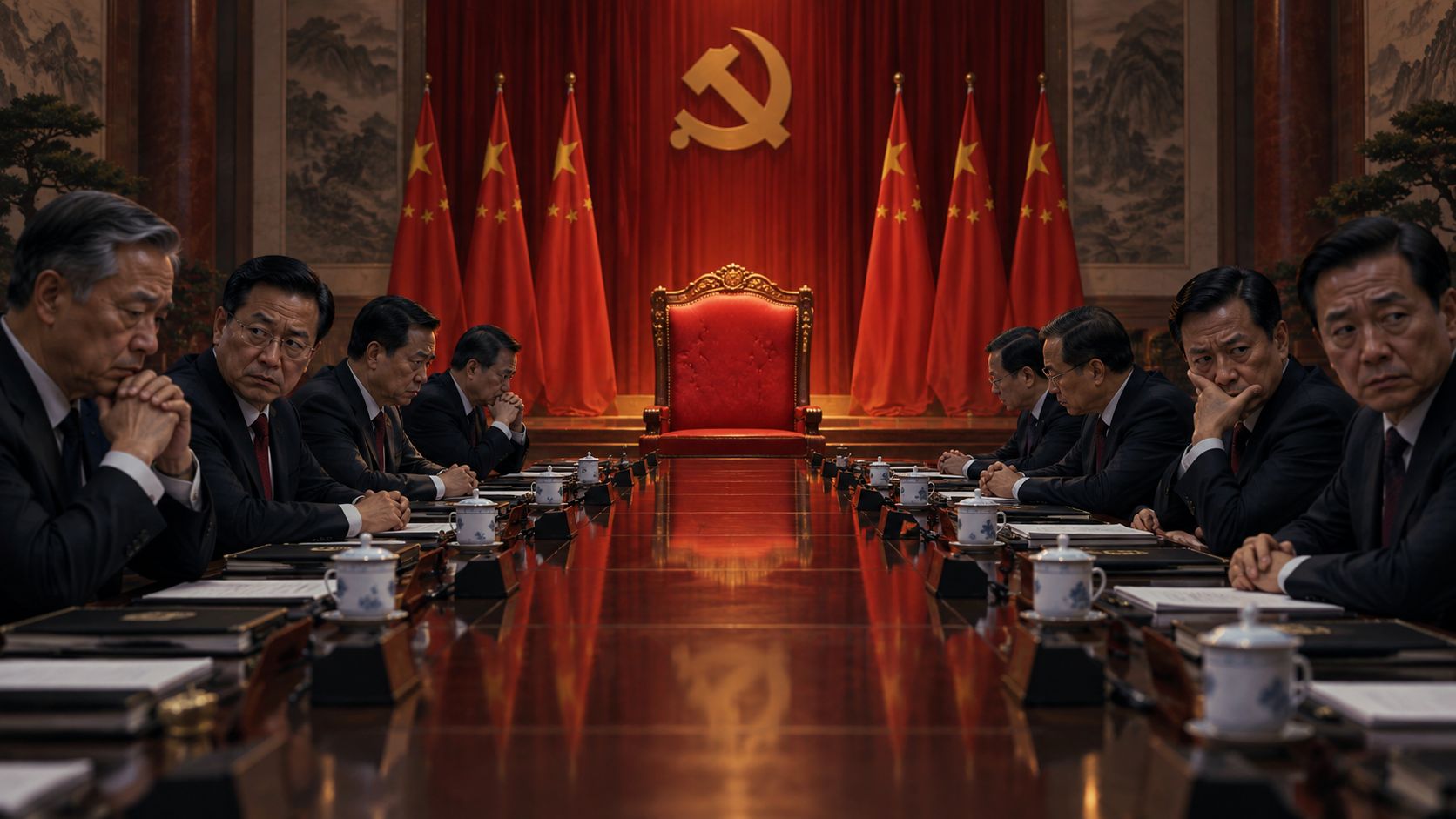
Xi Jinping has worked relentlessly to make himself difficult to challenge. He has concentrated authority, crushed dissent, and weakened the conventions that once made leadership changes more predictable. Yet securing his own position has created another problem: what happens to China when the man at the center of everything is no longer there?
Xi has not received a formal appointment for life. However, he has cleared the way to remain in power indefinitely. In 2018, China removed presidential term limits. He subsequently continued into a third term as Communist Party leader, breaking with the retirement pattern of his immediate predecessors. He has not publicly designated a successor.
The result is a dangerous contradiction. A government that promises stability has made its political future increasingly dependent on one aging individual. Xi can punish disloyalty, silence criticism, and remove potential competitors. He cannot abolish the need for someone to govern after him.
Consolidation through repression
The brutality of Xi’s rule extends far beyond competition inside the Communist Party. His government has persecuted human rights lawyers, suppressed independent activism, and tightened ideological control. Uyghurs and Tibetans face severe repression, while Beijing has imposed a national security regime that has devastated political freedoms in Hong Kong. These are people paying the price for a leadership that treats independent organization as a threat.
Within the party, anti-corruption investigations have removed powerful officials and military commanders, including figures previously close to Xi. Corruption is real, and an investigation does not automatically prove a fabricated political case. Nevertheless, the broader political effect is unmistakable: seniority and personal connections offer no reliable protection from the leadership.
Such a system gives officials powerful reasons to demonstrate loyalty. It gives them fewer reasons to challenge a mistaken decision or develop an independent political reputation. When advancement depends on satisfying the person above you, honest advice becomes a personal risk.
This is how a leader can strengthen his control while weakening the system around him. He becomes the person who resolves disputes, defines acceptable policy, and determines which ambitions are permissible. Eventually, the question of replacing him becomes inseparable from the question of how everyone else will survive the replacement.
The body behind the office
A September 18 report in The Wall Street Journal brought the human limits of this arrangement into focus. According to people familiar with the matter, Xi missed a leaders’ dinner at the BRICS summit in India because he felt unwell. The newspaper reported no evidence that he was gravely ill or had suffered a stroke.
The article also cited former CIA China analyst Dennis Wilder, who described Xi as a lifelong smoker, overweight, and uninterested in exercise. Wilder said former foreign minister Qin Gang had told him about drinking Moutai with Xi on long flights. “They would drink themselves silly,” Wilder recalled.
These are attributed accounts, not a medical diagnosis. They do not establish alcoholism, incapacity, or an approaching death. They do, however, underline an obvious reality: a ruler who can remain indefinitely still has a body that ages.
The political problem therefore exists regardless of whether Xi is currently healthy. China needs a dependable transition because every leader eventually leaves. No assessment of his drinking habits can substitute for that preparation.
China has institutions. Who will command them?
China would not cease functioning the moment Xi disappeared. It has a vast bureaucracy, established ministries, provincial governments, security agencies, and an enormous party organization. Officials would still go to work. Businesses would still produce goods. The country’s capabilities do not reside inside one man’s head.
Moreover, China has formal procedures for filling leadership positions. Its constitution says the vice president succeeds when the presidency becomes vacant. The party’s Central Committee selects the general secretary and determines the membership of the Central Military Commission.
However, occupying the presidency does not automatically deliver Xi’s authority over the party and armed forces. His power combines separate offices with personal dominance. A constitutional provision can fill one vacancy without resolving who commands the entire political system.
That distinction matters. The problem is not a complete absence of rules. It is the uncertainty over whether powerful people would accept the same outcome, how they would negotiate it, and who could enforce their agreement.
Richard McGregor and Jude Blanchette have argued that Xi strengthened his own position at the expense of predictable, peaceful succession. Removing restraints on his tenure and withholding a designated successor increased the possibility of a destabilizing transition.
The successor is also a potential rival
Choosing an heir would reduce some uncertainty. It would give officials time to understand the future leadership and allow the successor to acquire experience. It could also establish expectations before illness or death forced an urgent decision.
For a personal ruler, however, an identifiable successor creates another center of political attention. Officials may begin cultivating the person who could determine their careers tomorrow. The incumbent must then tolerate ambitions that do not revolve entirely around him.
Leaving the succession unresolved avoids that immediate difficulty. But it transfers the risk to the future. The longer the system discourages independent authority, the harder it may become to produce someone who can govern confidently without the departing leader’s support.
This creates a cruel selection problem. The qualities that make an official reassuring to an all-powerful incumbent—obedience, caution, and political dependence—may offer little preparation for taking command during a crisis. A ruler can spend years demanding subordination and still expect the system to produce decisive leadership after his death.
Several futures, no guaranteed outcome
An orderly transition remains possible. Xi could eventually promote a successor and oversee a gradual transfer. Alternatively, senior officials could agree on a replacement after his departure because they recognize the danger that open conflict would pose to their shared interests.
A more collective arrangement is also conceivable. Leaders might divide responsibilities and restore some restraints on personal power. That would not necessarily make China democratic. It could simply make its authoritarian leadership less dependent on one individual.
A contested succession presents a different possibility. Competing groups might struggle over appointments, policy, security institutions, or control of information. Such a conflict would not need to involve tanks in the streets. It could unfold through investigations, dismissals, unexplained absences, and announcements presented as unanimous decisions.
Prolonged incapacity could create its own difficulties. If Xi remained formally in office while others increasingly governed through him, officials might struggle to distinguish his decisions from those of people claiming to speak on his behalf. Secrecy would make accountability even harder.
These are scenarios, not predictions. China’s institutions and the leadership’s interest in preserving the regime could prevent a major rupture. Nevertheless, a responsible political system should reduce these uncertainties before events force it to confront them.
The consequences would reach beyond China
A disputed transition in Beijing would concern far more than the officials competing to control it. Governments, investors, and trading partners would need to know who could make binding decisions. Uncertainty could complicate diplomatic negotiations, economic policy, and responses to international emergencies.
Military policy would demand particular attention. A new leadership might act cautiously while consolidating its position. It might also use nationalist rhetoric to demonstrate strength. Neither outcome is inevitable, and succession uncertainty alone does not establish that China would become more aggressive.
For Chinese citizens, another danger deserves equal attention. Xi’s departure would not automatically dismantle censorship, release political prisoners, or create democratic government. The institutions that enforce repression have interests of their own. A successor could preserve them, intensify them, or change their methods without surrendering their power.
There may be opportunities for improvement after Xi. But hope should not depend on the assumption that the next unelected ruler will be more humane.
Indispensability is a failure of leadership
A capable leader should leave behind institutions that can function without him. People should know how authority changes hands, who can make decisions, and how disagreements will be resolved. Those arrangements matter most when the incumbent would prefer to ignore them.
Xi has instead made personal dominance a central feature of China’s government. His consolidation has been ruthless, but ruthlessness does not answer the succession question. Silencing alternatives can make a ruler appear indispensable while depriving the country of a dependable way to replace him.
China is larger, more capable, and more enduring than Xi Jinping. Its future should not depend on his health, his private intentions, or negotiations that its citizens cannot observe or influence. By making his own departure harder to plan for, he has imposed another cost of authoritarian rule on the people he claims to serve.
Leave a Reply