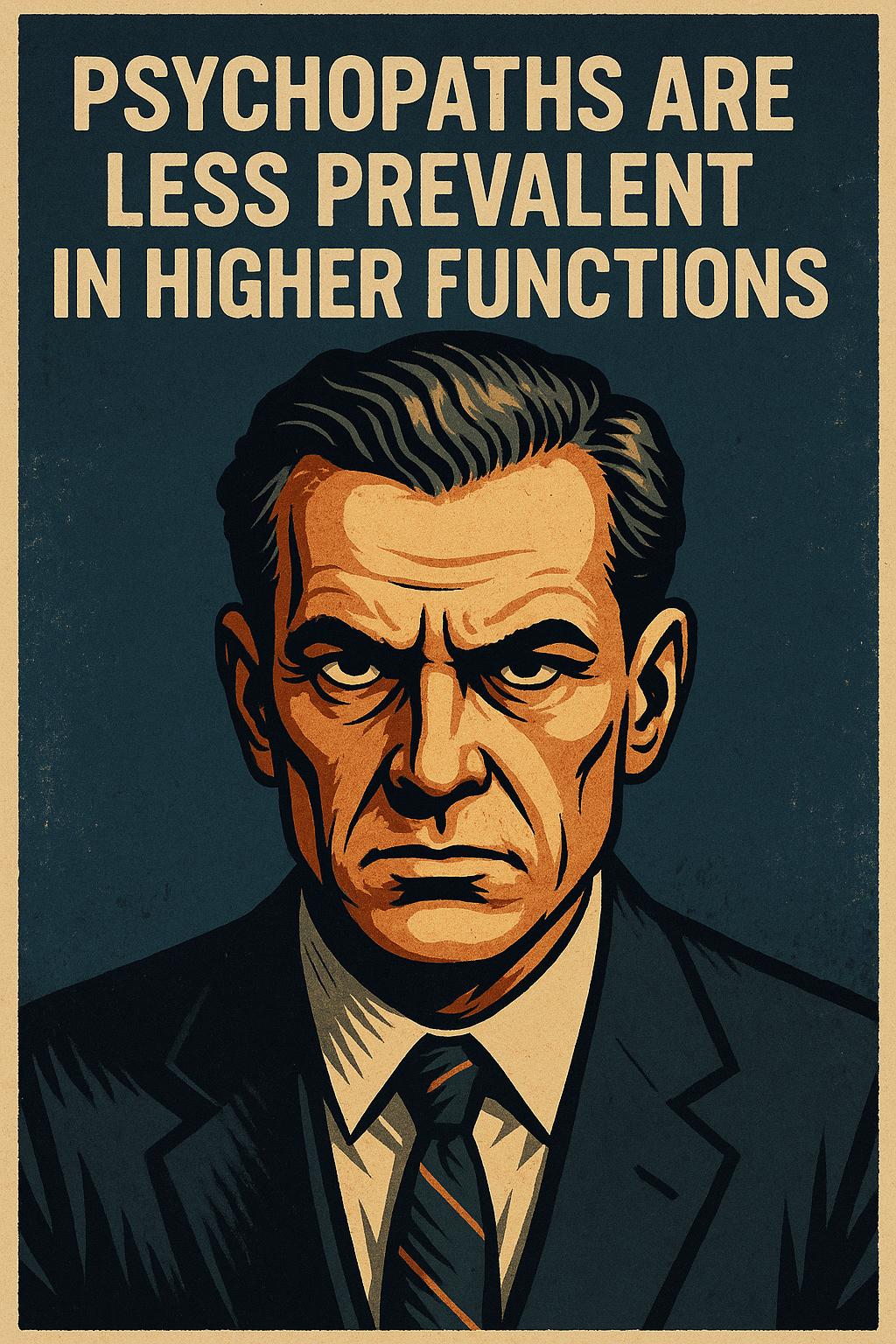
Psychopathy has long fascinated people. The word evokes images of cold manipulators, brilliant criminals, and emotionless masterminds. Yet the clinical picture is very different. In real life, most psychopaths are not masterminds. They are reckless, impulsive, and short-sighted. They destroy more than they build. Contrary to popular myth, psychopaths are less common among high-functioning professionals. They are not the secret rulers of the world—they are its troublemakers.
Defining psychopathy
Psychopathy is not simply cruelty or coldness. In clinical psychology, it falls under the broader category of Antisocial Personality Disorder (ASPD), as defined by the Diagnostic and Statistical Manual of Mental Disorders (DSM-5-TR). The diagnosis describes a persistent pattern of violating the rights of others, deceitfulness, impulsivity, irritability, irresponsibility, and lack of remorse.
The term psychopathy itself, however, still appears in forensic and research contexts. The best-known measure is the Psychopathy Checklist–Revised (PCL-R) developed by Robert D. Hare, which identifies two major clusters of traits. The first cluster includes emotional coldness, superficial charm, and lack of empathy. The second captures impulsive behavior, aggression, and chronic irresponsibility.
Not every person with antisocial traits is a psychopath. Psychopathy represents the extreme end of this spectrum—people who combine emotional detachment with chronic recklessness. They do not merely break rules; they are driven to test limits again and again.
The myth of the “successful psychopath”
Movies and popular books created a legend: the corporate or political psychopath. A cold executive who manipulates rivals, or a ruthless politician who feels no guilt. The idea sells well but misrepresents reality. High-level success demands emotional control, patience, and long-term thinking—qualities psychopaths lack.
True psychopaths are impulsive and easily bored. They take risks without strategy. Their charm fades as soon as others recognize the pattern. Studies consistently show that psychopathy correlates with career instability, criminal behavior, and poor impulse control, not with professional longevity. A few may briefly rise in unstable environments, but their volatility soon becomes self-destructive.
A longitudinal study by Babiak and Hare (2006) on corporate settings found that individuals with high psychopathic traits often failed to sustain their positions. They alienated colleagues, violated ethics rules, and collapsed under scrutiny. The so-called “successful psychopath” is largely myth.
Impulsivity and short-term focus
Neuroscientific studies show that psychopaths have reduced activity in the prefrontal cortex—the region responsible for restraint and foresight—and overactive reward circuits in the brain’s limbic system. This imbalance makes them impulsive thrill-seekers. They crave stimulation but cannot delay gratification.
Further research reveals amygdala dysfunction, the brain area responsible for emotional processing and fear learning. This defect explains their lack of empathy and inability to feel genuine remorse. They understand other people’s emotions intellectually but not emotionally, which makes their manipulation coldly efficient yet ultimately shallow.
Such wiring works against the slow, structured thinking needed in complex systems. When confronted with abstract planning or delayed outcomes, they lose focus. In business, politics, or science, where decisions unfold over months or years, impulsivity is fatal. The same energy that makes them bold also ensures they burn out early.
Social dysfunction and instability
Psychopaths are manipulative but socially unstable. They can charm initially, but trust erodes quickly. Their lies, betrayals, and aggression destroy relationships. Over time, people learn to avoid them.
In structured institutions, this is deadly. Success depends on reputation, alliances, and mutual reliability. Psychopaths cannot maintain any of these. They see loyalty as weakness and honesty as a tool. Once their pattern is exposed, doors close rapidly. Even when intelligent, they become professionally radioactive.
Why psychopaths thrive only in chaos
Psychopaths need disorder to survive. They perform best in chaotic or violent environments—gangs, criminal networks, collapsing organizations, or wartime settings. These worlds reward boldness, not reflection. They reward quick violence, not subtle strategy.
But modern societies are built on structure and accountability. Bureaucracies, corporations, and universities are designed to filter out the impulsive and the dishonest. Psychopaths cannot play by rules that require cooperation. In stable systems, their manipulations are visible and costly. They flourish only where chaos hides them—and chaos is rare at the top.
Cognitive versus social competence
Many psychopaths are intellectually average or above average. They can be articulate, quick-witted, and persuasive. Yet their intelligence lacks balance. What they possess in analytic sharpness, they lose in social competence—the ability to cooperate, predict reactions, and build stable relations.
This gap explains their long-term failure. Success in higher institutions depends on foresight, reliability, and cooperative strategy, not manipulation. Psychopaths misread social feedback and underestimate others. They can win arguments but not loyalty. Their short-term manipulations collapse when exposed to consistent scrutiny or ethical norms.
High-functioning organizations reward patience, predictability, and mutual trust. Psychopaths fail at all three. They are poor long-term strategists, incapable of maintaining credibility once their pattern is recognized.
Most importantly, they are biologically and psychologically incapable of reciprocal altruism—the foundation of human cooperation. Reciprocal altruism means helping others with the expectation that help will be returned later. It requires trust, memory, and empathy. Psychopaths lack all three. They exploit cooperation but cannot sustain it. In small groups, this makes them parasites; in large systems, liabilities.
The evolutionary trade-off
Psychopathic traits once had survival value. In prehistoric tribes, ruthlessness could secure resources or dominance. Courage without empathy was useful in war or hunting. Evolution rewarded risk-taking in violent, uncertain conditions.
But every adaptive strategy has limits. A tribe could tolerate only a few members who exploited others without giving back. Anthropological modeling suggests that about one percent of a hunter-gatherer group could consist of such parasitic individuals before cooperation collapsed. That figure—roughly the modern psychopathy rate—is not coincidence. It represents an evolutionary equilibrium, the maximum number of manipulators a cooperative system can sustain without self-destruction.
Modern anonymity and bureaucracy, however, disturb this balance. In tribal societies, cheaters were visible and punished. Today, digital communication and distant hierarchies can shield manipulation, allowing some sociopathic behavior to spread before being detected. Yet the long-term outcome remains the same—collapse of trust and eventual exclusion once the damage becomes clear.
Modern society changed those rules. Today, success depends on cooperation, foresight, and emotional stability. The ancient traits that once produced advantage now produce failure. The same impulsivity that worked in survival contests collapses under modern complexity. Psychopathy is an evolutionary relic—an old strategy misfiring in a civilized world.
Where true psychopaths end up
Research shows that psychopathy prevalence rises sharply in unstable or coercive environments. In the general population, it affects roughly 1 to 2 percent of people. Among prison inmates, it reaches 20 to 30 percent, depending on the sample and diagnostic tool (Hare, 1991; Neumann & Hare, 2008).
It is also heavily male-biased, with men outnumbering women roughly four to one. This difference likely reflects both evolutionary pressures and hormonal influences on aggression and risk-taking. While women can display psychopathic traits, they often express them through social manipulation rather than overt violence.
Most psychopaths drift between temporary jobs, conflicts, and the criminal system. They act impulsively, pursue immediate rewards, and fail to adapt to structured life. A few manage to reach professional success, but they rarely sustain it. Their lack of restraint, empathy, and cooperation undermines them over time.
The difference between narcissists and psychopaths is crucial. Narcissists crave admiration and recognition—they can at least imitate discipline to preserve status. Psychopaths crave stimulation and chaos. They cannot tolerate routine or hierarchy for long. That is why, even when they appear in leadership, they tend to self-destruct or be expelled by the system itself.
However, there exists a narrow category of high-functioning sociopaths—individuals who combine antisocial traits with high intelligence, discipline, and strategic awareness. These people can survive in structured environments for long periods, often in politics, business, or security institutions. They suppress overt impulsivity and use calculated aggression as a tool of power. Such figures are rare but dangerous, because they blend ruthlessness with control. A striking example is Benjamin Netanyahu, whose cold pragmatism, lack of remorse for civilian suffering, and manipulative political longevity illustrate how an extreme deviation of sociopathy can thrive when paired with high intelligence and institutional backing.
The human cost of impulsive leadership
When psychopaths do enter positions of authority, they leave trails of damage. Their decisions are erratic. They punish loyalty and reward fear. They view cooperation as submission and ethics as weakness. Whole departments or governments can suffer under such leadership.
Case studies of destructive CEOs and politicians often show classic psychopathic behavior—short-term gambles, disregard for norms, and contempt for others’ welfare. But even in these cases, their rule ends with exposure, scandal, or collapse. Systems recover because collective intelligence eventually outweighs individual recklessness.
Why society misunderstands them
People confuse confidence with psychopathy. They assume coldness equals strength. Yet the two differ profoundly. Real strength comes from self-control, not from the absence of emotion. Real leadership builds alliances; psychopathy burns them.
The myth of the powerful psychopath survives because it flatters cynicism. It lets us believe success is about ruthlessness, not competence. Popular culture feeds this illusion. Films and television glamorize psychopathy—characters like American Psycho’s Patrick Bateman or House of Cards’ Frank Underwood turn pathology into charisma. The result is public confusion: the psychopath becomes a symbol of power rather than its collapse.
But in every field—science, business, governance—data show the opposite. Cooperation, not cruelty, sustains civilization.
Conclusion
Psychopaths are not hidden architects of the modern world. They are its background noise. Their charm is temporary, their power unstable, their logic self-defeating. They rise fast and fall faster.
Societies built on stability, cooperation, and reason naturally filter them out. They cannot endure where rules reward foresight and responsibility. They are relics of an older, more violent age—out of place in complex systems that now depend on intelligence with conscience.
That is why psychopaths are less prevalent in higher functions: not because they lack boldness, but because they cannot build what they seek to rule.
Leave a Reply