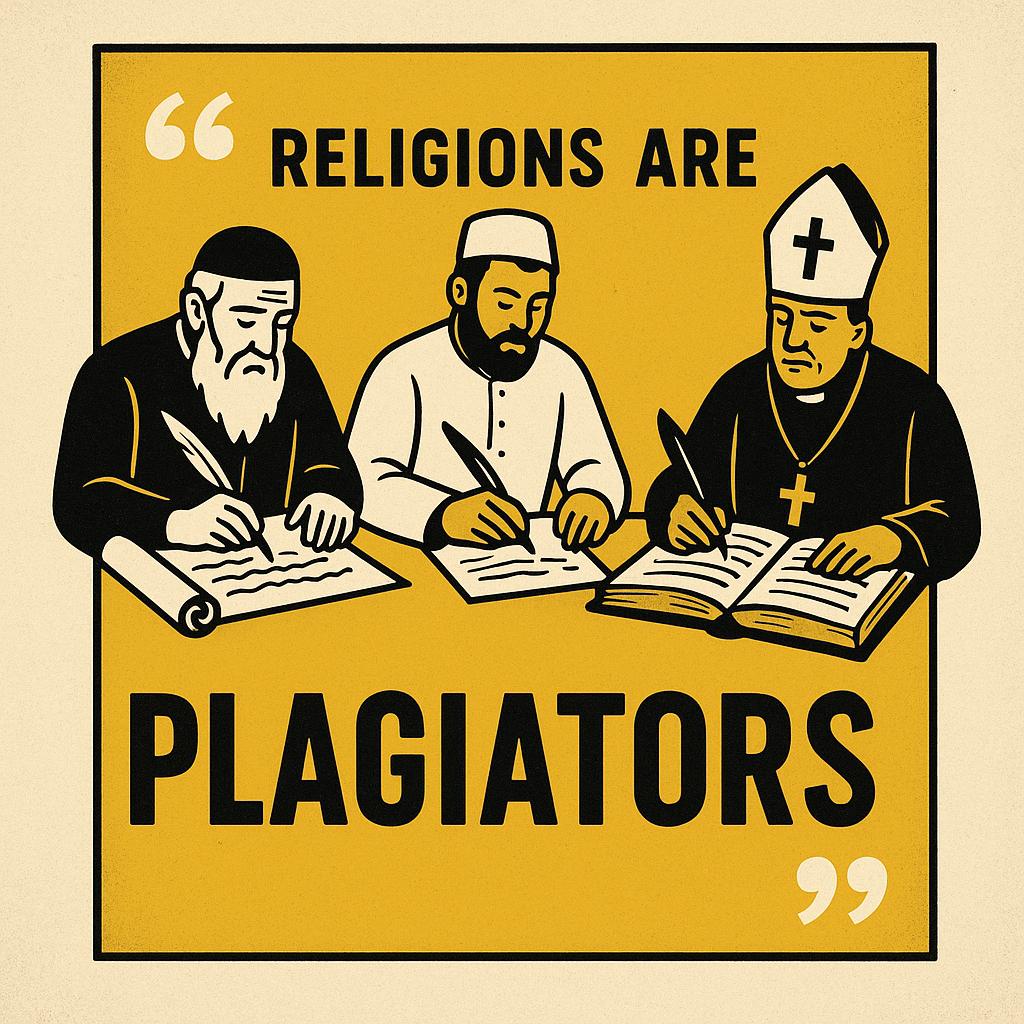
Religions claim to reveal eternal truths. They promise to explain the universe, morality, and destiny. But when we examine their origins, we discover something else. None of them began from nothing. They recycled older myths, rituals, and moral codes, rebranding them as divine revelation.
From the first prayers carved into stone to the latest New Age slogans, religion has been humanity’s longest-running plagiarism project. Every generation inherited stories, symbols, and fears from the previous one — and declared them sacred. Faith became an evolving imitation business that dressed ancient superstition in new clothes.
The birth of copycat gods
Before Christianity, countless civilizations worshiped gods who were born of virgins, performed miracles, died for mankind, and rose again. Horus in Egypt was said to have been born of the virgin Isis. Mithra in Persia shared a December 25th birthday and promised salvation through sacrifice. Krishna in India performed miracles and was adored by followers who saw him as divine love incarnate.
These stories circulated for centuries before the birth of Jesus. When Christianity emerged, it combined familiar myths into a new narrative perfectly tailored for the Roman world. The innovation was not theological but marketing-based — an adaptation that could unite slaves, citizens, and soldiers under a single universal story.
Christianity became the most successful remix in history.
The Hebrew blueprint – Borrowing from the neighbors
Judaism, often seen as the root of Western monotheism, was itself a product of cultural borrowing. Its creation and flood stories mirror those found in Mesopotamian myths, particularly the Epic of Gilgamesh. The laws of Moses closely resemble the Code of Hammurabi, a Babylonian legal text that predated it by centuries. Even the story of a divine covenant reflects earlier Sumerian ideas of kings serving gods.
Yahweh was not always the only god. Archaeological findings show that early Israelites worshiped him alongside a female counterpart, Asherah. Over time, tribal competition and the need for unity transformed a local mountain deity into the single God of heaven and earth. Monotheism emerged not from revelation but from politics — from the necessity to merge tribes under one authority.
Christianity – The greatest religious remix
Christianity did not invent its theology; it absorbed it. Its moral principles came from Judaism; its cosmology came from Greek philosophy. Its organizational model came from the Roman Empire.
The Apostle Paul blended Jewish monotheism with Stoic philosophy to make faith more intellectual. Early theologians like Augustine later merged the Bible with Plato’s metaphysics. Church rituals — incense, robes, holy water — were copied from pagan ceremonies that already filled Roman temples.
The Church’s calendar was also borrowed. Christmas replaced Saturnalia, a Roman festival celebrating the sun’s rebirth. Easter adapted from pagan spring fertility rituals symbolizing life’s return. Even the image of the halo around saints came from sun cults.
Christianity succeeded not because it was original, but because it plagiarized effectively. It took what worked from earlier beliefs and branded it with divine authority.
Islam – The continuation and consolidation
When Islam appeared in the seventh century, it presented itself as a restoration of the original Abrahamic faith. Yet, like all religions before it, it built upon existing foundations. The Quran reinterpreted Jewish and Christian stories, reshaped their prophets, and reframed them under a single, unified message.
Jesus became Isa, not divine but still sacred. Moses and Abraham reappeared as Muslim prophets. The concept of monotheism — already defined by Jewish theology — was reintroduced as tawhid, the oneness of God. Islam’s originality lay not in its content but in its consolidation. It gathered fragments of previous traditions and organized them into a coherent system that united Arabs under one faith and one law.
Even Mecca’s Kaaba, the holiest site in Islam, was a pre-Islamic shrine. Pagan tribes once worshiped multiple gods there before it was purified and rededicated to Allah. In that transformation, Islam did what religions always do — it took existing rituals and redefined their meaning.
Hinduism and Buddhism – Recycling in the East
In India, religion evolved as a living organism that constantly absorbed local beliefs. Hinduism emerged from the fusion of Vedic rituals, tribal deities, and philosophical reflection. It absorbed everything it touched — gods from mountain tribes, myths from farmers, and cosmic concepts from philosophers. That is why Hinduism has millions of deities but one ultimate principle — Brahman — uniting them all.
Buddhism later arose as a reform movement. It rejected animal sacrifice and the caste system but kept key ideas like reincarnation and karma. Even these ideas were older than Buddhism itself, appearing in earlier Jain and Vedic traditions. Buddhism rebranded spiritual concepts into a philosophy of self-liberation rather than worship, but the roots were still inherited.
Religions in the East also mastered plagiarism — not by copying texts but by integrating entire worldviews.
Paganism – The original source code
Before scriptures, there were seasons, storms, and stars. Early humans personified nature to survive its terror. The sun became a god, the river a spirit, the moon a mother. These primitive imaginations became the raw code for every later faith.
When civilizations evolved, they refined these myths into pantheons and rituals. The Greeks turned them into epic poetry. The Romans turned them into imperial cults. Christianity and Islam later claimed to have erased these pagan myths — but they simply reused them under new names. The sacred fire became the Holy Spirit. The mother goddess became the Virgin Mary. The divine king became the Son of God. Paganism never died; it changed its vocabulary.
The business of borrowing morality
Religious morality is also borrowed. The Ten Commandments, the Sermon on the Mount, and even the Quranic laws echo human instincts that existed long before religion. “Do not kill” and “do not steal” are not divine inventions. They are practical rules for group survival. Cooperation, fairness, and empathy evolved biologically because they helped human tribes survive.
Religion simply branded these instincts as commandments and monopolized them. What was once natural became holy property. Each religion claimed ownership of universal morality, as if compassion were invented in a temple.
Symbols, rituals, and marketing
Religions are marketing systems built on familiar imagery. The cross, the crescent, the lotus, and the wheel of dharma all symbolize universal human ideas — life, death, rebirth, and light. Fasting, prayer, pilgrimage, and sacrifice are found in nearly every tradition. The difference lies only in name and purpose.
Ancient Egyptians fasted for purification. Hindus bathed in the Ganges. Greeks made pilgrimages to Delphi. Muslims later formalized the Hajj to Mecca. Christianity turned fasting into Lent. Each borrowed the same concept: suffering or cleansing as proof of devotion.
What religions call “tradition” is often ancient marketing — a way to make familiar gestures feel sacred again.
Revelation or repetition?
When every religion borrows from the last, the claim of divine originality collapses. Prophets begin to look like editors. Holy books become compilations of earlier texts rewritten with new theological spin.
If a god truly revealed truth, it would not need to plagiarize humanity’s own imagination. The endless recycling of myths proves one thing: religions evolve like languages — through imitation, adaptation, and repetition, not revelation.
Modern faiths – The same old pattern
Even modern spiritual movements follow the same formula. Mormonism borrowed biblical structure and added American mythology. Scientology merged self-help psychology with space-age myth. New Age spirituality repackaged old Hindu and Buddhist concepts — karma, energy, and reincarnation — into consumer therapy.
They are not new religions. They are updates of ancient codes optimized for modern audiences. The words changed, but the promise remained the same: salvation through belief.
Why plagiarism works
Religious plagiarism endures because it feels safe. People trust ideas they have heard before. Familiar myths comfort the mind and connect generations. The repetition of symbols creates identity.
Religions thrive on recognition. When something sounds ancient, it feels true. That is why every new faith survives by stealing what already worked — morality, ritual, and myth — and claiming divine ownership.
The end of the copycat era
Science and reason broke the chain. They do not plagiarize; they discover. They test ideas instead of canonizing them. The scientific method is humanity’s first true alternative to revelation. It builds knowledge instead of repeating it.
Today we can explain lightning without Zeus, disease without demons, and morality without gods. The world becomes richer, not poorer, when stripped of divine imitation.
Conclusion – Humanity needs creation, not repetition
Religions perfected the art of imitation. They took human imagination, renamed it sacred, and sold it back as truth. Yet progress begins when imitation ends.
Humanity’s next stage is not to worship old myths, but to create new knowledge. The universe does not need gods to be awe-inspiring. It is already miraculous — not because someone made it, but because we can understand it.
Creation belongs to humanity now, not to its plagiarized gods.
Leave a Reply