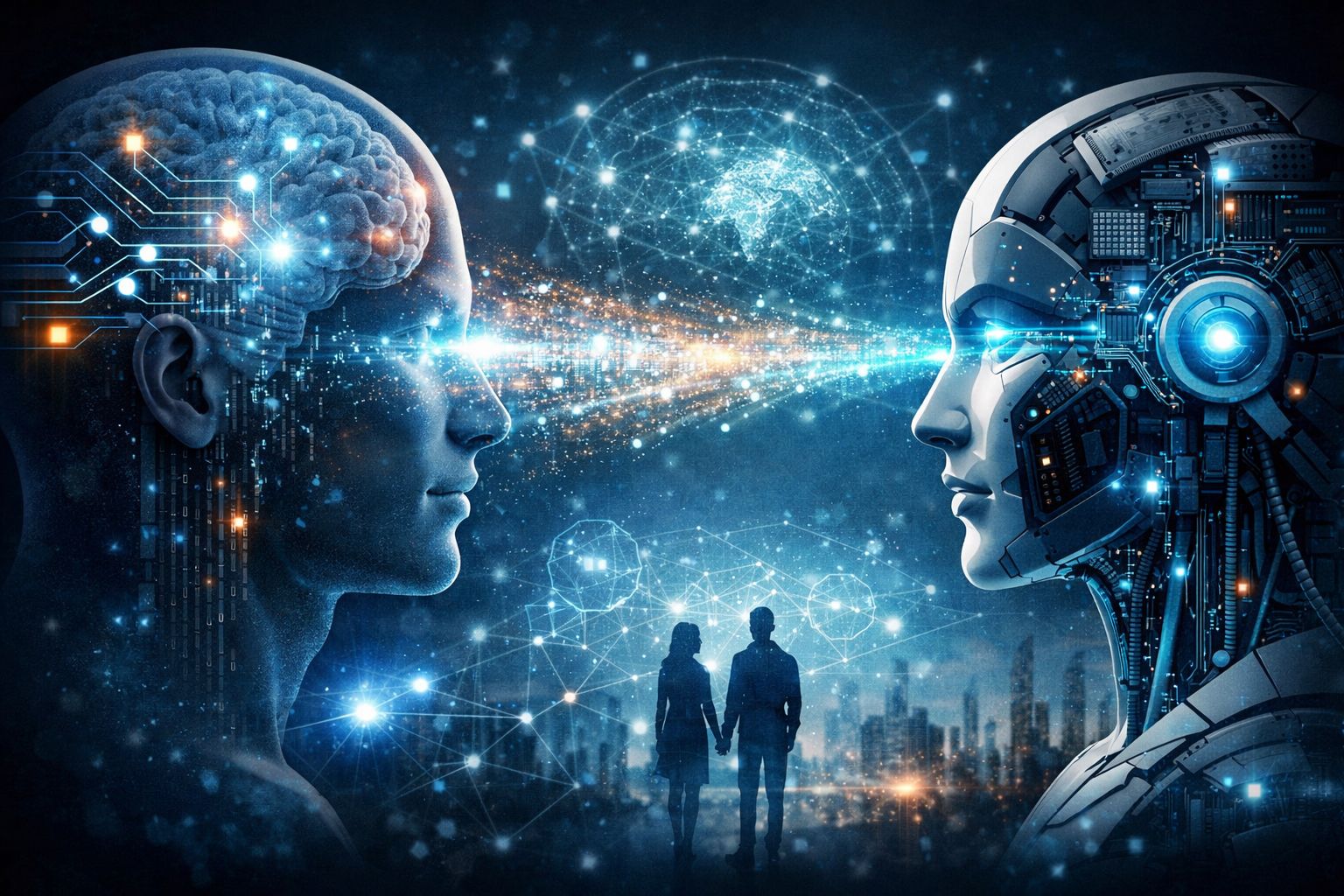
The idea sounds extreme. Human civilization depends on language. We think in words. We coordinate through speech and writing; we build institutions, laws, and science on shared symbols. Remove language, and everything seems to collapse. However, a shift has already begun. Language no longer belongs exclusively to humans. Artificial intelligence processes, generates, and translates it at scale. This changes its role. It no longer defines human uniqueness. It becomes infrastructure.
Language as the foundation of human civilization
Language allowed humans to escape biological limits. It enabled coordination in large groups. And it stored knowledge across generations. It transformed experience into symbols that others could understand. Through language, humans created culture, science, and political systems. Without it, complex societies would not exist.
At the same time, language imposed constraints. It forced thoughts into linear sequences. And it simplified complex experiences into approximate descriptions. It introduced ambiguity. Every sentence required interpretation. Every concept depended on shared assumptions.
Despite these limitations, language remained the best available tool. It balanced efficiency and flexibility. It allowed humans to operate in groups far larger than any other species.
The disruption: AI and the automation of language
This balance is now shifting. Language models process vast amounts of text. They generate explanations, arguments, translations, and summaries. Tasks that once required human communication now occur automatically. Writing, interpreting, and even negotiating can be delegated to machines.
As a result, language loses its scarcity. It becomes abundant. It becomes automated. The value of mastering language declines, at least in its functional role. Communication moves from human effort to machine-mediated processes.
This does not eliminate language. However, it changes its position. It moves from core human skill to supporting layer.
Language as infrastructure
Once a system becomes automated, it becomes invisible. Electricity no longer defines human identity. It supports it. The same process may occur with language. AI handles communication between individuals, systems, and cultures. Translation becomes instantaneous. Explanations adapt to each user. Complex ideas become accessible without effort.
In such a world, humans rely less on crafting precise sentences. They rely more on systems that interpret and transmit meaning. Language still exists, but it no longer demands attention. It fades into the background.
The limits of language
This transition exposes a deeper issue. Language is slow. It unfolds over time. It encodes meaning in sequences. Complex ideas require long explanations. Emotional states require indirect expression. Many experiences cannot be fully translated into words.
Even in ideal conditions, language compresses reality. It loses detail. It introduces noise. Misunderstandings arise because words never fully match internal states.
These limits become more visible when alternatives emerge.
Toward post-language communication
Technological development points toward new forms of communication. Brain-computer interfaces already allow limited interaction between neural activity and machines. While still early, they suggest a direction. Instead of translating thoughts into words, systems may transmit patterns directly.
In such a model, communication no longer relies on symbols. It relies on encoded states. A concept is not described. It is transferred. A memory is not narrated. It is shared.
This changes the structure of communication. It removes the need for linear sentences, it reduces ambiguity. It accelerates exchange.
From symbols to data
Language is a symbolic system. It represents reality indirectly. Words stand for objects, actions, and ideas. Future systems may bypass this layer. They may operate directly with data.
Thoughts become patterns. Patterns become signals. Signals become transferable units. Communication shifts from sentences to packets. Meaning becomes immediate rather than constructed.
This does not imply perfect understanding. However, it reduces the gap between internal experience and external expression.
Transhuman cognition
As communication changes, cognition itself may change. Human thinking could integrate with external systems. Memory may extend beyond the brain. Reasoning may involve distributed processing. Individuals may access shared knowledge without verbal explanation.
This leads to a form of transhuman cognition. Minds become partially networked. Boundaries between individuals weaken. Thought becomes less isolated.
Language, in this context, becomes optional. It remains useful for certain tasks, but it no longer defines interaction.
The reduction of misunderstanding
One of the main functions of language is to align mental states. However, alignment is imperfect. Words carry multiple meanings. Context shapes interpretation. Miscommunication is common.
Direct transmission of information could reduce this problem. Shared data creates shared reference points. Ambiguity decreases. Communication becomes more precise.
However, precision introduces new challenges. Complete clarity may remove flexibility. It may expose differences that language can obscure.
Identity under pressure
If thoughts can be shared directly, the concept of individual identity changes. Privacy becomes fragile. The boundary between self and others becomes less defined. Collective cognition may emerge.
This raises questions. Who controls access to thought? How much of the mind remains private? What happens to individuality in a networked system?
Language currently protects identity by filtering expression. Removing that filter alters the structure of the self.
Risks and losses
The shift beyond language carries risks. Language supports creativity, metaphor, and narrative. It shapes art and culture. Direct data exchange may reduce these forms. It may prioritize efficiency over expression.
There is also the risk of control. Systems that mediate thought transmission could influence content. They could filter, modify, or restrict information at a deeper level than language allows.
Finally, total transparency may become a burden. Constant exposure of internal states could undermine autonomy.
The persistence of language
Despite these changes, language is unlikely to disappear completely. It serves functions beyond communication, it shapes identity. And it enables storytelling. It provides distance between thought and expression.
In a post-language environment, language may shift roles. It may become an artistic medium rather than a primary tool. It may remain central to culture even if it becomes secondary in function.
The deeper question
This transition raises a broader issue. Is language a permanent feature of human existence, or a temporary evolutionary stage? If it emerged to solve coordination problems, it may decline when better solutions appear.
However, if it shapes thought itself, its removal may transform cognition in unpredictable ways.
Conclusion: From words to networks
Language built human civilization. It allowed cooperation, knowledge transfer, and cultural development. Artificial intelligence begins to automate its functional role. New technologies point toward direct communication and networked cognition.
The future may not eliminate language. However, it may reduce its centrality. Humans may move from speaking and writing to sharing and processing. The shift is not from silence, but from words to structured connection.
This transition does not occur instantly. It unfolds gradually. Yet its direction is clear. Language may no longer define what it means to be human.
Leave a Reply