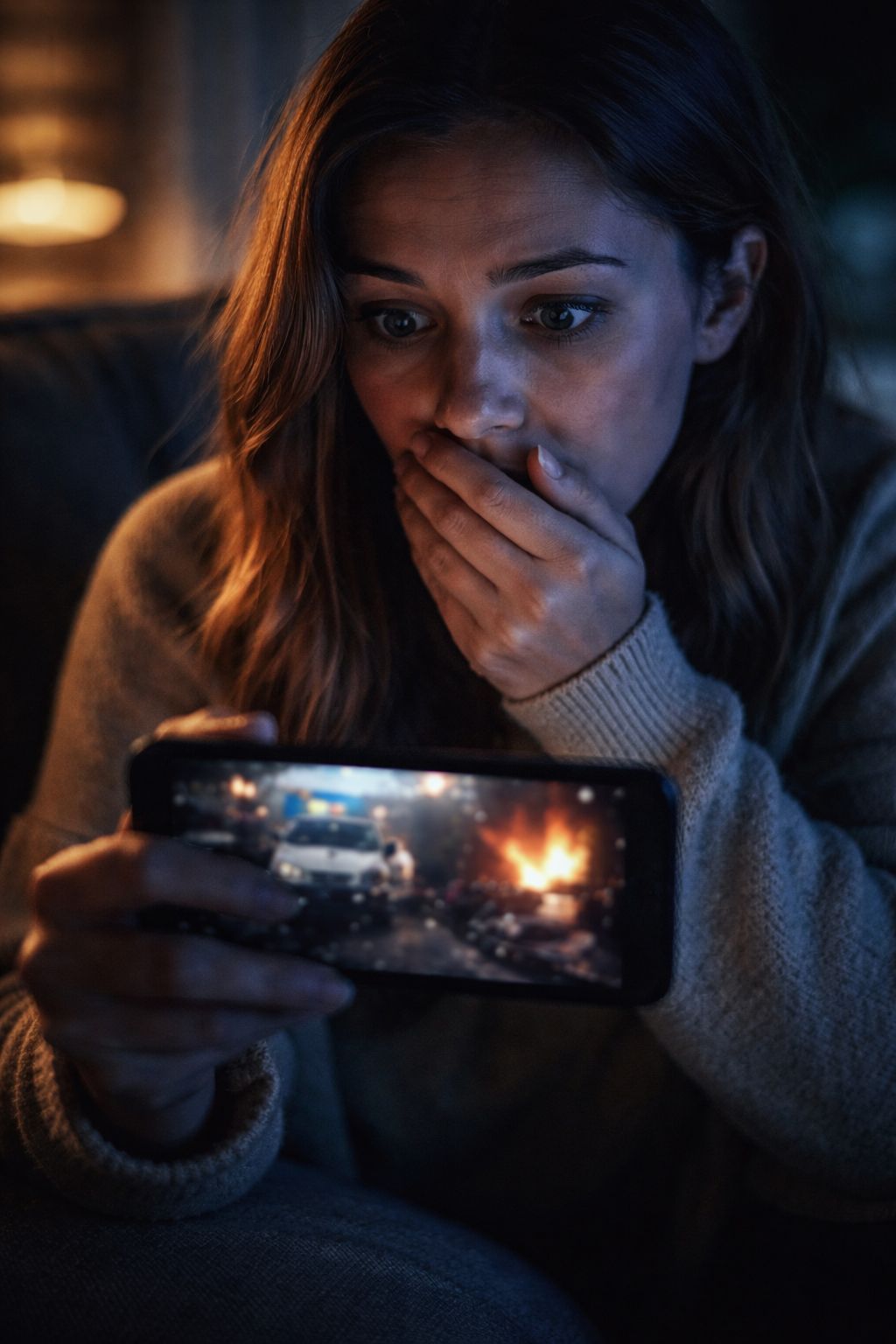
At first sight, the behavior looks irrational. People say they hate violence, death, and extreme events. They call such content disturbing. Yet they watch it. They click on it. They share it. This contradiction is not random. It reflects deep evolutionary mechanisms that shaped the human mind long before modern media existed.
The brain evolved for survival, not comfort
The human brain did not evolve to maximize happiness. It evolved to maximize survival. This distinction matters. A brain focused on survival prioritizes threats over comfort, danger over beauty, and urgency over calm reflection. Therefore, anything that signals potential harm immediately captures attention.
In ancestral environments, missing a threat could mean death. Ignoring a predator, a violent rival, or a dangerous situation had direct consequences. In contrast, ignoring something pleasant carried little risk. As a result, natural selection favored individuals who reacted quickly to negative and shocking stimuli.
Negativity bias as a central mechanism
This leads to what psychologists call negativity bias. Negative information has greater weight than positive information. It is processed faster, remembered longer, and triggers stronger emotional responses. This bias is not a flaw. It is an adaptation.
Shocking videos often contain exactly the types of stimuli that activate this bias. Violence, injury, chaos, and fear are all signals of potential danger. The brain treats them as important, regardless of whether the viewer is actually at risk. As a result, attention locks in.
The threat detection system
Humans possess rapid threat detection systems. These systems operate below conscious reasoning. They respond to specific cues such as blood, sudden movement, aggression, and abnormal behavior. When these cues appear, the brain shifts into alert mode.
This process is fast. It bypasses slow, analytical thinking. The goal is not to understand the situation in detail. The goal is to react. Shocking videos exploit this system. They present concentrated signals of danger that the brain cannot easily ignore.
Learning without direct risk
Another key factor is information value. Humans evolved to learn from observation. Watching others face danger allows individuals to simulate scenarios without experiencing them directly. This is efficient. It reduces risk.
Shocking videos function as modern simulations. They show extreme situations that most people will never encounter. However, the brain still treats them as relevant. It extracts patterns. It asks implicit questions. What happened? Why did it happen? Could this happen to me?
This process creates a strange attraction. The content is disturbing, but it is also informative from a survival perspective.
Social sharing as a survival strategy
Humans are social animals. Survival depended on communication. Sharing information about danger increased group survival. If one individual discovered a threat, spreading that information protected others.
Today, sharing shocking videos follows the same pattern. People do not only watch. They send the content to others; they comment on it. They warn, react, and discuss. This behavior mirrors ancient warning systems.
The difference is scale. Instead of small groups, information now spreads globally. However, the underlying mechanism remains the same.
Curiosity about extremes
The human mind is also drawn to extremes. It seeks boundaries. It wants to understand the limits of reality. What is the worst that can happen? How far can violence go? What does failure look like at its most severe?
Shocking videos provide answers to these questions. They present rare and extreme events. The brain uses them to refine its internal models. Even if the events are unlikely, they expand the range of what is considered possible.
Arousal and attention
Shocking content generates strong physiological arousal. Heart rate increases. Attention sharpens. The body prepares for action. This state is not the same as pleasure, but it is intense.
The brain often confuses intensity with importance. High-arousal stimuli feel significant. As a result, they are prioritized. This reinforces the cycle. The more intense the content, the more attention it receives.
Desensitization and escalation
Repeated exposure changes the response. The initial shock weakens over time. The brain adapts. What once felt extreme becomes familiar. As a result, people seek stronger stimuli to achieve the same level of arousal.
This leads to escalation. Content becomes more graphic, more extreme, and more frequent. Platforms amplify this process. Algorithms detect engagement and promote similar material. The cycle intensifies.
The modern mismatch
These mechanisms evolved in environments where extreme events were rare. Today, they are constant. The brain receives far more signals of danger than it was designed to handle.
This creates a mismatch. The system that once protected humans now overwhelms them. The world appears more dangerous than it actually is. Attention becomes trapped in cycles of shock and reaction.
Psychological and social consequences
The effects are significant. Repeated exposure can reduce emotional sensitivity. Empathy may decline. At the same time, anxiety can increase. The constant presence of extreme content distorts perception.
People begin to overestimate risks. They feel that violence and danger are more common than they are. This affects behavior, attitudes, and even political views.
Conclusion: An ancient mind in a modern environment
Attraction to shocking videos is not irrational. It is a direct result of evolutionary design. The brain prioritizes danger, learns from observation, and shares information socially. These mechanisms once increased survival.
However, in the modern environment, they operate at a scale that creates new problems. What once protected attention now hijacks it. The result is a constant pull toward the most extreme content available.
Understanding this does not eliminate the attraction. However, it explains it. The behavior is not a mystery. It is the predictable outcome of an ancient brain facing a radically different world.
Leave a Reply