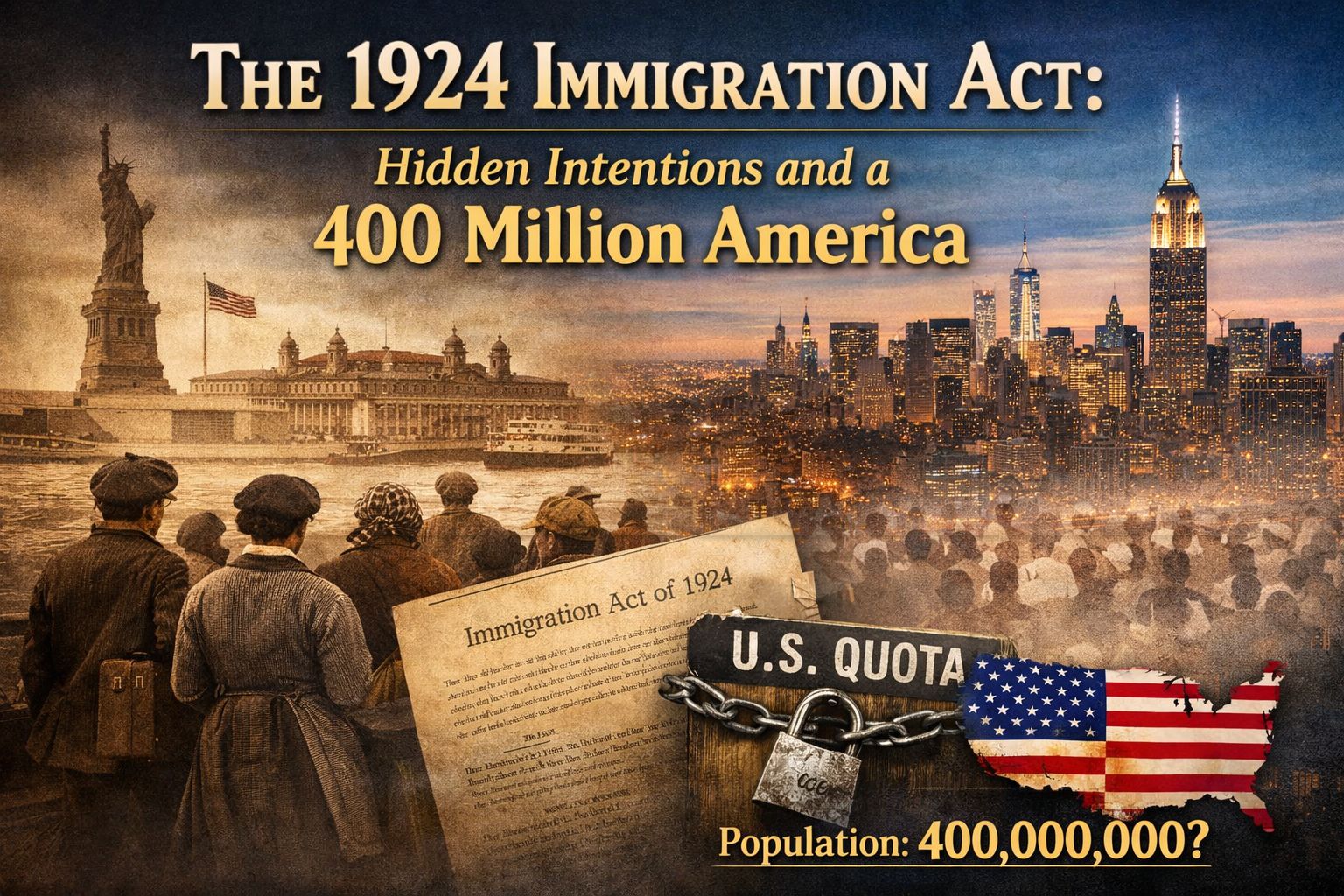
In 1924, the United States adopted one of the most restrictive immigration laws in its history. The Immigration Act of 1924 presented itself as a rational policy. It promised order, stability, and controlled population growth. Moreover, it framed itself as a necessary response to social tension and rapid change.
However, beneath this neutral language lay a different logic. The law did not simply regulate movement. It reshaped the demographic future of the country. Therefore, to understand it, one must separate its stated purpose from its underlying intentions.
Historical background: Pressure builds
The early 20th century brought massive migration to the United States. Millions arrived from Southern and Eastern Europe. Italians, Poles, Jews, and others entered industrial cities and transformed urban life.
At the same time, anxiety grew among political and economic elites. Cultural change accelerated. Cities became more diverse. Languages, religions, and customs shifted.
Moreover, global events intensified fear. The World War I had destabilized Europe. Soon after, the Russian Revolution raised concerns about radical ideologies spreading across borders.
Therefore, immigration became more than a demographic issue. It became a political and cultural threat in the eyes of many policymakers.
The structure of the law: Quotas as a tool
The Immigration Act of 1924 introduced a quota system. It limited how many people could enter the country each year. However, these limits were not equal.
The quotas favored immigrants from Northern and Western Europe. Countries such as the United Kingdom and Germany received relatively higher allowances.
At the same time, immigrants from Southern and Eastern Europe faced severe restrictions. Asian immigration was almost completely banned.
Therefore, the law did not simply reduce immigration. It selected who could enter and who could not.
The logic of selection: Engineering a population
The design of the quota system reveals its deeper purpose. Policymakers used earlier census data to determine quotas. This choice favored groups that had arrived earlier, mostly from Northern Europe.
Consequently, newer immigrant groups faced exclusion. The system effectively froze the ethnic composition of the country at an earlier stage.
Therefore, the law acted as a mechanism of demographic engineering. It attempted to preserve a specific version of national identity.
Ideological foundations: Eugenics and hierarchy
The intellectual climate of the time played a crucial role. The field of Eugenics influenced many policymakers.
Eugenics promoted the idea that human populations could be improved through selective breeding. It ranked ethnic groups according to supposed biological traits.
Therefore, many lawmakers believed that restricting certain groups would strengthen the nation. Northern Europeans were considered desirable. Others were viewed as inferior.
Consequently, the law reflected a hierarchy disguised as policy. It transformed prejudice into legislation.
Fear of ideology: Controlling political risk
Beyond race, ideology shaped the law. After the Russian Revolution, elites feared the spread of socialism, communism, and anarchism.
Immigrants from Eastern Europe often carried associations with these movements. Whether accurate or not, perception drove policy.
Therefore, restricting immigration became a way to manage political risk. The law aimed to prevent the import of radical ideas.
Economic motives: Labor and competition
Economic factors also played a role. Immigration influences labor markets. Large inflows can lower wages or increase competition for jobs.
Industrialists and workers held conflicting views. Some industries benefited from cheap labor. Others feared instability and unrest.
Therefore, the law balanced these pressures. It reduced immigration while maintaining enough labor supply to support economic growth.
Cultural preservation: Identity under pressure
Cultural concerns remained central. Many Americans feared losing a shared identity. Religion, language, and customs were changing rapidly.
Therefore, the law sought to slow cultural transformation. By limiting certain groups, it aimed to preserve existing norms.
Consequently, immigration policy became a tool of cultural control, not just economic or political management.
Legal neutrality vs practical discrimination
On paper, the law appeared neutral. It did not openly declare racial superiority. It used numbers, quotas, and administrative rules.
However, the outcomes revealed clear bias. Certain groups faced near-total exclusion. Others gained privileged access.
Therefore, neutrality functioned as a mask. The law achieved discriminatory goals through technical means.
Long-term consequences: Shaping a nation
The Immigration Act of 1924 had lasting effects. It reduced immigration from many regions for decades. It slowed demographic change.
Communities that might have grown remained small. Cultural diversity developed along different lines.
Moreover, the law influenced future policies. It established a model for using quotas to shape populations.
This case illustrates a wider phenomenon. Laws often present rational goals. They speak of order, stability, and fairness.
However, underlying intentions may involve power, identity, and control. Policy becomes a vehicle for deeper objectives.
Therefore, understanding law requires looking beyond its language. One must analyze its structure, context, and effects.
Moral dimension: Contradiction within modern systems
The 1924 law reveals a contradiction. A society that values freedom and equality enacted policies based on exclusion and hierarchy.
Therefore, ideals and practice diverged. The language of rights coexisted with restrictive reality.
This pattern does not belong only to the past. It appears whenever systems claim neutrality while pursuing selective outcomes.
Demographic impact: How many Americans did not arrive
The Immigration Act of 1924 did not only restrict movement. It reshaped the demographic trajectory of the United States for an entire century. Therefore, a key question emerges. How many Americans might exist today without it?
A precise calculation is impossible. One would need to model not only additional immigrants, but also their children, grandchildren, mortality rates, return migration, and intermarriage. However, a rough estimate still reveals the scale of impact.
Before strict quotas took hold, the United States had a high share of foreign-born residents. In 1920, immigrants made up more than 13 percent of the population. Later, after decades of restriction, that share dropped sharply. By 1970, it fell to under 5 percent.
This gap allows a simple comparison. If the earlier level had continued, the United States in 1970 could have had roughly 17 million more foreign-born residents. That figure reflects only the immediate effect.
However, the deeper impact lies in generational growth. Each immigrant represents not only one person, but an entire potential lineage. Children, grandchildren, and extended families multiply the effect over time.
Therefore, when projecting forward to today, the difference expands significantly. A reasonable estimate suggests tens of millions of additional Americans.
A clear final approximation can be stated. The United States today could plausibly have around 370 to 400 million people instead of roughly 330 to 340 million. In other words, about 30 to 60 million Americans did not exist because of the restrictions introduced in 1924.
Consequently, the law did not simply reduce immigration. It altered the scale, composition, and future growth of the nation. It shaped not only who entered, but who would ever be born.
This reveals the deeper nature of the policy. It was not only restrictive. It was transformative.
Conclusion: Beyond the surface of law
The Immigration Act of 1924 was not merely a strict regulation. It was a deliberate attempt to shape society according to specific preferences.
Its hidden intentions reflected fears, ideologies, and power structures of its time.
Therefore, it serves as a reminder. Laws do not only manage behavior. They define who belongs, who is excluded, and what a society chooses to become.
Leave a Reply