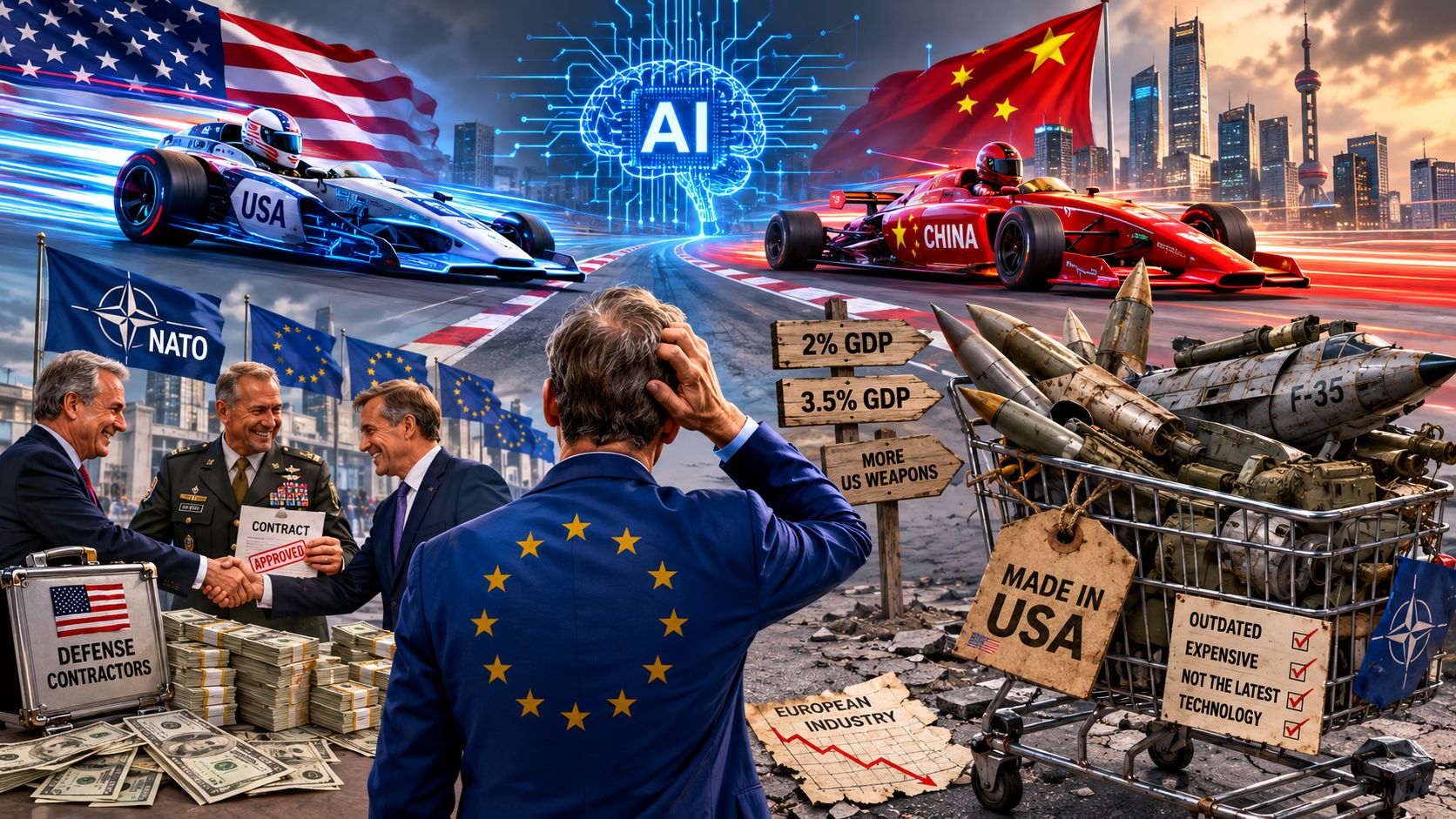
Artificial intelligence will shape the twenty-first century. Anyone who still doubts that reality ignores the biggest technological revolution of our time. AI will transform the job market. It will reshape education. It will redefine healthcare. Above all, it will revolutionize warfare.
That is exactly why the United States and China compete so fiercely.
The race has not ended.
Nobody knows who will dominate the next decade.
China invests enormous resources in AI. It also faces repeated accusations of conducting large-scale industrial espionage to accelerate its technological progress. Meanwhile, the United States relies on its research universities, technology companies, venture capital, and military-industrial complex. Both countries understand one simple fact. Whoever leads in AI will enjoy a huge economic and military advantage.
Europe, unfortunately, watches much of this race from the sidelines.
A very inept Europe
The continent still produces outstanding scientists and engineers. However, Europe struggles to build technology giants that can compete with American and Chinese companies. Bureaucracy slows innovation. Political fragmentation weakens investment. Regulation often arrives before invention. As a result, Europe increasingly depends on technologies developed elsewhere.
The consequences extend far beyond smartphones and chatbots.
Modern warfare no longer depends only on tanks, aircraft, and missiles. AI now influences intelligence gathering, drone swarms, logistics, cyberwarfare, satellite analysis, battlefield coordination, and autonomous weapons. The country that masters these technologies gains an enormous strategic advantage.
Donald Trump pushed NATO members to increase military spending. For years, many European countries spent well below NATO’s target of 2 percent of GDP. Trump demanded that allies meet that level and even argued that they should move toward 3.5 percent.
The question, however, does not concern only how much Europe spends.
It concerns where the money goes.
The United States remains the world’s largest military supplier. American defense companies dominate the global market. Europe still imports a significant share of its advanced military equipment from the United States. That means higher European defense budgets often translate into larger contracts for American defense manufacturers.
Many Europeans therefore ask an uncomfortable question.
Will Europe spend hundreds of billions while strengthening American industry more than its own?
Should we escalate the conflict with Russia?
Former Czech Prime Minister Jiří Paroubek went even further. He argued that if Germany wanted a war with Russia, it could pursue one without dragging the Czech Republic into it. He also claimed that today’s political climate increasingly resembles the period before the First World War. Finally, he argued that the Czech Republic would end up sending enormous sums of money to American military contractors instead of investing in its own future, while political leaders continued escalating tensions with Russia instead of seeking ways to reduce them.
His criticism deserves serious consideration.
American defense companies clearly benefit from rising military spending across Europe.
That does not automatically mean, however, that Europe faces no security threat.
Ukraine fights a defensive war that affects the security of the entire continent. Europe cannot simply pretend that the conflict carries no consequences beyond Ukraine’s borders. Likewise, dismissing any possibility of Russian imperial ambitions ignores both Russia’s recent actions and the concerns expressed by many of its neighbors. Reasonable people may disagree about the best response, but denying that possibility altogether makes little sense.
Europe therefore faces two challenges at the same time.
It must strengthen its security.
It must also strengthen its technological independence.
Europe without its own AI
Instead of spending vast sums mainly on foreign military equipment, Europe should invest aggressively in its own artificial intelligence, semiconductor industry, cybersecurity, autonomous systems, and next-generation military technology. The continent needs European innovation, European defense companies, and European AI champions that can compete with the United States and China.
Unfortunately, I see little reason for optimism.
The European Union has repeatedly demonstrated its inability to act quickly in strategic industries. It often regulates faster than it innovates. It reacts instead of leading. In my view, it also remains too heavily influenced by the United States to pursue a truly independent technological and defense strategy. As a result, Europe risks financing American defense contractors while falling even further behind in the technologies that will determine military power during the coming decades.
We do not live in a utopia.
The United States and China continue racing toward the future.
Europe continues debating regulations while buying yesterday’s weapons.
That may prove far more expensive than any defense budget.
Leave a Reply