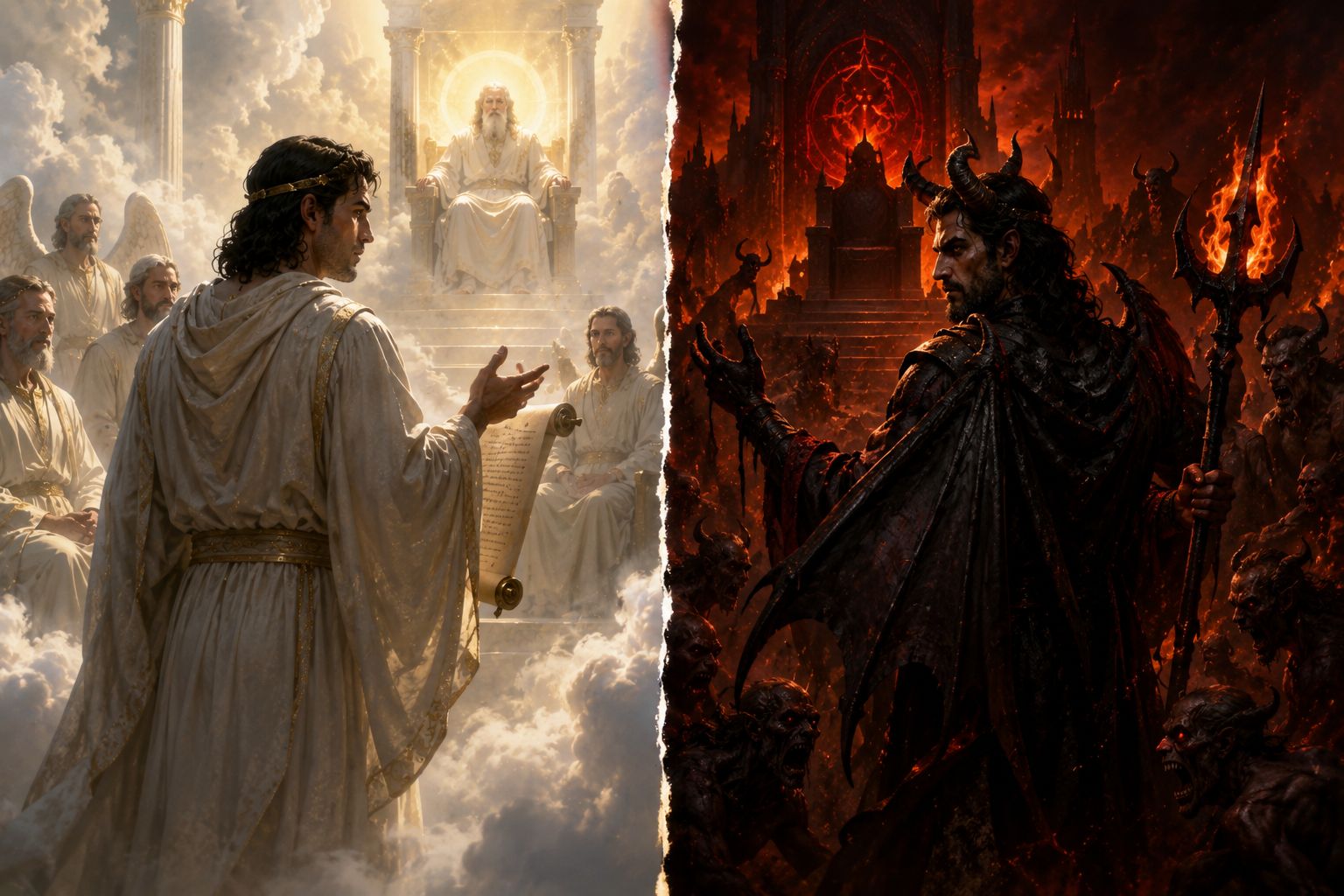
Most Christians imagine Satan as God’s eternal enemy. He rules hell. He commands demons. He tempts humanity. Moreover, he stands behind much of the evil in the world. Many believers assume this picture comes directly from the Old Testament. It does not. If we compare the Hebrew Bible with the New Testament and later Christian tradition, we discover one of the most remarkable transformations in religious history. Christianity did not simply inherit Satan from Judaism. It turned a relatively minor figure into the central antagonist of the cosmic story.
A servant, not a rival
The Hebrew Bible mentions Satan surprisingly rarely. Even when he appears, he does not resemble the Devil familiar to most Christians today. The clearest example comes from the Book of Job. There, Satan appears among the “sons of God” in God’s heavenly court. He does not rebel against God, nor does he challenge His authority. Instead, he functions as an accuser or prosecutor who tests human righteousness. Most importantly, he cannot act on his own. Before he afflicts Job, he must first receive God’s permission. His authority is therefore limited and entirely dependent on God’s will.
This picture differs fundamentally from later Christian theology. Rather than confronting God as an equal opponent, Satan serves within the divine order. He may question human faithfulness, but he remains part of God’s court. Consequently, the Hebrew Bible presents no cosmic struggle between two nearly equal supernatural powers. God remains completely sovereign, and no other being comes close to challenging His rule.
The Devil does not rule hell
Modern culture has firmly established one image of Satan. He sits on a throne surrounded by flames while demons carry out eternal punishments. Films, novels, paintings, and cartoons have reinforced this picture for centuries. Nevertheless, the Hebrew Bible contains nothing like it.
The Old Testament never describes Satan as the ruler of the underworld. In fact, Sheol—the destination of the dead—is not presented as a place where the Devil governs the souls of sinners. Instead, it is a shadowy realm where both the righteous and the wicked go after death. It is a place of silence rather than endless torture. Satan neither presides over it nor administers divine justice. The familiar image of the Devil reigning over hell emerged much later through Christian theology, medieval literature, and works such as Dante’s Inferno, not through the Hebrew Scriptures themselves.
Christianity expanded Satan’s role
The New Testament introduces a dramatically different picture. Satan now appears throughout Jesus’ ministry. He tempts Jesus in the wilderness. He enters Judas before the betrayal. Jesus repeatedly casts out demons, while evil spirits become a regular explanation for human suffering. Furthermore, the New Testament describes Satan as “the ruler of this world” and portrays him as actively opposing God’s plan for humanity.
The Book of Revelation takes this development even further. It depicts a heavenly war between Michael and his angels on one side and Satan and his followers on the other. Here, Satan becomes the great dragon, the deceiver of the whole world, and the leader of a vast army of rebellious spiritual beings. This is a profound departure from the restrained figure found in the Book of Job. Instead of serving within God’s court, Satan now stands as the principal enemy of God and humanity.
The world became much more supernatural
The transformation did not stop with Satan himself. The entire supernatural universe expanded. The Hebrew Bible contains relatively few references to demons or evil spirits. By contrast, the New Testament frequently speaks about demonic possession, exorcisms, fallen angels, and spiritual warfare. These themes occupy a central place in Jesus’ ministry and the lives of the early Christians.
Later Christian theology expanded this supernatural world even further. Medieval theologians developed elaborate classifications of demons and fallen angels. Folklore assigned demons individual names, personalities, and areas of influence. Satan gradually became the commander of a vast kingdom of darkness that constantly opposed God’s kingdom. Over the centuries, the Devil evolved from a relatively minor biblical character into one of the central figures of Christian imagination.
Why did this happen?
Scholars generally agree that Jewish ideas about angels, demons, and evil developed over several centuries. During the Second Temple period, Jewish literature became increasingly interested in supernatural beings and cosmic conflict. Books such as 1 Enoch and Jubilees describe rebellious angels and demonic spirits in much greater detail than the earlier books of the Hebrew Bible. Some historians also argue that contact with Persian religion, especially Zoroastrianism, encouraged stronger ideas about the struggle between the forces of good and evil, although the extent of this influence remains debated.
The New Testament inherited many of these later Jewish developments rather than the simpler worldview reflected in the earliest biblical texts. Christianity, however, did not merely preserve these ideas. It amplified them. Satan became more active, more powerful, and more central to the story of salvation than he had ever been before.
A profound theological shift
This transformation reflects more than the evolution of one character. It represents a fundamental change in how evil itself is understood. The Hebrew Bible generally presents both prosperity and disaster as occurring under God’s ultimate authority. Although human beings commit evil, there is no independent supernatural power that rivals God for control over creation.
Christianity increasingly personified evil in the figure of Satan. The Devil became the great deceiver, the tempter of humanity, the commander of demons, and the chief opponent of God’s kingdom. This shift offered believers a clearer explanation for the existence of evil, temptation, and suffering. At the same time, however, it raised new philosophical questions. If Satan possesses such extraordinary influence, why does an all-powerful and perfectly good God continue to allow him to operate? Christian theologians have debated that question for nearly two thousand years.
The Devil was not always the Devil
Many Christians assume the Bible presents one consistent picture of Satan from Genesis to Revelation. The evidence suggests otherwise. The Hebrew Bible portrays Satan as a subordinate figure who operates within God’s authority. The New Testament presents him as the great enemy of Christ and the deceiver of the world. Later Christian tradition expands his role even further, turning him into the ruler of a vast demonic kingdom and one of the most recognizable figures in Western culture.
Ironically, this means Christianity made the universe far more dualistic than ancient Judaism ever did. The Devil did not simply survive the transition from the Old Testament to the New Testament. He became one of the most powerful beings in the Christian worldview.
Leave a Reply