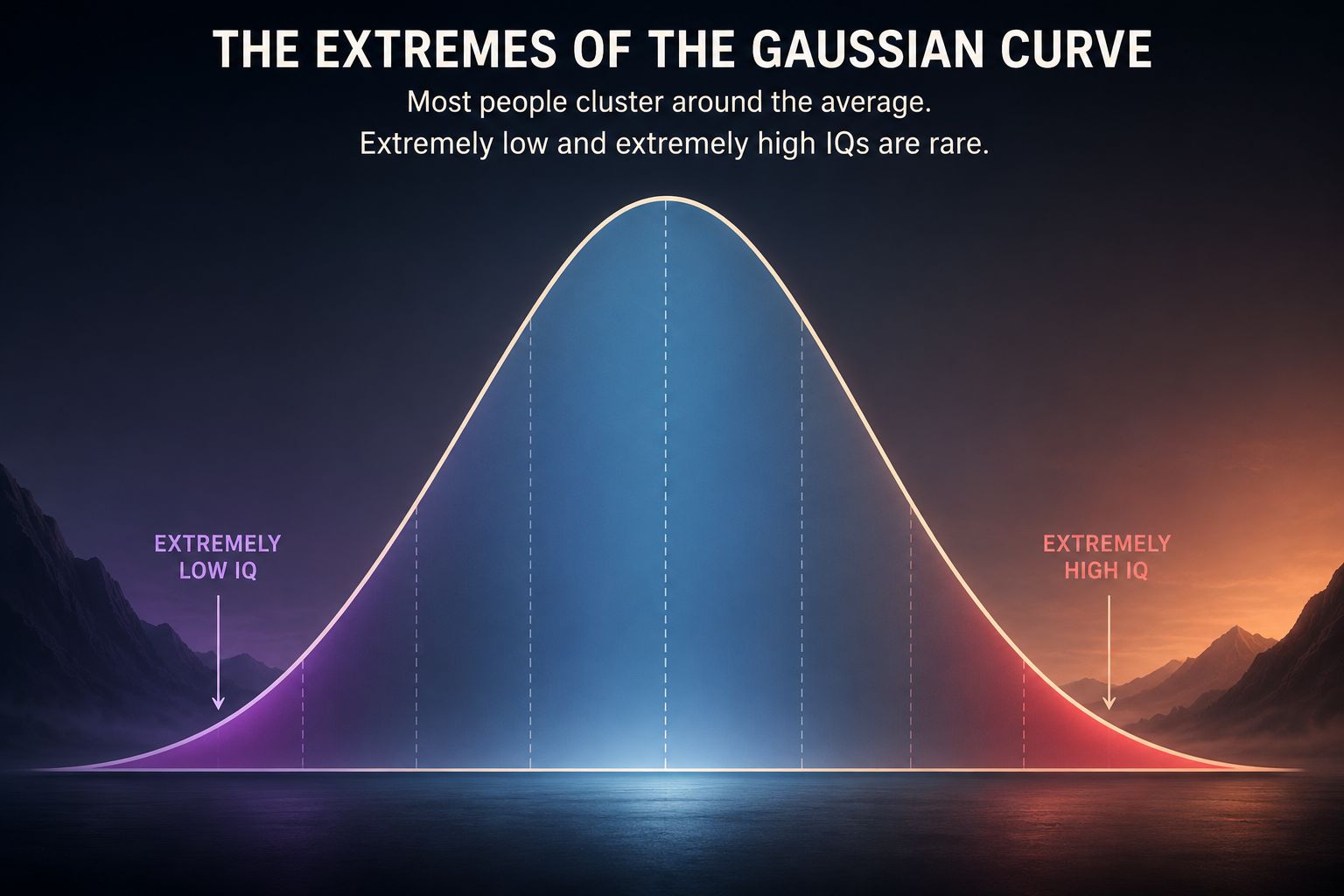
People often assume that intelligence researchers believe men are smarter than women. In reality, that is not the mainstream scientific position. Decades of research have found that men and women have essentially the same average IQ. If a difference exists, it is so small that it has little practical significance. The real controversy begins elsewhere, with the distribution of intelligence rather than its average.
Some psychologists argue that men display greater variability in cognitive ability. In simple terms, they believe male IQ scores are spread over a slightly wider range than female IQ scores. If that is true, more men would appear at both extremes of the distribution. There would be more men with intellectual disabilities, but there would also be more men among the exceptionally gifted. Whether this hypothesis is correct, and if so by how much, remains one of the most debated questions in intelligence research.
The average is not the issue
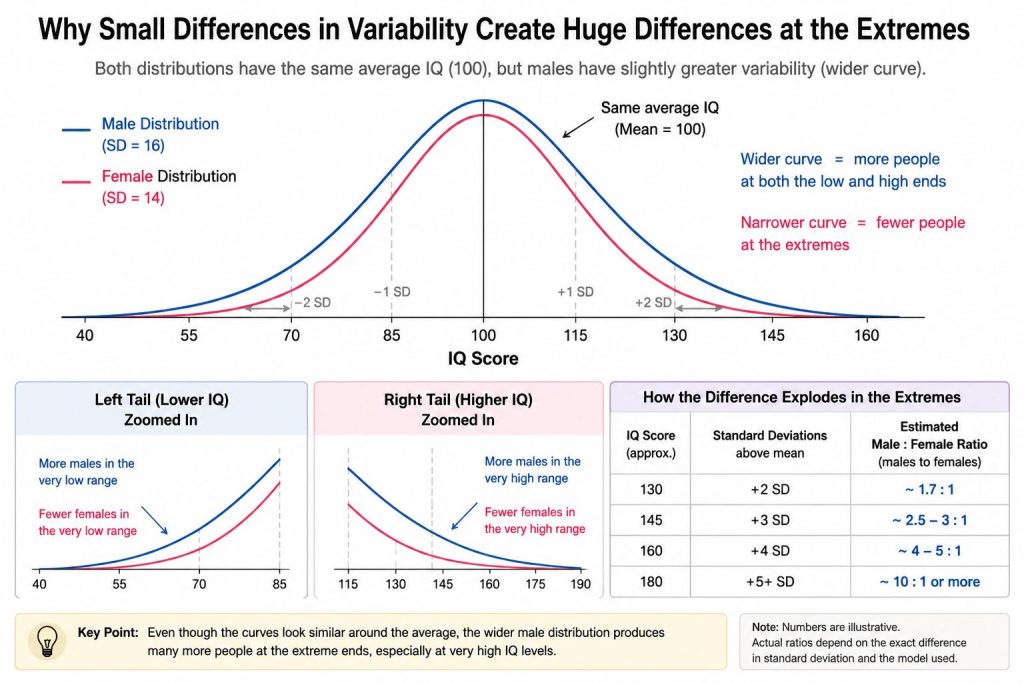
Imagine two bell curves centered at exactly the same point. Both peak at an IQ of 100. At first glance, they appear almost identical. However, one curve is just slightly wider than the other.
Near the center, this difference barely matters. Most people score somewhere between 85 and 115 regardless of sex. If researchers only examined average scores, they would conclude that men and women possess virtually identical intelligence. That conclusion is widely accepted and supported by numerous studies.
The situation changes only when we move far away from the average. A tiny increase in variability has almost no visible effect near the center of the distribution. At the extreme ends, however, it can produce surprisingly large differences in the number of people found there.
Why small differences become enormous
The mathematics behind the phenomenon is surprisingly simple. IQ tests are traditionally designed with an average score of 100 and a standard deviation of 15. About two-thirds of people fall within one standard deviation of the average. Only a small minority lies two or three standard deviations away.
An IQ of 130 already places someone roughly among the most intelligent two percent of the population. An IQ of 145 is far rarer. An IQ of 160 is extraordinarily uncommon. An IQ of 180 belongs to a statistical region where almost nobody exists.
This is where the greater male variability hypothesis becomes interesting. If the male distribution is only slightly wider than the female one, the difference near IQ 100 is almost invisible. At five standard deviations above the mean, however, the wider curve extends much farther into the tail. As a result, mathematical models predict that men become increasingly overrepresented as IQ rises.
This outcome surprises many people because the difference in variability does not have to be large. Even a modest increase in the standard deviation can produce dramatic changes at the extreme tail of the distribution. It is one of the unintuitive consequences of normal distributions.
What happens at IQ 180?
An IQ of 180 corresponds to more than five standard deviations above the average on the traditional IQ scale. Depending on the precise assumptions used, such a score may occur only once among several million people. In many countries, there may be no verified individual who genuinely reaches that level.
If researchers assume equal variability for men and women, then the proportion of males and females above IQ 180 should remain roughly equal. However, if they assume that male variability is even slightly greater, the prediction changes dramatically.
Some statistical simulations suggest ratios exceeding 10:1. Others produce 20:1 or even larger differences. Under those assumptions, women might represent fewer than one in ten individuals with an IQ of 180. In some models, the predicted proportion becomes even smaller.
These figures often circulate on the internet as though they were established facts. They are not. They are the outputs of mathematical models, and different assumptions produce different results.
Where do these numbers come from?
This is one of the biggest misunderstandings surrounding the subject. Researchers have not tested thousands of people with IQs of 180 and counted how many were male or female. Such a study has never existed because there are simply too few people who plausibly fall into that category.
Instead, scientists estimate the average IQ for each sex and estimate the amount of variability. They then fit statistical distributions to those data and extend the curves far into the extreme tail. The predicted sex ratio emerges from mathematics rather than direct observation.
This approach is perfectly legitimate in statistics, but it also introduces uncertainty. Small errors in estimating variability become greatly magnified once calculations extend five or six standard deviations beyond the mean. A tiny adjustment in the model can substantially change the predicted number of people expected at IQ 180.
How strong is the evidence for greater male variability?
Supporters of the hypothesis argue that evidence appears across many different datasets. Studies of school achievement, military aptitude tests, national intelligence surveys, and mathematical competitions have often found greater male variability than female variability. Similar patterns have also been reported for several physical and biological traits.
Some researchers even argue that greater male variability is widespread throughout biology. Males appear more frequently at both extremes for characteristics such as height, birth weight, certain diseases, and some behavioral traits. Intelligence, they suggest, may simply follow the same pattern.
Critics, however, argue that the evidence is far from conclusive. Different countries often produce different results. Some datasets show substantial differences, while others show almost none. Educational systems, cultural expectations, sampling methods, and statistical techniques may all influence the apparent amount of variability. Consequently, there is still no universal agreement about how large the effect actually is.
The problem with measuring IQ 180
Another major difficulty is that IQ tests become progressively less reliable at extremely high scores. Modern intelligence tests are designed primarily for clinical diagnosis, education, and psychological assessment. They distinguish ordinary levels of intelligence very well, but they become much less precise at the highest end.
Every psychological test contains measurement error. Near the average, that error has relatively little practical impact. Near IQ 180, however, it becomes substantial. A person who receives one exceptionally high score might obtain a noticeably different result on another day or on another professionally administered test.
Many famous historical claims of IQs above 180 were never based on modern standardized testing at all. Instead, they were estimated retrospectively, extrapolated beyond the test’s validated range, or reconstructed from childhood achievement. Consequently, psychologists generally view such numbers with considerable caution.
What about high-IQ societies?
Organizations such as Mensa, Intertel, and the Triple Nine Society usually have more male than female members. Some people interpret this as proof that exceptionally intelligent men greatly outnumber exceptionally intelligent women.
That conclusion does not necessarily follow. Membership in these organizations depends on much more than intelligence. People must choose to take the qualifying test, decide that joining is worthwhile, pay membership fees, and remain active. Many highly intelligent individuals simply have no interest in such organizations.
For that reason, membership statistics cannot establish the true sex ratio among the world’s most intelligent people. They reveal only the characteristics of those who decide to participate.
Could biology explain greater variability?
Several biological explanations have been proposed, although none has been conclusively demonstrated. One possibility involves genetics. Because males possess only one X chromosome, beneficial and harmful genetic variants linked to that chromosome may express themselves more frequently. This could increase variation among men without changing the average level of intelligence.
Other researchers have suggested that prenatal hormones influence brain development in ways that affect variability. Evolutionary psychologists have proposed that sexual selection may have favored greater variation among males because reproductive success historically differed more widely for men than for women.
Each of these explanations remains speculative. None has been universally accepted, and none alone fully explains the available evidence.
Could culture explain it instead?
Many psychologists believe social factors deserve at least as much attention as biology. Throughout history, girls often received different educational opportunities than boys. Expectations regarding mathematics, science, and academic careers also differed substantially across cultures.
Modern societies have reduced many of these inequalities, yet some differences remain. Critics of the greater male variability hypothesis argue that cultural influences may still shape educational choices, test participation, and performance under competitive conditions. If so, part of the observed difference at the extreme upper tail might reflect society rather than biology.
Disentangling biological and environmental influences is extremely difficult. Both almost certainly contribute to cognitive development, and their interaction remains an active area of research.
So are almost all people with IQ 180 really men?
The honest scientific answer is that nobody knows. If the greater male variability hypothesis is substantially correct, then statistical models predict that men should overwhelmingly dominate the extreme upper tail of the IQ distribution. Some models suggest women might account for fewer than 10% of individuals with IQs around 180.
However, these predictions have never been verified directly. There are simply too few reliably measured people with IQs anywhere near 180. The available evidence therefore comes primarily from extrapolating statistical distributions rather than observing real populations.
Consequently, statements such as “almost everyone with an IQ of 180 is male” should be understood as model-based predictions rather than established empirical facts. The mathematics behind those predictions is sound, but the assumptions feeding the models remain the subject of ongoing scientific debate.
Conclusion
An IQ of 180 sits at the edge of what psychology can realistically study. At such extraordinary levels, direct evidence becomes scarce, measurement error increases, and statistical assumptions begin to dominate the conclusions. This makes the subject fascinating, but it also demands caution.
The current evidence supports the idea that men and women have essentially identical average intelligence. It also provides at least moderate support for greater male variability. What remains uncertain is the magnitude of that variability and how faithfully mathematical models describe the tiny number of people who occupy the most extreme reaches of human intelligence. Until larger and better data become available, any precise estimate of the male-to-female ratio at IQ 180 should be viewed as an informed prediction rather than a settled scientific fact.
Leave a Reply