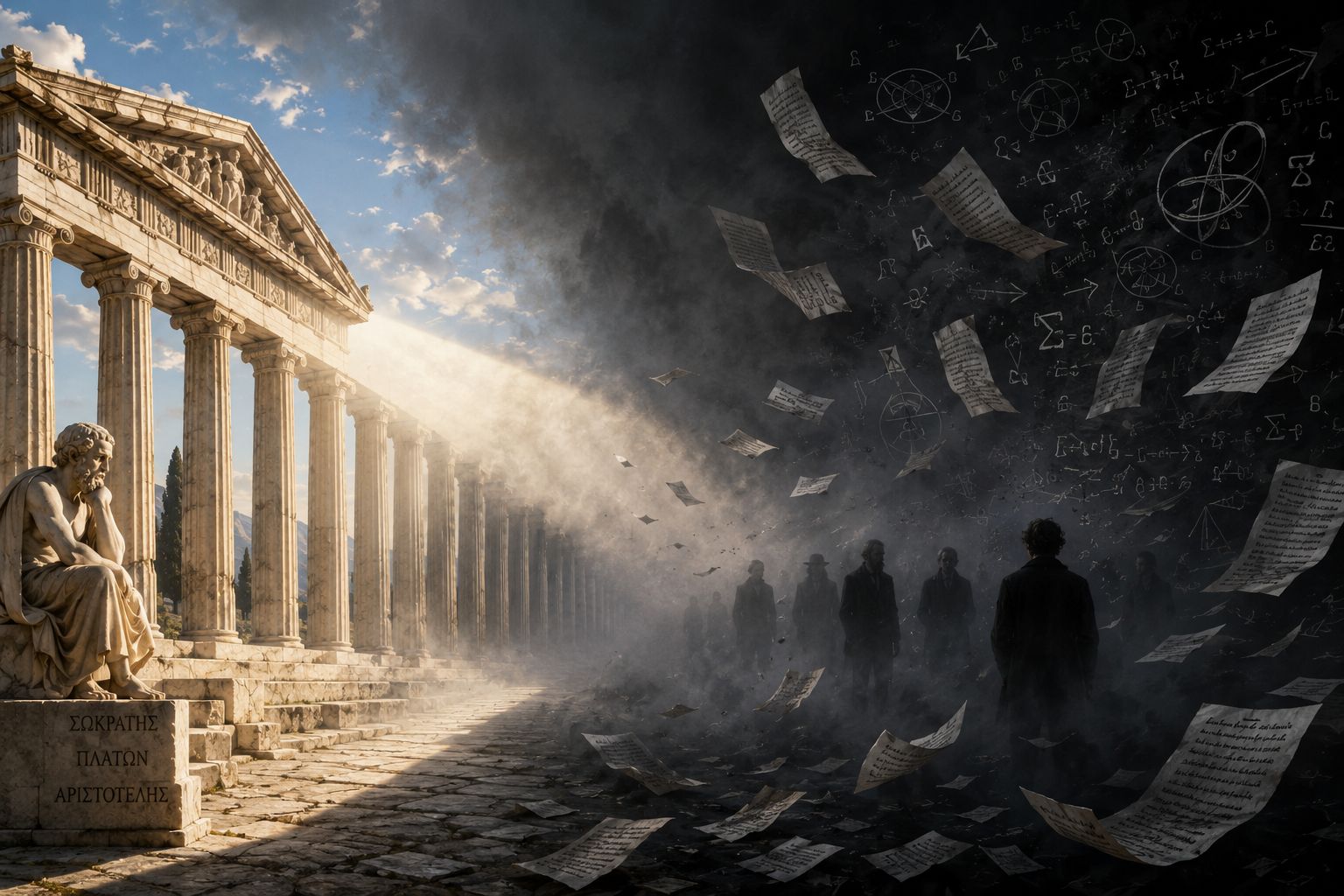
Philosophy has always asked humanity’s biggest questions. What is reality? Can we know anything with certainty? Does free will exist? What makes an action morally right? These questions have occupied some of the greatest minds in history, and the answers continue to shape science, politics, religion, and everyday life.
Unlike mythology or theology, philosophy built its reputation on reason. Philosophers certainly disagreed with one another, sometimes profoundly, but they generally shared one ambition. They wanted to replace confusion with understanding. A successful philosophical argument should make an idea clearer than it was before. Even when readers reject the conclusion, they should at least understand how the philosopher arrived there.
That is why philosophy has produced some of humanity’s greatest intellectual achievements. Aristotle laid the foundations of formal logic. David Hume transformed our understanding of causation and skepticism. John Stuart Mill refined utilitarian ethics. Karl Popper changed the philosophy of science by arguing that scientific theories must remain open to falsification. Even when these thinkers reached controversial conclusions, they explained their reasoning in enough detail for others to criticize it.
The same principle extends beyond philosophy. Albert Einstein’s theory of general relativity is notoriously difficult, yet physicists can explain every equation, every assumption, and every prediction. Quantum mechanics may appear bewildering, but its mathematical framework allows scientists to calculate phenomena with astonishing precision. Complexity alone does not make an idea suspicious. Some subjects are genuinely difficult because reality itself is complicated.
The trouble begins when difficulty stops serving understanding.
A reader who studies a demanding book should gradually feel that the pieces are coming together. Individual concepts become clearer. Arguments reveal their internal logic. Earlier chapters begin to illuminate later ones. Progress may be slow, but it exists. If careful reading only produces greater confusion, the problem may not lie entirely with the reader.
That distinction became increasingly important during the twentieth century. A number of influential philosophers abandoned the traditional ideal of clarity and embraced an entirely different style of writing. Their books became famous for dense terminology, endless neologisms, elaborate metaphors, and sentences that stretched across half a page. The more obscure the prose became, the more profound it often appeared to admirers.
Many readers accepted this as the unavoidable price of deep thought.
Others suspected something very different.
Difficult does not mean profound
There is an unfortunate habit in academic life. People often assume that if they cannot understand a text, the author must be extraordinarily intelligent. Few readers immediately ask whether the writing itself might simply be poor. Instead, they blame themselves. They reread the same paragraph repeatedly, consult commentaries, compare translations, and search for hidden meanings. Eventually, many convince themselves that obscurity is evidence of genius.
History suggests otherwise.
Some of the greatest philosophers wrote with remarkable clarity. Bertrand Russell discussed logic, mathematics, politics, religion, and language in prose that remains accessible more than a century later. Daniel Dennett tackled consciousness, free will, evolution, and artificial intelligence without hiding behind impenetrable jargon. Peter Singer writes about ethics in language that educated non-specialists can follow. Their arguments may be controversial, but readers usually know exactly what those arguments are.
Even philosophers famous for their difficulty often remain far clearer than their reputation suggests. Immanuel Kant’s sentences are undeniably long, yet his technical vocabulary follows carefully defined rules. Ludwig Wittgenstein’s later philosophy frequently consists of short observations rather than labyrinthine prose. W. V. O. Quine challenged deeply entrenched assumptions about language and knowledge, but he presented his reasoning in a way that other philosophers could analyze, criticize, or reject. Their writing demands effort because their ideas are complex, not because they deliberately obscure them.
This distinction matters enormously.
A genuinely difficult argument still allows readers to identify its premises, evaluate its logic, and decide whether the conclusion follows. Different philosophers may disagree about the answer, but they usually understand the question. By contrast, an obscure argument often resists even basic analysis. Readers struggle to identify what exactly is being claimed. Terms appear without clear definitions. Metaphors replace explanations. Scientific vocabulary enters the discussion without obvious purpose. The text begins to resemble poetry more than philosophy.
Of course, philosophy has always employed metaphor. Plato wrote myths. Friedrich Nietzsche filled his books with aphorisms and symbolism. Søren Kierkegaard used fictional characters to explore existential questions. None of this prevented them from making recognizable arguments. Their literary style enriched the philosophy rather than replacing it.
The problem emerges when style becomes more important than substance.
If every criticism can be dismissed by claiming that the critic simply “does not understand,” meaningful debate becomes almost impossible. A theory that cannot be explained clearly cannot easily be tested, challenged, or improved. Philosophy gradually stops functioning as a search for truth and starts functioning as a performance. The author’s authority replaces the author’s argument.
Several philosophers warned about this long before the controversy reached its peak. The logical positivists argued that philosophical claims should possess clear meaning and logical structure. Bertrand Russell repeatedly criticized unnecessary obscurity, insisting that philosophy should aspire to the same intellectual honesty found in science. Later, Daniel Dennett introduced the concept of a “deepity”—a statement that appears profound because it combines a trivial truth with an unsupported or meaningless interpretation. Such statements impress readers while contributing surprisingly little to genuine understanding.
Not everyone agreed with these criticisms. Many continental philosophers argued that ordinary language cannot adequately express the deepest questions about existence, consciousness, or society. They believed that new ideas require new vocabulary and that unfamiliar language is sometimes unavoidable. That defense deserves to be taken seriously, and this article will return to it repeatedly.
Nevertheless, a difficult question remains.
How can we distinguish genuinely profound philosophy from language that merely sounds profound?
The answer lies not in whether a philosopher writes difficult prose, but in whether that difficulty ultimately produces greater understanding. Throughout the twentieth century, that distinction became the center of one of philosophy’s fiercest debates. Some thinkers transformed the humanities forever. Others convinced critics that philosophy had begun confusing obscurity with insight. No figure illustrates that controversy better than Martin Heidegger.
Heidegger: When language stops communicating
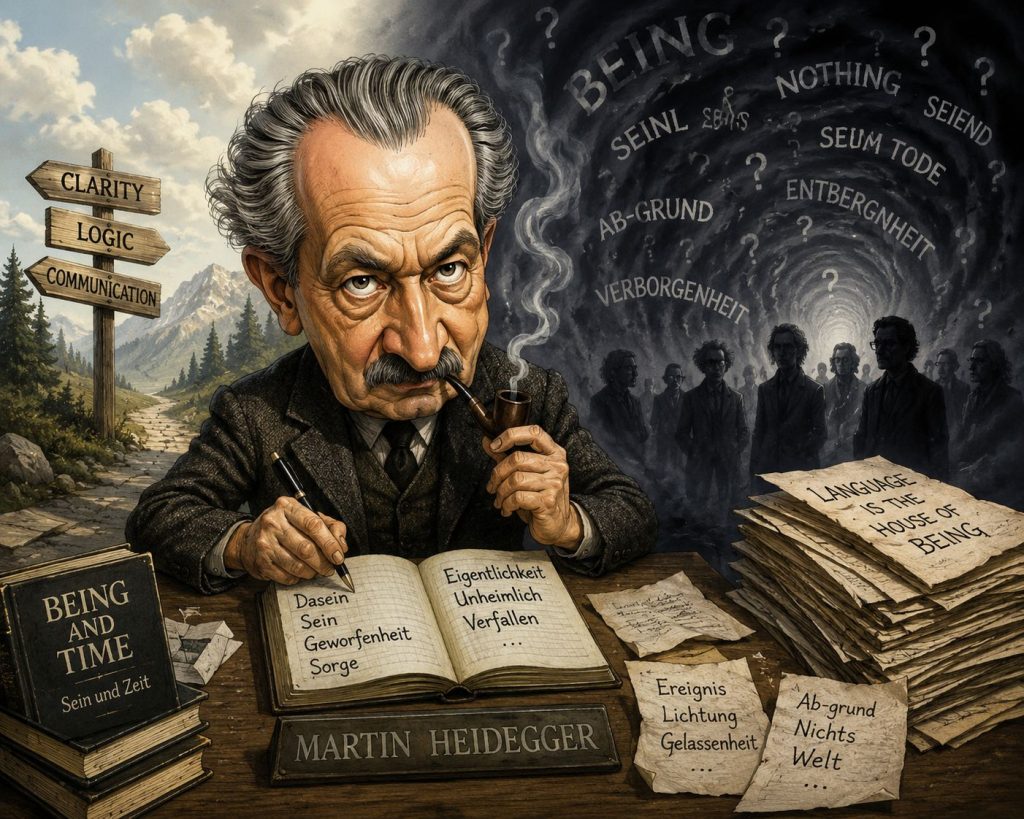
No philosopher better illustrates the controversy over obscurity than Martin Heidegger. Few thinkers shaped twentieth-century philosophy as profoundly. His influence reaches far beyond phenomenology and existentialism into hermeneutics, literary theory, postmodernism, political philosophy, and theology. Jean-Paul Sartre, Hans-Georg Gadamer, Hannah Arendt, Jacques Derrida, and countless others built upon his ideas. Even philosophers who rejected his conclusions rarely ignored him. Yet alongside this enormous influence came a persistent question that refuses to disappear: did Heidegger communicate profound ideas, or did he simply make philosophy unnecessarily incomprehensible?
Heidegger himself believed that ordinary language prevented genuine philosophical inquiry. According to him, Western philosophy had misunderstood the nature of Being since the time of Plato. Everyday words carried centuries of hidden assumptions that distorted our thinking before we even began asking philosophical questions. If philosophy hoped to rediscover the meaning of existence, Heidegger argued, it first had to reshape language itself. Familiar vocabulary could not solve an unfamiliar problem.
This ambition explains why his books often seem written in an entirely different language. Readers quickly encounter terms such as Dasein, Being-in-the-world, Being-toward-death, worldhood, thrownness, the clearing, ready-to-hand, present-at-hand, and Ereignis, usually translated as enowning or appropriation. Some expressions represent ordinary German words that Heidegger assigned highly technical meanings. Others are neologisms that have no obvious equivalent in English. Still others combine familiar words into entirely new philosophical concepts. Even professional philosophers frequently disagree about how particular passages should be translated, let alone interpreted.
None of this automatically proves Heidegger guilty of obscurantism. Mathematics also creates new terminology. So does physics. If a discipline discovers genuinely new phenomena, new language often follows. Heidegger’s defenders therefore argue that his unusual vocabulary reflects intellectual necessity rather than stylistic excess. They insist that readers expecting ordinary prose misunderstand the very project Heidegger was attempting to accomplish.
That defense deserves serious consideration.
The problem is that many passages remain extraordinarily difficult even after readers learn Heidegger’s terminology. Technical language normally becomes clearer once its definitions are understood. Medical textbooks appear intimidating at first, yet students gradually learn what each anatomical structure or physiological process means. Mathematical symbols initially confuse beginners, but they eventually form a coherent system governed by precise rules. Heidegger’s writing often produces the opposite experience. Readers master the vocabulary only to discover that the surrounding arguments remain just as elusive.
His lecture What Is Metaphysics? became the center of this controversy. There Heidegger introduced one of the most famous sentences in modern philosophy:
“The Nothing itself nothings.”
Supporters argue that Heidegger was challenging conventional logic. According to this interpretation, “nothing” should not be understood merely as the absence of things but as an essential feature of human existence. Anxiety confronts people with the possibility that beings as a whole might withdraw, revealing “the Nothing” in a way that ordinary language cannot adequately express. Heidegger therefore deliberately transformed “nothing” into a verb because conventional grammar prevented him from describing this existential experience.
Critics found that explanation deeply unconvincing.
The philosopher Rudolf Carnap responded with one of the most influential attacks in twentieth-century philosophy. Carnap argued that Heidegger confused grammar with logic. In ordinary language, “nothing” does not refer to an object. It simply indicates the absence of objects. Turning “nothing” into something capable of performing actions violated the basic rules governing meaningful statements. According to Carnap, the sentence created an illusion of profundity by treating a logical expression as though it named an actual thing.
Carnap’s criticism reached beyond a single sentence. He believed that much of metaphysics relied on grammatical confusion. Language allows people to construct sentences that appear meaningful despite lacking any clear conditions under which they could be true or false. In his view, Heidegger’s prose exemplified this problem. It resembled meaningful discourse without satisfying the logical requirements necessary for genuine philosophical argument.
The criticism did not stop with Carnap. Bertrand Russell repeatedly warned that philosophy should aspire to the clarity and intellectual honesty found in science rather than imitate poetry or mysticism. Although Russell wrote comparatively little about Heidegger specifically, he regarded much of continental philosophy as increasingly detached from logical analysis. Later, A. J. Ayer advanced similar objections, arguing that statements incapable of empirical verification or logical analysis often fail to express meaningful propositions at all. While these philosophers differed in important respects, they agreed that obscurity should never become evidence of philosophical depth.
Heidegger’s admirers answer that logical positivists fundamentally misunderstood his project. They argue that Carnap demanded scientific precision from a philosopher who was investigating the preconditions of science itself. Questions concerning Being, existence, mortality, and human experience cannot always be expressed through the same linguistic framework used in physics or formal logic. If philosophy merely repeated ordinary language, they contend, it could never reveal the assumptions hidden within that language. From this perspective, Heidegger’s unusual style represents an attempt to expand thought rather than to obscure it.
Even if one accepts that defense, an uncomfortable question remains.
How much obscurity is justified?
Every discipline requires specialized vocabulary, but no discipline benefits from unnecessary confusion. If readers repeatedly struggle to identify a philosopher’s claims, distinguish arguments from metaphors, or determine whether a conclusion follows from its premises, the burden increasingly shifts to the author. Intellectual difficulty may be unavoidable. Intellectual opacity is another matter entirely.
He may have helped establish a tradition in which obscurity itself acquired academic prestige. Whether one views him as a revolutionary thinker or an exceptionally gifted stylist, his influence extends far beyond his own work. Many later continental philosophers adopted the assumption that radically new ideas require radically new language. Their critics responded that the new language often concealed remarkably old problems.
That debate did not end with Heidegger.
In many ways, it had only just begun.
Lacan: When mathematics became psychoanalysis
If Heidegger transformed philosophical language, Jacques Lacan transformed philosophical obscurity into an art form. Even many of his admirers admit that reading Lacan can feel like solving a puzzle with missing pieces. His seminars frequently wandered from psychoanalysis to linguistics, topology, algebra, logic, and literature before returning to the original subject. Technical terms appeared without warning. Mathematical symbols suddenly interrupted discussions of desire. Diagrams replaced ordinary explanations. By the end of a lecture, listeners often found themselves wondering whether they had witnessed a profound intellectual breakthrough or an extraordinarily sophisticated performance.
Lacan did not believe this complexity was accidental. He argued that the unconscious cannot be understood through ordinary language because language itself structures human thought. His famous claim that “the unconscious is structured like a language” became one of the most influential ideas in modern psychoanalysis. Drawing heavily upon the linguist Ferdinand de Saussure, Lacan argued that unconscious desires emerge through systems of symbols rather than biological instincts alone. The proposal was ambitious and, at least in broad outline, philosophically coherent.
The controversy began when Lacan started borrowing concepts from mathematics.
Throughout his writings, readers encounter Möbius strips, toruses, cross-caps, Borromean knots, set theory, topology, imaginary numbers, and formal logic. These concepts appear not in discussions of geometry or mathematics, but in explanations of sexuality, identity, desire, psychosis, and the unconscious. Lacan insisted that these mathematical structures captured relationships that ordinary language could not express. According to him, topology revealed the architecture of the human mind more effectively than traditional psychology.
One of his most famous statements illustrates the problem. Discussing sexuality and symbolic structures, Lacan compared the phallus to the mathematical square root of minus one. The comparison has generated decades of debate because he never demonstrated why this particular mathematical object explains anything about human psychology. Mathematicians understand the imaginary unit because it occupies a precise place within a rigorously defined formal system. Outside that system, the analogy becomes increasingly difficult to justify. Critics therefore argued that Lacan had borrowed mathematical terminology primarily because it sounded scientific rather than because it strengthened his argument.
The same criticism applies to his fascination with topology. A Möbius strip possesses only one continuous surface. A torus resembles the shape of a doughnut. Borromean knots consist of three interconnected rings in which removing any single ring causes the entire structure to fall apart. These objects are perfectly legitimate mathematical constructions, and they have important applications in geometry and topology. Lacan repeatedly invoked them to describe the relationship between what he called the Real, the Symbolic, and the Imaginary—the three domains that supposedly organize human experience.
The immediate question is obvious.
Why should these particular mathematical objects describe the human mind better than ordinary concepts? Lacan rarely offered anything resembling a mathematical proof. Nor did he provide empirical evidence showing that these topological structures predict psychological behavior. Instead, the diagrams often functioned as elaborate metaphors. Admirers found them intellectually illuminating. Critics regarded them as visual ornaments that created an illusion of scientific precision without supplying its substance.
Few critics expressed this concern more forcefully than physicist Alan Sokal and mathematician Jean Bricmont. In their book Fashionable Nonsense, they devoted an entire chapter to Lacan’s use of mathematics. They did not criticize him for discussing mathematics outside its traditional domain. Philosophers have every right to draw inspiration from other disciplines. Rather, Sokal and Bricmont argued that Lacan repeatedly employed advanced mathematical concepts without demonstrating any meaningful connection to the psychological phenomena under discussion. In their view, the technical vocabulary functioned rhetorically rather than analytically.
The criticism struck a nerve because it came from specialists rather than philosophical opponents. Sokal and Bricmont understood the mathematics Lacan cited. Their objection was not that the mathematics was incorrect. It was that it had become detached from its original meaning. A mathematical concept derives its power from precise definitions and logical relationships. Once those definitions disappear, the terminology may retain its aura of sophistication while losing the very properties that made it scientifically valuable.
Lacan’s supporters responded that Sokal and Bricmont had misunderstood the nature of metaphor. They argued that Lacan never intended topology to operate as mathematics in the strict sense. Instead, topological figures served as heuristic devices—visual models that helped readers imagine relationships within the unconscious that resist ordinary description. According to this interpretation, demanding mathematical rigor misses the point entirely. The diagrams should be judged as philosophical tools rather than scientific theories.
This defense raises another difficulty.
If the mathematics functions only as metaphor, why employ highly specialized mathematical language instead of ordinary metaphors that readers already understand? Shakespeare explained love without invoking topology. Freud transformed psychology without requiring knot theory. Philosophers have long relied upon analogies drawn from everyday life because effective metaphors illuminate unfamiliar ideas through familiar experience. Lacan often moved in the opposite direction, replacing familiar language with concepts that required years of mathematical training before readers could even grasp the analogy.
The controversy therefore extends beyond Lacan himself. It concerns a broader question about intellectual responsibility. Scholars should certainly borrow ideas from other disciplines when those ideas genuinely improve understanding. Biology has enriched philosophy. Economics has enriched political science. Neuroscience continues to reshape debates about consciousness and free will. Interdisciplinary thinking often produces remarkable discoveries.
Yet borrowing also carries obligations.
A philosopher who invokes quantum mechanics should understand quantum mechanics. A literary theorist citing topology should explain why topology contributes something essential to the argument. Otherwise, scientific language risks becoming little more than decoration. Technical terminology can impress readers simply because it appears difficult. The appearance of rigor, however, should never replace rigor itself.
Whether Lacan ultimately deserves the accusations leveled against him remains a matter of philosophical disagreement. There is no doubt that he profoundly influenced psychoanalysis, literary criticism, feminist theory, and cultural studies. His concepts continue to inspire thousands of scholars around the world. At the same time, there is equally little doubt that his writing exemplifies a style of philosophy in which obscurity itself became part of the intellectual experience. Readers often leave his work with the impression that they have encountered something extraordinarily profound. Determining exactly what that profound insight consists of, however, can prove remarkably elusive.
The controversy only intensified with the philosophers who followed him. If Lacan clothed psychoanalysis in the language of mathematics, Jacques Derrida would question whether language itself could ever possess a stable meaning.
Derrida: If words never settle
If Heidegger made philosophy difficult and Lacan wrapped psychoanalysis in mathematical language, Jacques Derrida challenged something even more fundamental. He questioned whether language itself could ever possess stable meaning. His work transformed literary criticism, philosophy, law, political theory, architecture, and cultural studies. Few twentieth-century philosophers have exercised greater influence. Few have also attracted as much criticism for the opacity of their writing.
Unlike Lacan, Derrida rarely filled his books with mathematics. His obscurity arose from another source. He believed that ordinary philosophical writing falsely suggests that language can communicate fixed meanings. According to Derrida, words acquire meaning only through their relationships with other words. Every concept depends upon concepts that themselves require explanation. Every definition points toward another definition. Meaning therefore never reaches a final destination. It continually shifts as language refers to itself.
This insight became one of the foundations of what later became known as deconstruction.
Unfortunately, the idea proved far easier to summarize than to read in Derrida’s own words.
His books often proceed through long chains of wordplay, etymology, literary references, and subtle distinctions that can span dozens of pages before reaching a tentative conclusion. He frequently invents new expressions, deliberately chooses ambiguous wording, and explores multiple interpretations simultaneously. Readers expecting a straightforward argument quickly discover that Derrida has little interest in writing straightforward philosophy.
Perhaps his most famous concept illustrates the problem.
Derrida introduced the term différance, deliberately replacing the “e” in the French word différence with an “a.” The alteration cannot be heard in spoken French because both words sound identical. It exists only in writing. Derrida used this subtle spelling difference to argue that meaning always involves both difference and deferral. Words differ from one another, yet they also postpone complete understanding because each definition requires additional definitions.
The concept itself is intellectually interesting.
The presentation is another matter.
Many readers finish Derrida’s explanation uncertain whether they have encountered a philosophical argument, a linguistic observation, or an elaborate literary performance. The boundaries between these possibilities often remain deliberately blurred. Derrida himself resisted simple summaries of his work because he believed that summaries inevitably distort the complexities of language.
This approach delighted many literary theorists.
It frustrated many philosophers.
Critics argued that Derrida frequently replaced ordinary philosophical analysis with endless reinterpretation. If every text contains countless equally valid meanings, how can one distinguish a convincing interpretation from an implausible one? If language never reaches stable conclusions, what prevents philosophy from dissolving into subjective opinion? These questions became central objections to deconstruction throughout the English-speaking world.
The American philosopher John Searle famously clashed with Derrida over precisely these issues. Searle argued that communication succeeds because language generally possesses stable conventions that speakers understand. Without those conventions, everyday conversation would become impossible. Derrida responded that Searle underestimated the complexity of language and overlooked the instability hidden beneath apparently straightforward communication. Their disagreement became one of the most celebrated philosophical disputes of the late twentieth century because it reflected two radically different conceptions of philosophy itself.
Supporters of Derrida insist that many critics misunderstand his intentions.
They argue that Derrida never claimed language is meaningless. Instead, he argued that meaning is more complicated than philosophers traditionally assumed. Deconstruction does not destroy meaning; it reveals tensions, assumptions, and contradictions that texts often conceal. According to this interpretation, Derrida teaches readers to examine philosophical and literary works more carefully rather than to abandon rational inquiry altogether.
Even if that interpretation is correct, another difficulty remains.
Why express these ideas in such an extraordinarily complicated manner?
Many philosophers have questioned certainty without abandoning clarity. David Hume demonstrated the limits of human knowledge in elegant prose. Ludwig Wittgenstein exposed the ways language misleads us through brief observations and concrete examples. W. V. O. Quine challenged the distinction between analytic and synthetic truths using arguments that readers can reconstruct step by step. Their conclusions may be controversial, but their reasoning remains accessible enough for critics to evaluate.
Derrida chose a different path.
He frequently wrote as though the style of his prose formed part of the argument itself. Ambiguity was not merely an unfortunate consequence of discussing language. It became a philosophical method. Sentences doubled back on themselves. Definitions shifted while readers followed them. Footnotes occasionally became miniature essays. Seemingly minor details expanded into lengthy discussions that wandered through literature, linguistics, psychoanalysis, and history before returning to the original topic. Admirers viewed this style as a faithful reflection of language’s complexity. Critics saw something far less charitable: writing that transformed relatively simple insights into unnecessarily complicated prose.
This disagreement has never disappeared.
More than fifty years after Derrida’s most influential works appeared, scholars continue debating whether deconstruction uncovered genuine philosophical problems or merely encouraged endless interpretation without clear standards for deciding among competing readings. The debate itself demonstrates Derrida’s enormous influence. Regardless of where one stands, it is impossible to deny that he fundamentally changed the humanities.
Yet for critics of obscurantism, Derrida represents another step away from philosophy’s traditional ideal. Instead of clarifying concepts, philosophy increasingly explored why concepts resist clarification. Instead of resolving ambiguity, it celebrated ambiguity. Instead of treating language as a tool for expressing ideas, language itself became the principal object of investigation. Whether that transformation enriched philosophy or weakened it remains one of the defining intellectual questions of the modern era.
The movement toward increasingly abstract language did not stop with Derrida. Other thinkers would push the trend even further, importing advanced mathematics, psychoanalysis, and scientific terminology into literary theory with results that many scientists found increasingly difficult to defend.
Kristeva: Mathematics without calculation
If Jacques Derrida blurred the boundaries between language and philosophy, Julia Kristeva blurred the boundaries between literary theory, psychoanalysis, linguistics, semiotics, and mathematics. Few scholars have crossed as many disciplines during a single career. Her work influenced feminism, literary criticism, cultural studies, linguistics, and psychoanalysis. Like several other leading figures of French theory, however, she also became a target of criticism for the way she incorporated scientific concepts into her writing.
Kristeva’s early work frequently draws upon mathematics, formal logic, set theory, topology, and theoretical physics. Readers encounter references to infinite sets, higher-dimensional spaces, mathematical transformations, and formal systems while discussing literature, poetry, language, and human subjectivity. At first glance, these references create the impression of extraordinary theoretical sophistication. The question, however, is whether they actually contribute to the argument or merely decorate it.
That distinction became central to the criticism directed at her work.
Borrowing ideas from another discipline is not inherently problematic. Philosophy has borrowed from mathematics since Pythagoras. Economics has borrowed from psychology. Neuroscience increasingly informs debates about free will and consciousness. Scientific discoveries often inspire entirely new philosophical questions. Interdisciplinary thinking has repeatedly advanced human knowledge.
Successful borrowing, however, requires more than importing technical vocabulary.
When physicists use differential equations, those equations generate measurable predictions. When mathematicians invoke set theory, every concept follows precise logical rules. Technical language derives its authority from the structure supporting it. Remove that structure, and the terminology loses the very characteristics that made it scientifically meaningful.
Critics argued that this is exactly what happened in parts of Kristeva’s work.
In Revolution in Poetic Language, for example, mathematical terminology frequently appears alongside discussions of literature and psychoanalysis. Kristeva invokes concepts from formal mathematics while examining the structure of poetic language, symbolic systems, and subjectivity. Yet she rarely explains how these mathematical concepts operate beyond the level of metaphor. Readers therefore encounter scientific vocabulary without discovering why science itself is necessary to the argument.
Alan Sokal and Jean Bricmont devoted considerable attention to this issue in Fashionable Nonsense. Unlike philosophical critics who questioned Kristeva’s conclusions, Sokal and Bricmont focused almost exclusively on the scientific material. They argued that her mathematical references often appeared disconnected from their original meanings. According to them, concepts from mathematics had become rhetorical devices rather than analytical tools.
Their criticism was remarkably restrained.
They did not argue that philosophers should never discuss mathematics. Nor did they claim that literary theory must avoid scientific ideas. Instead, they proposed a much simpler standard. If an author invokes advanced mathematics, readers should be able to understand why the mathematics is relevant. If the technical concepts can be removed without affecting the argument, their presence becomes difficult to justify.
Kristeva’s defenders reject this criticism for several reasons. They argue that Sokal and Bricmont approached literary theory with the expectations of physicists. Scientific concepts, they maintain, can function metaphorically without preserving every detail of their formal definition. Literature has always borrowed from science, just as science has borrowed metaphors from literature. Demanding mathematical rigor from philosophical metaphor misunderstands the purpose of interdisciplinary writing.
This defense contains an important truth.
Metaphors rarely preserve every property of the ideas they borrow. When people describe DNA as a “blueprint,” nobody imagines that genes literally resemble architectural drawings. The metaphor succeeds because it highlights one relevant similarity while ignoring countless differences. Philosophical writing may legitimately employ the same strategy.
The difficulty arises when readers can no longer distinguish metaphor from explanation.
If mathematical terminology merely illustrates an idea, ordinary language usually communicates the same point more clearly. If the mathematics performs genuine explanatory work, then the author should demonstrate exactly how it advances the argument. Many critics contend that Kristeva often occupies an uncomfortable middle ground. The technical language appears too elaborate to function as a simple metaphor, yet too loosely defined to function as mathematics.
This problem extends far beyond Kristeva herself.
Academic writing often rewards complexity. Dense prose can create an impression of sophistication even when simpler language would communicate the same ideas more effectively. Young scholars quickly learn that difficult writing sometimes attracts greater prestige than accessible writing. Articles filled with specialized terminology appear more theoretical, while straightforward prose risks being dismissed as insufficiently rigorous. The incentive structure therefore encourages authors to write in increasingly abstract language, regardless of whether abstraction actually improves understanding.
That tendency helps explain why the controversy surrounding French theory reached well beyond philosophy departments. Scientists, mathematicians, and logicians increasingly questioned whether technical concepts were being used to illuminate ideas or merely to impress readers. The dispute gradually evolved into something much larger than a disagreement over individual philosophers. It became a debate about the standards governing intellectual life itself.
No figure illustrated that controversy more dramatically than Luce Irigaray. Her criticisms of modern science would provoke one of the most famous disputes between scientists and continental philosophers, raising a question that continues to divide scholars today: can a scientific theory itself be masculine or feminine?
Irigaray: When Einstein became sexist
Few philosophers attracted as much criticism from scientists as Luce Irigaray. A leading figure in feminist philosophy and psychoanalysis, Irigaray devoted much of her career to examining how language, culture, and philosophy reflected male perspectives. Many of her observations about the historical exclusion of women from intellectual life contributed significantly to feminist thought. There is little doubt that women faced enormous barriers in universities, scientific institutions, and public life for centuries. On that point, historians overwhelmingly agree.
The controversy began when Irigaray extended her criticism from scientific institutions to science itself.
Her most frequently cited example concerns Albert Einstein’s famous equation, E = mc². Discussing the relationship between science and gender, Irigaray suggested that Einstein’s equation was a “sexed equation.” She argued that modern physics privileged the speed of light over other speeds that might be more relevant to human experience. In another passage, she suggested that fluid mechanics had historically received less scientific attention than solid mechanics because fluids symbolically represented femininity.
These statements immediately attracted criticism from physicists.
The first problem concerns Einstein’s equation itself. The speed of light does not appear in E = mc² because physicists arbitrarily chose to privilege it. It appears because experiments repeatedly demonstrate that light travels at a universal constant in a vacuum, a fact that underlies Einstein’s theory of special relativity. Replacing that constant with another speed would not produce an alternative scientific perspective. It would simply produce incorrect physics.
The criticism of fluid mechanics proved equally controversial.
According to Irigaray, Western science had historically concentrated on rigid bodies while neglecting fluids. Critics responded that this description bears little resemblance to the history of science. Long before modern feminism emerged, scientists devoted enormous effort to understanding rivers, oceans, blood circulation, atmospheric dynamics, aerodynamics, hydraulics, and the movement of gases. Entire branches of engineering developed around fluid mechanics because modern civilization depends upon understanding how liquids and gases behave.
The history of aviation illustrates the point perfectly.
Aircraft remain in the air because engineers understand airflow over wings. Weather forecasting depends upon fluid dynamics operating within the Earth’s atmosphere. Cardiologists study blood flow through arteries and veins. Oceanographers analyze currents that regulate the global climate. Chemical engineers design industrial systems based upon the movement of fluids. Far from being neglected, fluid mechanics became one of the central disciplines of modern science.
This does not mean that every criticism Irigaray made should be dismissed.
There is an important distinction between criticizing scientific knowledge and criticizing scientific institutions. Historians have documented countless examples of women excluded from universities, denied academic positions, refused funding, or prevented from publishing their work. Many scientific communities remained overwhelmingly male well into the twentieth century. Social biases undoubtedly influenced who became a scientist and whose work received recognition.
That historical reality, however, does not automatically imply that the laws of physics themselves possess masculine or feminine characteristics.
Gravity accelerates falling objects regardless of the researcher’s gender. Maxwell’s equations describe electromagnetism equally well whether the physicist is male or female. Einstein’s theory of relativity neither strengthens nor weakens because of the identity of the person who discovers it. Scientific theories ultimately succeed by explaining observations and surviving experimental testing. Their validity depends upon evidence rather than the demographic characteristics of their authors.
This distinction became central to the broader controversy surrounding French theory.
Scientists generally welcomed discussions about discrimination within academia. Those discussions relied upon historical evidence and sociological analysis. They became far more skeptical when philosophical arguments appeared to challenge the content of established scientific theories without engaging the underlying mathematics or experimental data. Critics argued that some philosophers blurred the line between sociology and science, moving from legitimate observations about scientific communities to unsupported conclusions about scientific knowledge itself.
Alan Sokal and Jean Bricmont regarded Irigaray as one of the clearest examples of this tendency. In Fashionable Nonsense, they argued that her references to physics frequently misunderstood the concepts she criticized. Their objection was not ideological. They did not dispute her broader interest in gender or social inequality. Instead, they maintained that philosophical critiques of science should accurately describe the science under discussion. Otherwise, readers unfamiliar with physics could easily mistake rhetorical claims for scientific criticism.
Irigaray’s supporters offer a different interpretation.
They argue that critics often read her too literally. According to this view, she was not proposing an alternative version of physics but exposing the cultural assumptions embedded within scientific language and historical practice. Scientific metaphors, institutional priorities, and research traditions, they argue, do not emerge in a cultural vacuum. Even if the laws of nature remain objective, the questions scientists choose to investigate may still reflect broader social values.
That argument deserves consideration.
Scientific research has certainly been influenced by politics, economics, religion, and military priorities throughout history. Governments fund some projects while ignoring others. Pharmaceutical companies invest in profitable treatments rather than unprofitable ones. Military conflicts have accelerated developments in nuclear physics, computing, and aerospace engineering. Social values undeniably shape the direction of scientific research.
Yet that observation does not support every conclusion drawn from it.
The existence of cultural influences on science does not imply that scientific theories themselves become culturally relative. Distinguishing between the sociology of science and the content of science remains essential. Confusing the two risks undermining precisely the evidence-based reasoning that allows science to correct its own mistakes.
The debate surrounding Irigaray therefore illustrates a broader pattern that had begun with Heidegger and continued through Lacan, Derrida, and Kristeva. Increasingly, critics argued that philosophical writing relied upon metaphor where argument was needed, borrowed scientific language without scientific rigor, and blurred distinctions that earlier philosophers had carefully maintained. The controversy would reach its most ambitious expression in the work of Gilles Deleuze and Félix Guattari, whose philosophy attempted nothing less than a complete reinvention of reality itself.
Deleuze and Guattari: A philosophy of endless metaphors
By the time Gilles Deleuze and Félix Guattari published Anti-Oedipus in 1972, continental philosophy had entered entirely new territory. Heidegger had reinvented philosophical language. Lacan had clothed psychoanalysis in mathematics. Derrida had questioned the stability of meaning itself. Deleuze and Guattari went even further. They attempted to replace the traditional vocabulary of philosophy altogether with a new conceptual universe populated by machines, flows, rhizomes, assemblages, territories, and bodies without organs.
Their ambition was breathtaking.
They did not merely criticize existing philosophy. They sought to reconstruct the way people think about psychology, politics, economics, biology, art, history, and even reality itself. Few philosophical projects of the twentieth century were as expansive. Few were also as difficult to summarize in ordinary language.
The central concept of Anti-Oedipus illustrates both the originality and the controversy surrounding their work. Deleuze and Guattari rejected Sigmund Freud’s claim that unconscious desire primarily revolves around family relationships, especially the Oedipus complex. Instead, they argued that desire is fundamentally productive. Human beings do not merely lack things and seek to satisfy those deficiencies. Desire continuously creates connections, relationships, institutions, and social structures. In their words, desire operates through what they called desiring-machines.
The expression immediately raises a question.
What exactly is a desiring-machine?
Readers searching for a precise definition often become frustrated. Sometimes the term appears to describe biological processes. Elsewhere it refers to psychological mechanisms. In other passages it seems to encompass social institutions, economic systems, or even relationships between ideas. The concept expands and contracts throughout the book, making it remarkably flexible but also remarkably difficult to evaluate. Critics argue that almost anything can become a desiring-machine provided the context changes sufficiently.
The same pattern appears throughout their philosophy.
Capitalism becomes a system of “flows.” Society constantly “deterritorializes” and “reterritorializes” itself. Human identity dissolves into “assemblages.” Knowledge spreads through “rhizomes” rather than hierarchical trees. Traditional categories collapse beneath an ever-expanding network of interconnected metaphors. The vocabulary is imaginative and often visually striking. Determining where metaphor ends and philosophical explanation begins proves considerably more difficult.
Perhaps no expression better illustrates this problem than the famous body without organs.
At first glance, the phrase appears absurd. Human bodies obviously possess organs. Deleuze and Guattari did not literally deny biology. Instead, the expression refers to a state in which habitual structures, identities, and social constraints dissolve, allowing new possibilities for desire and experience to emerge. Supporters describe the concept as a powerful challenge to rigid ways of thinking. Critics respond that even after this explanation, the phrase remains so elastic that almost any interpretation appears acceptable.
The problem extends beyond unusual terminology.
Good philosophical concepts normally become more precise as they develop. Aristotle carefully defined substance, causation, and virtue. Immanuel Kant systematically distinguished phenomena from noumena. Bertrand Russell introduced logical distinctions that readers can apply consistently throughout his work. Once the definitions are understood, they constrain future arguments. Readers know what the philosopher means and can determine whether later conclusions follow from earlier premises.
Deleuze and Guattari often move in the opposite direction.
Their concepts evolve continuously. A term introduced in one chapter may acquire additional meanings in the next. Metaphors overlap with one another. Images replace definitions. Literary references merge with psychology, anthropology, economics, and biology until disciplinary boundaries largely disappear. Admirers see extraordinary intellectual creativity. Critics see a philosophical system in which concepts become so flexible that they resist clear analysis.
Alan Sokal and Jean Bricmont reached precisely that conclusion. They argued that Deleuze and Guattari repeatedly borrowed scientific terminology from chaos theory, mathematics, thermodynamics, and physics without demonstrating why those concepts belonged in the philosophical arguments under discussion. Scientific language, they suggested, often served an aesthetic rather than an explanatory function. Technical vocabulary created an impression of rigor while remaining detached from the scientific theories that originally gave it meaning.
Their supporters strongly reject this criticism.
According to many interpreters, Deleuze and Guattari never intended to construct scientific theories. They wrote philosophy, not physics. Their concepts function as tools for generating new perspectives rather than hypotheses awaiting empirical confirmation. Asking whether a rhizome or a body without organs is scientifically accurate, they argue, misunderstands the purpose of the project. Philosophy explores possibilities that science cannot easily capture.
That defense contains an important insight.
Philosophy has never operated under exactly the same standards as science. Plato’s allegory of the cave is not an experiment. Thomas Hobbes’ Leviathan is not a biological organism. John Rawls’ original position is a thought experiment rather than a historical event. Philosophers routinely employ hypothetical models to illuminate complex ideas. Their value depends upon whether they increase understanding rather than whether they literally describe reality.
The difficulty lies elsewhere.
Thought experiments usually simplify complicated problems. They isolate essential features so readers can follow the reasoning step by step. Deleuze and Guattari frequently move in the opposite direction. Their metaphors multiply faster than they are explained. Instead of reducing complexity, they often increase it. Readers finish a chapter with more terminology than they began with, yet frequently struggle to identify the central argument connecting those terms together.
This style became enormously influential.
The language of rhizomes, deterritorialization, assemblages, and desiring-machines spread through literary criticism, sociology, anthropology, education, architecture, political theory, and cultural studies. Entire academic fields adopted concepts originally introduced in Anti-Oedipus and A Thousand Plateaus. For supporters, these ideas opened entirely new ways of understanding society. For critics, they demonstrated how philosophical language could become increasingly detached from precision while retaining enormous academic prestige.
By the early 1990s, frustration among scientists had reached a breaking point. They no longer wished merely to criticize individual philosophers. Instead, one physicist decided to perform an experiment. Rather than arguing that obscurantism had infiltrated parts of academia, he would test whether prestigious journals could distinguish sophisticated nonsense from genuine scholarship.
His name was Alan Sokal.
Here’s the next section, focusing on the Sokal Hoax.
The Sokal Hoax: An experiment that embarrassed academia
Most philosophical controversies unfold over decades. Scholars publish books. Critics respond. Conferences debate competing interpretations. Consensus, if it ever arrives, develops slowly.
The Sokal Hoax unfolded very differently.
It took only a single article.
In 1996, Alan Sokal, a theoretical physicist at New York University, decided to perform an unusual experiment. Rather than criticizing fashionable academic writing from the outside, he wanted to discover whether a respected journal could distinguish genuine scholarship from meaningless prose. His target was Social Text, one of the most influential journals in cultural studies and postmodern theory.
Sokal deliberately wrote an article that sounded impressive while saying as little as possible.
The paper, titled Transgressing the Boundaries: Toward a Transformative Hermeneutics of Quantum Gravity, overflowed with references to quantum mechanics, chaos theory, relativity, feminist theory, postmodern philosophy, and progressive politics. It cited many of the intellectual figures discussed in this article, including Jacques Derrida, Jacques Lacan, Julia Kristeva, Gilles Deleuze, Félix Guattari, Luce Irigaray, and Jean Baudrillard. Technical scientific language appeared throughout the paper, yet much of it lacked any coherent connection to the philosophical claims surrounding it.
The article was accepted and published.
Only after publication did Sokal reveal what he had done.
In another journal, Lingua Franca, he explained that the article had been an intentional parody. He had deliberately mixed accurate scientific terminology with absurd conclusions, unsupported analogies, and fashionable jargon to determine whether the editors would publish an article that flattered their ideological assumptions despite lacking intellectual substance.
His answer was yes.
The revelation exploded across the academic world.
Supporters of Sokal argued that he had exposed a serious weakness within parts of the humanities. If trained editors could not distinguish sophisticated nonsense from legitimate scholarship, something had gone badly wrong. They claimed that fashionable language, political sympathy, and prestigious citations had begun replacing careful argument and critical scrutiny.
Others viewed the affair very differently.
Many scholars condemned Sokal’s deception itself. Academic publishing depends upon trust, they argued, and deliberately submitting fraudulent work violated that trust. Others insisted that one successful hoax could not invalidate entire fields of scholarship. Every discipline occasionally publishes weak papers. Medicine, psychology, economics, and physics have all experienced embarrassing failures of peer review. The existence of one fraudulent article does not prove that an entire discipline lacks intellectual merit.
That criticism is perfectly fair.
The Sokal Hoax did not disprove postmodern philosophy.
Nor did it demonstrate that every philosopher discussed in this article wrote meaningless prose.
What it did demonstrate was something much narrower, yet potentially more important. It showed that an article could successfully imitate the style of certain academic writing while containing arguments that even its author regarded as nonsensical. The experiment therefore raised uncomfortable questions about the standards used to evaluate scholarship in some intellectual communities.
The controversy intensified two years later when Sokal collaborated with Belgian physicist Jean Bricmont to publish Fashionable Nonsense. Unlike the hoax itself, this book abandoned parody altogether. Instead, Sokal and Bricmont carefully examined passages from several celebrated French intellectuals. They quoted the original texts, explained the scientific concepts involved, and argued that many authors employed mathematics and physics in ways that professional scientists would regard as misleading or incorrect.
Their criticism was surprisingly restrained.
They did not argue that philosophers should never discuss science. Nor did they claim that scientific concepts belong exclusively to scientists. Philosophy has always drawn inspiration from mathematics, astronomy, biology, and physics. Aristotle relied upon biology. René Descartes borrowed from geometry. Bertrand Russell helped develop mathematical logic. Interdisciplinary thinking has often enriched philosophy rather than weakened it.
Sokal and Bricmont demanded only one thing.
If philosophers borrow scientific ideas, they should borrow them accurately.
A discussion of quantum mechanics should reflect what quantum mechanics actually says. References to topology should preserve the essential properties of topology. Mathematical terminology should clarify an argument rather than merely decorate it. Otherwise, scientific language risks becoming a rhetorical device rather than an intellectual tool.
The implications extended far beyond French philosophy.
The Sokal Hoax forced universities to confront an uncomfortable possibility. Could academic prestige sometimes protect weak arguments from criticism? Could complicated language discourage readers from asking simple questions? Could journals mistake obscurity for originality simply because nobody wished to admit that a celebrated author might not be making a coherent point?
Those questions remain controversial nearly three decades later.
The Sokal Hoax neither destroyed postmodern philosophy nor vindicated every one of its critics. It did, however, accomplish something far more enduring. It reminded scholars that intellectual authority should never replace intellectual accountability. An argument deserves acceptance because it withstands careful examination, not because it sounds sophisticated or comes wrapped in technical vocabulary.
Yet one important question still remained unanswered.
If obscure writing survives repeated criticism, why does it remain so influential? Why do ideas that many readers struggle to understand continue shaping entire academic disciplines? The answer lies not only in philosophy itself, but also in the psychology and sociology of academic life.
Why nonsense survives
One might expect ideas that resist understanding to disappear naturally. Science eventually abandons theories that fail experimental tests. Engineers stop using bridges that collapse. Physicians stop prescribing treatments that consistently fail their patients. Knowledge advances because errors gradually give way to better explanations.
Philosophy operates differently.
Philosophical theories rarely disappear after a decisive experiment because philosophy addresses questions that often cannot be settled experimentally. This creates an environment where weak arguments can survive far longer than they would in the natural sciences. If an idea cannot be tested, rejected, or clearly disproved, it may continue attracting followers for generations.
That alone, however, does not explain why extraordinarily obscure writing often becomes extraordinarily influential.
Psychology offers part of the answer.
Human beings naturally associate complexity with intelligence. A simple explanation can appear unsophisticated even when it is correct. Conversely, difficult language often creates the impression that the underlying ideas must be profound. This tendency appears well beyond philosophy. Medical advice sounds more convincing when it uses technical terminology. Financial experts impress clients with specialized vocabulary. Politicians frequently substitute bureaucratic language for clear communication. Complexity carries social prestige.
Universities can unintentionally reinforce this tendency.
Young researchers quickly discover that publishing original work is difficult. Producing genuinely new ideas is even more difficult. The temptation therefore arises to present familiar observations in unfamiliar language. A simple claim wrapped in sufficiently elaborate terminology may appear more innovative than it actually is. Readers often hesitate to ask obvious questions because nobody wishes to reveal ignorance in front of colleagues.
This creates a powerful social dynamic.
Imagine a graduate seminar discussing an exceptionally difficult text. Ten students silently struggle to understand the reading. Each privately suspects that the prose may be unnecessarily obscure. Yet each also assumes that everyone else understands it perfectly. Rather than risking embarrassment, they remain silent. The professor interprets their silence as careful reflection. The students interpret one another’s silence as evidence of comprehension. Nobody asks the question that everyone is secretly thinking.
Social psychologists call this phenomenon pluralistic ignorance.
Individuals privately reject an idea while incorrectly believing that everyone else accepts it. As a result, the appearance of consensus becomes stronger than the reality. Similar mechanisms influence politics, financial markets, and public opinion. Academic life is not immune. If enough people behave as though they understand a difficult text, others may conclude that the fault lies with themselves rather than with the writing.
Prestige amplifies the effect.
Once a philosopher acquires an international reputation, later readers often approach the work with different expectations. Obscurity becomes evidence of depth rather than a potential weakness. Commentaries multiply. Entire careers develop around interpreting passages whose meaning remains uncertain. New books explain earlier books, which themselves require further explanation. The secondary literature eventually grows larger than the original texts. At that point, questioning the original author’s clarity becomes increasingly difficult because so much intellectual investment depends upon assuming that the work contains profound insights waiting to be uncovered.
Citation practices can strengthen this process.
Academic publishing rewards authors whose work receives frequent citations. Influential philosophers therefore appear repeatedly in articles, dissertations, and conference presentations. Later scholars cite them partly because they remain important, but their importance also grows because they continue being cited. Sociologist Robert K. Merton described this phenomenon as the Matthew Effect: recognition tends to accumulate around scholars who are already famous. Success breeds further success, regardless of whether later generations critically reexamine the original work.
None of this proves that influential philosophers are wrong.
Popularity and error are not the same thing.
Many of history’s greatest thinkers became influential because they genuinely transformed human understanding. Charles Darwin revolutionized biology. Albert Einstein revolutionized physics. Ludwig Wittgenstein revolutionized the philosophy of language. Their reputations reflect remarkable intellectual achievements rather than social prestige alone.
The difficulty arises when prestige begins replacing critical evaluation.
A philosopher should never receive immunity from criticism simply because generations of scholars have admired the work. Every argument deserves examination on its own merits. Every concept should withstand careful questioning. Every claim should become clearer rather than more mysterious as readers devote increasing effort to understanding it. If years of study leave experts unable to explain central ideas in ordinary language, criticism becomes not only legitimate but necessary.
There is another reason obscure philosophy survives.
Some ideas genuinely reward repeated reading. Plato, Kant, Hegel, and Wittgenstein all reveal new insights as readers become more familiar with their work. Consequently, readers often assume that every difficult philosopher belongs in the same category. Distinguishing genuine depth from unnecessary obscurity becomes remarkably challenging. Nobody wants to dismiss a future genius merely because the writing initially seems impenetrable.
This creates an understandable bias toward generosity.
Scholars prefer to assume that the meaning exists, even if they cannot yet identify it. Most of the time, that attitude serves intellectual progress well. Great discoveries often appear strange before they become familiar. Occasionally, however, generosity becomes excessive. Readers stop asking whether a difficult passage could have been written more clearly. Instead, they assume that every ambiguity conceals profound wisdom.
That assumption may represent the greatest danger of all.
Philosophy advances through criticism, not reverence. Socrates questioned the Sophists. Aristotle criticized Plato. Hume challenged rationalism. Kant responded to Hume. Russell dismantled British idealism. Karl Popper attacked logical positivism despite sharing many of its concerns. Progress occurred because philosophers treated no authority as beyond question.
The same principle should apply today.
An argument should persuade because its reasoning succeeds, not because its language intimidates. Technical vocabulary should clarify thought, not conceal it. Intellectual difficulty should emerge from the complexity of reality, not from the complexity of prose. Whenever readers begin confusing incomprehensibility with profundity, philosophy risks abandoning its oldest mission.
It ceases to illuminate the world.
Instead, it begins to obscure it.
The final question therefore becomes unavoidable. If difficult writing alone cannot distinguish genius from gibberish, what standards should we use instead?
Yes. The next logical chapter is the most important one in the article because it prevents it from becoming merely a collection of criticisms. It answers the obvious objection:
“How do you know these philosophers are wrong rather than simply difficult?”
That chapter gives the reader objective criteria.
How to distinguish profundity from gibberish
By this point, an obvious objection presents itself.
Every generation has dismissed ideas it failed to understand. Galileo’s astronomy appeared absurd to many of his contemporaries. Charles Darwin’s theory of evolution shocked much of Victorian society. Albert Einstein’s theory of relativity initially seemed incomprehensible even to many physicists. New ideas often sound strange because they challenge deeply rooted assumptions.
How, then, can anyone distinguish genuine intellectual breakthroughs from empty obscurity?
The answer cannot simply be clarity.
Some ideas are genuinely difficult. Quantum mechanics remains extraordinarily challenging despite a century of research. Modern mathematics contains concepts that require years of study before they become intuitive. Philosophy, too, sometimes confronts questions that resist simple answers. Demanding that every philosopher write like a newspaper columnist would impoverish the discipline rather than improve it.
Clarity, however, remains an essential virtue.
A difficult idea should become clearer with careful explanation. The reader may not immediately understand it, but every definition should reduce confusion rather than increase it. Technical concepts should illuminate the argument, not replace it. A philosopher who cannot explain a central idea in simpler language should at least explain why simplification fails. Obscurity requires justification just as much as simplicity does.
The second criterion is internal consistency.
A philosophical system should employ its concepts consistently throughout the argument. Definitions may become more refined as the discussion progresses, but they should not constantly shift according to convenience. Readers should know what a philosopher means by a particular term and should be able to recognize that meaning when it appears later. If key concepts continuously change their significance, evaluating the argument becomes almost impossible.
The third criterion is logical structure.
Readers should be able to identify the premises of an argument, follow the reasoning, and determine whether the conclusion actually follows. They may reject the premises or dispute the logic, but they should at least know what they are criticizing. If nobody can identify the conclusion because the discussion continually dissolves into metaphor, wordplay, or ambiguity, philosophical debate becomes extraordinarily difficult.
The fourth criterion concerns explanatory power.
A philosophical theory should explain something that competing theories fail to explain. Darwin explained biological diversity more successfully than special creation. Einstein explained anomalies that Newtonian physics could not. Bertrand Russell’s logical analysis resolved problems that earlier philosophers had struggled to formulate clearly. Good philosophy does not merely invent new terminology. It increases understanding.
The fifth criterion is openness to criticism.
Every worthwhile philosophical theory should expose itself to serious objections. Critics should be able to identify weaknesses, propose alternatives, and challenge underlying assumptions. If every objection receives the same response—”you simply do not understand”—the discussion quickly becomes unproductive. No philosopher, however brilliant, should become immune from criticism by making his or her writing sufficiently obscure.
Daniel Dennett captured this danger with the concept of the deepity. A deepity is a statement that appears profound because it possesses two different interpretations. One interpretation is true but trivial. The other is exciting but unsupported. Readers unconsciously slide between the two meanings, creating the illusion of depth without the burden of demonstrating anything substantial. The statement sounds profound largely because its ambiguity protects it from careful examination.
None of these criteria automatically disqualifies Heidegger, Derrida, Lacan, or any other philosopher discussed in this article. Reasonable scholars continue to disagree about the value of their work. Some readers genuinely find their ideas transformative. Others regard them as unnecessarily obscure. Intellectual disagreement is healthy. It has always driven philosophy forward.
What should concern us is something else entirely.
Philosophy loses its purpose when readers begin admiring obscurity for its own sake. Difficult writing should serve difficult ideas. It should never become a substitute for them. Whenever complexity itself becomes a badge of intellectual prestige, philosophers risk rewarding style over substance and reputation over reasoning.
The irony is impossible to ignore.
The discipline that once taught humanity how to question assumptions can itself become trapped by one of the oldest assumptions of all—that what sounds mysterious must necessarily be profound.
Conclusion: Philosophy’s first duty
The purpose of this article has not been to declare continental philosophy worthless. Such a conclusion would be as simplistic as the arguments it criticizes. Twentieth-century continental philosophy produced original insights into language, power, culture, history, politics, literature, and human existence. Heidegger fundamentally reshaped phenomenology. Derrida transformed literary criticism. Lacan changed psychoanalysis. Deleuze and Guattari inspired entirely new approaches to politics, sociology, and cultural theory. Their influence cannot honestly be denied.
Influence, however, is not the same as clarity.
Throughout this article, a recurring pattern has emerged. Scientific concepts become detached from their original meanings. Technical vocabulary replaces ordinary language. Metaphors gradually evolve into explanations. Arguments become increasingly difficult to reconstruct. Readers often leave with the impression that they have encountered something profound while struggling to explain exactly what they have learned. None of these features automatically proves that a philosophical theory is wrong. Taken together, however, they raise an important question about the standards philosophy should demand of itself.
The Sokal Hoax demonstrated that this question is more than theoretical.
Alan Sokal did not prove that postmodern philosophy is nonsense. He demonstrated something both narrower and more disturbing. It is possible to imitate the style of certain academic writing closely enough that specialists fail to distinguish parody from scholarship. That should concern every academic discipline. If sophisticated language can successfully conceal the absence of coherent argument, intellectual rigor has begun giving way to intellectual theater.
The danger extends far beyond philosophy.
Every profession develops jargon. Lawyers speak differently from engineers. Physicians use vocabulary unfamiliar to historians. Economists employ mathematical models that most people never study. Specialized language often serves an important purpose because it allows experts to communicate with precision. Problems arise only when jargon stops increasing precision and starts protecting ideas from criticism. At that point, technical language ceases to function as a tool of communication. It becomes a barrier to communication.
Philosophy should resist that temptation more than any other discipline.
Unlike physics or chemistry, philosophy cannot rely upon laboratory experiments to settle most of its disagreements. Its primary instrument is argument itself. Every claim must ultimately stand or fall according to the quality of its reasoning. If readers cannot identify that reasoning, philosophy loses the very mechanism through which it distinguishes stronger ideas from weaker ones. Obscurity may inspire admiration, but it rarely advances understanding.
Some defenders of continental philosophy would object that this criticism misunderstands their entire project. They would argue that reality itself is ambiguous, that ordinary language conceals rather than reveals important truths, and that genuinely new ways of thinking require genuinely new forms of expression. There is considerable force in that objection. Every intellectual revolution has introduced unfamiliar concepts that initially seemed strange. Demanding complete simplicity from every philosopher would reduce philosophy to little more than popular journalism.
The opposite mistake is equally dangerous.
If obscurity itself becomes evidence of profundity, philosophy abandons one of its oldest virtues. Socrates questioned accepted wisdom by asking simple questions. Aristotle organized knowledge through careful definitions. David Hume wrote with remarkable elegance despite addressing some of philosophy’s deepest problems. Bertrand Russell believed that even the most difficult ideas should become clearer through analysis rather than more mysterious. None of these thinkers confused incomprehensibility with depth.
Perhaps the best test of a philosophical theory is surprisingly simple.
After reading a difficult book, can someone explain its central ideas in ordinary language without destroying the argument? The explanation may still require patience and careful thought. Important nuances may disappear. Some technical vocabulary may remain unavoidable. Yet the essential claim should survive translation into clearer prose. If it cannot, one must ask whether the difficulty belongs to the idea itself or merely to the writing.
History suggests that genuinely great thinkers eventually become easier to understand, not because their ideas become simpler, but because their reasoning gradually reveals its internal structure. Einstein’s equations remain mathematically demanding, yet physicists can explain what relativity actually says. Darwin’s theory transformed biology, yet educated readers can understand its central principles without mastering genetics. Good ideas invite explanation. They do not fear it.
The same standard should apply to philosophy.
A philosopher should never receive admiration merely for sounding profound. Prestige should not replace precision. Reputation should not replace reasoning. Readers should never feel embarrassed for asking the simplest question of all: What exactly does this mean? If that question cannot be answered after hundreds of pages, criticism is not only justified. It becomes necessary.
Philosophy began more than two thousand years ago with a simple conviction: that human beings can improve their understanding of the world through careful reasoning and honest debate. That ambition remains as valuable today as it was in ancient Athens. The greatest philosophers challenge our assumptions, force us to rethink familiar ideas, and reveal truths we had previously overlooked.
They do not merely leave us confused.
Clarity is not the enemy of philosophy.
It is one of philosophy’s highest achievements.
Leave a Reply