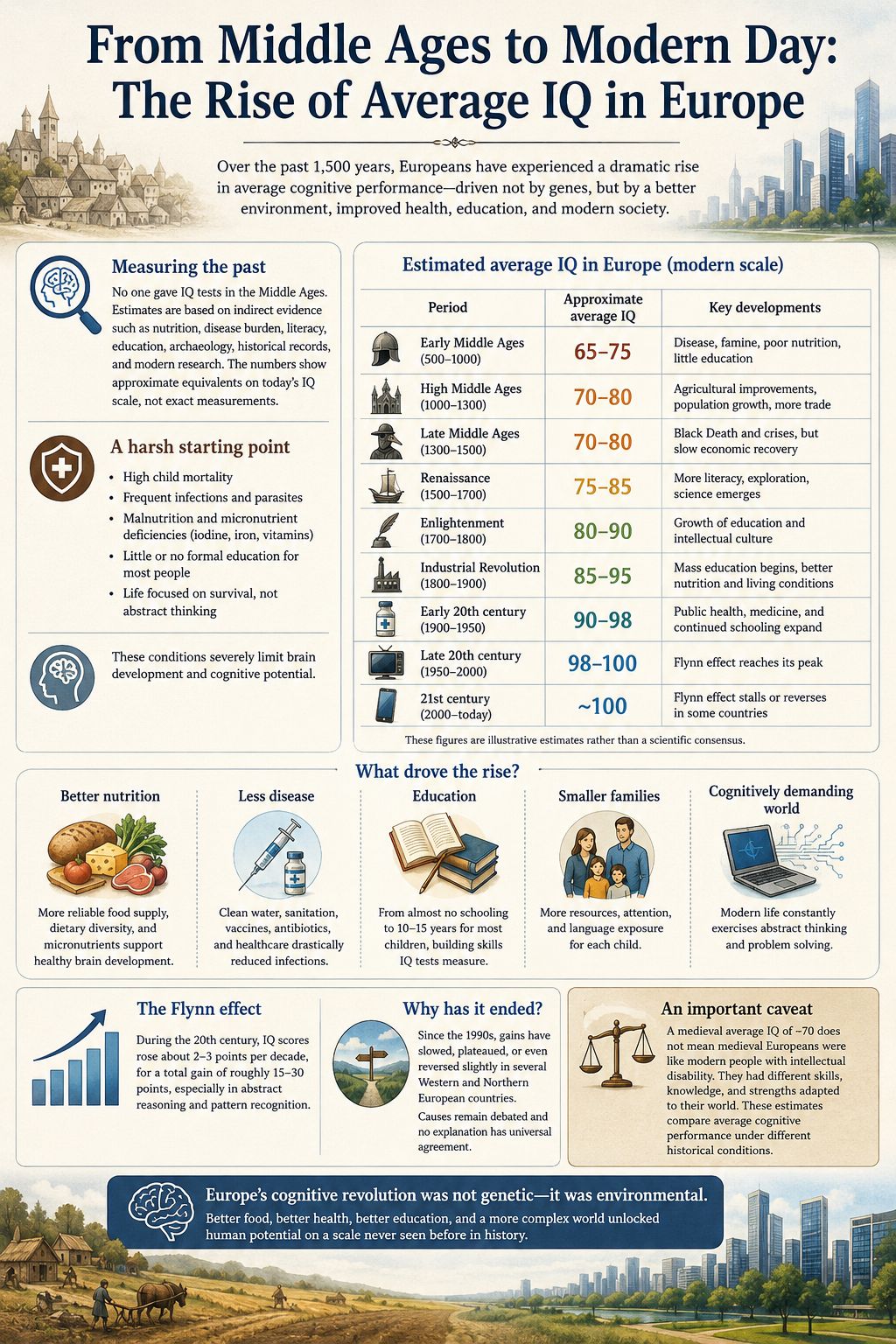
Walk through a medieval European village. Most people cannot read. Childhood diseases are everywhere. Food shortages are common. Parasites, contaminated water, and recurring epidemics shape everyday life. Children work from an early age instead of attending school. Scientific thinking barely exists outside monasteries and a handful of universities.
Now compare that world with modern Europe.
Children receive years of formal education. Vaccinations eliminate many deadly diseases. Nutrition is abundant. Technology constantly challenges people to think abstractly. The average person performs cognitive tasks every day that would have been unimaginable even two centuries ago.
Did all of this make Europeans more intelligent?
Many psychologists believe the answer is yes. The exact numbers remain controversial, but there is broad agreement that average cognitive performance rose dramatically over the past several centuries before largely stopping in the late twentieth century.
Measuring medieval intelligence
No one administered IQ tests in the Middle Ages. Every estimate is therefore indirect.
Researchers instead rely on evidence such as childhood nutrition, disease burden, literacy rates, education, reaction time studies, archaeological findings, historical records, and the well-documented Flynn effect. Together, these sources allow scientists to construct cautious estimates rather than precise measurements.
This distinction is important. Nobody knows whether the average medieval European would score exactly 72 or 76 on a modern IQ test. The estimates simply represent the cognitive performance we might expect if people from different historical periods were raised under the conditions of their own time.
The harsh environment of medieval Europe
The medieval world was extraordinarily difficult for healthy brain development.
Infant mortality was extremely high. Many children suffered repeated infections before reaching adulthood. Chronic malnutrition affected large parts of the population. Protein intake was often insufficient, while deficiencies of iodine, iron, and vitamins were widespread. Intestinal parasites and contaminated drinking water further impaired children’s development.
Modern neuroscience leaves little doubt that these conditions reduce cognitive performance. The human brain consumes enormous amounts of energy during childhood. When nutrients are scarce or disease constantly diverts the body’s resources, brain development suffers.
Education added another obstacle.
Outside wealthy families, monasteries, and a few cities, most Europeans never learned to read or write. Daily life emphasized practical survival rather than abstract reasoning. Mathematics rarely extended beyond basic arithmetic. Scientific thinking remained confined to a tiny intellectual elite.
None of this means medieval people were unintelligent in an everyday sense. A skilled blacksmith, builder, or farmer possessed remarkable practical knowledge. They simply grew up in environments that were far less favorable to developing the kinds of reasoning measured by modern IQ tests.
Estimated development of European IQ
Although estimates differ, many psychologists would consider the following progression plausible.
| Historical period | Estimated average IQ (modern scale) |
|---|---|
| Early Middle Ages (500–1000) | 65–75 |
| High Middle Ages (1000–1300) | 70–80 |
| Late Middle Ages (1300–1500) | 70–80 |
| Renaissance (1500–1700) | 75–85 |
| Enlightenment (1700–1800) | 80–90 |
| Industrial Revolution (1800–1900) | 85–95 |
| Early twentieth century | 90–98 |
| Late twentieth century | 98–100 |
| Twenty-first century | Around 100 |
These figures should never be interpreted as measurements. They are reconstructions based on historical evidence and modern research on cognitive development.
Better nutrition changed everything
Among the many explanations, nutrition is probably the strongest.
Human brains require proteins, fats, iodine, iron, zinc, and many vitamins during childhood. Throughout European history, these nutrients often fluctuated with harvests, wars, and local famines.
Agricultural improvements gradually transformed this situation. Better farming techniques increased food production. Trade diversified diets. Refrigeration, food preservation, and modern agriculture almost eliminated the catastrophic famines that repeatedly devastated medieval populations.
Each generation therefore entered adulthood with healthier brains than the one before.
Disease slowly disappeared
Disease was another enormous obstacle.
Repeated infections affect more than physical health. They consume energy that would otherwise support brain development. Children who survive chronic infections often perform worse on cognitive tests later in life.
Modern sanitation dramatically changed this picture.
Clean drinking water, sewage systems, vaccinations, antibiotics, and improved medical care greatly reduced childhood disease. Europeans today grow up under conditions that would have seemed miraculous just a few centuries ago.
Education expanded beyond imagination
Education also transformed society.
In the Middle Ages, literacy remained limited. By contrast, modern Europeans typically spend at least ten years in school.
Schools do not magically increase innate intelligence. However, they train many of the exact abilities that IQ tests measure. Students constantly solve abstract problems, recognize patterns, manipulate symbols, and practice logical reasoning.
Even everyday life became cognitively demanding. Banking, computers, maps, legal systems, smartphones, and scientific information require continuous abstract thinking.
James Flynn argued that modern societies increasingly reward this kind of reasoning, helping explain why IQ scores rose so rapidly during the twentieth century.
The remarkable Flynn effect
One of psychology’s most famous discoveries is the Flynn effect.
Beginning in the early twentieth century, IQ scores increased across much of the world at an astonishing rate.
Typical gains reached approximately two to three IQ points every decade.
Over an entire century, this amounted to gains of roughly fifteen to thirty IQ points depending on the country and the specific test used.
The largest improvements appeared on tests measuring abstract reasoning rather than vocabulary or factual knowledge.
This surprised psychologists. Human evolution simply cannot proceed quickly enough to explain such rapid changes. The obvious conclusion was that environmental improvements had substantially increased measured cognitive performance.
Why did the Flynn effect stop?
The most surprising development came after the 1990s.
Across much of Northern and Western Europe, IQ gains slowed dramatically. In several countries they stopped entirely. Some studies even found modest declines.
Norway, Denmark, Finland, Sweden, the Netherlands, and the United Kingdom have all reported evidence that the Flynn effect has plateaued or slightly reversed, although the size of these changes varies between studies.
No consensus explanation exists.
Some researchers believe Europe simply reached the maximum gains that environmental improvements could provide. Others point to changes in education, increased screen time, demographic factors, environmental influences, or shifts in the kinds of cognitive skills modern life encourages.
The evidence remains inconclusive.
Does a medieval IQ of 70 mean medieval Europeans resembled modern people with intellectual disability?
Absolutely not.
This is one of the most common misunderstandings.
Modern IQ tests were designed for literate, technologically advanced societies. Medieval Europeans possessed highly developed practical abilities that these tests only partially measure. A farmer who could manage crops, predict weather, repair tools, build structures, and navigate unfamiliar terrain demonstrated sophisticated intelligence adapted to a completely different environment.
When researchers estimate a medieval average IQ of around 70 to 75, they are attempting to compare average cognitive performance under radically different developmental conditions. They are not claiming that medieval people lacked creativity, wisdom, or practical competence.
The greatest cognitive revolution in European history
The story of European intelligence is not one of genetic transformation. It is primarily a story of environment.
Better nutrition allowed children’s brains to develop more fully. Medicine eliminated diseases that once stole cognitive potential. Education taught abstract reasoning to entire populations instead of tiny elites. Modern society surrounded people with increasingly complex intellectual challenges.
Together, these changes likely produced one of the largest increases in average cognitive performance ever documented.
For much of the twentieth century, each new generation genuinely outperformed the previous one on standardized intelligence tests.
Today, however, that extraordinary rise appears to have ended. Europe has reached a plateau, and whether average IQ will remain stable, increase again, or slowly decline has become one of the most intriguing questions in modern psychology.
Leave a Reply