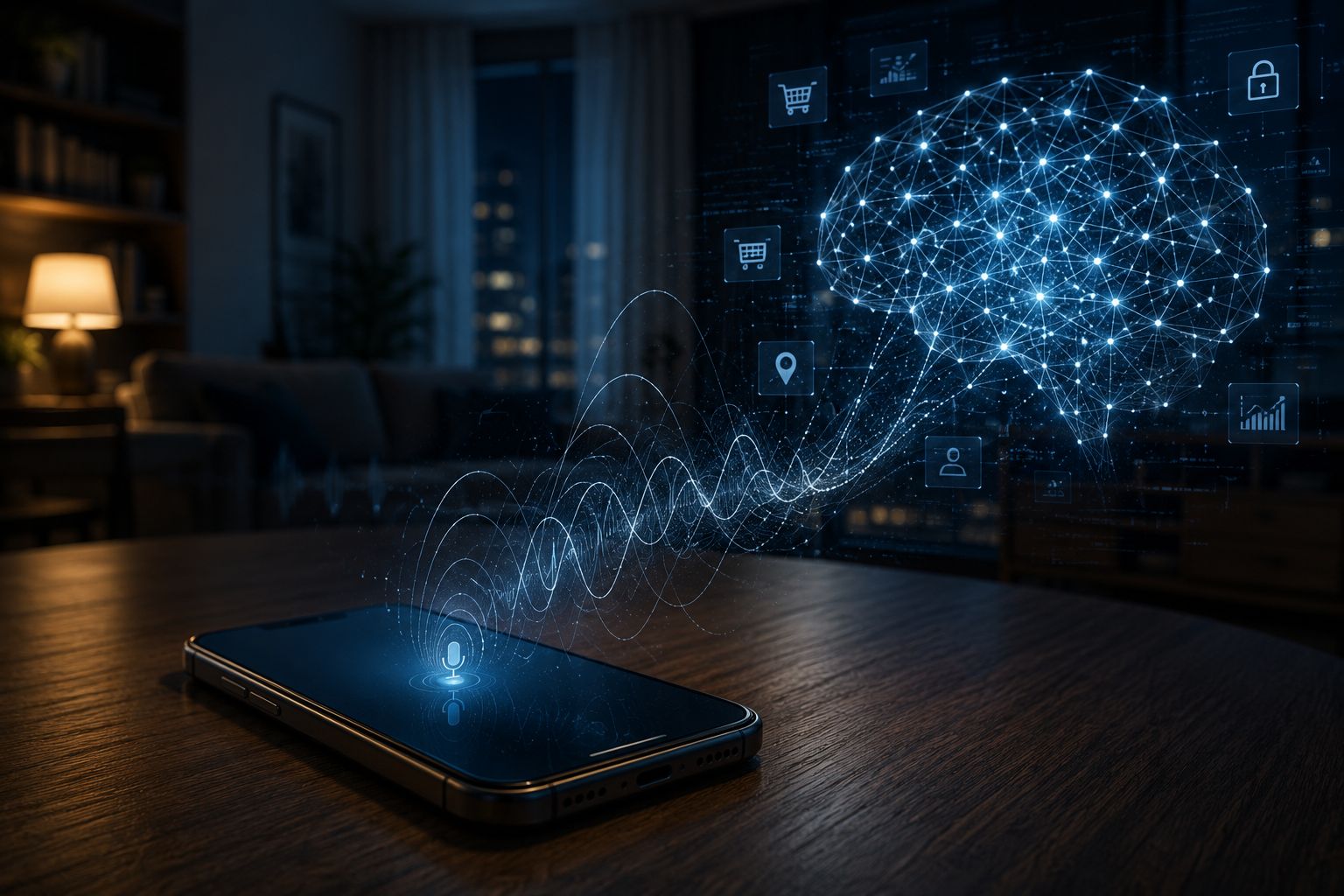
Every few months, someone experiences the same unsettling coincidence. They discuss a holiday with a friend, mention a new car, or casually talk about buying a coffee machine. Hours later, advertisements for exactly those products appear on their phone. Many people immediately reach the same conclusion: the smartphone must have been listening.
Despite countless anecdotes, there is no convincing public evidence that Apple, Google, or other major smartphone manufacturers continuously record ambient conversations or ordinary phone calls to target advertisements. Independent investigations have repeatedly suggested that companies achieve remarkably accurate predictions without needing to activate the microphone. Search history, location, browsing behavior, purchases, contacts, calendars, and app usage already reveal astonishing amounts about our lives.
Yet dismissing the discussion entirely would be a mistake.
The more interesting question is not whether smartphones secretly listen today. It is whether they could one day listen continuously, even while sitting idle in our pockets, and whether the technological barriers that make such surveillance impractical today will eventually disappear.
Today’s limitations
At first glance, continuous listening sounds technically straightforward. Smartphone microphones consume relatively little power, and modern processors are capable of recognizing speech with impressive accuracy. Recording, however, is only the first step. The real challenge begins once the audio has been captured.
Someone must process every spoken word.
If billions of smartphones continuously uploaded conversations to remote servers, the amount of data would be staggering. Companies would need enormous data centers filled with specialized processors capable of analyzing speech around the clock. The costs of storing, indexing, and processing this information would be immense.
The burden would not end there. Every recording would first have to travel through the global telecommunications infrastructure. Mobile network operators would need to carry this constant stream of data through millions of cell towers, fiber-optic backhaul connections, switching equipment, and internet backbone networks. Today’s mobile infrastructure is designed primarily for web browsing, messaging, video streaming, and occasional voice calls. It is not designed for every smartphone to transmit live audio every second of the day.
Such a system would require massive investments not only from technology companies but also from telecommunications providers. Even with modern compression, the additional traffic could overwhelm existing networks unless they were significantly expanded. The infrastructure costs alone would likely exceed any additional advertising revenue generated by analyzing every conversation.
Battery life presents another obstacle. Although smartphones have become dramatically more efficient over the past decade, continuously recording, processing, and transmitting audio still consumes energy. Consumers would quickly notice if their batteries suddenly lasted only half as long. Such a change would almost certainly attract attention from reviewers, security researchers, and software engineers who routinely monitor smartphone behavior.
These practical limitations explain why technology companies currently rely on a different strategy. Instead of recording conversations, they collect enormous amounts of other information that is far cheaper to obtain and surprisingly informative. Search history, GPS location, online purchases, browsing habits, social media activity, contacts, calendars, and app usage together create remarkably detailed behavioral profiles. Artificial intelligence combines these fragments to predict interests, preferences, and even future purchases with impressive accuracy.
In many cases, companies simply do not need to listen.
Artificial intelligence changes the equation
The situation could look very different within the next decade.
Artificial intelligence is becoming dramatically more efficient. Modern smartphones already contain dedicated AI processors capable of recognizing speech, translating languages, identifying objects in photographs, and answering increasingly complex questions without relying entirely on cloud computing. Every new generation performs more calculations while consuming less electricity.
This evolution fundamentally changes the economics of continuous listening. Instead of transmitting every spoken word to distant servers, future smartphones could analyze conversations locally using on-device artificial intelligence. Most audio would never leave the device. The software could recognize topics, identify interests, and retain only small summaries or anonymous signals rather than complete recordings.
The difference would be enormous. Instead of uploading gigabytes of audio every day, a smartphone might transmit only a few kilobytes of processed information. Existing mobile networks, cell towers, and fiber-optic infrastructure would experience only a modest increase in traffic, while companies would still obtain valuable insights into users’ interests. At the same time, data centers would no longer need to process billions of continuous audio streams because much of the computational work would already have been completed on the device itself.
Ironically, advances in artificial intelligence may remove the very infrastructure limitations that currently make continuous listening economically unattractive.
Batteries continue to improve
Battery technology evolves more slowly than processors, but steady progress continues. Modern smartphone chips consume significantly less energy than those produced only a few years ago, particularly when performing artificial intelligence tasks on specialized hardware rather than general-purpose processors.
Researchers are also improving battery chemistry, charging speeds, and power management. Although yearly gains may appear modest, their cumulative effect over a decade can be substantial.
If future smartphones routinely operate for several days on a single charge while performing sophisticated AI calculations, battery life may no longer be a meaningful obstacle. Combined with local processing, continuous speech analysis could become technically feasible without users noticing any significant reduction in performance or battery endurance.
Would companies actually do it?
People once believed that the technology giants had enough moral restraint to reject mass surveillance. They were wrong. Before Edward Snowden’s revelations, most people knew little about the scale of intelligence agencies’ surveillance programs. Snowden presented compelling evidence that mass surveillance was already taking place. But did anything truly change after his disclosures? We all know the answer.
The real concern
Targeted advertising may not be the greatest issue.
A system capable of continuously understanding human speech could infer emotional states, relationship problems, financial difficulties, medical symptoms, political opinions, religious beliefs, daily routines, and countless other aspects of private life. Combined with existing information about location, internet activity, purchases, and social networks, such data would create the most comprehensive behavioral profiles ever assembled.
Governments would inevitably recognize the potential. Law enforcement agencies could argue that continuous analysis helps prevent terrorism or violent crime. Healthcare organizations might claim it detects depression or dementia earlier than current methods. Insurance companies could seek more accurate assessments of individual risk. Each proposal might appear reasonable in isolation, yet together they would represent an unprecedented expansion of digital surveillance.
Will it happen?
From a purely technological perspective, the answer increasingly appears to be yes. Advances in artificial intelligence, specialized processors, battery efficiency, and on-device computing steadily reduce the practical barriers that exist today. The greatest obstacles are no longer microphones or processors but economics, infrastructure, regulation, and public acceptance.
Ironically, artificial intelligence itself may eliminate many of those economic and infrastructure constraints. By analyzing conversations directly on smartphones instead of transmitting every spoken word through mobile networks to distant data centers, future systems could operate with only minimal additional demands on existing telecommunications infrastructure.
Whether companies ultimately deploy such technology is therefore unlikely to depend on engineering alone. It will depend on legislation, public opinion, ethical considerations, competitive pressure, and the willingness of consumers to trade another portion of their privacy for greater convenience.
The question is no longer whether smartphones could eventually listen all the time. The question is whether society will decide that they should.
Leave a Reply