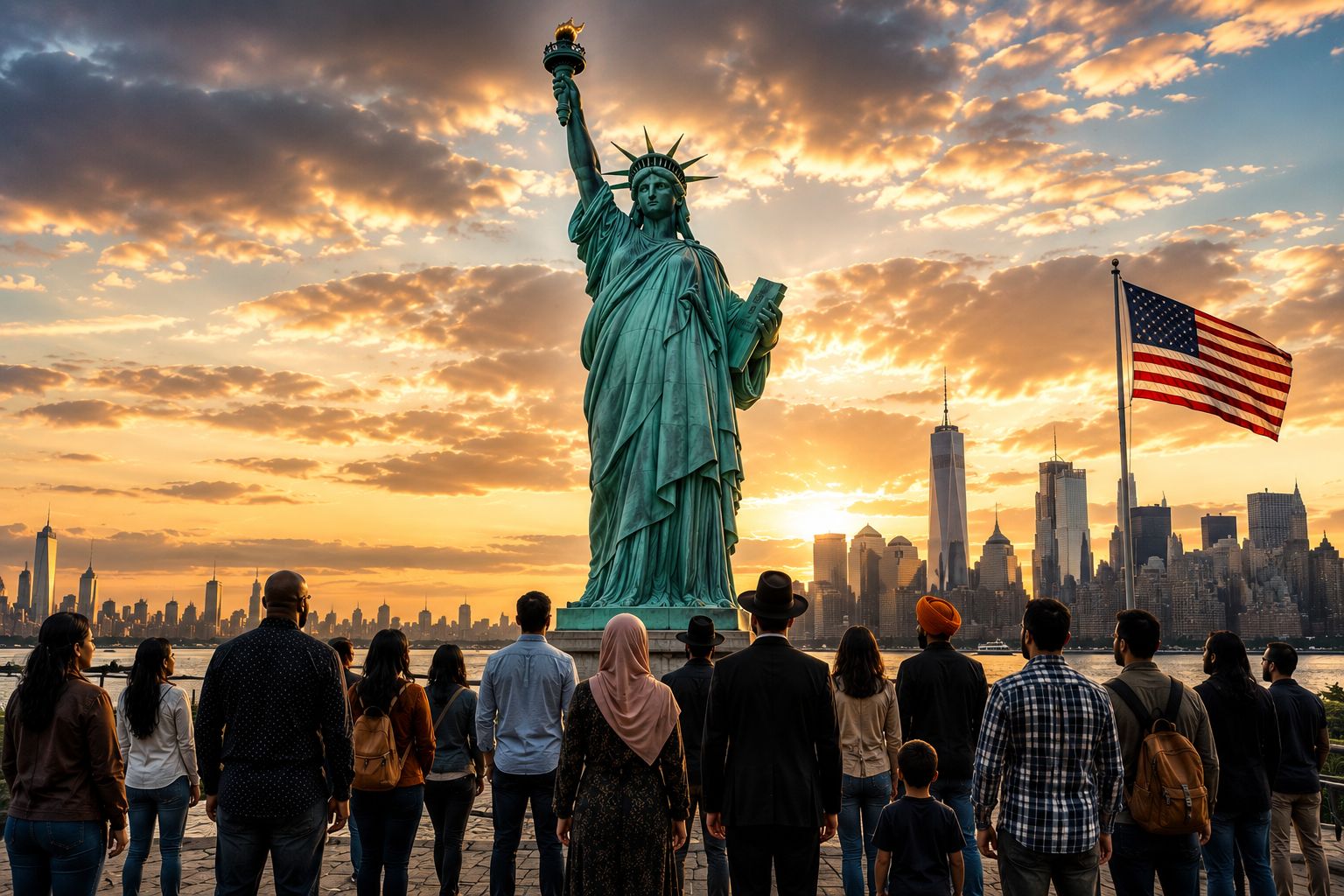
The election of New York City’s new mayor, Zohran Mamdani, once again exposed one of the biggest weaknesses of modern political debate. For many people, the word “Muslim” immediately evokes terrorism, religious extremism, the September 11 attacks, or authoritarian regimes. Others react in the opposite direction, refusing to acknowledge that Islamist extremism exists at all. Both reactions are mistakes.
The first distinction that must always be made is between a person’s religion, their political beliefs, and the degree to which religion shapes their public life.
Mamdani describes himself as a Muslim, yet he has consistently condemned religious extremism and presented himself as a defender of a pluralistic America in which people of different backgrounds, beliefs, and ethnicities can live together. Whether one agrees with his economic or social policies is a separate political question. His religion alone says little about how he governs.
September 11, 2001
Some commentators expressed surprise that New York elected a Muslim mayor at all. For many Americans, especially those old enough to remember September 11, 2001, Islam remains emotionally connected with one of the darkest days in the country’s history. That emotional association is understandable. However, it does not logically follow that every Muslim shares the ideology that motivated Al-Qaeda’s terrorists.
This distinction should be obvious, yet public debate often ignores it.
One controversial aspect of Mamdani’s inauguration was his decision to take the oath of office on a Quran. Legally, no New York mayor is required to swear on any religious text. Previous mayors commonly chose a Bible because of American tradition, but the law does not require it. Mamdani became the first New York mayor to use a Quran during the ceremony.
From a secular perspective, this choice deserves discussion.
A genuinely secular state does not need religious symbolism. Ideally, elected officials would swear solely to uphold the Constitution and the law, without invoking any sacred book. Whether the text is the Bible, the Quran, the Torah, the Bhagavad Gita, or any other religious scripture makes little difference from a strictly secular viewpoint. The office belongs to all citizens, including believers of every religion and those with none.
Bible or Quran
That said, using a religious text does not automatically mean the politician intends to introduce religious law or weaken democracy. Throughout American history, countless officials have taken office while placing a hand on a Bible. Few would conclude from that fact alone that they intended to establish a Christian theocracy. The same standard should apply consistently regardless of the religion involved.
The real question is not whether someone is Christian, Muslim, Jewish, Hindu, atheist, or anything else.
The real question is whether they respect democratic institutions, individual rights, freedom of speech, equality before the law, and peaceful transfers of power.
These principles separate secular democracy from every form of religious extremism.
The inability to distinguish between radical Islamism and secular Muslims has become one of the defining problems of modern political discourse. Radical Islamist organizations openly seek governments based on their interpretation of Islamic law. They justify violence, terrorism, discrimination against minorities, or restrictions on civil liberties. Secular Muslims reject those goals, just as secular Christians reject Christian nationalism or theocratic movements seeking to impose biblical law on society.
Lumping these fundamentally different groups together is intellectually no better than claiming that every Christian supports violent anti-abortion extremists or every Jew supports every policy of the Israeli government.
The categories simply do not match reality.
Radical Islam and secular Islam are not the same
One of the greatest mistakes in public debate is treating all Muslims as if they belonged to the same ideological movement. They do not. Islam, like Christianity, Judaism, or Hinduism, encompasses a wide spectrum of beliefs and ways of living. Some Muslims are deeply religious, some are only culturally Muslim, others are effectively secular, and some even identify as atheists while coming from Muslim families. Ignoring these differences leads to poor analysis and unfair conclusions.
Radical Islam, more accurately called Islamist extremism, is a political ideology that seeks to organize society according to a strict interpretation of Islamic law. Its supporters often argue that religion should dominate government, legislation, education, and public life. In its most extreme forms, it rejects liberal democracy, equality before the law, freedom of expression, and sometimes even religious freedom itself. Terrorist organizations such as Al-Qaeda and ISIS represent the most violent manifestation of this ideology, although many non-violent Islamist movements also seek greater political power for religion.
Secular Muslims represent a fundamentally different approach. They may believe in God, pray, fast during Ramadan, or follow other religious traditions, yet they do not seek to impose their beliefs on the rest of society through the state. Many support constitutional democracy, equal rights for people of different religions, freedom of speech, and the separation of religion from political institutions. Their faith is a personal matter rather than a blueprint for government.
Christianity and Judaism
The distinction resembles that found in other religions. A Christian who attends church every Sunday is not automatically a Christian nationalist. A Jew who follows religious traditions is not automatically a supporter of religious rule. Likewise, a Muslim who believes in Islam is not automatically an Islamist. Confusing personal faith with political extremism is a category error.
This distinction is crucial for democratic societies. Governments should confront violent extremism and any ideology that seeks to undermine democracy or fundamental human rights, regardless of whether it is motivated by religion, nationalism, or another belief system. At the same time, democracies should protect the rights of peaceful citizens to practice their religion freely. Failing to distinguish between extremists and ordinary believers not only harms innocent people. But can also make it more difficult to identify genuine threats.
Ultimately, the issue is not whether someone is Muslim, Christian, Jewish, Hindu, atheist, or follows another worldview. The essential question is whether they respect democratic institutions, the rule of law, individual liberty, and the equal rights of all citizens. Those principles, rather than religious identity alone, determine whether a person strengthens or weakens a liberal democracy.
The land of immigrants? Really?
New York itself illustrates why such distinctions matter. It has long been one of the world’s most multicultural cities, built by successive waves of immigrants from Europe, Latin America, Asia, Africa, and the Middle East. Millions of residents speak English with noticeable accents. Many arrived with little money. Yet over generations they became business owners, scientists, doctors, artists, police officers, teachers, and public officials.
That has always been one of America’s greatest strengths.
An immigrant’s accent should matter far less than their respect for democratic values, the Constitution, and the rule of law. A society that judges people primarily by ethnicity or religion rather than by their actions ultimately undermines the very principles on which liberal democracy is based.
The same principle applies to Muslims.
Some are religious conservatives. Some are secular. Some are atheists who happened to be born into Muslim families. Others actively campaign against Islamist extremism. Treating these groups as identical is analytically useless.
Likewise, pretending Islamist extremism does not exist is equally dangerous. Organizations inspired by extremist interpretations of Islam have committed terrorist attacks around the world and have imposed brutal rule wherever they gained power. Recognizing that fact is not Islamophobia. It is acknowledging reality.
At the same time, assuming that every Muslim shares those beliefs is equally irrational.
The challenge for democratic societies is therefore not to ignore extremism but to identify it accurately. Democracies succeed when they judge individuals by their own conduct rather than by collective guilt.
Whether Zohran Mamdani ultimately proves to be a successful mayor will depend on his policies, competence, and leadership, not on the religion into which he was born or the scripture on which he chose to take his oath.
That is the distinction many political debates still fail to make.
Leave a Reply