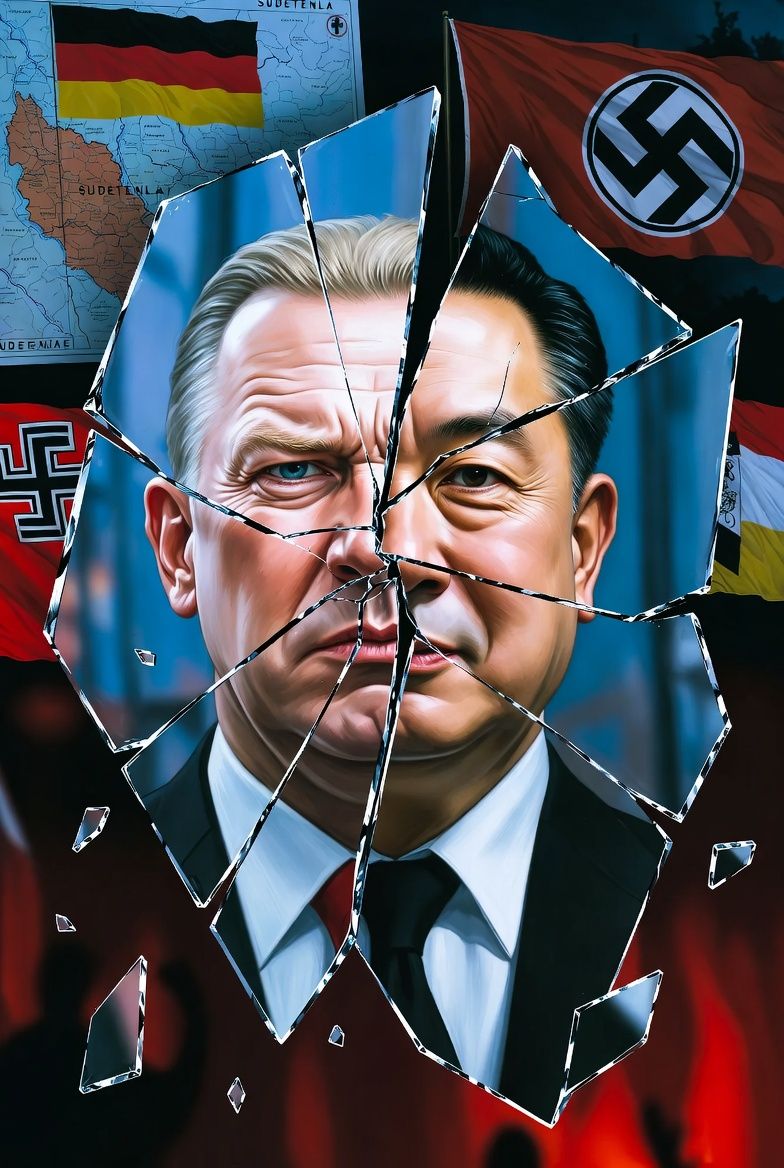
The Czech Republic has a mentally retarded and psychiatric ill electorate. Let us not mince words about it. This is not an insult; this is a clinical observation of a populace that has, for decades, been fed a steady diet of cheap beer, cheaper propaganda, and the comforting lullaby of victimhood. They have forgotten history, they have forgotten geography, and most importantly, they have forgotten how to think. But we must turn things into fun—because if we do not laugh at the absurdity, we would be forced to weep at the tragedy. And weeping is exhausting; laughter is a weapon.
I know a person who was at a Sudeten German (Germans expelled from Czechoslovakia after WW2) reunion. Yes, that relic of a bygone era, where wrinkled old men and women gather to polish their grievances like family heirlooms. Among them was an elderly German lady—a woman who, let us be clear, had nothing common with Nazi crimes. She was not a perpetrator, not a true believer, just a product of her time and her displacement. She spoke with my acquaintance, and at one point, she said, “Děkuji.” Thank you. In Czech. My acquaintance, being a decent sort, started to speak German with her, thinking to make her comfortable.
And then she said it. The sentence that cuts to the bone of this entire sordid circus:
“We understand the hate, but what about the slant-eyed politician?”
A Hitler-loving Jew?
There it is. The unvarnished, unapologetic racism of the old guard, dressed up as a simple question. They understand the hate—oh, yes, they understand it perfectly, because they have lived with it, nurtured it, passed it down like a curse. But their concern is not with the substance of politics, not with policies or economics or the future of Europe. Their concern is with the shape of his eyes. They see a man who does not look like them, and that, in their fossilized worldview, is the ultimate betrayal. Never mind his actions, his alliances, his betrayals of his own stated principles. The eyes are wrong. And for them, that is enough.
I won’t mention his name as he sues everyone. The man has made a career out of litigation, using the courts as a cudgel to silence critics while wrapping himself in the tattered flag of free speech. He is a hypocrite of the highest order, a man who will lecture you on democracy while simultaneously trying to bankrupt anyone who dares to point out his inconsistencies. He is a legal terrorist, and his weapon is the lawsuit.
Marine Le Pen doesn’t like him
Marine Le Pen refuses to collaborate with him. Let that sink in. Marine Le Pen—the woman who has made a career out of normalizing the far-right, who has scrubbed her party’s antisemitic past with the diligence of a PR agent cleaning up a celebrity scandal—even she finds him too toxic to touch. But the photo of him with her is priceless. You have seen it, haven’t you? The two of them, smiling like Cheshire cats, pretending to be the vanguard of a new Europe. The glorious white race at its best. Two pale faces, one sharp-nosed, one with those infamous eyes, both grinning as if they have just discovered the secret to eternal relevance. It is a masterpiece of political theater, a snapshot of two grifters who would sell their grandmothers for a headline.
Prior to his political life, he warned against Russia. He was a hawk, a cold warrior, a man who understood the menace of totalitarian regimes. He spoke of freedom, of Western values, of the need to stand up to Moscow’s expansionism. He had principles, or at least he pretended to. Now he has their back. He bends the knee to the Kremlin, echoes their talking points, and does their bidding with the enthusiasm of a convert who has discovered a new god. Why? Because power is a drug, and he is an addict. Because the money is good. Because the enemy of his enemy—the liberal, progressive, multicultural Europe—has become his friend, and if that means shaking hands with the very tyrants he once condemned, so be it.
The worst of populism
His political party is the worst of populism. It is not a party of ideas; it is a party of resentments. It has no platform beyond “us versus them,” no vision beyond the next outrage, no future beyond the next scapegoat. It feeds on fear, on ignorance, on the basest instincts of a population that has been left behind by globalization and is too lazy to catch up. And he supports AfD, the Alternative for Germany, that gang of revisionists and reactionaries who want Beneš’s decrees to be revoked.
Yes, you heard that right. He wants to undo the very legal framework that expelled the Sudeten Germans after World War II, the framework that redrew the map of Central Europe and gave the region a fragile, post-war stability. He wants to reopen that wound, to pour salt into it, to relitigate a history that was settled seventy years ago—all because it plays well with his base. All because it gives him something to shout about.
And what is the result of all this? A political landscape that is increasingly toxic, increasingly tribal, increasingly detached from reality. A Czech Republic that has traded its proud history of dissidence for a cheap imitation of Western populism. An electorate that votes not for solutions, but for revenge. A leader—if you can call him that—who stands for nothing except his own aggrandizement.
Conclusion
But we must not despair. We must turn things into fun, as I said. Because the alternative is to give in to the darkness, to let these people define the terms of the debate, to allow their hatred to become the new normal. No. We will laugh at them. We will mock them. We will point out every contradiction, every hypocrisy, every absurdity. We will remind them that the “glorious white race” is a myth, a fantasy, a comforting lie for those who cannot face the complexity of the world. We will remind them that the “slant-eyed politician” is not a threat to their identity, but a mirror to their own insecurities.
And we will continue to write. Because that is what we do. We do not omit anything. We do not soften the blow. We call it as we see it, and we let the chips fall where they may. If he sues us, let him. If they hate us, let them. History will judge, and history has a long memory.
In the end, this is not about one man (other politicians call him “political entrepreneur), one party, or one country. It is about the soul of Europe. It is about whether we will succumb to the siren song of tribalism or rise to the challenge of pluralism. It is about whether we will let the ghosts of the past dictate our future or whether we will have the courage to build something new.
I know which side I am on. And I suspect, dear reader, that you do too.
So let us laugh. Let us write. Let us fight.
And let us never, ever look away.
Leave a Reply