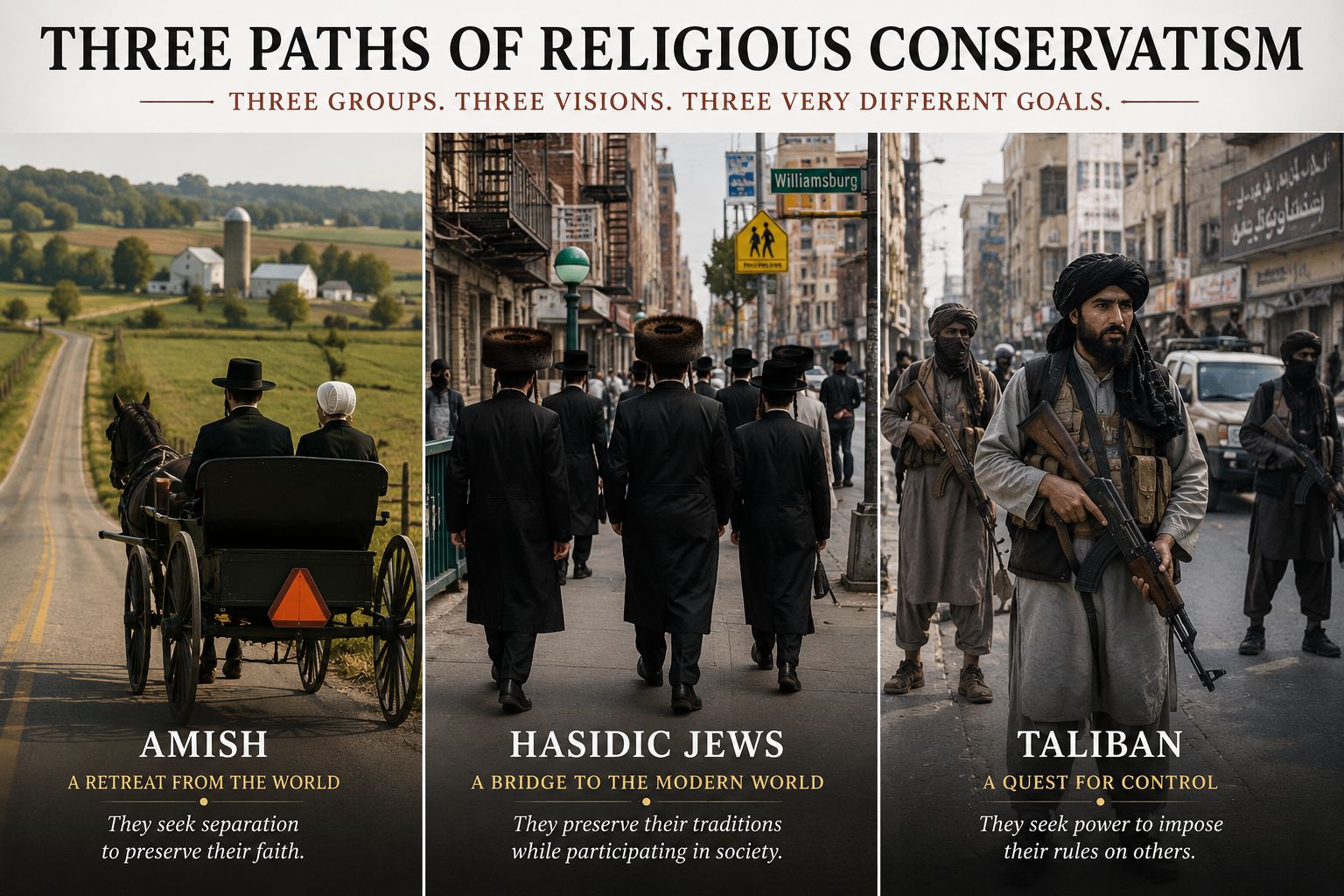
It is a comparison that appears surprisingly often. Images of Amish horse-drawn buggies, Hasidic Jews in black coats and fur hats, and Taliban fighters carrying rifles are frequently grouped together as symbols of religious “extremism.” At first glance, they all seem to reject many aspects of the modern world. They dress differently, follow strict religious rules, and often distance themselves from mainstream society. To many observers, these similarities appear obvious.
Yet appearances are deceptive. Judging religious movements by clothing, technology, or social conservatism alone is one of the easiest ways to misunderstand them. A man who refuses to own a television is not automatically comparable to a man who uses violence to establish a religious state. Likewise, living according to centuries-old traditions is fundamentally different from attempting to impose those traditions on millions of unwilling people.
This distinction is often lost in political debate. The word “extremist” has become so broad that it sometimes describes everyone from peaceful religious separatists to violent terrorist organizations. Such usage makes the word nearly meaningless. Before asking who is “more extreme,” we first have to ask what extremism actually is.
For the purposes of this article, extremism should not be measured by how unusual a group’s customs appear to outsiders. It should instead be measured by several more meaningful criteria: the willingness to use violence, the desire to impose religious beliefs on others, the relationship between religion and political power, the acceptance of pluralism, and the degree to which individual freedoms are restricted. Under these criteria, communities that voluntarily isolate themselves are fundamentally different from movements that seek to control entire populations.
The Amish, the Hasidic Jewish communities, and the Taliban therefore represent three very different responses to modernity. One largely withdraws from society. Another selectively participates while preserving a distinct religious identity. The third seeks to organize society itself according to its interpretation of religious law. Although all three are deeply religious and socially conservative, their goals could hardly be more different.
Understanding those differences requires moving beyond stereotypes. The Amish are not simply people without electricity. Hasidic Jews are not merely ultra-religious communities dressed in black. Likewise, the Taliban cannot be understood simply as exceptionally devout Muslims. Each movement emerged from a unique historical context, developed its own worldview, and adopted a very different relationship with the surrounding society. Only by examining those histories can we meaningfully compare them.
The Amish: A retreat from the world
Among the three groups, the Amish are perhaps the most visually distinctive. Horse-drawn buggies, plain clothing, beards without mustaches, and the absence of modern technology have made them instantly recognizable far beyond North America. These features often create the impression that the Amish are radically opposed to modern civilization itself. In reality, their rejection of many modern technologies is not based on hatred of progress but on a desire to preserve community, humility, and religious commitment.
The Amish trace their origins to the Anabaptist movement that emerged during the Protestant Reformation in sixteenth-century Europe. Unlike both Catholics and the emerging Protestant state churches, Anabaptists rejected infant baptism and insisted that only adults capable of making a conscious decision should be baptized. Their refusal to swear oaths, participate in military service, or submit completely to state authority led to severe persecution across much of Europe. Thousands were imprisoned, tortured, or executed, forcing many communities to seek refuge elsewhere.
During the late seventeenth century, the Swiss preacher Jakob Ammann argued that Anabaptists had become too lenient in enforcing church discipline. His followers eventually became known as the Amish. Seeking greater religious freedom, many emigrated during the eighteenth century to Pennsylvania and later spread across Ohio, Indiana, and several other American states, where most Amish communities remain today.
At the center of Amish life lies the German concept of Gelassenheit, usually translated as humility, submission, or yielding to God’s will. Individual ambition is discouraged, while cooperation, modesty, and obedience to the community are highly valued. Success is measured less by wealth or personal achievement than by faithfulness to family, church, and neighbors.
The misunderstood philosophy
This philosophy explains many practices that outsiders often misunderstand. Electricity is not universally forbidden because it is considered sinful. Instead, many Amish communities worry that unrestricted access to modern technology could weaken family bonds, encourage excessive individualism, or expose members to influences that undermine community cohesion. Consequently, different Amish groups adopt different rules. Some allow telephones in separate buildings, others permit diesel-powered machinery, and some even use battery-powered equipment for specific purposes. Their famous rejection of technology is therefore selective rather than absolute.
Education follows the same principle. Most Amish children attend one-room schools operated by their own communities and generally finish formal education after the eighth grade. Critics frequently argue that this limits economic opportunities, while the Amish maintain that additional education encourages careers and lifestyles incompatible with their religious values. The emphasis remains practical rather than academic, focusing on farming, craftsmanship, business skills, and family responsibilities.
Another defining feature is their commitment to nonviolence. Amish theology is deeply rooted in Jesus’ command to “love your enemies” and to “turn the other cheek.” Military service is rejected, firearms are generally avoided for self-defense, and conflicts are resolved through forgiveness rather than retaliation. During wars, Amish men have typically served as conscientious objectors instead of soldiers.
Perhaps the strongest evidence against describing the Amish as extremists in the ordinary political sense is their relationship with outsiders. They do not campaign to abolish secular governments, establish religious police, or compel non-Amish citizens to adopt their customs. Conversion into the Amish faith is possible but relatively uncommon, and there is virtually no organized missionary effort aimed at transforming wider society. Their primary concern is preserving their own community rather than changing everyone else’s.
Limited opportunities
Former members have described strict social expectations, limited educational opportunities, and the practice of Meidung (shunning), in which individuals who violate important community rules may be socially excluded. Scholars have also documented cases of abuse and failures to report crimes, problems that unfortunately exist in many closed communities regardless of religion. Such criticisms deserve serious attention and should not be dismissed simply because the Amish are widely perceived as peaceful.
Nevertheless, these problems differ fundamentally from ideological extremism aimed at dominating society. The Amish generally seek isolation rather than expansion. Their conservatism is voluntary for those who remain within the community, and it carries little direct consequence for people living outside it.
This distinction becomes crucial when comparing them with movements whose objective is not merely to preserve a traditional way of life but to reshape society itself. The Amish build boundaries around their own communities. They do not attempt to build prisons for everyone else. That difference separates cultural separatism from political or religious authoritarianism and places the Amish at the lowest end of the spectrum of extremism.
The Hasidic: A bridge between tradition and modern society
If the Amish represent a deliberate retreat from the modern world, Hasidic Judaism occupies a far more complicated position. Hasidic communities preserve centuries-old religious traditions, maintain distinctive clothing, and often educate their children within their own school systems. At the same time, however, they live in some of the world’s largest cities, operate successful businesses, vote in elections, and interact with governments on a daily basis. Their goal is not complete isolation but the preservation of a deeply religious way of life within a modern society.
Like the Amish, the Hasidim are frequently described as “extremists” simply because they look different. Men often wear black coats, wide-brimmed hats or fur shtreimels, while married women usually cover their hair with scarves, hats, or wigs. Yiddish remains the primary language in many communities, especially in New York, London, Antwerp, and Jerusalem. To outsiders, these customs can appear unusually rigid or even oppressive. Yet clothing alone reveals remarkably little about a movement’s political goals or its relationship with the wider world.
Hasidism emerged in the eighteenth century in what is now Ukraine and Poland. Its founder, Rabbi Israel ben Eliezer, better known as the Baal Shem Tov, argued that ordinary believers could achieve closeness to God through sincere prayer, joy, and devotion rather than through scholarship alone. His teachings spread rapidly among Eastern European Jews, offering an alternative to what many perceived as an overly intellectual approach to Judaism.
Over time, Hasidism developed into numerous dynasties led by charismatic spiritual leaders known as Rebbes. These leaders are not merely administrators but religious authorities who provide guidance on spiritual, ethical, and sometimes practical matters. Different dynasties, such as Satmar, Belz, Ger, Chabad-Lubavitch, and Breslov, have developed distinct traditions, customs, and theological emphases. Consequently, speaking about “the Hasidic” as though it were a single, unified movement oversimplifies a remarkably diverse religious landscape.
Daily life is governed by Halakhah, the comprehensive body of Jewish religious law derived from the Torah, the Talmud, and centuries of rabbinic interpretation. Religious observance extends into virtually every aspect of life, including prayer, diet, marriage, business ethics, family relationships, and the observance of the Sabbath. Far from viewing these rules as burdens, many Hasidim regard them as opportunities to sanctify ordinary existence and maintain a constant awareness of God.
Family occupies a central place within Hasidic society. Marriage generally occurs at a relatively young age compared with secular populations, and large families are common. Children receive intensive religious education from an early age, while community institutions often provide extensive mutual support during illness, financial hardship, or personal crises. This strong internal solidarity has enabled many Hasidic communities to preserve their identity despite centuries of persecution, migration, and rapid social change.
Modern economic life
Unlike the Amish, however, Hasidic Jews do not reject modern economic life. Many own businesses, work in finance, real estate, retail, technology, healthcare, or education. Even communities that seek to minimize exposure to secular culture frequently make pragmatic use of modern technology when it serves practical purposes. Smartphones, filtered internet access, and computers may be restricted in some groups, but they are not universally prohibited. The exact rules vary considerably from one Hasidic community to another.
Politics also distinguishes the Hasidic world from Amish society. Whereas the Amish generally avoid political participation whenever possible, many Hasidic communities actively vote and organize politically to protect their religious schools, social services, and legal rights. In New York City, for example, voting as a relatively unified bloc has occasionally given certain Hasidic neighborhoods considerable local political influence. This participation reflects not a desire to establish a Jewish theocracy in the United States but a practical effort to preserve religious freedom and community institutions.
The relationship between Hasidic Judaism and the State of Israel is considerably more complicated than many people realize. Some Hasidic dynasties strongly support Israel, while others, most famously Satmar, reject political Zionism on theological grounds. According to their interpretation of Jewish tradition, a Jewish state should not be established before the coming of the Messiah. Other groups cooperate closely with Israeli institutions while maintaining their own distinct religious priorities. These disagreements illustrate that Hasidic Judaism cannot be reduced to a single political ideology.
Former members have described strict social expectations, limited secular education in some schools, restrictions on personal autonomy, and difficulties faced by those who choose to leave. Investigative journalists have reported allegations of abuse and failures to address misconduct in certain communities. Such criticisms should be examined carefully, just as they should in any closed religious or secular institution. At the same time, it would be inaccurate to judge millions of Orthodox Jews by the failures of individual communities or leaders.
Violence against outsiders
Most importantly, the overwhelming majority of Hasidic communities do not advocate violence against outsiders or seek to impose Jewish religious law on non-Jews. Their primary objective is preserving their own religious identity rather than transforming society through force. They may strongly disagree with many aspects of secular culture, yet disagreement is fundamentally different from coercion.
This distinction again highlights the difference between cultural conservatism and political extremism. Hasidic Jews may live according to demanding religious rules that many outsiders would never accept for themselves. Nevertheless, those rules are intended principally for members of their own communities. The movement builds walls to preserve its traditions, not armies to export them. That reality places Hasidic Judaism significantly closer to the Amish than to movements that employ religion as an instrument of state power and violent enforcement.
The Taliban: When religion becomes the state
Unlike the Amish and the Hasidic Jews, the Taliban did not emerge as a community seeking to preserve its religious identity. Instead, it developed as a political and military movement whose ultimate objective was to capture state power and govern society according to its own interpretation of Islamic law. This distinction changes everything. Religious conservatism becomes something entirely different once it is backed by armies, police forces, courts, and prisons.
The Taliban first appeared in southern Afghanistan during the mid-1990s after years of devastating conflict. Following the Soviet withdrawal in 1989, Afghanistan descended into civil war as rival mujahideen factions fought one another for control of the country. Warlords carved the nation into competing territories, corruption became widespread, and ordinary civilians suffered from constant violence, looting, and instability. Against this backdrop, many Afghans initially welcomed a movement that promised to restore order, even if its religious views were unusually strict.
The movement’s name comes from the Arabic word talib, meaning “student,” because many of its early members studied in Islamic religious schools, or madrasas, located primarily in Afghanistan and neighboring Pakistan. Their religious education was heavily influenced by the Deobandi movement, a conservative Sunni Islamic tradition that originated in nineteenth-century India. Although Deobandism itself is not synonymous with the Taliban, the Taliban adopted one of its most rigid interpretations while also incorporating elements of Pashtun tribal customs known as Pashtunwali. The result was a unique ideology shaped by both religion and local culture.
From the beginning, the Taliban differed fundamentally from groups like the Amish and the Hasidim because political power was never secondary to religious belief. Their goal was not simply to live according to Islamic principles themselves but to require everyone under their authority to do the same. Once they captured Kabul in 1996, they rapidly transformed Afghanistan into an Islamic Emirate governed by their interpretation of Sharia.
Religious law
Religious law became state law. Judges, police officers, and government officials were expected to enforce strict behavioral rules affecting nearly every aspect of daily life. Music was largely prohibited, television broadcasts disappeared, cinemas closed, and many forms of entertainment were outlawed. Men were expected to grow beards, attend communal prayers, and dress according to official standards. Women faced even more severe restrictions, including requirements regarding dress, travel, employment, and education.
The treatment of women has become the defining feature of Taliban rule in the eyes of much of the international community. During their first period in power between 1996 and 2001, girls were largely excluded from secondary education, while women were prevented from working in most professions unless specific exceptions applied. After returning to power in 2021 following the withdrawal of NATO forces, the Taliban initially suggested they would govern more moderately. Those expectations quickly faded. Secondary schools and universities were again closed to most girls and women, many female government employees lost their jobs, and numerous restrictions on movement and public participation were reintroduced. Several international organizations, including the United Nations, have described these policies as constituting a system of gender-based discrimination or even “gender apartheid,” although the latter term remains a political rather than a formal legal classification under international law.
Religious minorities have also faced persecution under Taliban rule. Although Afghanistan has historically contained relatively small Sikh, Hindu, Christian, and Shiite communities, many members of these groups have fled because of discrimination, insecurity, or violence. The Taliban have publicly condemned some attacks carried out by the Islamic State’s Afghan branch, yet significant concerns about religious freedom remain throughout the country.
Freedom of expression is similarly restricted. Independent journalists face intimidation, censorship, and detention, while political opposition is suppressed. Public criticism of the authorities carries serious risks, and many Afghan intellectuals, academics, artists, and professionals have left the country since the Taliban regained power. Such policies demonstrate that the movement seeks not merely religious conformity but extensive control over public life.
Violence also distinguishes the Taliban from the Amish and Hasidic communities. The movement fought a decades-long insurgency against Afghan governments and international coalition forces, employing bombings, assassinations, guerrilla warfare, and other military tactics. Numerous reports by human rights organizations have documented civilian casualties, extrajudicial killings, torture, and other abuses committed during different phases of the conflict. Although Taliban leaders argue that they are enforcing Islamic law and defending Afghan sovereignty, their willingness to employ violence as a political instrument sets them apart from peaceful religious communities.
The global conquest?
It is important, however, to avoid oversimplification. The Taliban are often portrayed as seeking global conquest, but their primary objective has historically been control of Afghanistan rather than the establishment of a worldwide caliphate. That distinguishes them from organizations such as the self-proclaimed Islamic State (ISIS), whose ideology explicitly promotes global expansion through armed struggle. Nevertheless, the Taliban’s ambitions within Afghanistan are comprehensive. They seek to shape the legal system, education, media, culture, and public morality according to their own interpretation of Islam, leaving little room for ideological or religious pluralism.
Some defenders argue that the Taliban have restored security after decades of civil war and reduced certain forms of corruption. Others point to improvements in road safety or the decline of local warlordism. These observations should not be dismissed outright, as governments can simultaneously achieve some administrative successes while committing serious human rights violations. Recognizing limited achievements does not negate the extensive evidence documenting restrictions on fundamental freedoms.
This distinction ultimately explains why comparing the Taliban with the Amish or Hasidic Jews is deeply misleading. The Amish voluntarily separate themselves from mainstream society. Hasidic communities preserve their traditions while participating in democratic states. The Taliban, by contrast, possess the machinery of government and use it to compel conformity. Their authority extends far beyond willing believers to encompass every individual living under their control.
Religious devotion alone does not determine whether a movement is extremist. Rather, the decisive question is how that devotion is expressed. A community that chooses to live according to strict religious rules is exercising freedom of religion. A government that forces millions of people to obey those same rules under threat of imprisonment, corporal punishment, or worse enters an entirely different category. That distinction is precisely why the Taliban stand apart from the other groups discussed in this article.
Who is actually the most extreme?
At this point, the answer should be clear. If extremism is measured simply by how different a group appears from mainstream society, all three could reasonably be described as unusual. Their clothing, customs, and religious practices differ significantly from those of most people living in Western democracies. Such a definition, however, tells us almost nothing about the actual danger a movement poses.
A far more meaningful definition considers whether a group uses violence, suppresses individual freedom, rejects pluralism, and seeks to impose its beliefs upon others through political power. Under those criteria, the differences become unmistakable.
The Amish undoubtedly live according to demanding religious principles. They reject many modern technologies, educate their children within their own communities, and deliberately separate themselves from much of contemporary culture. Yet none of these choices are intended to transform wider society. They neither campaign to outlaw secular lifestyles nor attempt to establish a Christian state. Their philosophy is fundamentally defensive. They wish to preserve their own traditions, not replace everyone else’s.
The middle ground
Hasidic Judaism occupies the middle ground. Its communities are more politically engaged than the Amish and often participate actively in democratic institutions. They maintain strict religious standards, preserve their own educational systems, and encourage members to remain within the community. Nevertheless, their primary objective remains the protection of Jewish religious life rather than the domination of secular society. Although certain ultra-Orthodox groups have occasionally been involved in political controversies, the overwhelming majority pursue their goals through legal and democratic means rather than violence.
The Taliban represent something fundamentally different. Their interpretation of religion is inseparable from political authority. Instead of asking followers to voluntarily obey religious rules, they employ the institutions of the state to compel obedience from everyone living under their control. Those who disagree are not merely viewed as mistaken but may face imprisonment, corporal punishment, or worse. In that sense, the Taliban are not simply religious conservatives. They are the rulers of an authoritarian theocratic regime.
This comparison also illustrates an important lesson about religious freedom. Liberal democracies are designed to protect the right of people to live according to their beliefs, even when those beliefs appear strange or deeply conservative to others. The Amish and Hasidic Jews benefit from these protections, just as atheists, Muslims, Buddhists, Christians, and countless other groups do. Freedom of religion necessarily includes the freedom to live differently, provided others are not coerced into doing the same.
Confusing voluntary separation with authoritarian rule can therefore have dangerous consequences. A peaceful religious minority that chooses to educate its own children, wear distinctive clothing, or avoid modern technology may appear unusual, but such choices do not threaten democratic society. In contrast, movements that seek to eliminate political opposition, restrict basic human rights, and enforce religious doctrine through state violence pose a fundamentally different challenge. Treating both as equally “extreme” obscures this essential distinction.
Another common mistake is assuming that conservatism inevitably leads to violence. History does not support such a conclusion. Numerous religious communities around the world hold deeply traditional views on family, gender roles, education, or morality while remaining peaceful and law-abiding. Conversely, some of the twentieth century’s most brutal regimes—including Stalin’s Soviet Union, Mao’s China, and Pol Pot’s Cambodia—were officially atheist rather than religious. Extremism, therefore, is not defined by belief in God or rejection of modern culture. It arises when any ideology, religious or secular, becomes so absolute that it justifies suppressing the freedom and dignity of others.
Political scientists often distinguish between radical beliefs and violent extremism for precisely this reason. A person may hold views that most of society considers highly conservative—or highly progressive—without advocating violence or coercion. Democratic societies routinely accommodate a remarkable diversity of opinions. The line is crossed only when individuals or movements seek to achieve their objectives through intimidation, terrorism, or authoritarian control instead of persuasion and democratic processes.
The comparison between the Amish, the Hasidic Jews, and the Taliban therefore reveals far more than differences between three religious communities. It demonstrates that outward appearance can be a profoundly misleading guide to political reality. Horse-drawn buggies, black coats, long beards, or traditional robes may attract attention, but they reveal little about a group’s actual relationship with freedom, democracy, or violence.
Conclusion
The Amish, the Hasidic Jews, and the Taliban all preserve traditions that many people consider unusually strict. Beyond that superficial similarity, however, the comparison largely falls apart. The Amish seek isolation. The Hasidic communities seek preservation. The Taliban seek control.
That distinction is the one that truly matters.
A peaceful community that voluntarily follows demanding religious rules may be socially conservative, culturally unusual, or even highly insular, but it is not necessarily extremist in the political sense. A movement that acquires state power and uses violence or coercion to enforce its religious doctrine belongs in an entirely different category.
Measuring extremism
Ultimately, extremism should never be measured by clothing, technology, or religious devotion alone. Instead, it should be judged by a far simpler question: does a movement allow others to live differently? If the answer is yes, coexistence remains possible despite profound disagreements. If the answer is no, religion—or any other ideology—has become an instrument of authoritarian power rather than a matter of personal conviction.
One may disagree with aspects of Amish or Hasidic life, just as one may criticize practices within any religious community. Yet equating peaceful religious separatism with an armed theocratic regime ignores the most important distinction of all: the difference between choosing one’s own way of life and forcing it upon everyone else.
Ultimately, there is little room for comparison. The Amish are religious separatists. The Hasidic communities are religious conservatives who actively participate in democratic societies. The Taliban, by contrast, built an authoritarian state and enforce their interpretation of religion through coercion. If extremism is measured by the willingness to restrict freedom, suppress dissent, and use state power to impose ideology, the Taliban are unquestionably the most extreme of the three.
Leave a Reply