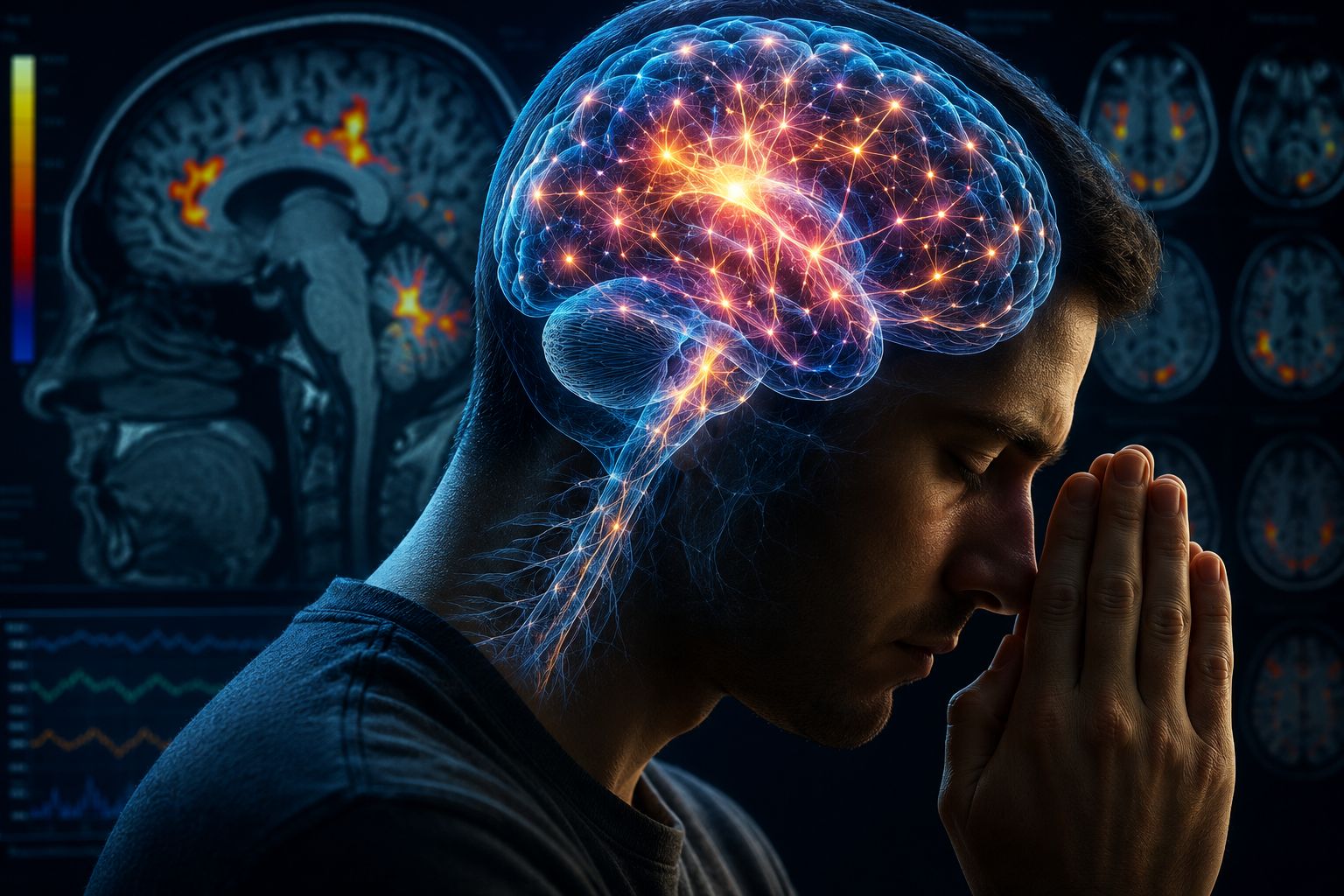
For thousands of years, believers have regarded prayer as a conversation with God. They have viewed it as a bridge between the human and the divine, capable of providing comfort, guidance, forgiveness, and sometimes even miracles. Neuroscience approaches the same phenomenon from an entirely different direction. Instead of asking whether anyone is listening, it asks what happens inside the brain while a person believes they are communicating with a supernatural being.
Over the past two decades, advances in functional magnetic resonance imaging (fMRI), electroencephalography (EEG), and computational neuroscience have transformed prayer from a purely theological subject into one that can also be investigated scientifically. Although the field remains young, researchers have already discovered that prayer is far more complex than once imagined. There is no single “God center” hidden somewhere in the brain. Instead, prayer recruits multiple neural systems that normally evolved for language, social interaction, emotional regulation, memory, imagination, and self-awareness.
The emerging picture is remarkable. Many of the psychological effects traditionally attributed to divine communication can be explained by ordinary brain mechanisms operating in extraordinary ways.
There is no God spot
One of the earliest popular ideas in neurotheology was the existence of a “God spot”—a specific brain region supposedly responsible for religious experiences. The hypothesis attracted considerable media attention but has not survived scientific scrutiny.
Modern neuroimaging consistently shows that prayer activates numerous interconnected brain regions rather than one isolated area. Religious experiences resemble music, love, morality, or language in this respect. None originates from a single location. Instead, they emerge from communication among large-scale neural networks.
During prayer, activity changes in regions responsible for executive control, emotional processing, autobiographical memory, language, imagination, and social cognition. Different forms of prayer recruit these networks in different proportions, depending on whether the individual is silently reflecting, reciting memorized texts, expressing gratitude, or believing they are speaking directly to God.
Rather than revealing a biological signature of God, neuroscience reveals the extraordinary flexibility of the human brain.
Talking to God resembles talking to another person
One of the strongest findings concerns the brain’s social networks.
Brain imaging studies consistently show that Christian prayer activates components of the default mode network and theory of mind network. These systems allow humans to imagine what other people think, intend, believe, and feel. They make empathy, conversation, cooperation, and friendship possible.
When believers pray personally instead of merely repeating memorized words, these same networks become active. Neurologically, the brain behaves as though it is participating in a genuine social interaction.
This does not demonstrate that God exists, nor does it demonstrate that He does not. It merely shows that the brain processes God much like it processes any other intentional social agent. The same neural machinery that evolved to understand parents, friends, rivals, and leaders appears capable of representing invisible supernatural beings.
Evolution of prayer
If prayer has entirely natural origins, why did it evolve in the first place? Evolutionary psychology offers several complementary explanations. None can be proven with certainty because they concern events that occurred tens or hundreds of thousands of years ago, but together they provide a coherent framework that fits what we know about human cognition.
The first mechanism is our tendency to detect agency. For our ancestors, assuming that rustling bushes concealed a predator rather than the wind was usually the safer mistake. Over thousands of generations, natural selection therefore favored brains that readily attributed events to intentional agents. This cognitive bias, often called hyperactive agency detection, may have laid the foundations for belief in invisible beings, ancestors, spirits, and eventually gods. Once the brain became capable of imagining agents that could not be seen, speaking to them through prayer was a relatively small cognitive step.
Equally important was the evolution of the social brain. Humans survived by cooperating in groups, predicting one another’s behavior, and maintaining long-term relationships. The neural systems that evolved for interacting with parents, friends, allies, and leaders are the very same systems activated during personal prayer. From the brain’s perspective, conversing with God resembles conversing with another trusted individual. The difference lies not in the underlying neural machinery but in the identity of the imagined conversation partner.
Imaginary protector
Prayer may also have increased psychological resilience. Life in prehistoric environments was unpredictable and often brutal. Disease, famine, predators, violent conflict, and the death of children were common. Believing that an all-powerful protector was watching over you could reduce anxiety, increase optimism, and encourage perseverance even when circumstances seemed hopeless. These psychological benefits alone might have improved survival without requiring that the supernatural beliefs themselves were objectively true.
Religious communities also gained social advantages. Shared prayers strengthened group identity, synchronized emotions, reinforced moral norms, and increased trust among members. Individuals who believed that an invisible supernatural agent observed their behavior may have been more likely to cooperate, keep promises, and avoid cheating, particularly when no human witnesses were present. Such groups may have functioned more cohesively than groups lacking comparable shared beliefs.
Just a by-product?
Another possibility is that prayer emerged as a by-product rather than a direct adaptation. Evolution rarely creates entirely new mental faculties from scratch. Instead, it modifies existing ones. Language, imagination, autobiographical memory, empathy, pattern recognition, and agency detection may each have evolved for independent reasons. Prayer could simply be the cultural product that emerged when these cognitive abilities became sufficiently sophisticated. In this view, religion is comparable to mathematics or music: not an adaptation in itself, but a consequence of capacities that evolved for other purposes.
These hypotheses are not mutually exclusive. Prayer may simultaneously be a by-product of human cognition, a source of psychological resilience, and a mechanism that strengthened cooperation within groups. What they all share is a common assumption: there is no need to invoke supernatural intervention to explain why human beings developed the capacity to pray. Evolution, acting over millions of years, provides a plausible natural framework for understanding one of humanity’s oldest and most universal behaviors.
Attention, language and memory
Prayer also recruits systems that have nothing specifically to do with religion.
The prefrontal cortex becomes more active during focused prayer because maintaining concentration requires executive control and the suppression of distracting thoughts. Internal speech activates language regions similar to those used during ordinary conversation. Meanwhile, the hippocampus retrieves religious teachings, personal memories, previous prayers, and emotionally significant life events.
The emotional significance of prayer involves structures within the limbic system, particularly the amygdala, which evaluates emotionally relevant information, and neighboring regions involved in motivation and emotional learning.
In other words, prayer combines many ordinary cognitive functions into one highly meaningful mental activity.
Different religions use different neural strategies
Prayer is not neurologically uniform.
Christian prayer often involves communicating with a transcendent, external God. Consequently, it emphasizes brain systems involved in social interaction and internal dialogue.
Other traditions pursue a very different goal. Sahaja Yoga meditation, for example, encourages practitioners to enter a state of “mental silence” in which ordinary thought gradually disappears while the divine is experienced as an internal presence rather than an external being.
Neuroimaging studies suggest that this form of meditation is accompanied by reduced activity within the thalamus, the brain’s major sensory relay station. Lower thalamic activity may reduce incoming sensory information, allowing attention to become increasingly focused on internal experience.
Interestingly, comparable thalamic deactivation has generally not been observed during conventional Christian prayer, suggesting that different religious traditions rely on different neural mechanisms despite producing experiences that participants describe as profoundly spiritual.
Why prayer feels real
One reason prayer feels convincing is that the brain continuously constructs models of reality rather than merely recording sensory information.
According to one of today’s leading theories in neuroscience, predictive processing, the brain constantly generates expectations about the world and updates them whenever reality differs from those predictions.
Within this framework, religious experiences may arise when internally generated models become especially influential. Expectations, prior beliefs, emotional significance, and attention interact to create an experience that feels completely authentic. The individual does not merely imagine God’s presence. They genuinely experience it.
This theory remains under active investigation, but it has become one of the most influential approaches to explaining perception, consciousness, and spiritual experience. Importantly, predictive processing does not dismiss religious experiences as imaginary. Instead, it attempts to explain how every conscious experience—religious or otherwise—is actively constructed by the brain.
Prayer reduces stress
One of the most reproducible findings concerns stress reduction.
Many studies report that sincere prayer decreases subjective anxiety and improves emotional well-being, particularly among individuals who genuinely believe their prayers are heard.
EEG studies frequently observe increased alpha and theta brain-wave activity, patterns associated with relaxed attention and reduced mental stress. Research on Islamic Salah, which combines rhythmic movement, controlled breathing, and recitation, has also reported substantial reductions in cortisol, the body’s primary stress hormone. Some studies have measured average reductions approaching 27%, although these findings require further replication.
These effects are not unique to religion. Similar physiological changes occur during mindfulness meditation, breathing exercises, yoga, music, and other activities that promote focused attention and emotional regulation.
This observation weakens claims that prayer possesses uniquely supernatural psychological properties. Instead, it appears to exploit biological mechanisms that evolved long before organized religion existed.
Placebo and expectation
Another important mechanism behind the effects of prayer is the placebo response. Although the word “placebo” is often used to imply that something is imaginary or ineffective, modern neuroscience paints a very different picture. Placebo effects are genuine biological phenomena produced by the brain’s expectations, beliefs, and previous experiences.
When individuals strongly believe that prayer will reduce pain, relieve anxiety, or help them recover from illness, these expectations can activate measurable neural and biochemical changes. Brain imaging studies show that placebo responses engage the prefrontal cortex, which generates expectations, together with regions involved in emotional regulation and reward. In some situations, placebo effects also trigger the release of endogenous opioids, dopamine, and other neurotransmitters that influence pain perception, motivation, and well-being.
This mechanism does not mean that prayer can cure infections, shrink tumors, or reverse severe neurological diseases. However, it may alter how people experience symptoms such as pain, stress, fatigue, and anxiety. Numerous clinical studies have demonstrated that expectations alone can significantly influence subjective health outcomes, even when no active medical treatment is administered.
Strengthening optimism
Prayer may therefore amplify placebo responses by strengthening optimism, reducing uncertainty, increasing perceived social support, and reinforcing the belief that a powerful being is providing protection or assistance. For believers, this expectation is often exceptionally strong because it is supported by years of religious teaching, personal experiences, and participation in a community that shares the same convictions.
From a predictive processing perspective, placebo and prayer may rely on similar neural principles. If the brain continuously generates predictions about the body and the external world, then strong expectations created through prayer can influence perception, emotion, and even certain physiological responses. In this sense, the placebo effect is not a flaw in human cognition but an illustration of how closely beliefs and biology interact.
Understanding these mechanisms does not diminish the psychological value of prayer. Instead, it provides a natural explanation for why millions of people genuinely feel calmer, safer, or emotionally stronger after praying, even without invoking supernatural intervention.
Dopamine, serotonin and reward
Prayer also influences the brain’s reward systems.
Although neurotransmitters cannot be measured directly with ordinary brain imaging, evidence suggests that meaningful religious experiences activate neural circuits associated with dopamine, motivation, anticipation, and reward.
Hope, gratitude, forgiveness, social support, and optimistic expectations all stimulate these systems. Serotonin may also contribute through its role in mood regulation and emotional stability.
Again, these mechanisms are not exclusive to religion. Falling in love, listening to emotionally powerful music, spending time with family, achieving personal goals, or engaging in meditation can activate many of the same neurochemical pathways.
The brain does not appear to distinguish whether hope originates from a religious belief or a secular source. What matters is the subjective meaning assigned to the experience.
Mystical experiences
Some individuals report overwhelming spiritual experiences characterized by timelessness, unity with the universe, loss of self, or direct encounters with God.
Neuroscience suggests these experiences involve altered communication among several large-scale brain networks. Activity within parts of the default mode network often decreases, reducing ordinary self-focused thinking. Simultaneously, changes in parietal regions responsible for spatial awareness may contribute to the feeling that the boundary between self and the external world has temporarily disappeared.
Comparable neural patterns have been observed during deep meditation, psychedelic experiences, sensory deprivation, and certain neurological conditions.
This does not prove that all mystical experiences have identical causes. It does demonstrate, however, that profoundly spiritual experiences can arise whenever the brain enters particular functional states.
Prayer changes the brain
Repeated mental activity changes neural connections through neuroplasticity.
Although research is still developing, long-term practitioners of prayer and meditation often show differences in functional connectivity between brain regions responsible for attention, emotional regulation, and self-control.
This should not be surprising. The brains of musicians, athletes, bilingual speakers, taxi drivers, and professional chess players all adapt to repeated experience. Prayer appears to represent another example of the brain reorganizing itself in response to sustained mental practice.
These structural and functional changes do not reveal whether religious beliefs are true. They merely demonstrate that beliefs can reshape the organ that produces them.
What neuroscience cannot answer
Despite its impressive progress, neuroscience cannot determine whether God exists.
Brain imaging reveals neural correlates of religious experience, not the objective reality of its subject. Every human experience has neural correlates. Love, mathematics, music, political convictions, and scientific reasoning all depend on brain activity. Identifying the relevant brain networks neither proves nor disproves the external reality of their objects.
However, neuroscience can evaluate competing explanations according to parsimony. If the thoughts, emotions, perceived conversations, feelings of divine presence, mystical states, and psychological benefits associated with prayer can all be explained by known brain mechanisms, then the supernatural hypothesis becomes scientifically unnecessary. Like every other scientific discipline, neuroscience favors explanations that require the fewest unsupported assumptions.
This does not mean science has disproved God. It means that, so far, it has not needed God to explain how prayer works.
The future of neurotheology
The neuroscience of religion remains in its infancy. Many studies include relatively small sample sizes, and not every finding has been independently replicated. Functional MRI provides excellent spatial resolution but relatively poor temporal resolution, making it difficult to capture the rapidly changing neural dynamics of prayer. Researchers also face the challenge that prayer differs enormously between religions, cultures, and individuals.
Future work will likely combine brain imaging, electrophysiology, endocrinology, computational neuroscience, and evolutionary psychology to develop more comprehensive models of religious experience.
What seems increasingly unlikely is that scientists will discover a miraculous “God circuit” hidden somewhere in the cortex. Instead, every new study reinforces the same conclusion: prayer emerges from the coordinated activity of brain systems that evolved long before the first temples, churches, mosques, or synagogues appeared.
Conclusion
Prayer remains one of humanity’s most widespread behaviors, but neuroscience is steadily transforming our understanding of it. Rather than revealing evidence for direct communication with the supernatural, modern research shows that prayer recruits ancient neural systems originally shaped by evolution for social interaction, emotional regulation, attention, memory, and imagination. The comfort, certainty, transcendence, and peace reported by millions of believers appear consistent with ordinary brain mechanisms operating under extraordinary circumstances.
For believers, these findings may describe the biological pathway through which God communicates. For skeptics, they provide a naturalistic explanation requiring no supernatural assumptions. Science cannot decide between those philosophical interpretations. It can only describe the evidence. At present, that evidence increasingly points toward prayer as a remarkable product of the human brain rather than proof of the existence of a divine mind.
Leave a Reply