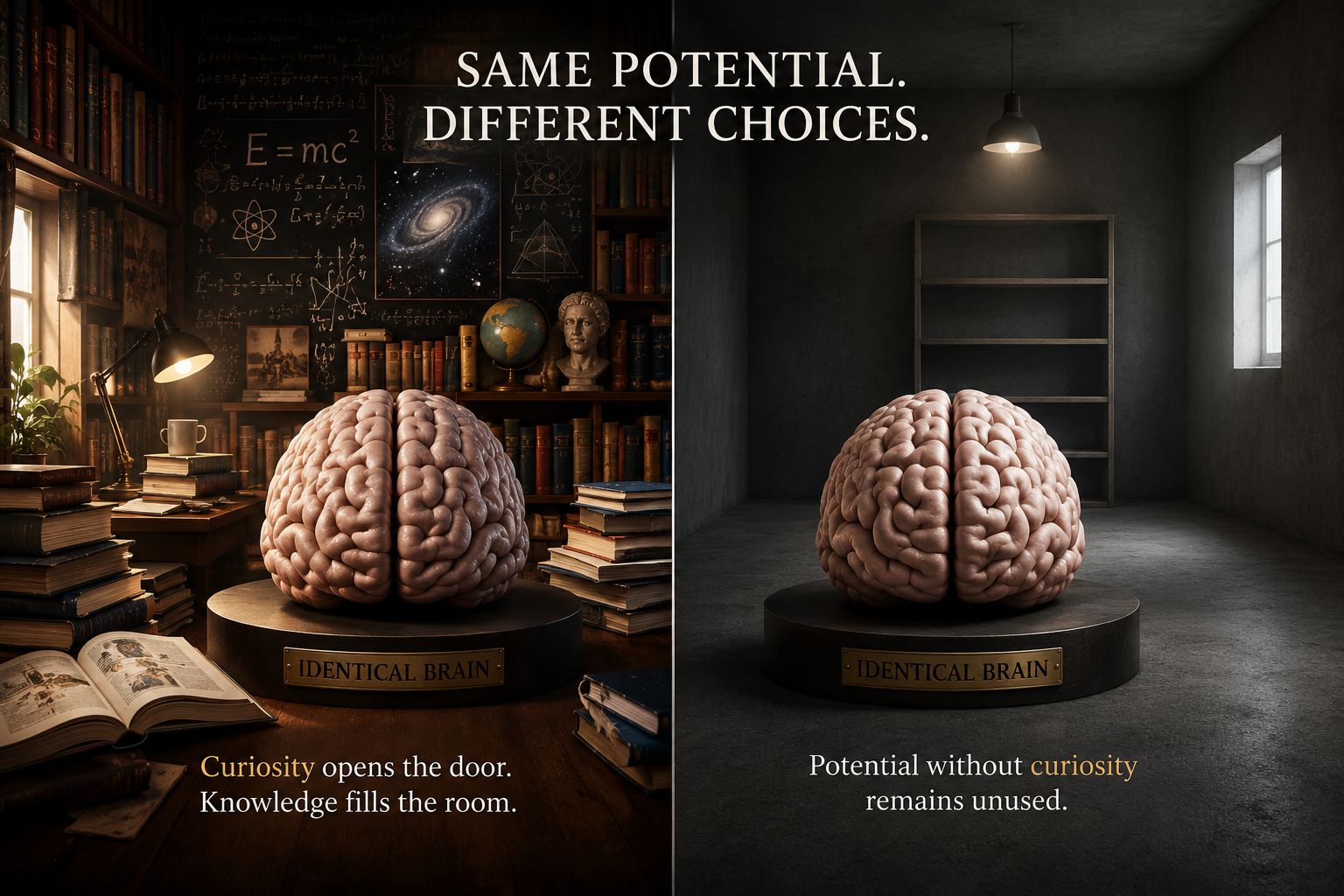
Intelligence is often viewed as the key to success in education and intellectual achievement. Yet anyone who has met exceptionally bright people knows that high IQ does not automatically translate into broad knowledge, expertise, or creativity. Some individuals with extraordinary cognitive abilities spend their lives pursuing ideas, while others rarely engage in intellectual activities beyond what is necessary.
One of the best explanations for this difference lies in the interaction between IQ and one of the Big Five personality traits: Openness to Experience. Modern psychology suggests that intelligence provides the ability to learn, but openness determines how much of that ability is actually used.
What IQ really measures
IQ tests are designed to assess general cognitive ability. They evaluate skills such as logical reasoning, pattern recognition, spatial visualization, memory, and problem-solving. High IQ indicates that a person can process information efficiently, recognize relationships between ideas, and solve unfamiliar problems more quickly than average.
Importantly, IQ does not measure how much someone already knows. It measures the capacity to acquire and manipulate information.
This distinction explains why two people with identical IQ scores may possess vastly different levels of knowledge. Intelligence is a potential rather than a finished product.
What openness to experience means
Openness to Experience is one of the five major personality dimensions identified in the Big Five model.
People who score highly on openness tend to be curious about the world. They enjoy exploring new ideas, reading, discussing abstract concepts, visiting unfamiliar places, and questioning established beliefs. They are often drawn to science, philosophy, literature, history, and the arts.
Psychologists frequently divide openness into two related aspects.
The first involves imagination, aesthetics, emotions, and appreciation of beauty. The second, often called Intellect, reflects enjoyment of reasoning, intellectual discussions, and solving complex problems. It is this intellectual curiosity that shows the strongest connection with cognitive ability.
Intelligence provides the engine
Imagine intelligence as the engine of a car.
A powerful engine allows the vehicle to travel quickly and efficiently. However, a parked sports car will never reach its destination if nobody chooses to drive it.
IQ works in much the same way. It determines how efficiently someone can learn when they decide to engage with new information.
A person with a very high IQ can master difficult concepts rapidly, identify patterns that others miss, and solve challenging problems with relatively little effort.
Yet these abilities remain underused if the individual rarely seeks intellectual challenges.
Openness chooses the destination
Openness determines whether someone actually explores the world of ideas.
Highly open individuals often spend countless hours reading books, listening to lectures, learning new languages, experimenting with hobbies, or debating philosophical questions. They pursue knowledge because they genuinely enjoy the process.
This motivation creates thousands of additional learning opportunities over a lifetime.
Someone with average intelligence but exceptional curiosity may accumulate an enormous body of knowledge simply because they never stop learning.
Performance and Verbal intelligence
This relationship is reflected in one of the most influential theories of intelligence.
Psychologists distinguish between Performance intelligence and Verbal intelligence.
Fluid intelligence (Performance IQ) refers to the ability to solve novel problems without relying on previously learned knowledge. It includes abstract reasoning, pattern recognition, and flexible thinking.
Crystallized intelligence (Verbal IQ) consists of accumulated knowledge, vocabulary, expertise, and information gained through education and life experience.
Researchers have long argued that people invest their fluid intelligence in acquiring crystallized intelligence. Personality traits, particularly openness, strongly influence how much of that investment occurs.
In simple terms, fluid intelligence determines how efficiently people can learn, while openness determines how often they choose to learn.
Three different learners
Consider three hypothetical individuals.
The first has an IQ of 145 but scores low on openness. They understand new concepts almost immediately when required. However, outside school or work they rarely read books, follow scientific discoveries, or explore unfamiliar topics. Their cognitive ability remains impressive, but much of its potential is never fully developed.
The second has an IQ of 120 and extremely high openness. They constantly read, ask questions, take online courses, and explore new disciplines. After decades of curiosity-driven learning, they may possess broader knowledge than many people with substantially higher IQs.
The third combines an IQ of 145 with exceptionally high openness. This individual learns rapidly and continuously seeks new intellectual challenges. Such people often become leading researchers, innovators, scholars, or highly accomplished professionals because curiosity and cognitive ability reinforce each other throughout life.
Why curiosity matters
Learning is cumulative.
Every book read, every conversation held, and every new experience creates connections with previous knowledge. Over time these connections make future learning easier.
Highly open people therefore benefit from a positive feedback loop. Curiosity encourages learning, learning expands knowledge, and greater knowledge stimulates even more curiosity.
Intelligence accelerates this process but does not initiate it.
Education rewards both traits
Schools and universities often emphasize intelligence because examinations measure reasoning and knowledge.
However, long-term educational success depends heavily on motivation.
Students with high IQ but little curiosity may achieve acceptable grades while investing minimal effort. They often stop learning once formal education ends.
Students with somewhat lower IQ but greater openness frequently continue learning throughout adulthood. Their willingness to explore new subjects gradually narrows the initial cognitive gap and sometimes surpasses those who relied solely on natural ability.
Creativity emerges from the combination
Creativity requires more than intelligence alone.
Innovative ideas usually arise when people combine knowledge from different domains.
Highly open individuals expose themselves to a wider range of experiences, perspectives, and disciplines. High IQ then allows them to integrate these diverse ideas into coherent and original solutions.
This helps explain why openness consistently predicts creative achievement better than intelligence alone.
Lifelong learning
Modern economies increasingly reward continuous education rather than fixed qualifications.
Technology evolves rapidly. Scientific knowledge expands every day. Entire industries change within a decade.
People who remain curious continue adapting throughout life. They learn new software, develop new professional skills, and revise their beliefs when evidence changes.
High IQ makes adaptation easier, but openness provides the motivation to begin the process.
Intelligence without curiosity
Popular culture often portrays genius as someone who knows everything.
Reality is different.
A highly intelligent individual may possess remarkable reasoning ability while lacking interest in history, literature, science, politics, or current events. Such a person may perform brilliantly on cognitive tests but have surprisingly limited general knowledge.
Intelligence offers the opportunity to learn. It does not create the desire.
Curiosity without exceptional IQ
The opposite pattern also exists.
Many people of average intelligence become highly knowledgeable because they spend decades reading, studying, travelling, and asking questions.
Their progress may be slower, but persistence and intellectual curiosity allow them to build impressive expertise over time.
Knowledge depends not only on learning speed but also on the total amount of learning invested.
The ideal combination
The greatest intellectual achievements often emerge when high IQ and high openness occur together.
Intelligence enables rapid understanding. Curiosity ensures continuous exploration.
Together they create a powerful cycle in which learning becomes both efficient and enjoyable.
This combination is frequently observed among outstanding scientists, philosophers, inventors, writers, and other lifelong learners who continually seek new knowledge instead of relying solely on innate ability.
Conclusion
IQ and Openness to Experience measure different aspects of human potential, but they work best together. Intelligence provides the cognitive tools needed to understand the world. Openness determines whether those tools are actually used.
A high IQ without curiosity may never reach its full potential. Curiosity without extraordinary intelligence can still produce remarkable expertise through years of dedicated learning. When both qualities are present, they reinforce each other, allowing people to transform cognitive ability into deep knowledge, creativity, and lifelong intellectual growth.
The lesson is simple. Intelligence determines how efficiently we can learn. Openness determines how much we choose to learn. Over a lifetime, it is often the combination of both—not either one alone—that shapes exceptional intellectual achievement.
Leave a Reply