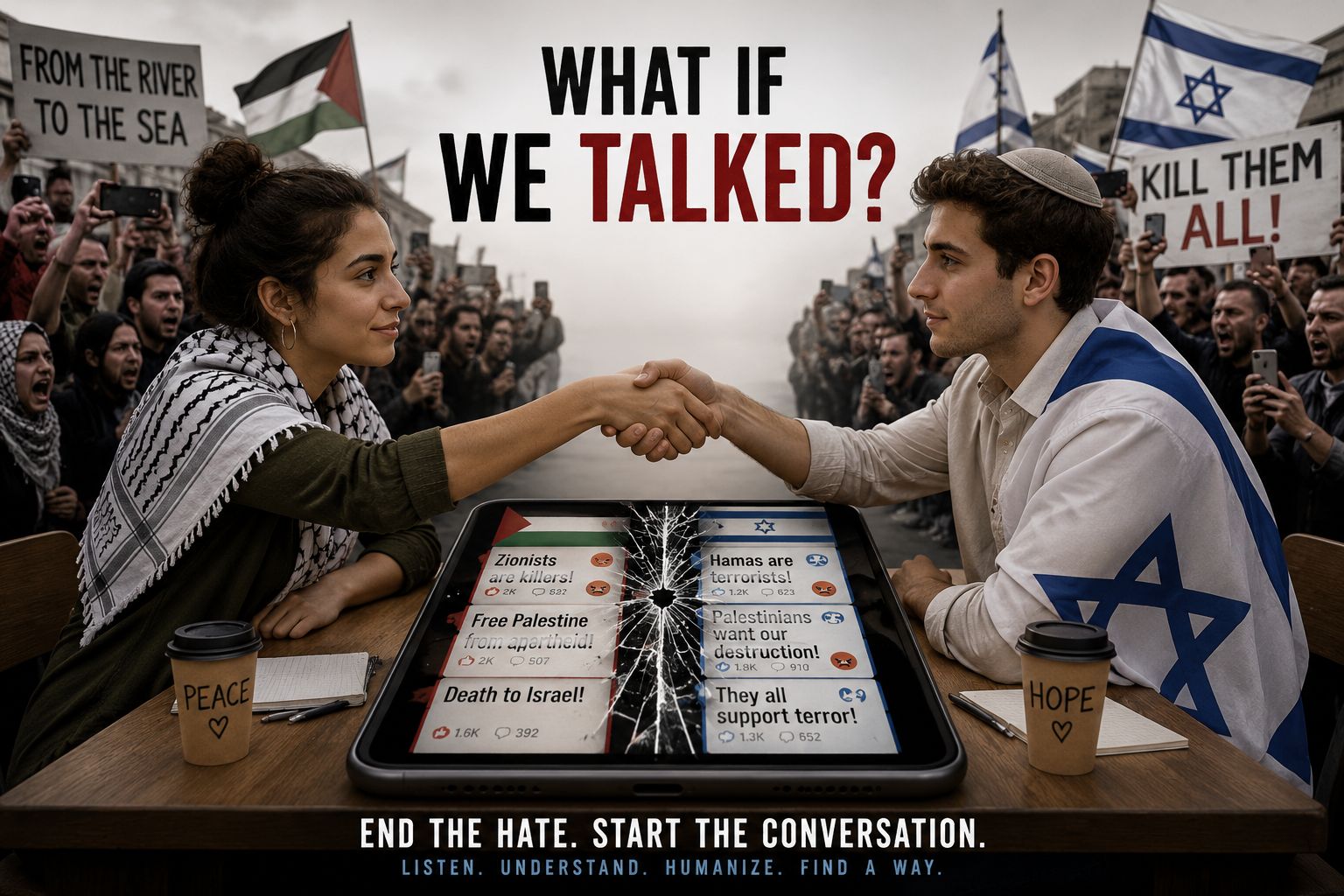
Social media promised to connect humanity. Instead, it often became extraordinarily efficient at sorting humanity into hostile camps.
Israel or Palestine. Capitalism or socialism. Left or right. Conservative or progressive. Religious or atheist. Pro-immigration or anti-immigration. Feminist or traditionalist. Western or anti-Western. Pick a subject, choose your tribe, follow the appropriate accounts, block the heretics, and allow an algorithm to supply you with an endless stream of evidence that you were right all along.
But imagine a different social media utopia.
Not one in which everybody suddenly agrees. That would be neither realistic nor desirable. Imagine instead that people disagree and collaborate anyway. They recognize that their opponents sometimes have a point. They admit when their own side does something terrible. They change their minds without experiencing it as humiliation. They search for solutions rather than victories.
The greatest social-media revolution would not be another platform.
It would be people learning to say: “You are right about that.”
Israel and Palestine: Two truths can exist simultaneously
Few issues demonstrate online tribalism more brutally than Israel and Palestine.
One online camp can appear incapable of discussing October 7 without immediately mentioning Gaza. Another can appear incapable of discussing dead Palestinian children without immediately mentioning Hamas.
What if both stopped?
Imagine a vigorous supporter of Israel saying:
Hamas deliberately murdered Israeli civilians. October 7 was an atrocity. Israel has a right to exist and Israelis have a right to live without terrorism. But none of that gives Israel unlimited moral permission to kill Palestinian civilians, destroy civilian life, abuse prisoners or deny Palestinians their own rights.
Then imagine a vigorous supporter of Palestine answering:
Palestinians have suffered occupation, displacement, blockade and enormous violence. They deserve freedom, dignity and self-determination. But none of that makes murdering Israeli civilians, taking hostages or celebrating the deaths of innocent people acceptable.
Neither person has abandoned their fundamental position.
Something much more important has happened: they have abandoned moral tribalism.
The next question is no longer, “How do I prove your people are worse than mine?”
It becomes, “How do we stop both peoples from burying their children?”
That conversation might actually lead somewhere.
Unfortunately, the architecture of social media often makes this kind of conversation difficult.
People naturally seek information that confirms existing beliefs. Group identity makes concessions psychologically expensive. Meanwhile, social platforms can reward material that produces engagement, and anger is exceptionally good at producing engagement.
A nuanced post saying, “There is compelling evidence on both sides, and the policy implications are complicated” has difficulty competing with:
THEY ARE LYING TO YOU.
The second message provides certainty, an enemy and an emotional reward.
Political identity consequently becomes something resembling a sports team. When your side scores, you celebrate. When it commits a foul, you complain about the referee.
But politics is not football. When political tribes refuse to acknowledge their own failures, actual human beings suffer.
The same transformation could happen economically.
A committed capitalist might admit something obvious: markets are extraordinarily powerful mechanisms for generating wealth, coordinating decentralized activity and encouraging innovation, but unregulated markets can also produce monopolies, exploitation, extreme concentrations of wealth and enormous disparities in bargaining power.
A socialist might simultaneously acknowledge that private enterprise, competition, entrepreneurship, investment and financial incentives can generate innovation and prosperity that centralized economic systems have repeatedly struggled to reproduce.
Now something interesting becomes possible.
Instead of spending another century arguing about whether capitalism or socialism should win, they could ask which mechanisms work best for which purposes.
Perhaps competitive markets are excellent at producing smartphones but terrible at guaranteeing universal access to emergency medicine. Perhaps governments are necessary for infrastructure, education and social insurance but terrible at deciding which restaurant should open on a particular street. Perhaps private companies can innovate while governments prevent monopolies. Perhaps workers can receive stronger protections without abolishing private enterprise.
Suddenly the conversation is no longer:
Capitalism versus socialism.
It is:
What actually works?
Left and right could discover that neither owns reality
A similar bargain could transform democratic politics.
The left could acknowledge that conservatives sometimes identify genuine problems involving social cohesion, government inefficiency, crime, uncontrolled bureaucracy or badly designed immigration policies.
The right could acknowledge that progressives sometimes correctly identify structural inequality, discrimination, environmental damage, inadequate worker protections and concentrations of corporate power.
Neither side needs to surrender its values.
They merely need to abandon the absurd proposition that one half of the political spectrum accidentally discovered every important truth while the other half discovered none of them.
A conservative might propose stricter immigration enforcement while supporting generous legal immigration and humane treatment of refugees. A progressive might support a large welfare state while accepting that programs need incentives, auditing and fiscal constraints. Both might oppose corruption, monopolies and politicians selling access to wealthy donors.
Those positions are not logically incompatible.
Tribalism makes them appear so.
Conservatives could change their minds
This utopia would require something particularly difficult: people publicly changing their opinions.
Imagine a conservative writing:
I opposed same-sex marriage 15 years ago. I was wrong.
Nothing terrible happens.
Nobody demands that he spend the remainder of his life apologizing for what he once believed. Progressives welcome the change rather than digging through his old posts to prove that he used to be a bad person.
Now reverse it.
Imagine a progressive saying:
I supported this policy because its intentions were good. The evidence now suggests that it doesn’t work. I was wrong.
Conservatives do not spend three days humiliating her. They say: good. Let’s find something better.
That is what intellectual progress looks like.
Yet online culture frequently creates the opposite incentive. Changing your mind can provide ammunition to your opponents while disappointing your allies. Consequently, people defend increasingly untenable positions because admitting error feels socially more expensive than continuing to be wrong.
A healthy intellectual culture would reverse the incentives.
Changing your mind after encountering better evidence should increase your credibility.
There would be no ideological bubbles
The greatest change would occur in what people choose to consume.
A socialist would deliberately follow intelligent capitalists.
An atheist would read thoughtful Christians and Muslims.
A conservative would follow serious progressive writers.
A Palestinian activist would listen to Israelis describing October 7. An Israeli supporter would listen to Palestinians describing life in Gaza and the West Bank.
Not because everybody deserves equal credibility. They don’t. Propaganda, conspiracy theories and deliberate lies remain lies.
The objective is not to pretend every argument is equally good.
The objective is to ensure that disagreement does not automatically become invisibility.
Algorithms could help. Instead of merely predicting which content will keep somebody scrolling, platforms could deliberately introduce credible arguments from outside a user’s ideological neighborhood. Not rage bait. Not the stupidest representative of the opposing side. The strongest one.
Imagine opening X and seeing:
“You strongly disagree with this person. Readers who share your views nevertheless rated this argument as thoughtful.”
That would be genuinely revolutionary.
Stop showing us the stupidest opponent
One of social media’s most destructive habits is selecting the worst possible representative of the opposing camp.
A conservative account finds an absurd progressive with 83 followers and presents the person’s ridiculous statement as:
THIS IS WHAT THE LEFT BELIEVES.
A progressive account finds an obscure racist and announces:
THIS IS CONSERVATISM.
Millions of moderate people disappear from the picture.
This is intellectually convenient because defeating an idiot is easier than defeating the strongest argument against your position.
A healthier culture would do the reverse.
Want to criticize capitalism? Debate its smartest defenders.
Want to criticize socialism? Find serious democratic socialists rather than Stalinists.
Want to criticize Christianity? Engage sophisticated Christian theology rather than pretending every Christian believes the Earth is 6,000 years old.
Want to defend Israel? Confront the strongest evidence concerning Palestinian suffering.
Want to defend Palestinians? Confront October 7 honestly rather than explaining away murdered civilians.
Steelman your opponent. Then disagree.
Facts would become more important than teams
Another feature of this utopia would be almost embarrassingly simple.
People would ask whether something is true before asking whether it helps their side.
Today, political information often undergoes the opposite test.
A damaging allegation about an opponent? Share immediately.
A damaging allegation about an ally? Demand seventeen independent investigations, three randomized controlled trials and God’s notarized signature.
This asymmetry destroys credibility.
In a collaborative information environment, standards of evidence would remain approximately constant regardless of whose reputation was at stake.
If your enemy lies, call it a lie.
If your ally lies, call it a lie faster.
Your principles mean very little if they disappear whenever they become inconvenient.
There would still be arguments
None of this means turning social media into an endless group hug.
People would still disagree profoundly.
An atheist may continue believing religion is false. A Christian may remain convinced that God exists. A socialist may want substantially more public ownership than a capitalist would tolerate. Conservatives and progressives will continue disagreeing about abortion, taxation, immigration, education, gender, criminal justice and countless other subjects.
Good.
A society without disagreement would probably be either dead or authoritarian.
The objective should not be consensus.
It should be productive disagreement.
You tell me where I am wrong. I tell you where I think you are wrong. We examine evidence. Perhaps neither of us changes our fundamental position. But maybe you move 5 percent toward me and I move 10 percent toward you.
More importantly, perhaps we discover the 60 percent on which we already agree.
That is enough to build policy.
Some positions should disappear
Collaboration also does not mean treating every belief as permanently deserving of preservation.
People sometimes change because society learns.
Racial segregation was wrong. Criminalizing homosexuality was wrong. Denying women equal political rights was wrong. Religious persecution is wrong.
There is no intellectual virtue in maintaining a belief merely because it is traditional.
Conservative people can change their minds. Progressives can change theirs. Religious people can become secular. Atheists can become religious. Nationalists can become internationalists. Socialists can accept markets. Capitalists can accept stronger redistribution.
The direction is less important than the process.
Did evidence, experience and contact with other human beings change you?
If so, changing your mind is not weakness.
It is evidence that your mind still works.
Platforms themselves could encourage this culture.
Instead of displaying only likes, reposts and follower counts, imagine rewarding corrections. A user who publicly corrects false information could gain a visible credibility signal rather than losing status.
Community fact-checking could emphasize context rather than humiliation. Recommendation systems could expose users to high-quality disagreement. Political discussions could highlight propositions on which opposing groups unexpectedly agree.
Imagine a discussion about immigration where the platform identifies:
78% of participants agree that legal immigration should be easier.
81% agree that asylum applications should be processed faster.
74% agree that violent criminals without a legal right to remain should be removed.
Suddenly participants see something algorithms rarely emphasize: common ground.
The disagreements remain. But the other side no longer looks like an alien civilization.
Collaboration is not centrism
There is an important distinction here.
The answer to every disagreement is not necessarily halfway between the two positions.
If one person says the Earth is spherical and another says it is flat, intellectual collaboration does not require concluding that Earth is shaped like a hamburger.
Evidence matters.
Nor does compromise require splitting every moral difference down the middle. There are situations in which one side is overwhelmingly wrong.
Collaboration means being willing to discover which side is wrong—including the possibility that it is yours.
That is radically different from reflexive centrism.
The hardest sentence on the internet
Perhaps social media needs a new status symbol.
Not followers.
Not verification.
Not viral posts.
The ability to write four words:
“I changed my mind.”
Or three even harder ones:
“You were right.”
Imagine millions of people saying those sentences without embarrassment.
An Israeli acknowledges Palestinian suffering without feeling that he has betrayed Israel. A Palestinian acknowledges Israeli suffering without feeling that she has betrayed Palestine. A capitalist recognizes exploitation without becoming a communist. A socialist recognizes the power of markets without becoming a libertarian. A conservative abandons an old prejudice. A progressive admits that a favored policy failed.
Nobody loses membership in the tribe because there is no tribe to lose.
There are simply human beings trying, imperfectly, to understand an extraordinarily complicated world.
The greatest social media utopia is not a platform without offensive speech. It is not a network where everybody holds the correct opinions. It is certainly not a place where algorithms have somehow eliminated conflict.
It is a place where conflict becomes cooperation.
People would still argue passionately. Sometimes they would become angry. Sometimes discussions would fail. Some people would remain dishonest, fanatical or impossible to persuade.
But the default objective would change.
Instead of asking:
How can I defeat these people?
We would ask:
What can we solve together?
Israelis and Palestinians would still disagree about history, borders and responsibility, but they might begin with the proposition that neither people’s children should be killed.
Capitalists and socialists would still argue about ownership and redistribution, but they might begin by agreeing that an economy should improve human lives.
Conservatives and progressives would still disagree about culture and change, but they might remember that they have to inhabit the same society when the argument is over.
Social media connected billions of people technologically.
It has not yet taught us how to be connected intellectually.
Perhaps that is the next revolution.
Not agreeing with everyone. Not surrendering our principles. Not pretending every side is equally right.
Just recognizing something tribalism desperately wants us to forget:
The person arguing with you may know something you don’t.
Leave a Reply