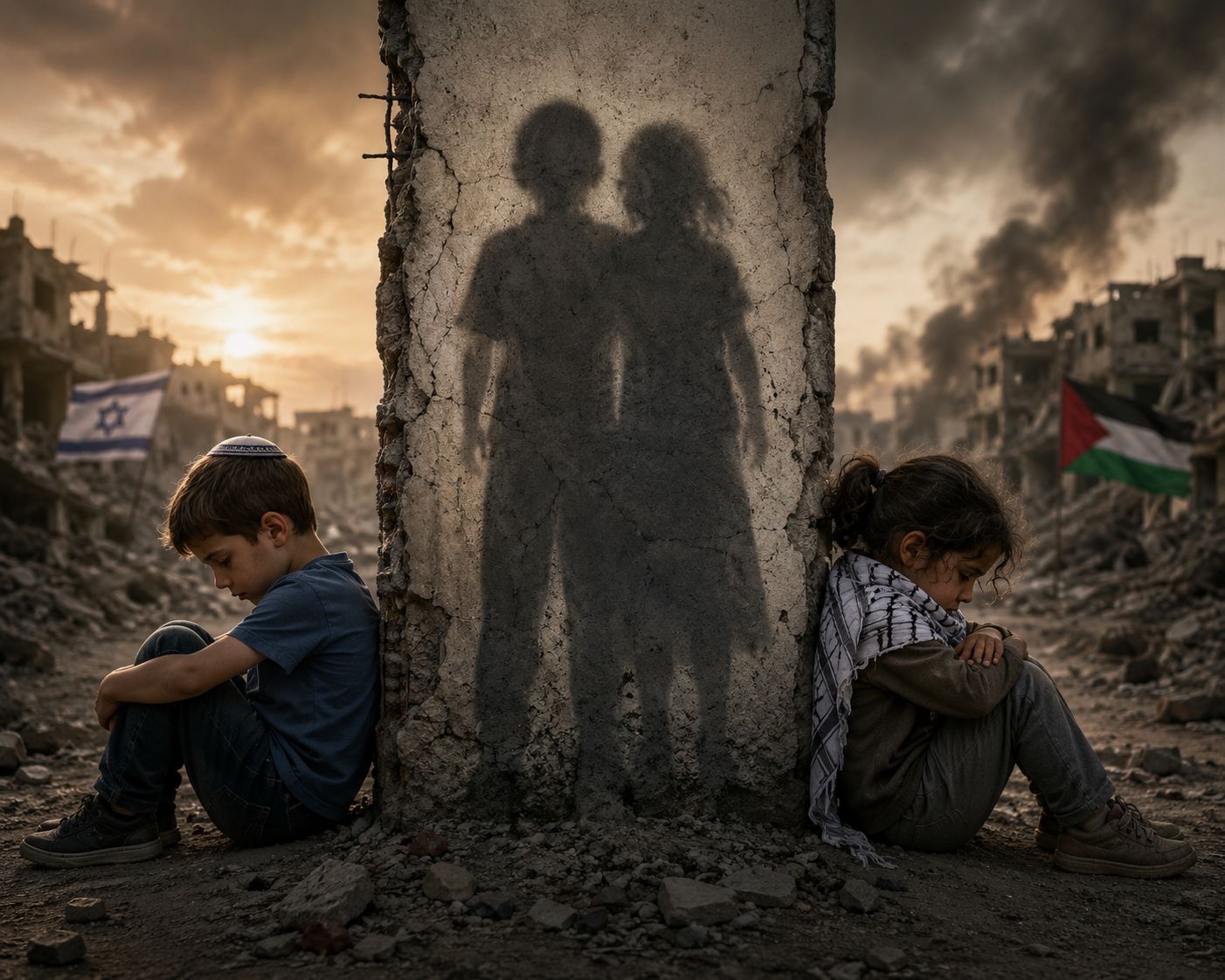
The conflict between Israelis and Palestinians is one of the clearest demonstrations of how tribalism can overwhelm empathy, reason, and moral consistency. It is also one of the few conflicts where many people appear unable to condemn atrocities committed by “their own side” while readily condemning identical acts committed by the other.
Before anything else, one point should be absolutely clear. Israel has an unquestionable right to exist as a sovereign state. That principle should not depend on political ideology. Likewise, the atrocities committed on October 7, 2023, were utterly disgusting. Thousands of civilians had gathered to celebrate life, music, and friendship. They did not attend expecting to be murdered, kidnapped, tortured, or raped. Such acts are indefensible regardless of the political grievances that preceded them.
Yet recognizing these facts does not eliminate the moral responsibility to evaluate what followed.
A conflict of absolute thinking
Benjamin Netanyahu’s father once argued that if Palestinians had the opportunity, they would kill every single Jew. Whether one accepts this statement completely or not, there is no denying that organizations such as Hamas openly call for Israel’s destruction and have deliberately targeted civilians for decades.
At the same time, Israel possesses overwhelming military superiority. If its government truly sought the physical extermination of Palestinians by military means alone, it possesses capabilities far beyond those available to Hamas. Military asymmetry has never been in serious doubt.
The moral question, however, is not whether one side could inflict greater destruction. It is whether military actions remain consistent with international humanitarian law and whether civilian lives retain equal value regardless of nationality.
Many legal scholars, human rights organizations, and some governments have argued that Israel’s military campaign has crossed into conduct that may constitute genocide or other grave violations of international law, while Israel strongly rejects that characterization and argues that it is conducting a lawful war against Hamas while attempting to minimize civilian casualties. The legal determination remains the subject of ongoing international proceedings and intense dispute.
Few places illustrate modern tribalism better than the social platform X.
If someone wishes to avoid endless hostility between Israeli and Palestinian supporters, X is perhaps the worst possible destination.
Large parts of the discussion no longer revolve around evidence, humanitarian principles, or international law. Instead, people choose a tribe and defend it almost without limit.
Among some extreme pro-Palestinian voices, one encounters conspiracy theories claiming that Jews control every aspect of international politics, finance, or the media. Jewish lives become secondary or entirely dismissed. Antisemitic stereotypes that should have disappeared decades ago are repeated as though they were established facts.
Such attitudes are morally repugnant. Criticism of Israeli government policy is entirely legitimate. Hatred toward Jews as an ethnic or religious group is not.
The opposite form of dehumanization
Yet the opposite extreme is equally disturbing.
Israel defines itself as a democratic state with institutions deeply influenced by modern liberal traditions, secular governance, and human rights principles, even while also defining itself as a Jewish state. Precisely because of this, one could reasonably expect greater sensitivity toward civilian suffering.
Instead, many supporters appear to dehumanize Palestinians almost completely.
For them, everything the Israel Defense Forces does is automatically justified.
Every bombing is necessary.
Every civilian death is unfortunate but acceptable.
Every criticism becomes antisemitism.
Every military decision is presumed morally correct before evidence is even examined.
Palestinians cease to exist as individuals. They become merely “them.”
The psychology of us versus them
Evolutionary psychology offers an uncomfortable explanation. Human beings evolved in small tribes competing over limited resources. Loyalty to one’s own group often improved survival. Distrust toward outsiders could also be advantageous under ancestral conditions.
These ancient instincts remain deeply embedded in the modern mind. Once group identity becomes central, moral reasoning changes dramatically.
If we kill them, many people conclude it is justified. If they kill us, it becomes proof of their barbarity.
Exactly the same action receives two completely different moral evaluations depending solely on who performed it.
This is not justice. It is tribal psychology.
Moral consistency is disappearing
The same individual may passionately condemn the murder of Israeli civilians while dismissing the deaths of Palestinian children as unavoidable.
Another person may condemn every Israeli military strike while celebrating attacks on Israeli civilians as “resistance.”
Both positions abandon universal ethics. The principle should be remarkably simple.
Murdering civilians is wrong.
Raping civilians is wrong.
Torturing civilians is wrong.
Kidnapping civilians is wrong.
These statements should not require an asterisk identifying the nationality of either victim or perpetrator.
Once exceptions begin, morality becomes nothing more than tribal preference.
Empathy should not have a nationality
Perhaps the saddest aspect of this conflict is not only the violence itself but also the disappearance of empathy.
Many people no longer see individual human beings. They see only Israelis. Or only Palestinians.
Every dead child becomes either a propaganda tool or an inconvenience for one’s preferred narrative.
Social media amplifies this process. Algorithms reward outrage, certainty, and emotional polarization. Compassion receives far less attention than hatred.
The result is a world where countless people spend hours defending deaths they would condemn instantly if the victims belonged to their own community.
Humanity deserves better
The Israeli–Palestinian conflict may be among the greatest modern examples of tribalism overwhelming humanism.
One side points to October 7 as justification for nearly every subsequent action.
The other points to decades of occupation and suffering to justify atrocities against Israeli civilians.
Neither narrative excuses crimes against innocent people.
The fundamental tragedy is that empathy has become conditional. Compassion depends on passports, ethnicity, religion, or political allegiance rather than on human suffering itself.
Humanity needs to rediscover something that should never have been lost: empathy, a humane approach, and the sensitivity to recognize that every civilian life has equal value. A grieving Israeli parent and a grieving Palestinian parent experience the same loss. Pain does not become less real because it occurs on the other side of a border.
If we cannot acknowledge that simple truth, then perhaps tribalism has already become worse than we ever imagined.
Leave a Reply