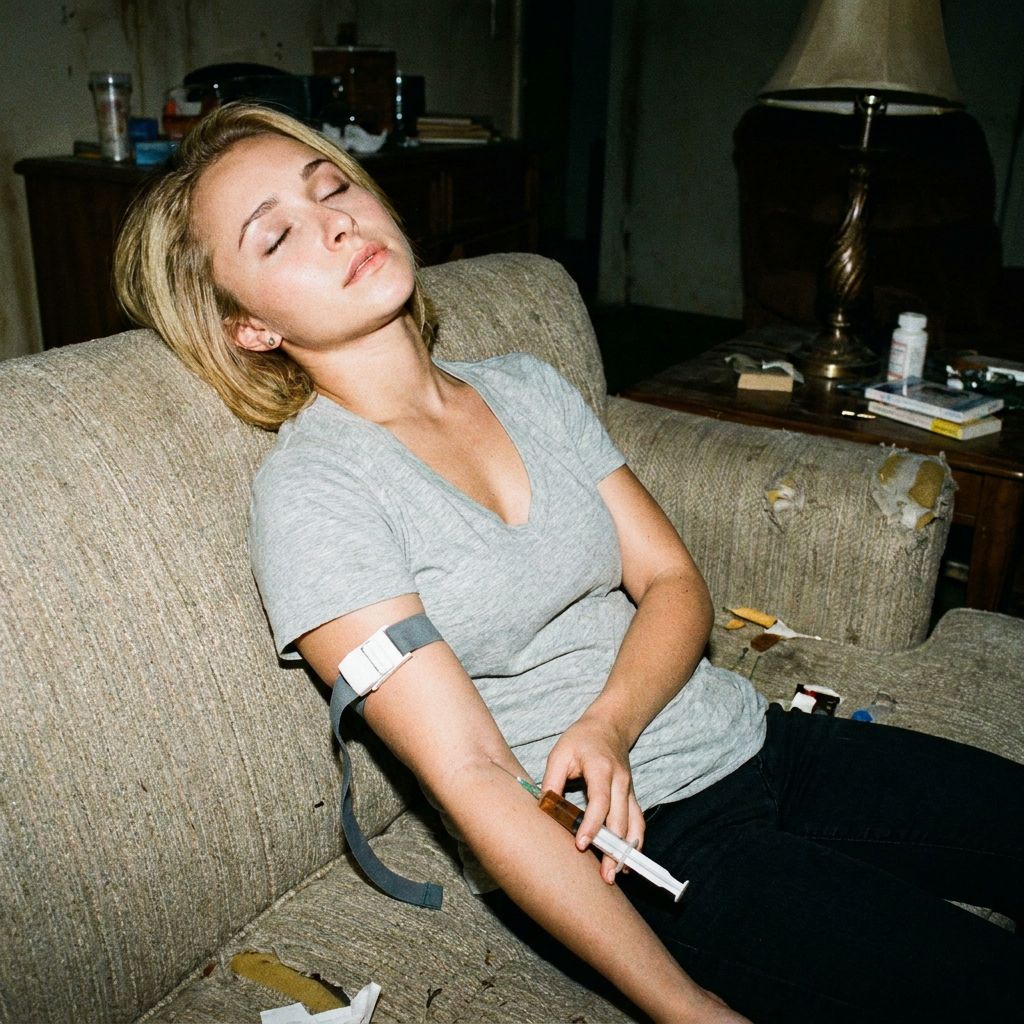
Hayden Panettiere was famous, successful and recognizable to millions. She was also remarkably open about addiction. She described years of problems with alcohol and drugs, repeated attempts at treatment and a struggle for sobriety that continued alongside a successful acting career.
Then, on August 16, 2026, Panettiere died at only 36. She was found unresponsive in Greenville, South Carolina, and emergency workers could not revive her. Authorities said there were no signs of foul play. A 911 call referred to a possible overdose, although her official cause of death remained under investigation when this article was written.
Her death immediately became international news. Newspapers reconstructed her struggle with addiction. Former colleagues discussed interventions and attempts to help her. Commentators analyzed the pressures of childhood fame, postpartum depression and substance dependence. Millions of people suddenly discussed addiction because the person who had died was someone they recognized.
There is nothing wrong with that attention. Panettiere was a human being, not merely a celebrity, and her death at 36 is tragic regardless of its ultimate cause. The uncomfortable question is what happens when exactly the same disease destroys someone whose name nobody knows.
Walk through parts of Los Angeles, Philadelphia, San Francisco or numerous other American cities and you can see another face of the addiction crisis. People sleep on sidewalks, live in tents, use drugs in public and cycle between emergency rooms, shelters, temporary treatment, police custody and the street. They may be severely addicted, physically ill, mentally unwell and completely disconnected from stable social support.
Most will never appear on television.
Addiction becomes visible when the addict is famous
Celebrity addiction produces a strange distortion in how society sees the problem. When an actor, musician or athlete struggles with drugs, we often receive a detailed human biography. We learn about childhood trauma, depression, relationships, career pressure, relapses, rehabilitation and attempts at recovery.
The person becomes understandable.
When an unknown homeless person is intoxicated on a sidewalk, the biography disappears. The public sees the behavior rather than the human being behind it. The person becomes “a junkie,” “a homeless person,” a nuisance, a threat or evidence that a city has lost control of its streets.
Yet the mechanisms of addiction do not fundamentally change when someone’s bank account reaches zero. Dependence, withdrawal, craving, trauma and impaired decision-making do not become moral failures simply because the person experiencing them lacks a publicist.
Hayden Panettiere could describe her addiction in interviews and a memoir. An anonymous man sleeping under a highway may have no audience at all. His story can end in an ambulance, jail cell, hospital or morgue without ever becoming a story.
Nearly eight in ten receive no treatment
The scale of America’s treatment failure is extraordinary. Federal data show that nearly eight in ten Americans with a substance use disorder in 2024 did not receive treatment.
That statistic should transform the way the country talks about addiction.
America does not merely have a drug problem. It has a treatment-access problem on an enormous scale. Millions of people meet criteria for substance use disorders while receiving no specialized treatment for them.
Some do not believe they need treatment. Others are not ready to stop using drugs. But willingness is only part of the problem. Cost, insurance, transportation, waiting lists, unstable housing, fragmented services and shortages of appropriate programs can all stand between an addicted person and sustained treatment.
For someone living on the street, every obstacle becomes harder. Keeping appointments is difficult when you have no reliable transportation. Storing medication becomes difficult when you have nowhere secure to keep it. Following a treatment plan becomes difficult when you do not know where you will sleep tonight.
We routinely expect severely destabilized people to navigate systems that relatively healthy people find confusing.
Then we blame them when they fail.
Homelessness and addiction feed each other
Homelessness and substance use disorders overlap, but the relationship should not be simplified into “drugs cause homelessness.”
Sometimes addiction contributes directly to losing employment, relationships and housing. In other cases, people become homeless first and subsequently increase their use of alcohol or drugs while attempting to survive fear, cold, violence, isolation and psychological distress.
Frequently, several problems interact.
Someone loses a job. Rent becomes impossible. A relationship collapses. Depression worsens. Alcohol provides temporary relief. Debt accumulates. Housing disappears. Drug use escalates. Criminal charges make employment harder. A criminal record makes housing harder. Life becomes progressively more unstable.
At that point, telling the person simply to “make better choices” borders on absurdity.
Choices still exist, but their range has narrowed dramatically.
The street is not treatment
Leaving severely addicted people on sidewalks is sometimes presented as tolerance. It is nothing of the kind.
There is nothing compassionate about watching a person deteriorate in public while insisting that respecting autonomy requires society to do virtually nothing until the individual requests precisely the right service in precisely the right way.
A person living in a tent while repeatedly overdosing does not possess meaningful freedom simply because nobody forces him into treatment. He may instead be trapped by addiction, poverty, illness and a fragmented support system.
The opposite extreme is equally inadequate. Arresting someone, removing him from public view for several days and then releasing him back into exactly the same environment does not constitute treatment either.
America too often oscillates between abandonment and punishment.
Neither solves addiction.
Criminalizing the consequences
Drug addiction frequently intersects with criminal law. Possession of illegal drugs can itself produce arrest, while addiction can also contribute indirectly to theft, dealing, trespassing, disorderly conduct and other offenses.
Some crimes committed by addicted people have real victims. Compassion for addiction cannot mean pretending that robbery, assault or theft becomes harmless when the perpetrator has a substance use disorder. Victims deserve protection, and dangerous behavior requires intervention.
But punishment without treatment can reproduce the conditions that contributed to the crime.
Imagine someone dependent on opioids who has no stable housing and steals to finance drug use. The state arrests him. He spends time in jail, accumulates another criminal record and eventually returns to the street. He is now expected to find employment and housing with the same addiction, the same poverty and an even worse criminal history.
What exactly has been solved?
If treatment does not interrupt the cycle, the criminal justice system can become another station within it.
Criminalization can create more criminality
This is where punitive drug policy can become self-defeating.
A criminal record reduces employment opportunities. Lack of employment makes stable housing more difficult. Housing instability makes recovery harder. Continued addiction increases the risk of further illegal behavior, which produces another arrest and another criminal record.
The system can therefore punish someone in a way that increases the conditions associated with future offending.
That does not mean every drug-related offense should simply be ignored. It means criminal justice should distinguish between protecting society from dangerous behavior and repeatedly punishing symptoms of a disorder without addressing the disorder itself.
If someone commits violence, society must protect potential victims. If someone repeatedly steals because of severe addiction, the theft cannot simply be dismissed. Yet incarceration should be connected to serious treatment, discharge planning, housing assistance and continuing care rather than functioning as an expensive temporary warehouse.
Otherwise, the person leaves jail with the same brain, the same addiction and fewer legitimate opportunities.
Jail can interrupt drug use without treating addiction
Incarceration can temporarily restrict access to a particular drug, but temporary abstinence is not the same as recovery.
People leaving incarceration can face an especially dangerous period because their tolerance may have fallen. Returning to the dose they previously used can result in fatal overdose.
Effective treatment therefore cannot end at the prison gate. People with opioid use disorder should have access to evidence-based medications such as methadone and buprenorphine where clinically appropriate. Treatment should continue after release, and people should leave custody with appointments, medication arrangements, identification documents, health coverage and somewhere realistic to live.
Instead, release can mean being returned to the same neighborhood, the same social environment and the same homelessness that existed before arrest.
Relapse under those conditions should surprise nobody.
Treatment is not simply detoxification
Another persistent misconception is that addiction treatment means getting someone through withdrawal and sending him home.
Detoxification can be medically necessary, but addiction is not cured when withdrawal ends. Effective care may involve medication, psychotherapy, psychiatric treatment, peer support, medical care, stable housing, employment assistance and long-term follow-up.
Recovery is often nonlinear.
Relapse does not automatically mean treatment was useless. Chronic conditions frequently fluctuate, and substance use disorders are no exception. The appropriate response to relapse is reassessment and continued care, not necessarily moral condemnation.
The American healthcare system is poorly suited to this complexity. Services can be divided between emergency departments, psychiatric facilities, addiction programs, primary care, shelters, jails and nonprofit organizations. A person with multiple problems may technically have access to several systems while effectively belonging to none of them.
The result is fragmentation disguised as care.
Mental illness cannot be separated from addiction
Many people with severe substance use disorders also experience psychiatric problems. Depression, anxiety, trauma-related disorders, psychotic illnesses and personality disorders can coexist with addiction, while prolonged drug use can itself produce or worsen psychiatric symptoms.
Treating only one side of that equation can fail spectacularly.
A homeless person experiencing psychosis while using methamphetamine does not fit neatly into a system that wants to know whether his primary problem is “mental health” or “drugs.” Both may require attention at the same time.
The same applies to trauma. People who have experienced childhood abuse, domestic violence, combat, incarceration or life on the streets may use substances partly because intoxication temporarily suppresses unbearable psychological states.
Removing the drug without addressing what the drug was helping the person escape can leave an enormous vacuum.
That does not make continued drug use healthy. It explains why simply ordering someone to stop may accomplish very little.
Housing is part of the equation
Treatment becomes much harder when recovery takes place on a sidewalk.
Imagine completing detoxification and then returning to a tent surrounded by people using the same drug you are desperately trying to avoid. Imagine trying to recover while worrying that your possessions will be stolen, that someone will attack you during the night or that police will tell you to move again tomorrow morning.
Stable housing does not magically cure addiction. Some people continue using drugs after receiving housing, and housing programs need effective connections to treatment and social services.
But expecting stable recovery without addressing severe housing insecurity is equally unrealistic.
Housing gives treatment somewhere to happen.
It gives medications somewhere to be stored, outreach workers somewhere to find the person and recovering individuals somewhere to sleep without constantly fighting for survival.
A bed is not rehabilitation, but rehabilitation is considerably harder without a bed.
Severe addiction can destroy relationships. Families become exhausted after years of lying, stealing, relapse, conflict and broken promises. Friends disappear. Employers stop offering chances. Eventually, the person may be left almost entirely alone.
It is easy to tell families that they should provide support. Reality is more complicated.
Nobody should be required to tolerate violence, theft or endless manipulation from a relative simply because that relative is addicted. Families have rights and limits too.
That is precisely why society needs professional support systems.
When family support collapses, the alternative cannot simply be a sidewalk.
Case management, supported housing, addiction medicine, psychiatric care, social workers, peer recovery programs and employment assistance can provide forms of structure that exhausted relatives cannot reasonably supply forever.
Without them, the person most impaired by addiction is expected to organize his own recovery while living in chaos.
I have seen the problem myself
I have encountered people with serious drug addictions both at a mental health center and during my stay in a mental hospital. Some were aggressive, unpredictable or extremely difficult to be around. Their behavior could frighten and exhaust other patients, and pretending otherwise would romanticize addiction. But what struck me was that these people clearly needed much more than punishment or condemnation. Many seemed trapped in a combination of addiction, psychiatric problems and social instability that they could hardly escape on their own. Their aggression did not make the behavior acceptable, nor did addiction excuse threats or violence.
)Other patients deserved protection from them. Yet simply labeling these people troublemakers would have solved nothing. They needed boundaries, supervision, psychiatric and addiction treatment, and sustained social support. Seeing them personally reinforced something statistics cannot fully convey: severe addiction can make people dangerous to themselves and sometimes to others, but that is precisely when serious intervention is needed most.
Poverty changes everything
Celebrity addiction and street addiction may involve the same drugs, but money radically changes the environment surrounding them.
A wealthy person can enter a private rehabilitation center. A manager can cancel appointments. Family members can arrange transportation. Lawyers can handle criminal problems. Assistants can protect privacy. A relapse can occur behind the walls of an expensive home.
A poor person may detox in jail.
A wealthy addict can be described as “struggling with substance use.” A homeless addict staggering through a train station is more likely to be described as a public-order problem.
This difference is not merely linguistic.
Money buys time, privacy, treatment options and second chances.
Poverty exposes addiction to police.
The celebrity becomes a tragedy. The homeless addict becomes scenery
This may be the most disturbing contrast.
When a famous person dies after years of addiction, the public reconstructs the person’s humanity. Childhood photographs appear. Friends describe talents and dreams. Journalists explain trauma and illness. People say the person was more than an addiction.
They are right.
But so is the unidentified man lying beside a shopping cart.
He also had a childhood. Someone once knew him before addiction. He may have had a job, relationships, ambitions and interests. Perhaps his family tried to help him for years, perhaps they abandoned him, perhaps he abandoned them. Perhaps nobody was ever there.
We rarely ask.
Extreme homelessness creates a kind of social invisibility in which a person can be physically present in front of thousands of pedestrians while almost disappearing as an individual.
Celebrities receive biographies.
The poor become statistics.
Compassion does not mean permissiveness
There is a legitimate backlash against policies perceived as allowing open-air drug markets, public intoxication, theft and severe disorder to become normal features of city life.
Residents have rights too. Parents should be able to take children to parks without finding discarded needles. Businesses should not be expected to absorb endless theft. Transit passengers should not have to accept threatening behavior as the price of compassion.
The mistake is assuming that the alternatives are either unlimited tolerance or mass incarceration.
A humane society can impose boundaries while simultaneously providing treatment.
Public drug use can be restricted. Violent and predatory behavior can have consequences. At the same time, people whose criminal behavior is substantially driven by addiction can be diverted toward intensive treatment where appropriate.
Accountability and healthcare are not opposites.
The objective should be reducing both addiction and the harm addiction causes to everyone else.
America spends enormous amounts dealing with the consequences
Untreated addiction is not free.
It appears in emergency rooms, ambulance calls, policing, courts, jails, shelters, child welfare systems and lost employment. Municipal governments pay to clear encampments that later reappear. Hospitals stabilize people who return weeks later. Police arrest the same individuals repeatedly.
Society therefore pays whether it treats addiction or not.
The relevant question is what it buys with that money.
A cycle of emergency treatment, arrest, temporary shelter and street homelessness can consume enormous resources without creating stability. Investment in evidence-based treatment, housing support and continuing care may be expensive, but repeated institutional failure is expensive too.
The cheapest-looking response at one stage can become extraordinarily costly when repeated for years.
There is no single solution
It would be comforting to claim that one policy could solve America’s addiction crisis.
There isn’t one.
Some people respond rapidly to treatment. Others relapse repeatedly. Some require medication for years. Some need intensive psychiatric care. Others primarily need stable housing and outpatient support. A minority may become so impaired or dangerous that involuntary intervention becomes necessary under carefully defined legal standards.
Different drugs also create different problems. Opioid addiction has highly effective medication treatments. Stimulant addiction presents different therapeutic challenges. Alcohol dependence can require medically supervised withdrawal because abrupt cessation can itself be dangerous.
The diversity of addiction makes ideological slogans particularly useless.
“Just arrest them” is not a treatment system.
“Just give them housing” is not a complete treatment system either.
Neither is “just let them choose.”
The difficult answer is an integrated system capable of combining housing, healthcare, psychiatric treatment, addiction medicine, social support and, when necessary, proportionate legal intervention.
Recovery is possible
The bleakness of street addiction can create another dangerous assumption: these people are beyond help.
They are not.
Millions of Americans live in recovery from substance use disorders. People who once lost jobs, families and homes can rebuild their lives. Medication can dramatically reduce opioid use and mortality. Psychological and social interventions can help people remain stable. Housing can provide the environment in which recovery becomes sustainable.
Not everyone will recover, and no serious policy should promise miracles.
But addiction is not automatically a terminal condition.
That is why abandonment is so indefensible.
Leaving someone on the street until he overdoses is not respecting his destiny. It is accepting a preventable failure.
Hayden Panettiere had a name
Hayden Panettiere’s death received attention because she had a name the world recognized. Her struggles were documented because people wanted to hear about her life.
She deserved that humanity.
The mistake would be reserving it for her.
Every day, people with addictions wake up in shelters, tents, cars, motels, prisons and abandoned buildings. Some will seek treatment, some will refuse it, some will steal, some will relapse. Some will recover. And some will overdose before anyone has another chance to help them.
Their lives are less visible, but they are not worth less.
America should stop pretending that leaving severely addicted people on sidewalks constitutes freedom and stop pretending that repeatedly arresting them constitutes treatment. Addiction requires healthcare, social support, housing, boundaries and sustained intervention.
A famous addict gets an obituary explaining how complicated life became.
An anonymous addict can die behind a dumpster and become a line in a database.
The disease does not know the difference.
We do.
Leave a Reply