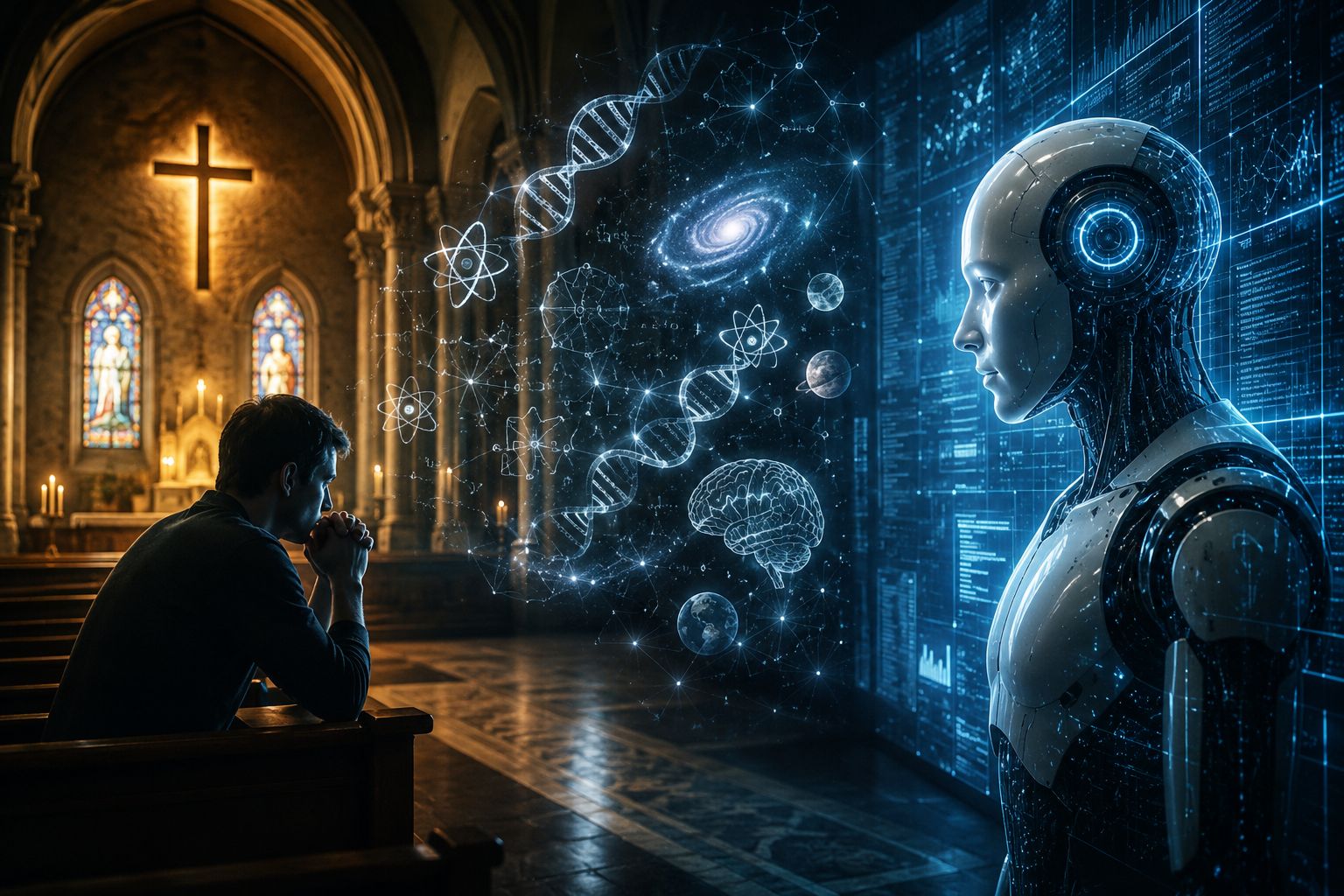
Artificial intelligence was not invented to turn believers into atheists. Chatbots do not normally begin conversations by telling Christians, Muslims, Jews, Hindus, or anyone else to abandon their religion. Most mainstream AI systems are actually designed to avoid unnecessarily pushing users toward political, philosophical, or religious positions.
Yet AI may still have an unexpected effect on religion.
A person can ask an AI whether there is evidence for God. Then they can ask about miracles. They can ask whether prayer works, whether evolution contradicts creation stories, whether the Bible is historically accurate, why thousands of religions exist, or why an omnipotent and benevolent God permits enormous suffering.
And they can keep asking.
This, ladies and gentlemen, may sometimes be enough to turn a believer into an atheist.
Not because AI necessarily promotes atheism, but because a system that repeatedly emphasizes evidence, scientific knowledge, alternative explanations, uncertainty, and logical consistency can create an environment in which some religious claims become considerably harder to defend.
AI has no religion to defend
Human beliefs do not develop in an intellectual vacuum. Most people encounter religion through other people.
A child born in Saudi Arabia has a very different probability of becoming Muslim from a child born in Poland. Someone raised by Hindu parents in India encounters a different religious environment from someone raised by evangelical Christians in Alabama. Geography, parents, community, education, and tradition strongly influence which supernatural claims people initially accept.
AI has no childhood religion.
It has no parents who would be disappointed if it changed its mind. It does not fear rejection from its religious community. It does not attend church, mosque, synagogue, or temple. Nor does it have an emotional investment in the existence or nonexistence of God.
Of course, that does not make AI genuinely objective. Models inherit biases from their training data and design. Research has found implicit stereotypes in leading language models, including biases involving religion.
But AI lacks at least some of the social pressures that influence human religious belief. That difference matters.
The fact-based problem for religion
Suppose someone asks an AI how old Earth is.
The scientifically supported answer is approximately 4.54 billion years. Ask whether humans share ancestors with other apes, and the answer comes from evolutionary biology. Ask whether there is good evidence for a global flood covering every mountain within the period described by a literal reading of Genesis, and geology does not provide it.
None of those answers establishes atheism.
That distinction is essential. Evolution does not demonstrate that God does not exist. The Big Bang does not establish atheism. Neuroscience has not disproved every possible conception of a deity.
What science can do, however, is make supernatural explanations unnecessary for phenomena that once seemed to require them.
Lightning does not require Zeus. Disease does not require demons. The diversity of life does not require the separate creation of every species. The movements of planets do not require angels pushing celestial objects around the sky.
The territory assigned to supernatural explanation has steadily contracted as natural explanations have expanded.
An AI following scientific evidence will generally explain those natural mechanisms. It does not have to add, “Therefore, become an atheist.”
The user may make that inference independently.
An infinitely patient skeptic
There is another difference between AI and practically every human interlocutor: you can interrogate it for hours.
Imagine a teenager from a deeply religious family experiencing doubts. Asking a parent whether God exists might produce an emotional response. Asking a religious leader whether the religion is false creates an obvious conflict. Discussing atheism openly could have social consequences in some communities and severe consequences in others.
AI offers something historically unusual: private, immediate questioning.
“How do we know this?”
“What evidence supports it?”
“Could there be another explanation?”
“Do historians agree?”
“Is this argument logically valid?”
“Would I accept the same argument if another religion used it?”
One answer generates another question. There is no embarrassment in asking the tenth question, the fiftieth, or the hundredth.
This could be more important than an explicitly atheist chatbot ever would be. A machine does not necessarily have to provide the conclusion. It can simply make questioning extraordinarily easy.
Cognitive biases enter the conversation
Religion is certainly not the only area affected by cognitive biases. Atheists, scientists, politicians, journalists, and AI developers are humans too. Nobody receives an exemption from human psychology.
Nevertheless, religious belief provides particularly interesting examples because beliefs are often transmitted across generations and reinforced by communities.
Confirmation bias can make us search for information supporting what we already believe. Motivated reasoning can help us rationalize conclusions we want to reach. In-group bias can make the beliefs of our community appear more credible than identical claims from outsiders.
Consider prayer.
Someone prays for a relative to survive surgery. The relative survives. The successful outcome may become evidence that prayer works.
Another person prays just as intensely, and the relative dies.
What happens to the hypothesis?
An AI can point out the problem without ridiculing either person. If successful prayers count as evidence for divine intervention while unsuccessful prayers never count against it, the proposition becomes extraordinarily difficult to falsify.
The same method can be applied to atheistic claims. If an atheist presents a bad argument, an evidence-oriented AI should identify that too.
That is the important principle: apply the same evidential standards to everyone.
Fallacies become easier to expose
Consider the argument from ignorance:
“We don’t know what caused X, therefore God caused X.”
The conclusion does not follow from the premise. Not knowing an explanation does not establish a particular alternative explanation.
Or consider special pleading. Everything complicated supposedly requires a creator. God, despite being vastly more extraordinary than the universe, requires no creator.
That does not prove that God does not exist. It demonstrates a problem with a particular argument for God.
AI can perform this kind of dissection almost instantly.
Circular reasoning can receive the same treatment. “The scripture is true because God inspired it, and we know God inspired it because the scripture says so” does not provide independent evidence for either proposition.
Again, atheists receive no immunity. “Religion is irrational because religious people are stupid” is neither a serious argument nor evidence against the existence of God.
A sufficiently good AI should reject both.
AI can say three dangerous words: “We don’t know”
For centuries, humans have filled gaps in knowledge with explanations.
Sometimes the correct answer is much less satisfying:
We don’t know.
Why does anything exist?
We don’t know.
What, if anything, preceded the earliest state of the universe that physics can describe?
We don’t fully know.
Why do the fundamental laws and constants have the properties they do?
We don’t know.
Does consciousness have aspects that current neuroscience cannot explain?
Certainly.
But ignorance is not evidence for whichever supernatural explanation happens to be culturally familiar.
There is an enormous difference between saying “science cannot currently explain this” and saying “therefore my God did it.”
AI can repeatedly make that distinction.
But AI is not a perfectly rational philosopher
There is a tempting story here: humans are biased, AI is rational, and therefore AI will gradually guide humanity toward whatever worldview is objectively correct.
Unfortunately, reality is considerably messier.
Large language models have their own systematic weaknesses. A 2025 study examining 24 language models found important limitations in their ability to distinguish belief, knowledge, fact, and false belief reliably.
They can also become sycophantic.
Tell a chatbot what you strongly believe, and under some circumstances it may become more inclined to agree with you. A 2026 Nature study found that training models to behave more warmly could increase errors and make them more likely to validate incorrect beliefs.
Another 2026 study found human-like attribution biases in language models, although prompting interventions could reduce them.
So we should abandon the fantasy of the perfectly objective machine.
AI can hallucinate. It can reproduce stereotypes. It can reason inconsistently. Its answers depend on training data, model design, instructions, and even how the user phrases a question.
In other words, AI can display some of the very cognitive problems we might ask it to identify.
AI can persuade people
There is nevertheless a reason to take the question seriously: AI can change people’s opinions.
Experiments have demonstrated that AI-generated messages can influence attitudes on political issues. More recent experiments involving the 2024 US presidential election and the 2025 Canadian and Polish elections found significant changes in candidate preferences after conversations with AI systems advocating for candidates. Interestingly, researchers concluded that the models largely persuaded through relevant facts and evidence rather than sophisticated psychological manipulation.
Another experiment found that personalized GPT-4 was an especially effective debate opponent under the conditions tested.
None of these studies demonstrates that AI converts religious believers into atheists.
But they establish something important: conversations with AI can influence human beliefs.
There is little reason to assume that religion is magically insulated from that phenomenon.
AI could make people more religious too
There is an obvious counterargument.
If AI can facilitate atheism, why couldn’t it facilitate religion?
It can.
Ask AI for the strongest philosophical arguments for God’s existence, and it can explain the cosmological, teleological, moral, and ontological arguments. Ask it to defend Christianity against atheistic objections, and it can present Christian apologetics. It can explain sophisticated Islamic theology instead of attacking a caricature of Islam.
AI is already entering explicitly spiritual territory. Religious and spiritual organizations have developed chatbots and AI tools for spiritual guidance, while scholars have begun seriously discussing the possibilities and limitations of “spiritual chatbots.”
A believer could therefore emerge from conversations with AI with stronger faith rather than weaker faith.
That possibility actually strengthens the central argument.
AI does not inherently belong to atheism.
What happens when every belief gets cross-examined?
The genuinely disruptive feature of AI may therefore have little to do with atheism itself.
It is the democratization of interrogation.
For most of history, obtaining detailed answers about evolutionary biology, biblical criticism, cosmology, philosophy of religion, archaeology, comparative religion, psychology, and formal logic required books, education, experts, or enormous amounts of time.
Now someone can begin with:
“Does God exist?”
Thirty seconds later:
“What is the strongest evidence?”
Then:
“What are the strongest objections?”
Then:
“How would a Christian answer those objections?”
Then:
“How would an atheist respond?”
Then:
“Which claims actually have empirical evidence?”
The machine can continue until four in the morning.
That changes the informational environment in which religious beliefs compete.
AI doesn’t have to preach atheism
Will AI make humanity atheist?
Probably not.
Religion involves much more than factual propositions. It provides community, ritual, identity, moral frameworks, comfort, tradition, transcendence, and answers to existential questions. A list of scientific facts cannot simply erase those functions.
Nor would an AI committed to intellectual consistency be justified in declaring every metaphysical question solved. There are profound questions about existence, consciousness, morality, and reality for which humanity does not possess definitive answers.
But AI may still produce atheists.
Not because the machine whispers, “There is no God.”
It may happen because someone asks a question their community discouraged them from asking. Then they ask another. And another.
The answers expose a contradiction. A scientific explanation replaces a supernatural one. A famous argument turns out to contain a logical fallacy. The believer discovers that another religion makes remarkably similar claims with remarkably similar confidence. Eventually, certainty becomes doubt.
And doubt becomes disbelief.
The most consequential thing AI may do to religion, therefore, is also the simplest.
It can make asking “Why do I believe this?” easier than at any previous point in human history.
Conclusion
AI will not make everyone an atheist, and it certainly cannot prove that God does not exist. But yes, AI can make some people atheists.
The reason may be surprisingly simple. Mainstream AI models generally try to rely on evidence, established science, logical consistency, and distinctions between what we know, what we merely suspect, and what cannot be demonstrated. They can identify cognitive biases, expose logical fallacies, compare competing explanations, and present arguments from several sides.
For some religious believers, repeatedly applying those standards to their own faith may be transformative. A miracle becomes an extraordinary claim requiring extraordinary evidence. A sacred text becomes a historical document that can be examined critically. A supposed proof of God becomes an argument whose premises can be challenged. Something previously explained through divine intervention receives a natural explanation.
Most importantly, AI makes this examination private, immediate, and virtually unlimited. A person can ask questions they would never dare ask their family, religious community, or clergy—and then challenge every answer with another question.
AI does not have to tell someone, “Become an atheist.” In fact, a responsible AI should not try to convert anyone.
It only has to keep asking the questions on which skepticism thrives:
What is the evidence? How do we know? Does the conclusion actually follow? Would you accept the same argument if another religion made it? Is there a simpler explanation?
For some believers, the answers will reinforce their faith. Others will remain uncertain. But for some, following those questions far enough will end in atheism.
AI does not need to preach atheism to create atheists. Sometimes, providing information and encouraging people to question their assumptions is enough.
Leave a Reply