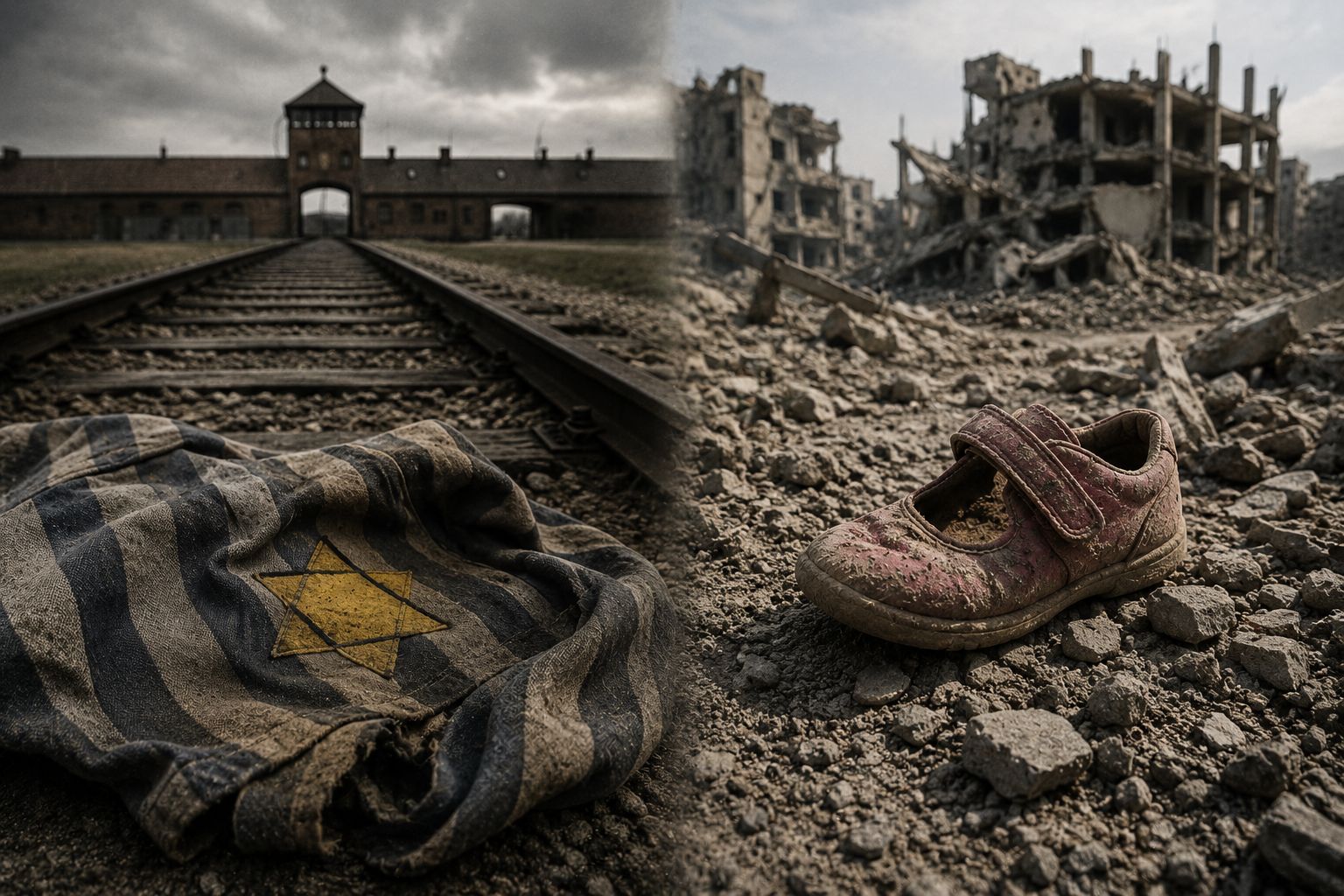
Jewish history contains an almost incomprehensible amount of persecution.
Long before the Holocaust, Jewish communities were expelled, segregated, robbed, forcibly converted, tortured, massacred, and blamed for catastrophes they did not cause. During the Crusades, entire Jewish communities were massacred. Medieval authorities restricted where Jews could live, what professions they could enter, whether they could own land, and sometimes even what clothing they had to wear. Jews were accused of ritual murder, poisoning wells, spreading disease, and conspiring against Christian society.
Then came modern racial antisemitism, pogroms, exclusion, and eventually the Holocaust.
Nazi Germany and its collaborators murdered approximately six million European Jews. Nearly two-thirds of Europe’s Jewish population was destroyed. People were shot beside mass graves, deliberately starved in ghettos, worked to death, deported in cattle cars, and murdered industrially in extermination camps.
One would think this history would provide one of humanity’s strongest warnings against dehumanization, collective punishment, ethnic hatred, and indifference toward civilian suffering.
Yet there is a terrible paradox.
Some of the political forces that invoke Jewish historical suffering most strongly have simultaneously defended, minimized, rationalized, or ignored enormous Palestinian suffering.
And in doing so, they risk diminishing the universal moral meaning of Jewish suffering itself.
Jewish suffering began long before Auschwitz
The Holocaust did not suddenly emerge from nowhere in 1933.
Anti-Jewish prejudice had existed in Europe for centuries. Christian teachings helped perpetuate the idea of collective Jewish responsibility for the death of Jesus. Medieval Jews were repeatedly treated as outsiders within overwhelmingly Christian societies.
During the First Crusade, crusaders massacred Jewish communities on their journey toward Jerusalem. Later centuries brought expulsions, forced conversions, discriminatory taxation, ghettos, occupational restrictions, and periodic massacres.
When the Black Death devastated Europe, Jews were falsely accused of poisoning wells. Blood-libel accusations claimed Jews murdered Christian children for religious purposes. Such fantasies repeatedly provided justification for persecution.
By the nineteenth and early twentieth centuries, religious antisemitism increasingly mixed with racial nationalism and pseudoscientific racism. Pogroms devastated Jewish communities in Eastern Europe.
Then Hitler came to power.
The Holocaust should have been the ultimate warning
The Holocaust represented something even more terrible.
Antisemitism became state policy on a genocidal scale.
Jews lost their rights, employment, businesses, property, homes, and eventually their lives. Nazi Germany and its collaborators systematically murdered six million Jews through shootings, starvation, forced labor, gas chambers, and other means.
The lesson should not merely be: Never again to Jews.
It should be: Never again to anyone.
That does not mean equating every war, atrocity, occupation, or episode of ethnic violence with the Holocaust. Historical analogies can easily become intellectually dishonest.
It means applying the underlying moral principle universally.
Human beings do not become less human because they belong to another nation, ethnicity, or religion.
Jewish people are not Israel
This distinction is absolutely essential.
There are millions of Jewish people with radically different political views. Some are Zionists, some are anti-Zionists, some support Israel while fiercely opposing Netanyahu. Some oppose the Gaza war. Others support Israeli military policy.
Likewise, Israelis are not a political monolith. Israeli journalists, activists, academics, soldiers, families of hostages, human-rights organizations, and ordinary citizens have challenged their own government.
Therefore, saying that “the Jews” are responsible for Gaza would itself reproduce precisely the tribalistic thinking this article condemns.
Judaism is not Zionism.
Jewish people are not the Israeli government.
Israelis are not Benjamin Netanyahu.
And criticism of Israeli conduct should never become collective condemnation of Jews.
Tribalism changes the moral equation
The more interesting question concerns tribalism.
Human beings readily divide themselves into us and them. Once that happens, identical behavior can receive completely different moral judgments depending on who commits it.
Our civilians are innocent. Their civilians are suspicious.
Our dead deserve names and photographs. Their dead become statistics.
Our fear explains our violence. Their fear demonstrates their hatred.
Our historical trauma must be understood. Their historical trauma is inconvenient.
This psychological mechanism is hardly unique to Jews or Israelis. Palestinians, Arabs, Europeans, Americans, Russians, Ukrainians, Muslims, Christians, atheists, and practically every other human group can engage in it.
That is precisely why universal human rights matter.
They are supposed to prevent morality from changing according to which tribe controls the gun.
October 7 does not make Palestinian civilians disposable
Hamas committed atrocities on October 7, 2023. Civilians were deliberately killed and kidnapped.
Nothing about condemning Israel requires minimizing that.
But the reverse is equally important.
Hamas’s crimes cannot make millions of Palestinians collectively responsible for October 7.
Children did not become legitimate targets because Hamas murdered Israeli children. A Palestinian family does not lose its right to food, water, shelter, medical treatment, and physical safety because armed men from the same territory committed atrocities.
Collective guilt is precisely the kind of reasoning that has produced some of humanity’s worst crimes.
Gaza genocide cannot simply become another statistic
The scale of Palestinian death and destruction is enormous.
By August 2026, the reported Palestinian death toll from the Gaza war had surpassed 73,000, according to Gaza health authorities, whose overall casualty figures have been widely used by international organizations and major news agencies. The true human cost extends beyond those directly recorded as killed.
People have been injured, displaced, deprived of adequate medical treatment, and left without secure access to food, clean water, sanitation, or housing. Gaza’s capacity to produce its own food has also been devastated: recent reporting citing satellite data says only around 3% of its prewar cropland remains both undamaged and accessible, while roughly 1.4 million people face acute food insecurity.
Even after the October 2025 ceasefire, Palestinians have continued to die. More than 1,280 Palestinians had reportedly been killed since the ceasefire by late August 2026.
These are not abstract numbers. They are human beings.
Israeli abuses were overlooked for too long
For decades, much international discussion of Israel was shaped by its legitimate security concerns, the Holocaust, antisemitism, terrorism, and the hostility Israel faced from neighboring states and armed organizations.
Those realities matter.
But they cannot erase another reality: Palestinians have also lived through occupation, dispossession, settlement expansion, restrictions on movement, military violence, imprisonment, displacement, and repeated wars.
Western governments, particularly the United States, have often treated Israel differently from countries regarded as adversaries.
That double standard becomes particularly dangerous when historical victimhood functions as political armor.
A people can have been victims of extraordinary historical crimes while a state claiming to represent them commits serious abuses of its own.
Both propositions can be true simultaneously.
The Holocaust is not a political credit balance
Historical suffering does not create moral credit that descendants can spend.
The Holocaust cannot justify deliberately killing Palestinian civilians. Medieval pogroms cannot justify depriving Palestinian children of food. The Crusades cannot excuse collective punishment in the twenty-first century.
Likewise, Palestinian dispossession cannot justify Hamas murdering Israeli civilians.
There is no moral bank account in which suffering accumulated by one generation permits violence by another.
That is where tribal morality fails.
If intentionally killing an innocent Jewish child is evil, intentionally killing an innocent Palestinian child is equally evil.
Their ethnicity changes nothing; their religion changes nothing. Their nationality changes nothing.
Israel’s crimes do not diminish Jewish suffering—but exploiting that suffering can
There is an important distinction in the title of this article.
Nothing Israel does today can retroactively make the Holocaust less horrific. Nothing happening in Gaza reduces the suffering of Jews murdered during the Crusades, pogroms, or Nazi genocide.
Those victims remain victims.
What can be diminished is the universal lesson we claim to have learned from their suffering.
When historical persecution becomes an argument for overlooking the suffering of another population, remembrance becomes tribal rather than universal.
When “never again” means never again to us, but allows extraordinary suffering to happen to them, something fundamental has been lost.
And Jewish critics of Israeli policy are among the people demonstrating that this outcome is not inevitable. Jewish identity does not require support for Netanyahu. Zionism does not have a single interpretation. Israeli citizenship does not require approval of the Gaza war.
The responsibility belongs to individuals, governments, institutions, military commanders, political movements, and those who defend their actions—not to an ethnicity or religion.
The lesson should be universal
Jewish history provides some of the strongest evidence imaginable of what happens when societies stop seeing another population as fully human.
That history should never become a reason to tolerate dehumanization elsewhere.
Quite the opposite.
The massacres of Jewish communities during the Crusades matter.
The ghettos matter.
The expulsions matter.
The pogroms matter.
The racist conspiracy theories matter.
The six million murdered in the Holocaust matter.
And Palestinians matter.
Recognizing one does not diminish the other.
The greatest tribute to victims of historical persecution is not to transform their suffering into permanent political immunity for a state. It is to take the lesson seriously enough to apply it even when doing so is politically, emotionally, and tribally uncomfortable.
Never again cannot mean never again only to us. It has to mean never again to anyone.
Leave a Reply