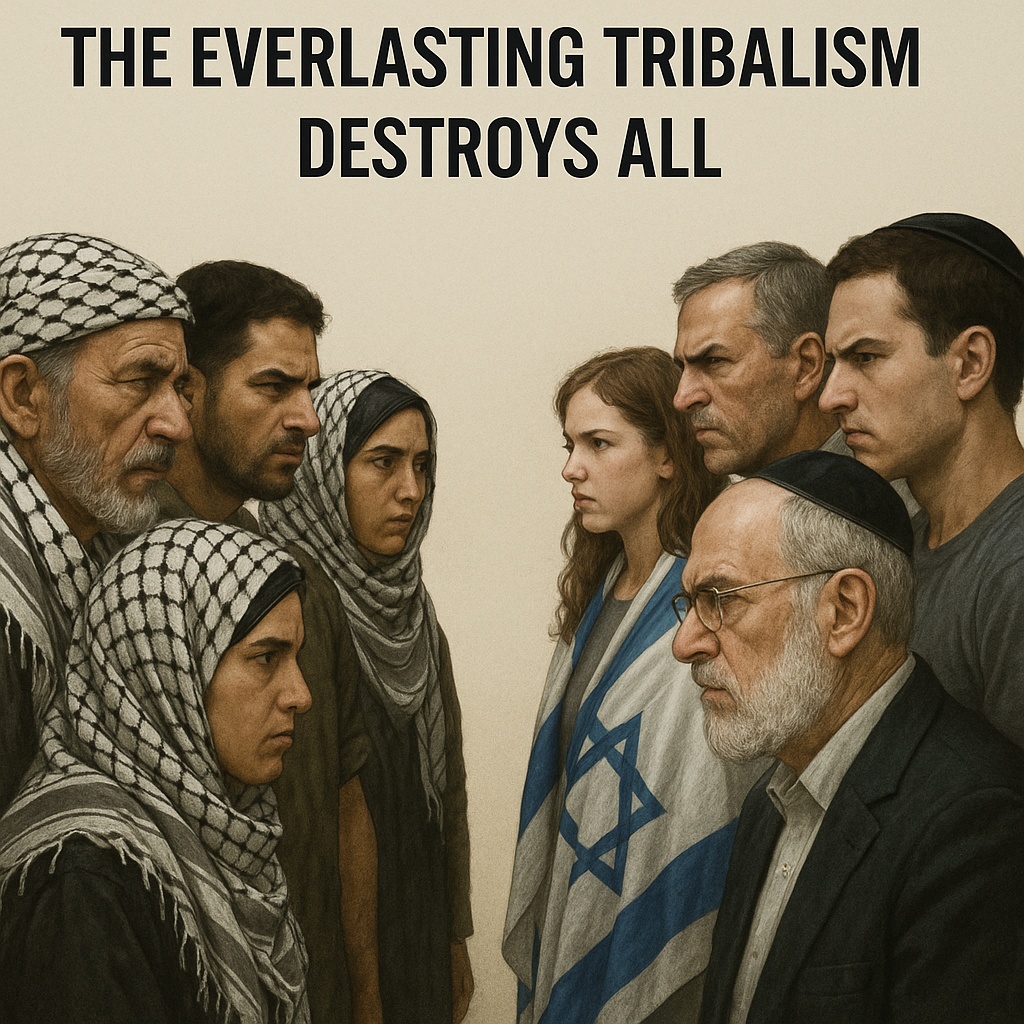
Tribalism never died. It simply evolved. The Israeli–Palestinian conflict proves that humanity still kneels before its oldest instinct — dividing the world into “us” and “them.” What began as a regional war has now turned into a global sickness. Every side, every faith, and every nation projects ancient loyalties onto modern politics. As a result, humanity keeps repeating the same mistake — worshipping the tribe instead of the truth.
Ancient instincts in a modern world
Tribal thinking once saved lives. In prehistoric times, loyalty to one’s group meant survival. People trusted their own, feared strangers, and punished betrayal. These instincts were natural in a world filled with danger and scarcity. Yet while civilization advanced, the brain barely changed. Modern societies still run on the same primitive reflexes. Nations, religions, and ideologies inherited that tribal drive to separate and protect.
Consequently, the instinct that once united small groups now divides entire civilizations. It builds identities that feel comforting but demand enemies. Today, we no longer defend ourselves from predators — we defend ourselves from other humans who simply think differently. Politics, religion, and nationalism exploit this instinct mercilessly. They turn belonging into virtue, and questioning into betrayal. The tribe defines truth, not reason, and emotion replaces thought. That is why ancient instincts keep shaping modern wars.
Had there not been tribalism, no conflict would exist
If tribalism did not exist, this conflict would never have begun. It is not destiny. It is not divine will, it is a failure of psychology. Without tribal thinking, Jews and Arabs could live as neighbors, traders, and thinkers — not as enemies. The land would be shared, the faiths respected, and differences seen as human, not hostile. However, the instinct to divide, defend, and dominate poisoned coexistence long before modern borders were drawn.
Religion, nationalism, and identity turned this poison into ideology. People began to see not individuals but categories — “Jews,” “Arabs,” “Muslims,” “Zionists.” Geography and history became excuses for hatred. In truth, the war is not about land or resources; it is about belonging and exclusion. Because belonging defines worth, both sides would rather destroy each other than share the same sky. Tribalism made peace not only difficult — it made it unimaginable.
Palestinians blaming all Jews
Centuries of oppression, genocide, and humiliation shaped deep anger among Palestinians. Their pain is undeniable, yet their collective blame is tragic. Many no longer separate Israel’s military machine from the Jewish people as a whole. They see every Jew as complicit, even those who live far away and reject the violence. American Ashkenazi Jews, who have nothing to do with the conflict, become symbolic enemies. Synagogues in New York or Paris are targeted as if they were Israeli military bases.
This is the same logic that once justified pogroms and racism. The idea that one person represents an entire group is the oldest moral error in human history. By blaming all Jews for the crimes of a government, Palestinians reproduce the very injustice they fight against. Hatred of the innocent does not liberate the oppressed; it corrupts their cause. In the end, this tribal rage consumes the very moral foundation of resistance.
Jews attacking innocent Palestinians
The other side repeats the same mistake. Many Jews, haunted by the memory of persecution, now see every Palestinian as a threat. Fear of annihilation became a political tool. Israeli leaders, aware of this deep trauma, manipulate it to justify their aggression. Every civilian becomes suspicious, every child a potential terrorist. As a result, bombings, starvation, and occupation are recast as “self-defense.”
Thus, paranoia replaces justice. Fear becomes moral reasoning. When a society defines survival through domination, it cannot see its victims as human. Tribalism transforms morality into arithmetic — one life for another, revenge for revenge. What remains is not protection but perpetual war.
The war that spills beyond borders
The tragedy no longer belongs to the Middle East alone. It now bleeds across continents. Because of global communication, every act of violence in Gaza reverberates instantly in Europe and America. In France, Jews are attacked for Israel’s crimes. In Britain, Muslims are insulted for Gaza’s resistance. The hatred migrates faster than refugees.
Moreover, people now fight symbolic wars from their own living rooms. Online, strangers choose sides they barely understand. Antisemitism and Islamophobia rise in parallel. Each reinforces the other. Punishing Jews in Europe for Israeli atrocities is as irrational as punishing Palestinians in the West for Hamas’s violence. Yet tribal thinking demands revenge, not reflection. The war, once local, has become psychological and planetary.
The myth of collective guilt
Every generation repeats the same mistake — believing that guilt is hereditary. Collective guilt always leads to collective punishment. It simplifies morality until it collapses. Israelis see all Palestinians as Hamas; Palestinians see all Jews as settlers. Both sides inherit the same blindness, believing that suffering grants them moral immunity.
However, moral individualism — judging people by their actions, not their ancestry — is the only defense against barbarism. Without it, humanity reverts to tribal justice. History confirms it again and again: Catholics and Protestants, Hutus and Tutsis, Serbs and Bosniaks — all once believed their vengeance was righteous. In the end, they only buried their own children.
Global tribalism and its consequences
Tribalism is now a global epidemic. The internet became its amplifier. Algorithms reward outrage and silence reason. People engage with fury, not facts. They adopt conflicts they do not understand and defend identities they barely possess. Online, they scream for justice but feed on hate.
Meanwhile, political and corporate elites thrive in the chaos. They understand that division is power. The more people hate, the easier they are to govern and distract. Global tribalism thus turns moral outrage into currency. It keeps populations busy fighting symbols while real power — economic and political — remains untouched.
Breaking the tribal curse
Humanity must learn again to see people as people. Not as tribes, flags, or religions, but as individuals with pain and conscience. The only escape from this spiral is moral individualism — the courage to separate human beings from the groups they belong to. Compassion must cross identities. Suffering must be recognized, not traded.
Therefore, education, reason, and secular ethics are not luxuries — they are survival tools. The human brain must evolve faster than its instincts. The war in Gaza is not just a regional tragedy; it is a global mirror. It shows what happens when tribal emotion overpowers human intelligence. If humanity fails to overcome this reflex, every nation will become Gaza, and every city will inherit its ruins. Tribalism never saves. It only multiplies destruction — until there is nothing left to destroy but ourselves.
Leave a Reply