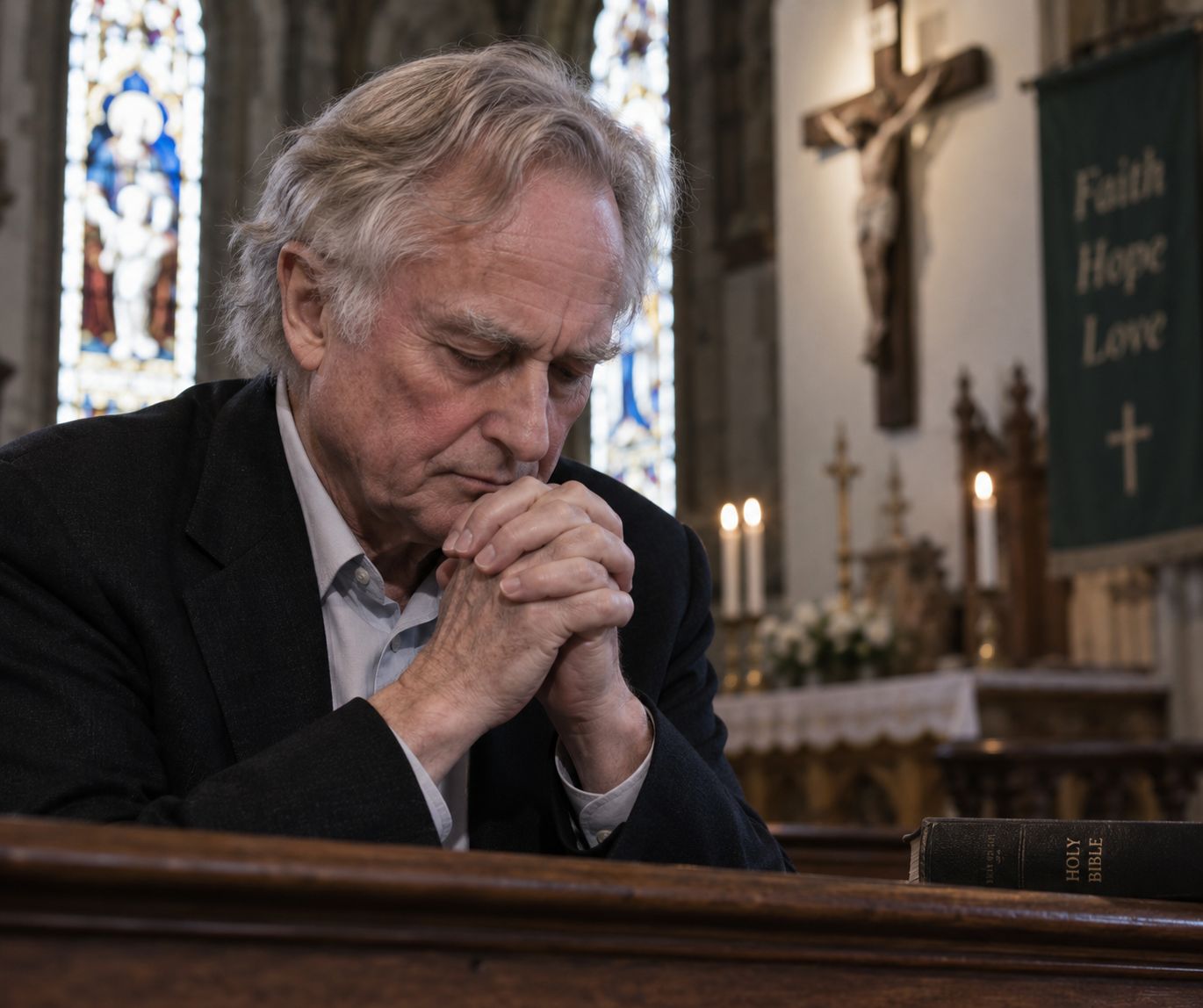
Richard Dawkins has spent much of his life arguing that there is almost certainly no God. Yet if one day the news announces that the famous evolutionary biologist accepted Christianity on his deathbed, believers around the world may celebrate one of the greatest conversions imaginable.
But would it actually mean anything?
The question is more complicated than it sounds. A person’s final words do not necessarily represent the considered beliefs of the person who spent decades developing them. Severe illness can affect consciousness, judgment, memory and perception. Drugs can do the same. Delirium can transform someone’s understanding of reality almost overnight.
Dawkins is well aware of the problem. He has even joked about protecting himself against his own future deathbed conversion.
Christopher Hitchens was supposed to convert too
There is an obvious precedent.
Christopher Hitchens, one of the world’s most prominent atheists and Dawkins’s friend, died from esophageal cancer in December 2011. Before his death, Hitchens knew perfectly well what some believers were waiting for: his conversion.
He therefore addressed the possibility while he was still capable of making his position unmistakably clear. Hitchens said that if disease reduced him to a frightened, barely conscious state and he called for a priest, that person should not be regarded as the intellectually competent Hitchens expressing his genuine convictions. Accounts from people close to him after his death likewise rejected claims that he had converted.
Nevertheless, the story did not end there.
In 2016, evangelical Christian Larry Alex Taunton published The Faith of Christopher Hitchens, arguing that Hitchens had privately been considering Christianity. Taunton did not actually claim to know that Hitchens converted on his deathbed, but publicity surrounding the book quickly generated precisely that impression. Hitchens’s family and close friends strongly rejected the suggestion that he was moving toward conversion.
His son Alexander, who was present during his final weeks and at his death, was unequivocal: there had been no indication of a conversion.
The episode illustrates exactly why deathbed conversions of famous unbelievers are so attractive. Converting an ordinary atheist is one thing. Converting Christopher Hitchens symbolically transforms one of Christianity’s most formidable opponents into its final trophy.
Dawkins has already thought about it
Dawkins knows that he could eventually become another target of the same phenomenon.
In The God Delusion, he discusses the persistent false story that Charles Darwin abandoned evolution and converted to Christianity near his death. Dawkins then notes that people have also predicted his own deathbed conversion. His proposed solution was wonderfully Dawkinsian: he joked that he should install a tape recorder to protect his posthumous reputation.
More recently, discussing Hitchens, Dawkins again warned about the enthusiasm of religious apologists for alleged deathbed conversions.
There is a very good reason to record what happens. But even a camera cannot completely solve the problem.
What if Dawkins actually converts?
Imagine Dawkins at 95.
He is seriously ill. His body is failing. Perhaps his cognition is failing too. A camera records everything.
A priest enters.
Dawkins asks to be baptized. He says that he accepts Jesus Christ. Perhaps he even apologizes for The God Delusion and announces that he was wrong all along.
The recording would seemingly settle the historical question. Nobody could plausibly claim that Christians simply invented his conversion afterward.
But it would create a much more important question:
What was happening to his brain?
If Dawkins remained cognitively intact, understood what he was saying, could explain why he had changed his mind and could rationally defend his new position, then intellectual honesty would require atheists to acknowledge the obvious: Richard Dawkins changed his mind.
That still would not constitute evidence that Christianity is true. Dawkins is an eminent scientist, not an oracle. Scientists can be wrong, and one person’s conversion cannot establish the existence of God.
But it would genuinely be Dawkins’s conversion. Now consider the alternative.
What if he is no longer Richard Dawkins as we know him?
Suppose instead that Dawkins develops severe dementia.
Or delirium.
Or suffers neurological damage.
Perhaps he becomes confused about where he is. He sees people who aren’t there. He cannot remember what happened an hour earlier. He becomes convinced that nurses are angels and the hospital is heaven.
Then he announces his conversion. The camera records every word.
Would Christianity have defeated Richard Dawkins? Obviously not.
It would have documented the deterioration of a human brain.
This distinction matters because our mental lives depend enormously on the physical condition of our brains. Delirium can cause abrupt disturbances in attention, awareness and cognition, particularly in older and seriously ill people. Illnesses, metabolic disturbances and medications can contribute to it.
A person experiencing delirium may sincerely believe something at that moment without possessing their ordinary capacity to evaluate whether it is true.
That is not dishonesty. It is impaired cognition.
Recording everything is not enough
Dawkins’s proposed precaution therefore solves only one problem.
A recording could establish what he said.
It could not, by itself, establish whether he possessed the cognitive capacity necessary to endorse it meaningfully.
That would require context.
Was he oriented to time and place? Did he recognize the people around him? Could he understand complicated questions? Did he remember his previous beliefs? Could he explain why he had abandoned them? Were physicians observing delirium or severe cognitive impairment? What medications had he received?
There is an enormous difference between:
“I have reconsidered my arguments. Here is why I now believe Christianity is true.”
and:
“Jesus is standing next to my bed.”
Both could theoretically be recorded as evidence of a “conversion.”
Intellectually, they would be worlds apart.
What if he converts while completely lucid?
This is the uncomfortable scenario atheists should also accept.
Suppose Dawkins remains mentally sharp. There is no dementia, delirium or obvious cognitive impairment. He talks coherently for hours. He understands exactly what Christianity claims.
And he converts.
Then we should simply say:
Richard Dawkins converted.
Trying to invent neurological explanations without evidence would be intellectually dishonest.
But believers would face the opposite problem if his cognition were demonstrably destroyed. They could not reasonably take statements produced by severe delirium as the triumphant conclusion to an 80-year intellectual argument.
The same standard has to operate in both directions.
Death does not make an argument stronger
There is something peculiar about our fascination with people’s final words.
Imagine Dawkins converted to Christianity tomorrow while perfectly healthy and then returned to atheism six months later. Which Dawkins would count?
Presumably the later one.
Yet death freezes someone’s final position permanently. There is no possibility of reconsideration the following morning.
That gives deathbed statements an emotional significance they do not necessarily deserve intellectually.
A proposition does not become more rational because somebody believes it five minutes before dying.
The existence of God is independent of Richard Dawkins’s opinion about it. Christianity would not become true if Dawkins converted. It would not become false if he died reciting passages from The God Delusion.
Arguments require evidence.
The ultimate irony
Perhaps Dawkins will eventually die exactly as he has lived: an atheist.
Perhaps he will convert.
Perhaps, as Hitchens feared for himself, Dawkins will reach a neurological state in which the intellectual personality recognized by the world has largely disappeared.
We cannot know.
That is precisely why his joke about recording his final days contains a surprisingly serious philosophical point. The recording would protect the historical record from fabricated stories.
But if the camera someday captures Richard Dawkins asking for a priest, we should not immediately ask whether Christianity has finally defeated one of its most famous opponents.
We should first ask a much simpler question:
Was Richard Dawkins still capable of knowing what he was saying?
Leave a Reply