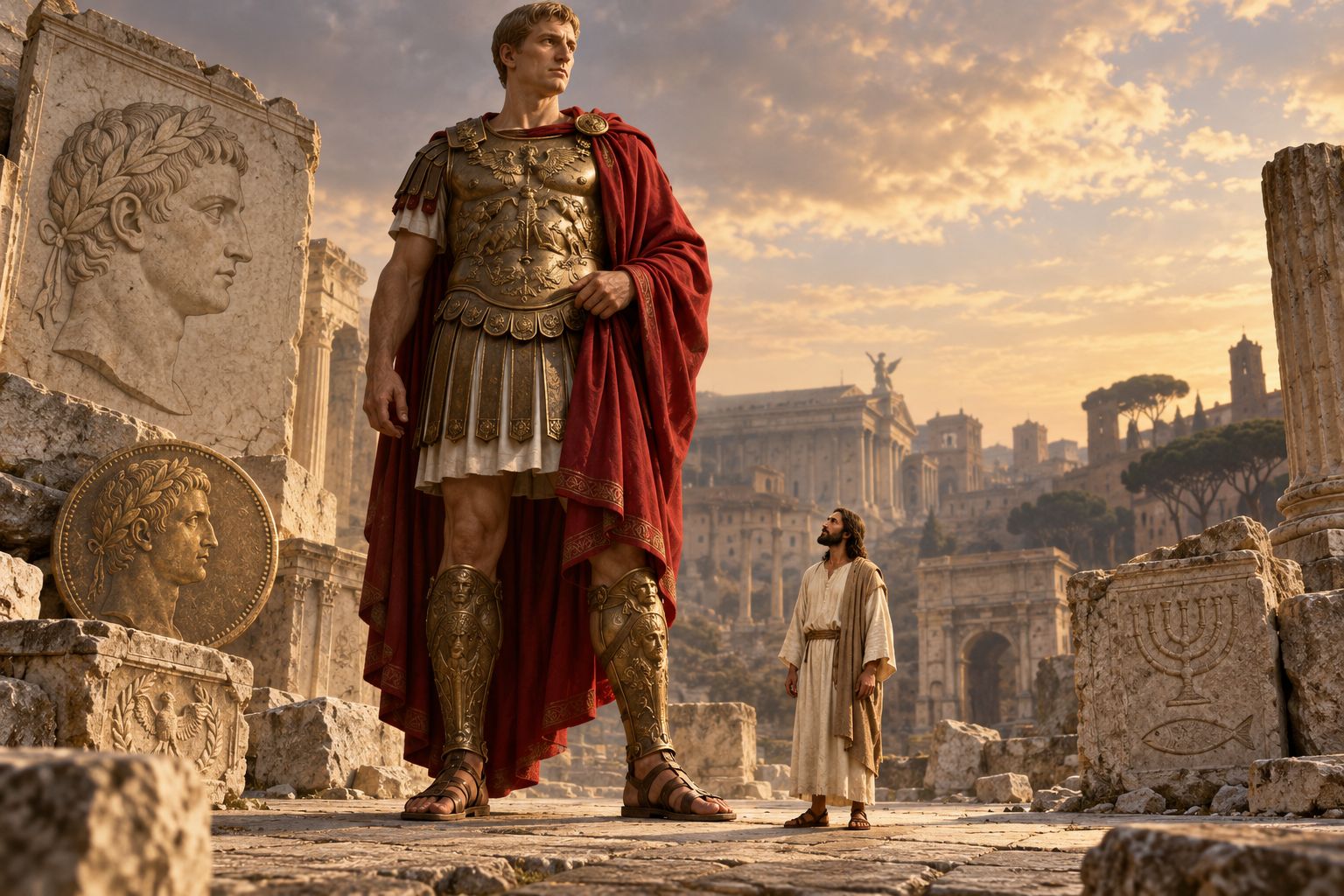
Augustus left coins, inscriptions, monuments, and portraits made during his lifetime. His contemporaries discussed his actions and corresponded with him. Jesus left a much narrower historical record, largely preserved in religious writings and later references.
Both belong to the ancient world. Yet the evidence for their existence differs enormously in quantity, variety, and proximity to their lives. Accepting that both existed does not make their documentation remotely equivalent.
Here, “very little” describes the evidence for Jesus compared with the extraordinary record for Augustus. It does not mean no evidence, nor does it establish that Jesus never existed. Most specialists accept a historical Jesus, while distinguishing that conclusion from Christian claims about his divinity and resurrection.
Augustus appears on objects from his own lifetime
Augustus, originally known as Gaius Octavius, lived from 63 BCE to 14 CE. He became Rome’s first emperor and ruled during the period traditionally associated with Jesus’ birth. Consequently, the comparison does not require placing an ancient preacher beside a modern president with photographs and birth certificates.
Consider the coins. The British Museum holds numerous examples featuring Augustus, including coins dated to 19–18 BCE. These objects circulated while he was alive. We can examine their portraits, inscriptions, materials, and manufacturing techniques.
Coins served political purposes, of course. Imperial authorities used them to advertise power, legitimacy, and achievement. However, recognizing their propaganda does not erase their value as contemporary evidence for the ruler who issued them.
The bronze head from Meroë provides another example. The British Museum dates it to approximately 27–25 BCE. It once belonged to a statue of Augustus and eventually reached Meroë, in present-day Sudan, where archaeologists recovered it.
Portraits can flatter, and rulers can standardize their public appearance. Nevertheless, this is a physical object from Augustus’ lifetime. Its historical value differs from that of an artist imagining his face centuries later.
His government left records in stone
The Cyrene edicts offer evidence beyond imperial imagery. A surviving Greek inscription preserves five edicts of Augustus, dated to 7–6 BCE and 4 BCE. They concern practical matters, including judicial procedures, citizenship, and provincial administration.
These texts place Augustus within a functioning government. They connect his name and official titles to decisions affecting identifiable communities. Their subject matter extends far beyond celebrating an emperor’s greatness.
Meanwhile, the Temple of Dendur preserves another form of contemporary representation. Built around 15 BCE and now housed in New York’s Metropolitan Museum of Art, it depicts Augustus as a pharaoh. The reliefs show him making offerings to Egyptian deities.
Such images do not prove that Augustus personally performed every depicted ritual. Instead, they document how his authority appeared in the religious and political culture of Roman Egypt. Once again, the evidence survives on an ancient monument.
People who knew Augustus wrote about him
The documentary record also includes Cicero’s letters. In 44 BCE, Cicero discussed Octavian and correspondence he received from him. These writings capture contemporary political judgments, calculations, and uncertainty.
Cicero was a participant in that political world. His letters therefore provide something more immediate than a biography composed generations afterward. They discuss a living person with whom he interacted.
However, an important distinction remains. We possess the letters through manuscript transmission, not Cicero’s original writing sheets. Their composition during Augustus’ lifetime and the age of the surviving manuscripts are separate questions.
Augustus also composed an account of his own achievements, known as the Res Gestae. Ancient inscribed copies preserve this text, most famously on the temple walls at Ankara. The Ankara inscription followed his death in 14 CE, so we should not present it as a surviving lifetime inscription.
The account is self-serving, as we would expect from an emperor describing his career. Historians must test its claims against other evidence. Still, its limitations do not cancel the wider record of coins, inscriptions, monuments, and contemporary correspondence.
Jesus has a different kind of historical record
For Jesus, we have no securely authenticated surviving writing in his own hand. Nor do we have a securely identified lifetime portrait or an undisputed contemporary inscription naming him. No surviving Roman trial record directly documents his prosecution.
Archaeology can establish the world around him. It can illuminate settlements, burial practices, religious life, and Roman administration. However, evidence that a place or official existed does not independently establish every story involving them.
The earliest surviving Christian compositions include Paul’s authentic letters, generally dated to the 50s CE. These appeared roughly two decades after Jesus’ commonly dated death around 30 CE. They predate the narrative Gospels and deserve serious historical consideration.
In Galatians, Paul reports meeting Cephas, usually identified as Peter, and James, whom he calls “the Lord’s brother.” Many historians understand James as Jesus’ actual brother. This passage is a significant reason to reject the claim that the evidence consists only of distant legends.
Nevertheless, Paul does not present himself as a companion of Jesus during his ministry. His letters address religious communities and theological disputes. They provide limited biographical detail rather than a continuous account of Jesus’ life.
The Gospels and later references require interpretation
Scholars commonly date Mark, usually considered the earliest canonical Gospel, to around 70 CE. That places its composition approximately four decades after Jesus’ death. The other canonical Gospels generally receive later dates, although scholars debate the precise chronology.
Their religious purposes do not automatically make them historically worthless. However, historians must examine their sources, literary relationships, theological interests, and differences. Four narratives do not necessarily provide four independent confirmations of every event they share.
Outside Christian literature, Josephus and Tacitus supply important references. Josephus completed his Jewish Antiquities around 93–94 CE. It includes a passage about Jesus and a separate reference identifying James through Jesus, who was called Christ.
The longer passage, commonly called the Testimonium Flavianum, presents a serious textual problem. Many scholars consider its received wording partly altered by Christian transmission. They disagree about how much of the passage Josephus originally wrote.
The shorter reference to James generally receives greater acceptance. Nonetheless, Josephus wrote decades after Jesus’ lifetime. His work adds historical evidence without supplying a contemporary eyewitness account of Jesus’ ministry.
Tacitus, writing in the early second century, connects Christus with execution under Pontius Pilate during Tiberius’ reign. His account matters because it comes from a Roman author hostile to Christianity. However, the passage does not identify the precise source of his information.
These references deserve evaluation rather than automatic dismissal. Equally, their existence does not produce a documentary record comparable to Augustus’ lifetime coins, administrative inscriptions, portraits, and correspondence.
The emperor’s advantage explains the gap
An emperor controlled institutions that produced monuments, money, and official records. A provincial preacher had no comparable machinery. Therefore, we should expect Augustus to leave a much larger archaeological footprint.
That observation limits what the comparison can prove. A shortage of surviving objects does not establish that an ordinary ancient person was imaginary. Historians routinely reconstruct lives from incomplete and uneven evidence.
However, explaining the difference does not eliminate it. The evidence for Augustus remains much broader and more direct. Anyone claiming equivalent documentation must account for the categories of evidence that survive for one figure and not the other.
Existence does not establish divinity
Augustus also received divine honors. Religious imagery and inscriptions document those beliefs, yet they do not establish that he possessed supernatural powers. Historians can accept his existence without accepting the theology surrounding him.
The same distinction applies to Jesus. Evidence for a Jewish preacher who attracted followers and suffered execution does not automatically establish miracles or resurrection. Those claims require arguments beyond the conclusion that a historical person existed.
Augustus offers an overwhelming collection of mutually supporting historical evidence. Jesus presents a smaller, predominantly literary record that requires more reconstruction. We can acknowledge that difference without pretending the evidence is either identical or entirely absent.
The question of existence deserves careful historical analysis. The claim of divinity demands its own justification. Neither the survival of a religious movement nor confidence in its founder’s existence can supply that justification by itself.
Leave a Reply