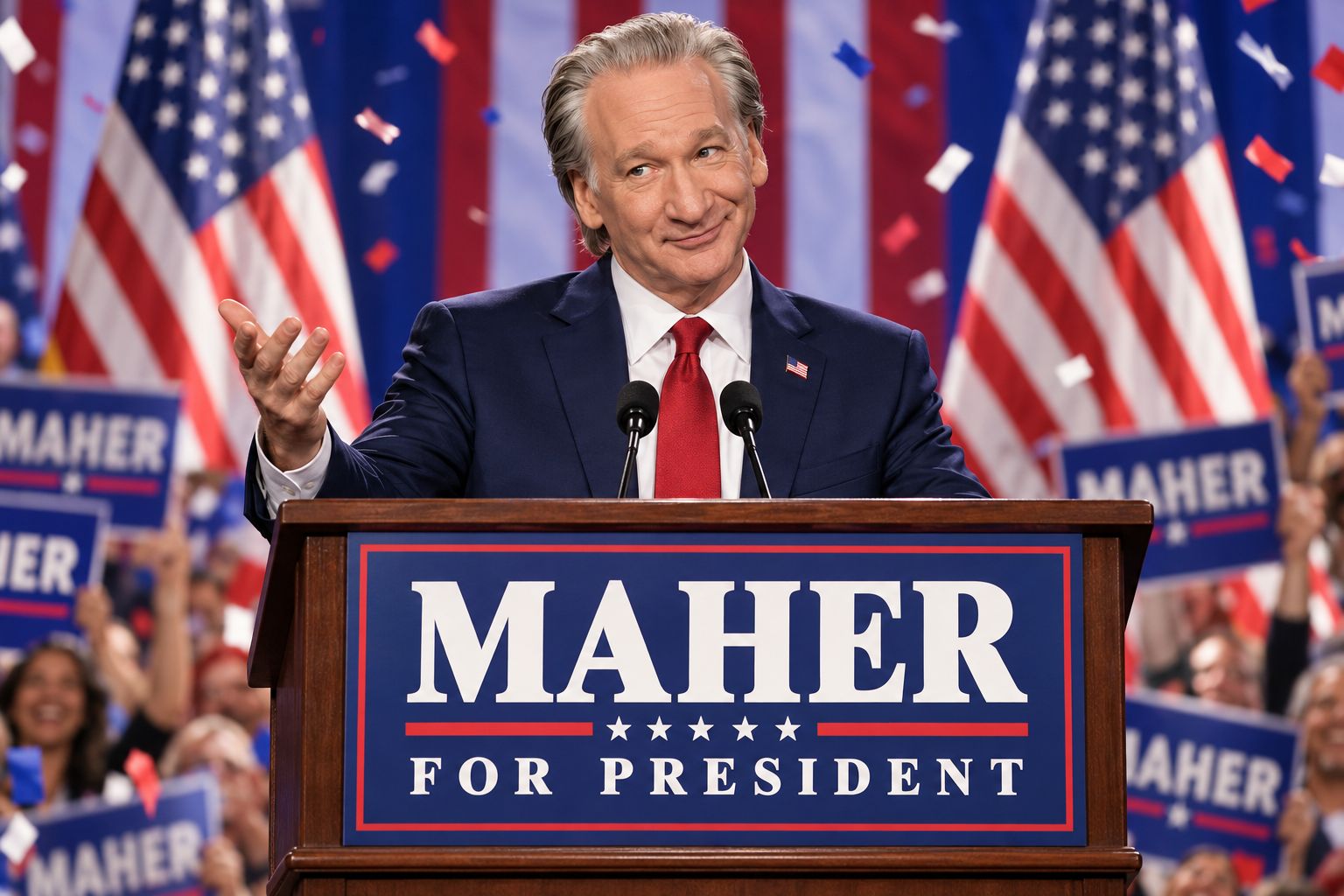
For more than three decades, Bill Maher has cultivated a brand built on the promise of fearless, contrarian truth-telling. From Politically Incorrect to Real Time, he has positioned himself as the comedian who says what others won’t, a self-styled rebel beholden to no party or ideology. But a closer examination of his career reveals a different arc. The showman who once risked network cancellation for a post-9/11 comment has evolved into something else entirely: a political actor whose boundaries are as carefully managed as any elected official’s. The question is no longer whether Maher is a comedian who talks about politics. It is whether he has become a politician who occasionally tells jokes.
The limits of mainstream comedy
The structural constraints on mainstream political comedy are rarely acknowledged, but Maher’s career illustrates them precisely. Every mainstream comedian can criticize the rich—but only to a degree. Maher has built segments like “Eat the Rich,” yet the critique remains safely contained within the parameters of acceptable discourse, targeting cultural signifiers rather than the architecture of wealth itself. To go further—to systematically uncover what every powerful interest group did and how they did it—would be to invite a swift end to any stint in corporate media. Maher risks absolutely nothing; he tapes in front of a vetted, compliant audience, retreats to a private jet, and collects a massive paycheck. The system does not punish him because he does not threaten it.
The same calculus applies to political criticism. Maher may criticize political issues, but just to a degree. He can bash both Democrats and Republicans, lamenting that neither party can “be normal”. He can say he would “of course” consider voting Republican. But promoting a non-mainstream party would mean an end as well. Maher himself has been explicit about this: third-party candidates “can never win in this country,” he has told guests, dismissing independent bids as structurally futile. The parameters of his political commentary are thus defined not by principle but by viability. He operates within the two-party frame because stepping outside it would render him irrelevant to the conversation he claims to lead.
The politician’s reflex
What makes Maher’s transformation distinctive is not that he comments on politics—comedians have always done that—but that he has adopted the reflexive habits of a politician. The most telling example is his shifting posture toward Donald Trump. Maher has criticized elements of the Trump administration, from the Pentagon budget to immigration policy. Yet he has also dined with Trump at the White House, defended the dinners against critics, praised Trump’s private demeanor as “gracious and measured,” and admitted that there is “just something thrilling” about being announced at the White House. One moment he is the comedian mocking the president; the next he is the insider trading pleasantries over a four-hour meal. This is not the behavior of a truth-teller. It is the behavior of a political operator keeping lines of communication open, calibrating criticism to maintain access.
The lobby dynamic is even more revealing. Maher’s commentary on Israel and Gaza has been notably one-sided. He has rejected the genocide accusation outright, framing the war as a “counterattack” in a conflict waged against Israel since 1948, and arguing that Jews are indigenous to their ancestral homeland. Whatever one thinks about the situation in Gaza, something is clear: the situation is not one-sided. Such an intelligent person would have to be absolutely biased not to know that. Maher, who is of Jewish ancestry, has done nothing but stick up for the Israeli lobby, attacking Democratic candidates who distance themselves from AIPAC and arguing that refusing the lobby’s money gives “permission to actual antisemites”. This is not comedy. It is advocacy—and advocacy of a very particular, organized kind. When Maher says “this lobby wants this, I will do this,” he is no longer speaking as a jester. He is speaking as a politician.
The court Jester’s Prize
The institutional recognition confirms the diagnosis. Maher’s acceptance of the Kennedy Center’s Mark Twain Prize—an award handed out by the very establishment he purports to mock—is the ultimate proof that his satire has been domesticated. True satire is supposed to make the powerful uncomfortable. Instead, an auditorium of politicians, lobbyists, and media elites will stand and applaud the man who claims to speak truth to them. Maher did not change the system; the system bought him out, put a tuxedo on him, and handed him a trophy for keeping the conversation exactly where they want it.
The arc is complete. A once-talented entertainer—a comic who could genuinely provoke, who once lost a show for saying something that mattered—has become just a mere politician. He criticizes the rich within approved limits. He criticizes political issues within approved limits. He defends the lobbies that matter to his identity and his access. He dines with the president and calls it bravery. He warns that third parties cannot win and thereby ensures they don’t. The showman has not disappeared entirely; the jokes still land, the monologues still provoke a knowing laugh. But the laughter is now the laughter of recognition, not disruption. The audience is not being challenged. It is being reassured. And Bill Maher, the man who once set the boundaries of what could be said on television, has settled comfortably within them.
Leave a Reply