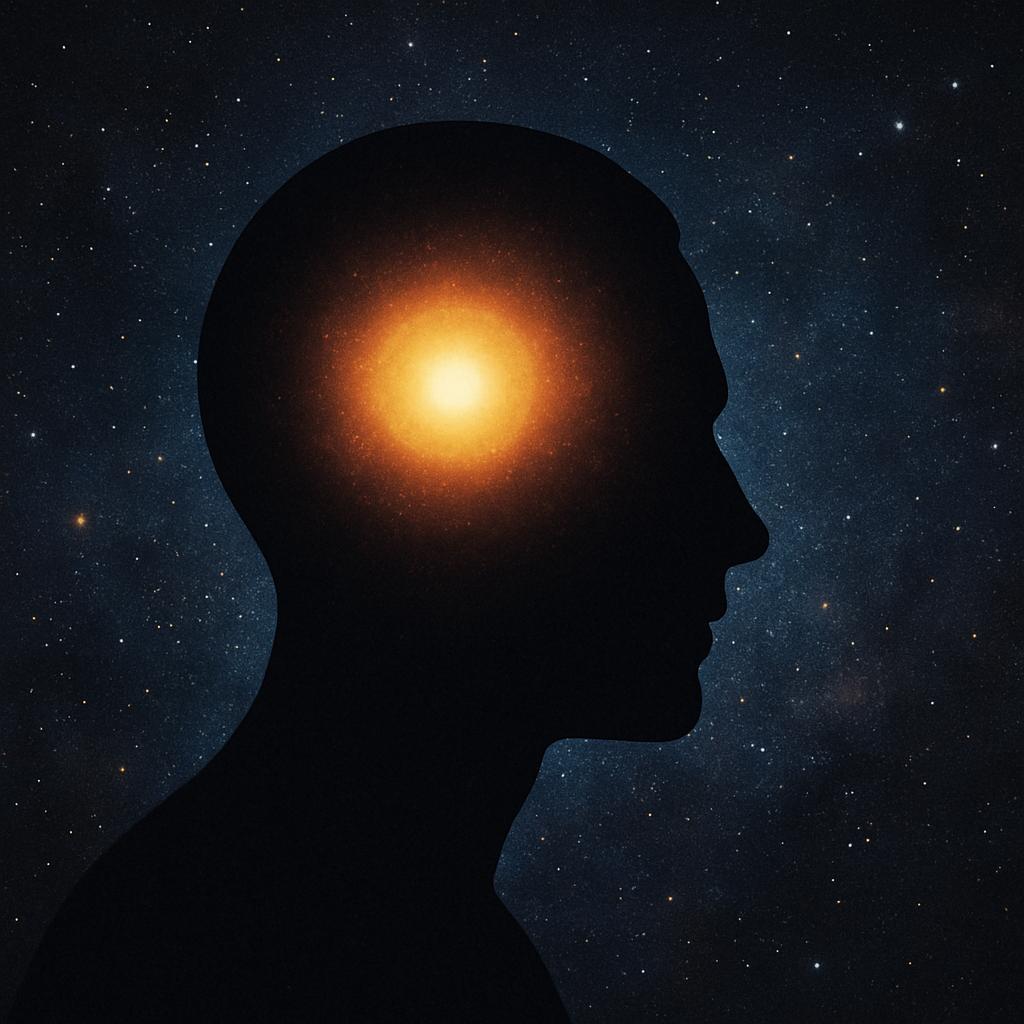
You are not eternal. You are not a recycled soul wandering through endless lifetimes. And you are a one-time event — a conscious robot built by evolution, running on fragile flesh and electric neurons.
In this infinite and indifferent universe, you are the only version of yourself that will ever exist. Your consciousness, this flicker between birth and death, is a microsecond on the cosmic clock. Nothing like it has happened before, and nothing like it will happen again.
We are animals with brains
We are not made of spirit or starlight, we are animals with brains. Biology, psychiatry, and neuroscience leave no doubt. Every thought, memory, or emotion is born from electrical impulses, synaptic exchanges, and chemical gradients.
When people die, the brain deteriorates. Neurons stop firing, oxygen vanishes, and consciousness collapses. EEGs go flat. There is no signal. Nothing continues. The “soul” disappears because it was never a separate entity — it was the brain itself.
Evolution created this brain for survival, not eternity. It made consciousness as a side effect of computation. We are the only animals aware of dying — but awareness does not grant escape from biology.
The comfort of heaven and rebirth
Still, people dream of heaven, rebirth, or cycles of life. They invent stories to comfort themselves against the terror of extinction. Ancient myths promised eternal reward; modern faiths recycle the same promise in new language.
These beliefs satisfy emotional needs, not scientific evidence. Cognitive science shows why. The brain hates uncertainty. It prefers narrative closure. When it faces finality, it fabricates meaning beyond death. Religion became the ultimate anesthetic — a tranquilizer against the inevitable.
But physics, biology, and EEG data all converge: once the brain shuts down, consciousness ends. There is no mechanism for thought without matter. There is no transmitter sending awareness into another body or another world.
The microsecond of consciousness
Your consciousness is not eternal. It is a single spark in an endless void. It appears for a moment, glows, and vanishes. That moment is your entire universe — every sound, touch, and memory you ever had.
This is not tragic. It is beautiful. You are the universe briefly aware of itself. You are the cosmos thinking, for one instant, “I exist.” Out of billions of galaxies, countless stars, and infinite lifeless matter, a small lump of organic cells produced awareness. That awareness is you.
When you die, the program ends. There is no reboot. This microsecond will never repeat. That is what makes it sacred.
Why uniqueness matters
If this life is all you have, every action gains weight. Every choice becomes irreversible. You cannot save meaning for another round. You must create it now, in this one configuration of neurons, memories, and time.
Knowing there is no afterlife is not despair — it is freedom. It frees you from judgment, fear, and cosmic bureaucracy. It forces you to build your own ethics. Without eternal punishment or reward, your morality becomes honest. You do good because it matters here, not somewhere else.
The exceptional robot
We are robots made by evolution, but exceptional ones; we do not just compute. We reflect, imagine, and question the code. Our brains can simulate universes, invent gods, and destroy illusions. We are the only machines capable of knowing we exist — and that knowledge ends with us.
This makes every heartbeat priceless. The universe does not care, yet we care. We love, build, and hope even when we know everything will end. That defiance is our glory.
To be human is to rebel against meaninglessness by creating meaning anyway.
The illusion of immortality
Human history is a long negotiation with death. Every religion, from Egyptian resurrection myths to Hindu reincarnation, tries to deny it. Every philosopher who promised eternity traded curiosity for comfort.
But cognitive science and neuroscience strip the illusion naked. When neurons die, the sense of self dies too. There is no observer left to travel anywhere. Consciousness does not drift — it ceases. The afterlife is a linguistic mistake, born from our inability to imagine not existing.
The tragedy is not that we die. It is that we waste the only life we have on stories that deny it.
One life, one chance
If you understand this, existence becomes more urgent. You stop waiting for salvation or karmic return, you start living with precision. And you value honesty, curiosity, and love because they are fleeting.
You stop lying to yourself about eternity, you stop worshiping fantasies. You start appreciating the fragile seconds that make your life irreplaceable. The moment you realize your brain creates consciousness and then loses it, you also realize how rare it is to have it at all.
Conclusion: The only spark
You are the exceptional thing in the universe — a single consciousness among cold stars. Your awareness is a cosmic accident, a self-reflective flame that flickers for a moment and disappears. But within that moment lies everything: art, love, science, thought, hope.
There will never be another you. When your brain stops, the movie ends, the screen goes dark, and the projector melts. No heaven follows. No reincarnation begins. Just silence.
And that is enough. Because for one brief instant, the universe looked back at itself — and saw you.
Leave a Reply