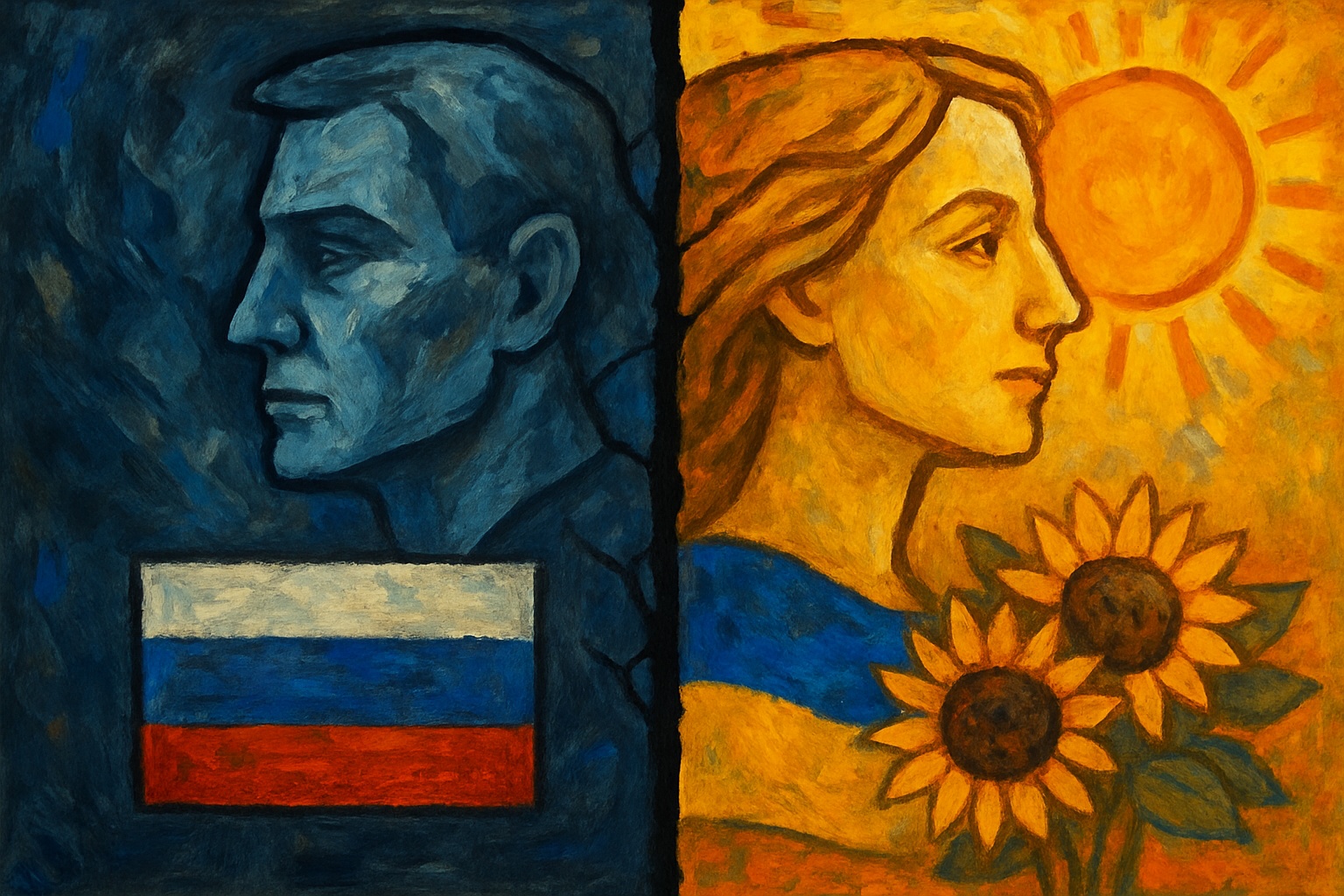
Russia and Ukraine were not born as enemies. Their roots stretch back to the same civilization—Kievan Rus—the medieval state that laid the foundations for Slavic culture and Orthodox Christianity. Yet from this shared origin, two very different paths emerged. Geography, foreign domination, religion, and psychology shaped two distinct ways of thinking. Russia evolved under the shadow of empires and autocrats. Ukraine developed through fragmentation, foreign rule, and local self-organization.
Over time, these experiences hardened into mental patterns. Russians learned to respect power and endurance. Ukrainians learned to value independence and adaptability. Both peoples carry a sense of mission, but their missions diverge—Russia’s mission of control and Ukraine’s mission of survival.
Historical roots of mentality
The Mongol invasion in the 13th century left deep scars on Russian psychology. It established an enduring model of centralized, fear-based governance. Submission to authority became a form of security. The tsar later replaced the khan, but the vertical power structure remained. Order, even when oppressive, was seen as preferable to chaos.
Ukraine’s trajectory differed. Its western regions fell under Polish-Lithuanian and later Habsburg influence. These systems fostered a tradition of local autonomy, legalism, and civic participation. The Cossack era, with its semi-democratic traditions, deepened this mentality. For centuries, Ukrainians had to negotiate, adapt, and coexist within larger empires. This produced a strong sense of individuality, skepticism toward authority, and attachment to the local community.
Collectivism versus individualism
The Russian mentality tends toward collectivism. It celebrates unity, obedience, and sacrifice for the greater good. This is visible in literature, religion, and daily behavior. The ideal Russian hero is the one who endures, not the one who rebels. The collective comes before the individual. The concept of “rodina”—the motherland—is sacred. Personal suffering is redeemed when it serves the state or nation.
Ukrainians lean in the opposite direction. They emphasize personal freedom and local responsibility. Centuries of domination by foreign powers created a mentality that values self-reliance and community solidarity without blind submission. The Cossack councils and village assemblies of the past reinforced horizontal power relations rather than vertical hierarchies. Even today, Ukrainians often distrust distant authority but respect local initiative.
Power and freedom
Russians admire strength. They believe order requires a strong hand. Political leaders who project power and stability are admired even if they restrict freedom. The ideal ruler is not necessarily just but decisive. This acceptance of power stems from historical necessity—a vast, insecure land that needed centralized control to survive invasions and internal divisions.
Ukrainians, by contrast, associate power with abuse. Their history taught them to distrust rulers, whether Polish nobles, Russian tsars, or Soviet commissars. Freedom is not an abstract ideal but a daily necessity. It is the ability to think and act without interference. In Ukrainian history, resistance—not obedience—became the moral act. From the Cossack revolts to the Maidan uprisings, defiance of power is seen as a virtue.
Attitudes toward the West
Russia’s relationship with the West is complex and ambivalent. It oscillates between admiration and resentment. Russian thinkers have long debated whether their country belongs to Europe or stands apart from it. Western technology and culture were admired, but Western political ideals—democracy, individual rights—were often rejected as alien or decadent. The result is a mentality that feels both superior to and victimized by the West.
Ukraine’s view of the West is more pragmatic. It sees the West not as a threat but as a model for governance and opportunity. This does not mean blind imitation. Many Ukrainians recognize Western hypocrisy, but they still aspire to build a society where law, transparency, and accountability matter. Their pro-European orientation is less ideological and more existential—an escape from the authoritarian legacy of the East.
Corruption and morality
Both Russians and Ukrainians live in systems where corruption has long been part of survival. Informal networks, bribery, and nepotism are not seen as extraordinary. They are coping mechanisms in societies where official rules often fail.
However, the moral framing differs. Russians often rationalize corruption as part of how things work. It is an expected feature of power. People adapt rather than resist. Ukrainians, on the other hand, are more likely to condemn it publicly, even if they sometimes participate in it privately. They see corruption as an obstacle to fairness and progress, not as a normal condition. The Maidan revolutions were in large part moral protests—uprisings against a system of entrenched deceit.
National pride and victimhood
Russian national pride is rooted in empire. It celebrates vastness, conquest, and endurance. The Russian narrative is one of triumph through suffering—a chosen people defending civilization against barbarism. This sense of historical mission gives Russians confidence but also fuels arrogance and isolation.
Ukrainian pride is built on resilience. It comes from survival, not domination. Ukrainians see themselves as a people who have endured centuries of oppression and still retained identity, language, and dignity. Their victimhood narrative is not one of superiority but of perseverance. It produces empathy and a longing for justice rather than conquest.
Language and identity
Language reflects mentality. Russian is formal, structured, and often fatalistic. Its idioms carry resignation and endurance. Ukrainian is melodic, emotional, and filled with irony. It expresses warmth and local color. In everyday speech, Ukrainians often switch between Ukrainian and Russian, signaling complex layers of identity.
The language question became a symbol of sovereignty. For many Ukrainians, speaking Ukrainian is not only cultural but moral—an act of resistance. For Russians, linguistic unity has always meant political unity. Thus, language itself turned into a battlefield of the mind.
Post-Soviet trajectories
After the Soviet collapse, both nations faced the same chaos but chose different paths. Russia returned to centralized control under Putin, reviving imperial nostalgia and state propaganda. It rebuilt pride through power, not freedom. Ukraine, though unstable and corrupt at times, kept experimenting with pluralism. It held competitive elections, tolerated opposition, and allowed civil society to grow.
These diverging trajectories deepened psychological separation. Russia chose security over liberty. Ukraine chose liberty despite insecurity. When the war came, these choices became visible in action—one side obeying, the other resisting.
War as a psychological mirror
The current war reveals more than political borders; it exposes mental boundaries. Russians fight to preserve hierarchy and empire. Ukrainians fight to preserve autonomy and dignity. Propaganda versus resilience. Submission versus defiance.
Russian soldiers often show loyalty to the system, even when the cause is unclear. Ukrainian soldiers show loyalty to the land and to one another. This difference defines how both societies respond to trauma. In Russia, dissent is crushed. In Ukraine, dissent fuels unity. The war became a test of mental evolution—whether a people can break free from centuries of obedience and shape their own destiny.
Conclusion
Russians and Ukrainians share blood, religion, and history. But they do not share the same soul. One mentality seeks strength through control. The other seeks meaning through freedom. The two worldviews may coexist geographically, but psychologically they are on different continents.
The war is not only territorial. It is civilizational. It is the collision between submission and self-determination, between fear and hope. History once united them. Mentality now divides them. The outcome will decide not only their borders but the future character of Eastern Europe itself.
Leave a Reply