Modern religious radicalization did not emerge from religion alone. Instead, it emerged from collapsing states, foreign interventions, geopolitical competition, economic dependency, identity crises, propaganda systems, and prolonged instability.
Nevertheless, many mainstream narratives simplify the issue heavily. They present extremism as if it appeared naturally inside certain cultures or religions. However, this explanation ignores how global powers repeatedly reshaped entire regions politically, economically, militarily, psychologically, and culturally.
Therefore, the modern world did not simply inherit religious radicalization. In many cases, global power struggles actively helped manufacture the conditions in which it could flourish.
Colonialism and the destruction of older structures
First, European colonial expansion transformed enormous parts of Africa, the Middle East, and Asia.
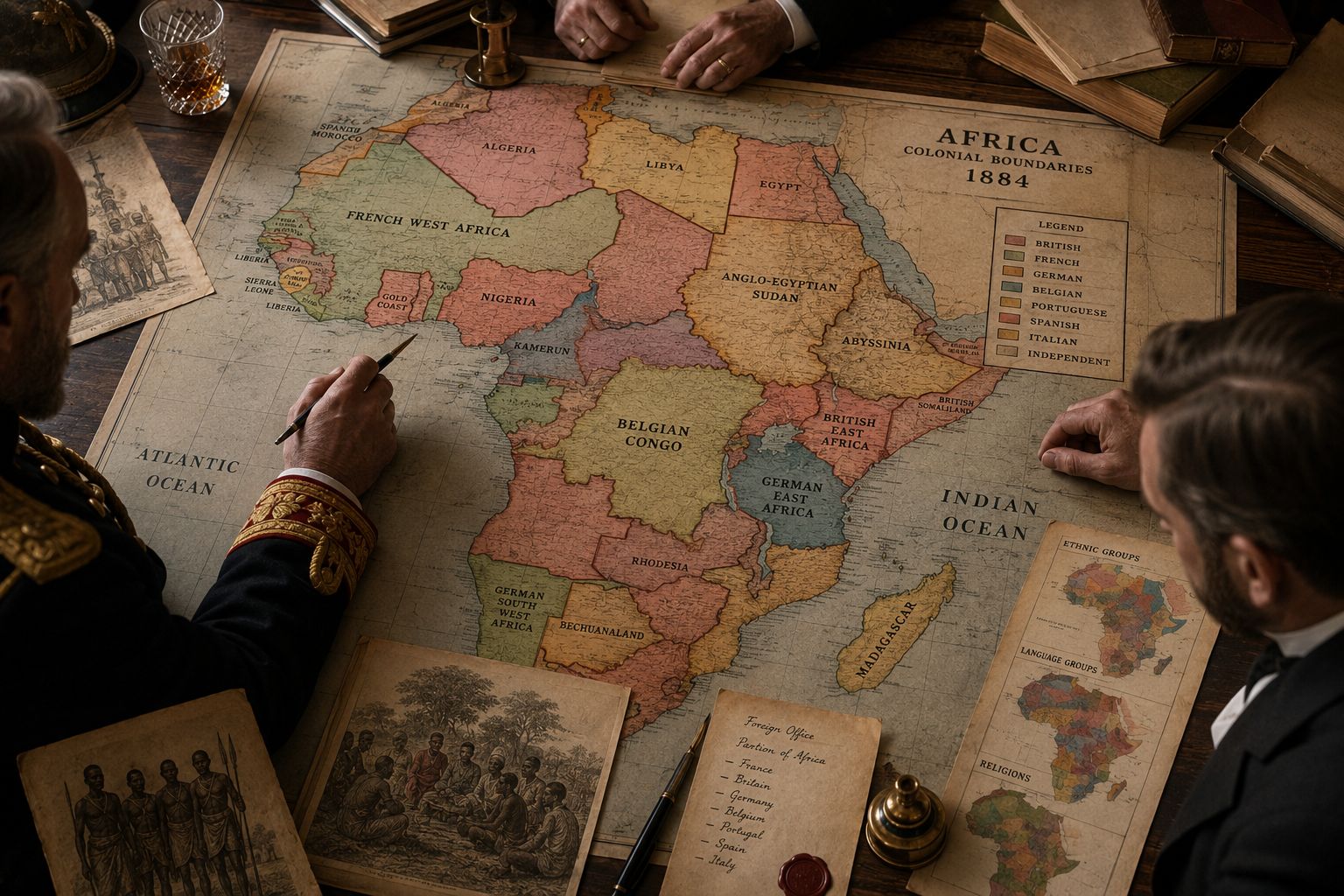
Moreover, colonial administrations rarely designed borders around ethnic, linguistic, tribal, national, or religious realities. Instead, imperial powers frequently drew borders according to strategic interests, resource access, military convenience, trade routes, and negotiations between empires.
Africa became one of the clearest examples.
Modern African borders often ignored ethnic distributions, tribal structures, migration routes, linguistic zones, and religious realities almost entirely. Rival populations became trapped inside shared states while many ethnic groups became divided across multiple countries.
At the same time, the same pattern appeared elsewhere. Colonial powers frequently fragmented traditional authority structures while simultaneously forcing highly different populations into artificial political systems.
Therefore, instability did not emerge from nowhere. Rather, it emerged partly from externally imposed geopolitical engineering.
Religion becoming a defensive identity
As colonial domination expanded, many populations gradually lost political autonomy, economic control, and traditional governance systems.
Religion increasingly became one of the few remaining stable identities.
Moreover, mosques, churches, clerics, and religious institutions often transformed into centers of resistance, social organization, education, charity, and psychological survival.
Thus, religion gradually shifted from purely spiritual structure toward political identity as well.
Divide and rule
At the same time, colonial systems frequently governed through fragmentation.
Some groups received preferential treatment. Meanwhile, others became marginalized politically, economically, or militarily. In many regions, colonial administrations empowered selected minorities, tribes, sects, or ethnic intermediaries in order to maintain control more efficiently.
As a result, distrust between communities deepened significantly.
Furthermore, religious divisions became politically useful. Populations divided internally became easier to govern externally.
Therefore, sectarian tensions frequently intensified under imperial administration rather than disappearing.
The Cold War: Religion weaponized geopolitically
Later, the Cold War transformed huge parts of the world into ideological battlefields.
The United States and the Soviet Union competed globally for influence. Consequently, governments, militias, insurgencies, dictatorships, intelligence networks, and ideological movements became instruments inside this struggle.
Religion increasingly became one of those instruments.
For example, Western powers often supported religious movements as barriers against socialism, communism, Arab nationalism, or Soviet expansion.
Afghanistan became one of the most consequential examples.
During the Soviet-Afghan War, Islamist fighters received funding, weapons, training, propaganda support, and international recruitment assistance. The strategic goal focused primarily on weakening Soviet influence.
However, militant networks rarely disappear cleanly after wars end.
Instead, they frequently mutate, reorganize, radicalize further, and spread internationally.
Wars and state collapse
Furthermore, modern interventions repeatedly destabilized entire regions.
For instance, Iraq lost institutional stability after invasion and occupation. Consequently, sectarian violence exploded while militant groups expanded rapidly inside the resulting power vacuum.
Similarly, Libya collapsed into fragmentation after intervention. Weapons spread across neighboring regions. Militias multiplied rapidly.
Meanwhile, Syria became a catastrophic proxy battlefield involving regional powers, global powers, ideological movements, intelligence operations, militias, and extremist organizations simultaneously.
Under such conditions, radicalization thrives.
War destroys:
- education,
- infrastructure,
- trust,
- economic opportunity,
- social stability,
- institutional legitimacy.
Consequently, extremist movements increasingly present themselves as providers of certainty, justice, identity, revenge, order, and belonging.
Economic dependency and humiliation
Meanwhile, many countries remain economically dependent on wealthier powers, multinational corporations, international lenders, or resource extraction systems.
As a result, large populations experience unemployment, corruption, instability, inflation, weak institutions, and limited upward mobility.
At the same time, global media continuously exposes populations to extraordinary wealth elsewhere.
Consequently, humiliation intensifies psychologically.
Under these circumstances, religion may become:
- emotional refuge,
- identity anchor,
- moral certainty,
- symbolic resistance,
- anti-Western expression,
- source of belonging.
Naturally, radical movements exploit precisely these conditions.
Western allies and the export of fundamentalism
One of the greatest contradictions emerged through alliances with highly conservative religious states.
For decades, oil-rich states financed schools, mosques, clerical institutions, religious literature, satellite channels, charities, and ideological networks globally.
Simultaneously, many Western governments maintained close strategic relationships with these regimes because of oil, military cooperation, investment flows, and geopolitical interests.
Thus, governments often publicly opposed extremism while indirectly cooperating with systems exporting rigid religious ideology internationally.
Religion as a tool of mobilization
Importantly, religion possesses enormous mobilizing power.
Political ideologies may fail emotionally. Economic theories may appear abstract. However, religion connects directly to identity, morality, sacrifice, eternity, tribal belonging, and existential meaning.
Therefore, governments, militias, insurgencies, and extremist organizations repeatedly use religion to mobilize populations rapidly.
Moreover, conflicts framed spiritually become psychologically absolute.
Opponents stop appearing merely political. Instead, they become evil, impure, heretical, or existential threats.
Consequently, violence intensifies dramatically.
Media, internet, and permanent outrage
Additionally, modern communication technologies accelerated radicalization globally.
Images of bombings, civilian casualties, invasions, torture, humiliation, corruption, and destruction now spread instantly worldwide.
As a result, outrage spreads rapidly. Polarization spreads rapidly. Recruitment spreads rapidly.
Furthermore, social media algorithms intensify emotional extremity because outrage generates engagement more effectively than nuance.
Consequently, digital systems increasingly reward radical emotional content over careful analysis.
Immigration, backlash, and reciprocal extremism
At the same time, wars and instability generated large migration waves.
Receiving societies often experienced:
- cultural anxiety,
- demographic fear,
- nationalism,
- anti-immigration movements,
- far-right radicalization.
Consequently, reciprocal extremism emerged.
Religious radicals point toward anti-Muslim hostility as evidence of civilizational conflict. Meanwhile, far-right movements point toward extremism as proof multiculturalism failed.
Therefore, each side psychologically reinforces the other.
Weak states and survival politics
Moreover, in many unstable regions, states struggle to provide:
- security,
- courts,
- healthcare,
- education,
- infrastructure,
- welfare.
Consequently, extremist groups sometimes fill these gaps.
They distribute food, they enforce order, they provide belonging. And they punish corruption selectively. They create simplified moral structures.
Under collapsing conditions, ideology therefore becomes materially connected to survival itself.
Western cultural expansion and identity panic
Meanwhile, globalization spread Western consumer culture almost everywhere.
Hollywood, social media, advertising, pornography, luxury culture, celebrity worship, and hyper-individualism entered deeply traditional societies extremely rapidly.
As a result, some populations interpreted this not as modernization but as cultural invasion.
Consequently, reactionary religious revival intensified partly as psychological defense against perceived moral collapse and identity destruction.
Intelligence operations and unintended consequences
Historically, major powers repeatedly supported armed groups temporarily for strategic reasons.
However, geopolitical short-term thinking often produced long-term instability.
Groups initially considered “useful” later evolved independently.
Weapons spread. Networks expanded. Ideologies hardened.
Consequently, the result frequently became geopolitical blowback.
Why radicalization persists
Religious radicalization persists because its underlying causes remain unresolved.
Wars continue. Economic inequality continues. Humiliation continues. Proxy conflicts continue. Authoritarianism continues. Corruption continues. Identity crises continue.
Therefore, extremism repeatedly regenerates itself inside unstable systems.
Religion itself is not the only factor
Importantly, most religious people never become extremists.
In fact, the overwhelming majority of believers live peacefully.
Therefore, religion alone cannot explain radicalization.
Instead, political instability, humiliation, war, economic collapse, social fragmentation, propaganda, identity crises, and institutional failure all interact together.
Religion often becomes the language through which deeper frustrations express themselves.
The hypocrisy problem
Furthermore, many populations observe enormous contradictions in global politics.
Human rights rhetoric often appears selective. Interventions occur inconsistently. Allies receive different treatment depending on strategic value.
Consequently, distrust toward Western governments expands significantly.
Extremist narratives then exploit these contradictions aggressively.
Conclusion: Radicalization as a product of modern power struggles
Ultimately, modern religious radicalization did not emerge in a vacuum.
Colonialism destabilized older structures. Artificial borders ignored ethnic, linguistic, tribal, national, and religious realities. Cold War geopolitics weaponized religion strategically. Wars destroyed institutions. Economic dependency deepened humiliation. Global media amplified outrage continuously.
This does not excuse extremism. Violent movements still remain responsible for atrocities they commit.
However, understanding radicalization requires examining the larger systems that repeatedly produced the conditions in which extremism could grow.
The modern world did not merely fight religious radicalization.
In many ways, global power struggles also helped create it.
Leave a Reply