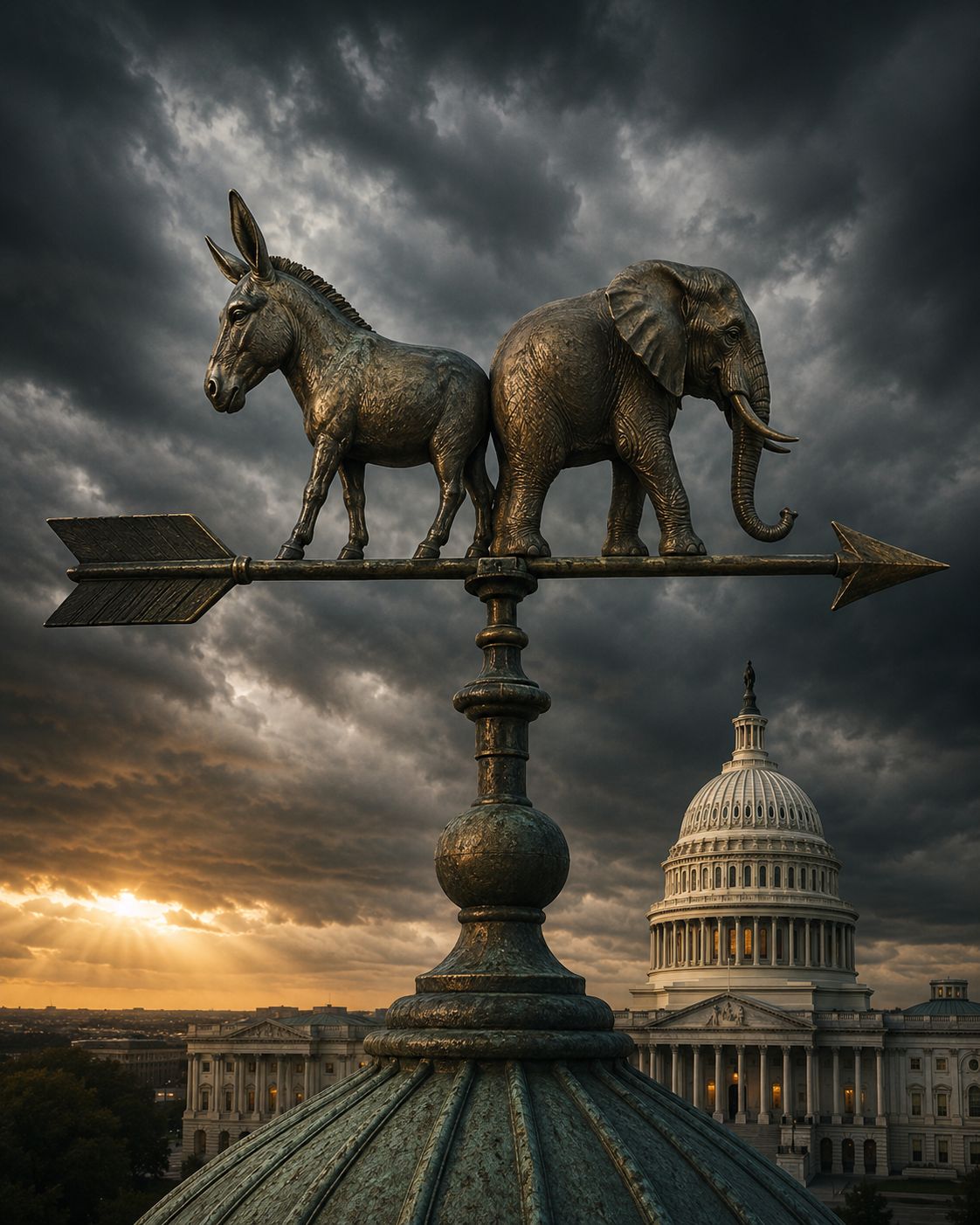
Politics is supposed to be driven by ideas.
Conservatives should defend conservative principles. Progressives should defend progressive ones. Parties should disagree because they genuinely see the world differently. Voters should know what they are supporting.
That is the democratic ideal.
Reality looks very different.
Modern American politics increasingly resembles a contest of personalities, donors, and political marketing rather than a competition between coherent ideological worldviews. Politicians who once passionately defended certain principles suddenly abandon them when the political winds change. Commentators who spent years criticizing particular policies begin defending almost identical policies once their preferred political leader adopts them. Likewise, journalists, influencers, activists, and media outlets frequently adjust their rhetoric with remarkable speed.
Donald Trump’s rise to power demonstrated this phenomenon more clearly than almost any event in recent American history.
Instead of forcing many Republican politicians and commentators to reject positions that contradicted decades of conservative thinking, Trump gradually shifted the entire center of gravity inside the Republican Party. Rather than standing by their previous convictions, many simply moved with him.
That raises an uncomfortable question.
If people can abandon supposedly fundamental principles so quickly, how deeply did they ever believe them?
Trump’s ideological revolution
Before Donald Trump became the dominant figure in the Republican Party, many conservative politicians defended free trade, fiscal restraint, respect for America’s traditional alliances, and a relatively interventionist foreign policy.
Trump challenged many of those positions.
He promoted tariffs rather than free trade. He attacked NATO allies while often speaking more favorably about authoritarian leaders than many previous Republican presidents had done. He dramatically expanded the national debt during his presidency despite years of Republican criticism of government spending. His political style also emphasized personal loyalty far more than traditional conservative institutions.
These changes did not produce a massive ideological rebellion within the Republican establishment.
Instead, much of the establishment gradually adapted.
Politicians who had previously condemned tariffs began defending them. Commentators who had warned about protectionism suddenly praised it. Individuals who had described personal morality as essential for political leadership became noticeably less concerned when the leader belonged to their own political camp.
Of course, not every Republican followed this path. Some prominent conservatives openly criticized Trump or left the party altogether. Nevertheless, the broader pattern remains difficult to ignore.
The center of Republican politics moved, and many people moved with it.
Democrats behave similarly
This pattern is not unique to Republicans.
Democratic politicians and commentators have also demonstrated remarkable flexibility whenever political incentives changed.
Positions on immigration, policing, trade, military intervention, surveillance, free speech, and numerous social issues have often shifted rapidly depending on political circumstances.
The underlying mechanism appears strikingly similar.
When party leaders redefine acceptable opinions, many politicians and public intellectuals gradually adjust their own positions rather than publicly challenging the new consensus.
Instead of asking whether a proposal matches long-standing principles, they increasingly ask whether it benefits their political coalition.
Party loyalty frequently becomes stronger than ideological consistency.
The pundits move with the leader
Perhaps the most revealing transformation occurs among political commentators.
Pundits often present themselves as independent thinkers. They claim to evaluate politicians objectively. They insist that principles matter more than personalities.
Yet reality frequently suggests otherwise.
When a major political leader changes direction, many commentators change with him.
A policy that was described as reckless yesterday suddenly becomes visionary today. Statements that previously attracted fierce condemnation receive enthusiastic praise once the political circumstances change.
This phenomenon appears across the political spectrum.
The identity of the politician often matters more than the substance of the policy.
That should concern anyone who values intellectual honesty.
If commentators genuinely believed their earlier arguments, they would continue criticizing policies that violate those arguments regardless of who proposes them.
Consistency should survive changes in leadership.
Too often, it does not.
Donors may matter more than ideology
Another explanation focuses less on psychology and more on money.
Political campaigns require enormous financial resources. Modern elections involve television advertising, digital campaigns, consultants, polling firms, legal teams, travel, fundraising organizations, and countless employees.
That money rarely appears by accident.
Many political scientists and investigative journalists have argued that wealthy donors, corporations, lobbying organizations, and interest groups exercise enormous influence over both major American parties.
One of the strongest presentations of this argument appears in Republic, Lost by Lawrence Lessig. He argues that the American political system has become structurally dependent on large donors and campaign fundraising, making politicians increasingly responsive to those who finance their campaigns rather than to ordinary voters.
One does not need to accept every conclusion of the book to recognize an obvious reality.
Major donors possess access that ordinary citizens rarely enjoy.
Politicians spend countless hours raising money. Wealthy contributors receive meetings, phone calls, invitations, and opportunities that average voters almost never obtain.
Consequently, ideological purity may become secondary.
Winning elections and maintaining financial support often become the dominant priorities.
Ideologies evolved for a different world
I have argued repeatedly that ideologies themselves may be part of the problem.
Human beings did not evolve in modern democracies.
Ideologies themselves are part of human evolutionary history. They did not suddenly appear during the Enlightenment. Rather, modern political ideologies are descendants of much older systems of beliefs that must have evolved at some point during human evolution. Exactly why they evolved remains unknown. Numerous hypotheses exist, but none has been conclusively demonstrated. Nevertheless, one fact is difficult to dispute: the human mind appears naturally inclined to divide the world into competing groups organized around shared beliefs.
Evolution therefore favored minds that naturally formed coalitions.
Modern political ideologies exploit precisely these ancient instincts.
People frequently defend their political tribe in much the same way previous generations defended their clan, village, religion, or dynasty. Evidence often becomes less important than loyalty. Contradictions become easier to tolerate when they strengthen one’s own side. Opponents become enemies rather than fellow citizens with different opinions.
As a result, ideological identity frequently overrides rational evaluation.
When ideology becomes identity
Once political beliefs become part of personal identity, changing one’s mind becomes psychologically painful.
Criticizing one’s own political leader can feel like betraying one’s community.
Defending obviously inconsistent positions becomes easier than admitting that one’s tribe made a mistake.
Psychologists have documented numerous cognitive biases that reinforce this behavior. Confirmation bias encourages people to search for evidence supporting existing beliefs. Motivated reasoning leads individuals to interpret identical facts differently depending on political affiliation. Social identity strengthens conformity inside ideological groups.
Consequently, many political debates become competitions between identities rather than searches for truth.
The goal quietly changes.
Instead of discovering what is correct, participants increasingly attempt to protect their side.
The twentieth century showed where blind ideology can lead
History repeatedly demonstrates the dangers of placing ideology above reality.
Nazi Germany demanded complete loyalty to racial ideology. Stalin’s Soviet Union required unquestioning acceptance of communist doctrine. Maoist China transformed political conformity into a matter of life and death.
The United States is obviously not comparable to those totalitarian regimes. American institutions remain fundamentally different. Competitive elections continue to exist. Independent courts still function. Citizens retain extensive civil liberties.
Nevertheless, an important psychological similarity deserves attention.
Every system that encourages people to stop questioning their own side increases the risk of intellectual stagnation.
Whenever loyalty becomes more valuable than evidence, truth becomes the first casualty.
The scale differs enormously. The mechanism does not.
Democracy needs independent minds
Healthy democracies require disagreement.
More importantly, they require disagreement within political movements themselves.
Republicans should criticize Republican presidents when they abandon conservative principles. Democrats should criticize Democratic presidents when they violate progressive values. Journalists should evaluate policies consistently regardless of who proposes them. Commentators should defend principles even when doing so becomes politically inconvenient.
Otherwise, ideology becomes little more than branding.
Citizens deserve representatives who possess genuine convictions rather than flexible talking points designed to match the latest political trend.
Political parties will always evolve. Changing one’s opinion is not inherently dishonest because new evidence sometimes justifies new conclusions. However, abandoning long-held principles simply because a powerful leader demands it represents something entirely different.
Democracy depends on citizens who value evidence more than tribes, principles more than personalities, and truth more than political victory.
Without those qualities, parties may continue calling themselves ideological while behaving as little more than competing marketing organizations.
Leave a Reply