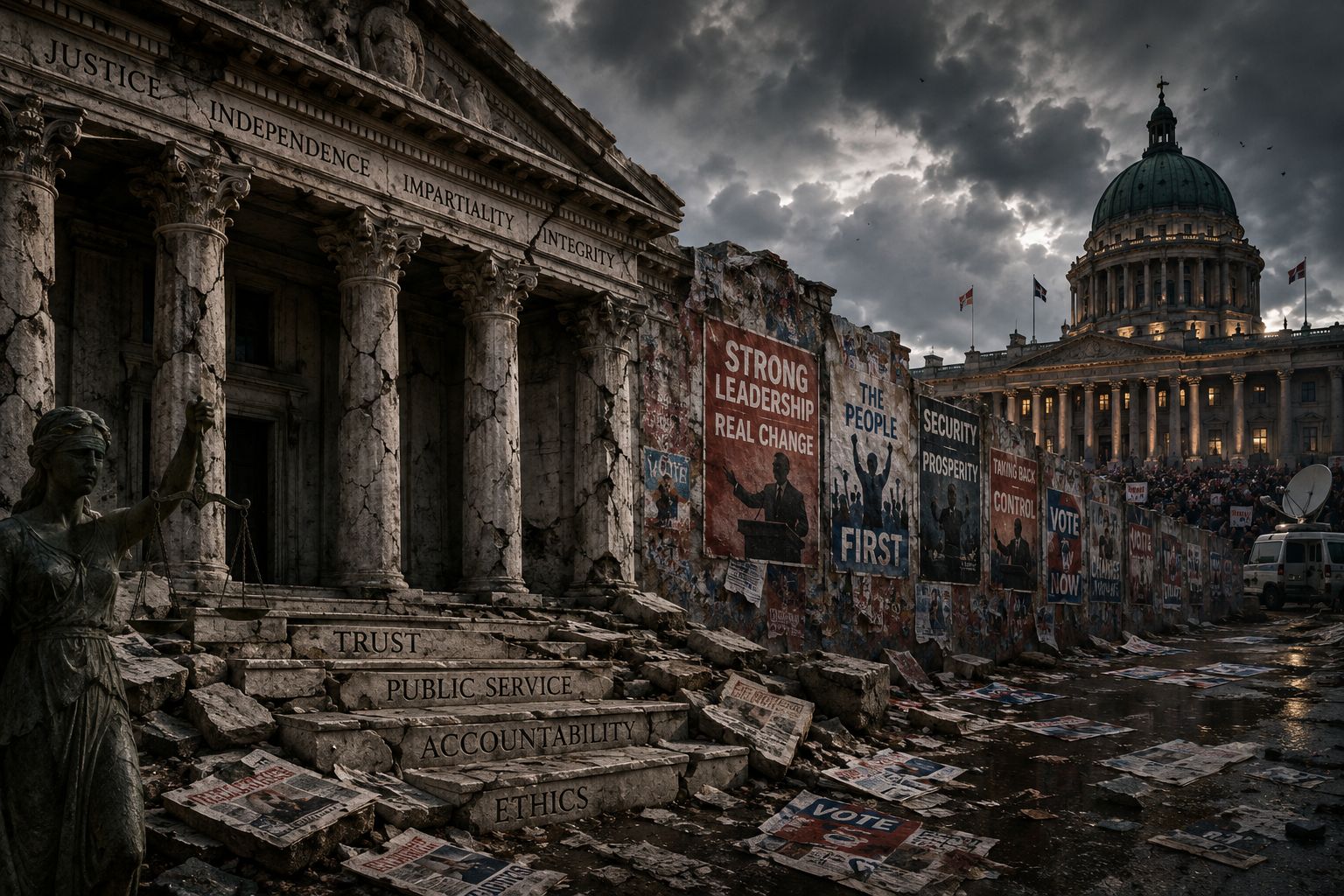
For much of the twentieth century, democratic politics operated according to a relatively stable set of unwritten rules. Politicians accused of serious corruption, financial crimes, or abuse of office often saw their careers collapse long before a court reached its final verdict. Public trust mattered, and even the appearance of wrongdoing could permanently damage a politician’s reputation. Voters generally expected their representatives to meet certain ethical standards, while political parties often removed controversial figures to avoid electoral costs.
That culture is changing. Across many democracies, politicians facing criminal investigations, court proceedings, or even imprisonment have continued to enjoy substantial public support. In some cases, legal troubles have not merely failed to end political careers—they have strengthened them. Supporters increasingly interpret prosecutions as evidence that their preferred candidate threatens powerful interests rather than as proof of misconduct.
Whether this development represents greater democratic skepticism or a deterioration of political culture remains one of the defining political questions of the twenty-first century.
A transformation that once seemed unimaginable
Brazil provides one of the most remarkable examples. Luiz Inácio Lula da Silva served time in prison after being convicted during the Operation Car Wash corruption investigation. Those convictions were later annulled on procedural and jurisdictional grounds, allowing him to return to politics and ultimately win another presidential election. Regardless of how one evaluates the legal decisions, the political outcome would have appeared extraordinary only a few decades earlier. Few observers would have expected a former prisoner to return directly to the highest political office.
France offers another illustration of changing political norms. Marine Le Pen was convicted of misusing European Parliament funds, yet she has remained one of France’s leading political figures while challenging the verdict through the appeals process. Instead of disappearing from public life, she continues to command the loyalty of millions of voters who view the case through a political lens rather than a purely legal one.
These examples are not isolated. Politicians facing criminal charges or investigations have remained electorally competitive in several democracies, including the United States, Israel, Romania, and South Korea. The traditional assumption that legal scandal automatically ends a political career has become far less reliable than it once was.
The forces behind this transformation
This shift did not occur by accident. Instead, it emerged from several powerful social and political changes that reinforce one another. Like many broader political developments, it is the product of multiple long-term trends rather than a single cause.
Politics has become part of personal identity
Political affiliation increasingly resembles social identity rather than ideological preference. Many citizens no longer support parties simply because they agree with particular policies. Instead, political identity becomes part of who they are, similar to religion, nationality, or membership in a sports club.
Once politics becomes intertwined with identity, criticism of political leaders is often perceived as criticism of the supporters themselves. Admitting that one’s preferred politician behaved unethically may feel psychologically similar to admitting personal failure. As a result, many voters instinctively defend politicians whom they perceive as representing their community or worldview.
This psychological mechanism helps explain why scandals often reinforce political loyalty instead of weakening it.
Growing distrust of institutions
Confidence in traditional institutions has declined across much of the democratic world. Public trust in governments, political parties, courts, journalists, and experts has fallen in many countries over the past several decades.
When citizens no longer trust these institutions, legal investigations become easier to dismiss. Every indictment can be portrayed as politically motivated. Every court ruling can be interpreted as evidence of bias. Supporters often assume that institutions themselves have become participants in political conflict rather than neutral arbiters.
Whether those suspicions are justified in individual cases becomes less important than the broader perception that institutions cannot be trusted.
The structure of modern communication has also transformed political incentives. Social media algorithms prioritize content that generates strong emotional reactions because such material attracts attention and increases engagement.
Calm discussions about public policy rarely spread as rapidly as dramatic accusations of corruption, conspiracy, or persecution. Politicians quickly learn that outrage receives more visibility than moderation. Every controversy therefore becomes an opportunity to dominate public debate.
This environment rewards personalities who constantly generate conflict while making compromise appear weak or uninteresting.
Populism thrives on confrontation
Modern populist movements often define themselves through opposition to established institutions. Courts, mainstream media, universities, and civil servants are frequently portrayed as members of a corrupt elite that supposedly works against ordinary citizens.
Within this narrative, criminal investigations become politically useful. Rather than damaging a politician’s reputation, prosecution can reinforce claims that powerful interests are attempting to silence an outsider. Every legal setback becomes another chapter in the story of persecution.
The politician is no longer presented as someone defending themselves against allegations. Instead, they become a symbol of resistance against an allegedly corrupt establishment.
Increasing political polarization
Political polarization has reached levels unseen in many democratic societies for decades. As ideological divisions deepen, citizens increasingly evaluate information according to its political source rather than its factual content.
This produces striking double standards. Allegations against political opponents are often accepted immediately, while identical accusations against political allies are dismissed as fabricated or exaggerated. Ethical standards become conditional upon party affiliation instead of being applied consistently.
Such selective reasoning gradually weakens shared norms regarding political accountability.
Economic frustration creates demand for disruption
Economic uncertainty further contributes to this process. Rising housing costs, stagnant wages, inflation, increasing inequality, and concerns about globalization have left many citizens dissatisfied with existing political systems.
When voters conclude that conventional politicians have failed to solve persistent problems, they become more willing to support unconventional candidates. Personal controversy becomes less important than promises of radical change. For many voters, disrupting the political system appears preferable to preserving established norms that they believe have already failed them.
This creates fertile ground for candidates who portray themselves as fighters against the political establishment.
The permanent election campaign
The distinction between governing and campaigning has largely disappeared. Politicians now operate within a continuous media environment in which every speech, interview, court hearing, or parliamentary debate becomes part of an ongoing electoral campaign.
Negative publicity often increases visibility. Even legal proceedings can dominate news cycles for weeks, providing politicians with enormous media exposure. In earlier decades, scandals often removed politicians from public attention. Today, they frequently become the center of it.
Attention itself has become one of the most valuable political resources.
International imitation
Political strategies increasingly spread across borders. Campaign techniques that prove successful in one country are rapidly adopted elsewhere. Claims of politically motivated prosecutions, attacks on journalists, criticism of judges, and accusations against electoral institutions now appear in numerous democracies regardless of ideological orientation.
Global media allows politicians to observe successful communication strategies almost instantly. As a result, political cultures increasingly influence one another instead of developing independently.
What might happen next?
If these trends continue, political culture is likely to become even more confrontational during the coming decade. Criminal investigations will probably lose even more of their ability to determine electoral outcomes. Instead, they may become another battlefield in broader political conflicts.
Political parties may become increasingly willing to nominate candidates facing legal proceedings if polling indicates they remain popular. Voters may continue placing greater emphasis on ideological alignment than on personal conduct, particularly in highly polarized societies. Social media is also likely to further amplify emotional narratives unless its underlying incentives fundamentally change.
Trust in institutions may continue to decline if governments fail to demonstrate transparency, competence, and impartiality. As confidence weakens, accusations of political bias will probably become even more common, regardless of whether they are supported by evidence.
At the same time, democratic societies may become increasingly divided into competing informational communities. Citizens will consume different media, trust different experts, and reach entirely different conclusions about the same political events. Under such conditions, achieving broad public agreement on even basic facts becomes progressively more difficult.
Can the trend be reversed?
Political culture is not fixed. Throughout history, democratic norms have strengthened during some periods and weakened during others. Institutional reforms, greater transparency, independent courts, responsible journalism, improved civic education, and stronger economic performance could gradually restore public confidence.
Nevertheless, reversing current trends will not be easy. The forces driving polarization, distrust, and populism are deeply embedded within modern communication technologies and broader social change. They reinforce one another, creating a feedback loop that rewards confrontation while punishing moderation.
Whether political culture continues to deteriorate will ultimately depend less on individual politicians than on the resilience of democratic institutions and the willingness of citizens to defend shared standards of accountability. Democracies can survive fierce political disagreement, but they struggle when large segments of society cease to believe that common rules apply equally to everyone.
Leave a Reply