Tag: capitalism
-

WW3 and stupidity: Voters, politicians, media, shadow eminences
At first glance, people search for a single cause of war. Of course, it is complex, but if we should regard to simplified actors by current morality, this article is for you. They want one villain, one mistake, one decisive moment. However, reality looks very different. Wars emerge from layers of incentives, ignorance, fear, and…
-

How does US democracy survive Donald Trump?
People panic. They imagine one man can destroy everything. They talk about collapse as if it stands one election away. However, that view ignores how the system actually works. It ignores structure, it ignores incentives. It ignores history. The system already survived far worse The United States did not face its first crisis under Trump.…
-
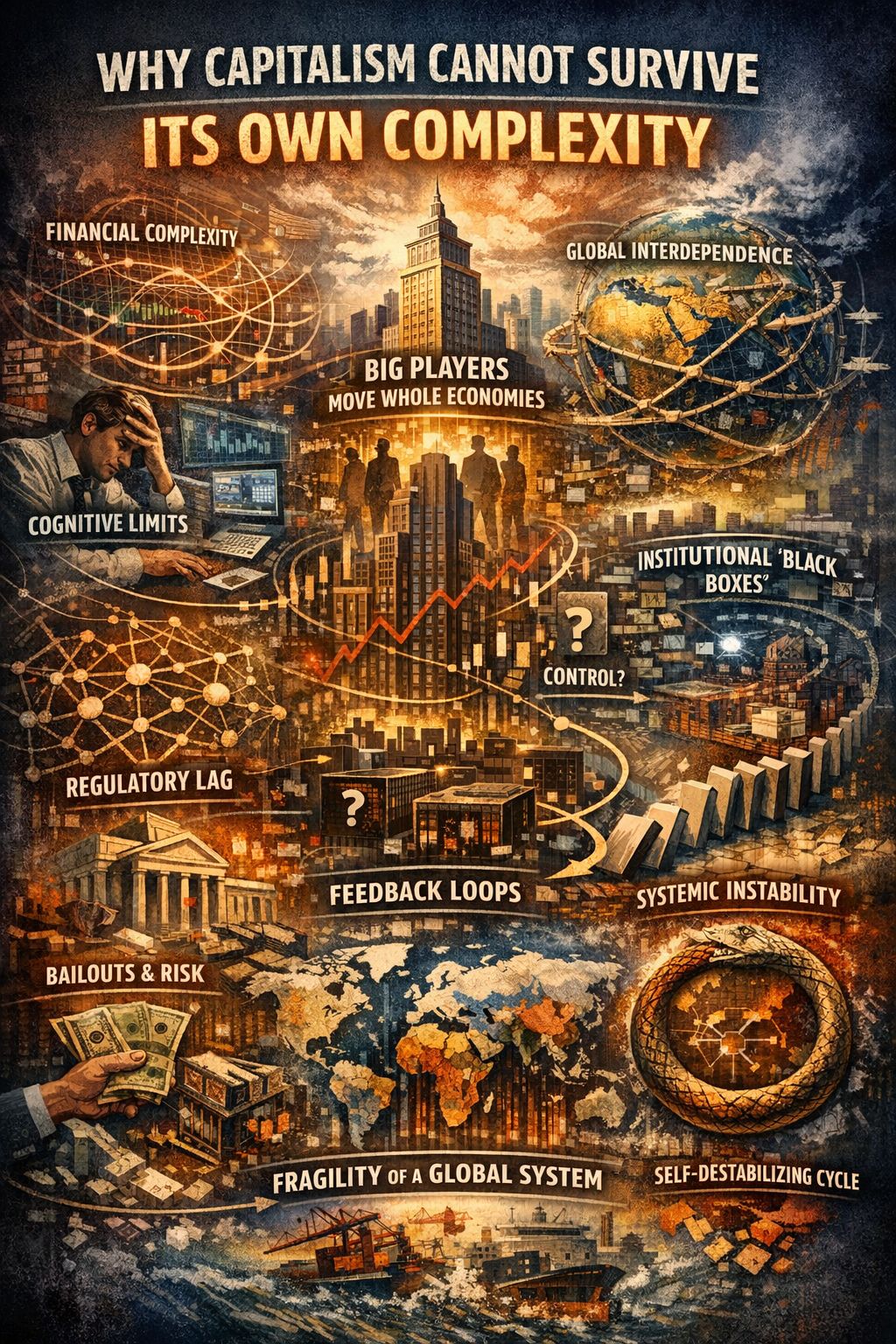
Why capitalism cannot survive its own complexity
At first glance, capitalism looks simple. It connects buyers and sellers. It rewards effort, innovation, and efficiency. It scales across societies and creates wealth at unprecedented levels. For a time, it even appears self-correcting. However, this simplicity belongs to an earlier stage. As capitalism expanded, it did not merely grow. Instead, it accumulated layers. It…
-

The rich manipulation of whole economies
Modern economies appear decentralized. Governments debate. Voters elect leaders. Markets supposedly react to millions of independent decisions. Yet this visible surface hides a far more concentrated structure. Big banks, super-rich families, multinational corporations, and powerful lobbying networks interact constantly behind the scenes. They move capital, shape regulations, and define investment priorities. Consequently, they influence economic…
-

The myth of meritocracy in modern society
Modern societies repeat one central promise. Work hard. Be talented. Stay disciplined. And you will rise. However, this promise describes an ideal, not a mechanism. It comforts the middle class; it legitimizes the elite. It disciplines those at the bottom. Meritocracy sounds rational. It sounds fair. It sounds scientific. Yet when you examine how capital,…
-

When search engines silence controversy
At first glance, search engines appear neutral. They promise relevance. And they promise quality. They imply that the best content naturally rises to the top. However, once we examine their structure more closely, that promise begins to weaken. In reality, modern search is not a neutral archive. Rather, it is a risk-managed, advertiser-sensitive, regulation-aware ranking…
-

Will a New Monroe Doctrine bring peace?
The international system is entering a phase of open instability. Power no longer concentrates in one center, nor does it move predictably through established institutions. Instead, it fragments across regions, alliances, and competing economic blocs. The West still possesses enormous military, financial, and technological advantages, yet its ability to shape outcomes has clearly diminished. At…
-

The American global geopolitical downfall
The decline of American global power is often described in cultural or political terms. Commentators focus on polarization, elections, leadership failures, or social conflict. While these factors matter at the surface level, they do not explain the structural shift in global power. The core mechanism of decline lies elsewhere. It lies in capital flows, financial…
-

If banks wanted the Czech government gone, It would be over
Public debate in Czechia constantly misidentifies power. It focuses on ministers, party leaders, scandals, and occasionally on flamboyant oligarchs. As a result, power appears chaotic, personal, and noisy. However, this picture misses the decisive layer. It ignores the actors who control liquidity, credit, refinancing, and market confidence. Therefore, it ignores the actors who decide whether…
-

The end of American soft power and the illusion of leadership
At its core, American soft power never meant kindness, morality, or cultural charm alone. Instead, it meant credibility. More precisely, it meant trust, predictability, and consistency. Countries aligned with the United States because the system appeared to work. As long as cooperation produced growth, alignment made sense. As long as rules delivered stability, persuasion succeeded.…