
I live in a country that experienced all of this. Hardcore censorship, auto-censorship, and – finally – the post-Snowden internet era. There is an ongoing, finitely not answered question of whether there are more naive people who grew up in totalitarianism or people who grew up in a functional democracy.
We can be aware of the history of censorship, dating back to when massive posts started to exist, and reflect our findings when we have to stand in auto-censorship in capitalism or the post-Snowden internet era.
This article also deals with the consequently intertwined function of freedom of speaking in a broader sense.
Hardcore censorship: Are more naive people who lived in communism than Westerners?
Whether people who grew up under communism are more naive than those who didn’t is a question that touches on history, psychology, and cultural experience. The answer isn’t straightforward, as both groups face different influences that shape their understanding of the world.
In communist regimes, information was tightly controlled. Governments censored media and controlled the narrative, feeding citizens a steady stream of propaganda. For those who grew up in these environments, access to outside perspectives was often limited or non-existent. This isolation could lead to a narrower worldview, fostering a certain naivety about how other systems functioned. Many grew up believing in the superiority of the communist state, unaware of its failings compared to democratic or capitalist systems. In countries like the Soviet Union, for example, citizens often believed that shortages and state control were necessary for equality, and they didn’t always see the stark contrast between their lives and those in the West.
Diverse information
But while people living in communism may have had limited access to diverse opinions, this doesn’t necessarily mean they were more naive. Living under such systems required a kind of resourcefulness and survival instinct that’s often overlooked. People had to navigate a complex bureaucracy, understand the unwritten rules of the regime, and learn to make do with limited resources. Many became adept at reading between the lines, interpreting state propaganda with a grain of salt. Far from being naive, they developed a kind of pragmatic understanding of how to get by under an authoritarian system. They understood that the truth was often hidden, and learned to be skeptical of official messages.
On the other hand, those who didn’t grow up under communism often enjoyed access to a wider variety of information, opinions, and ideologies. In democratic, capitalist societies, media landscapes are much broader. People have access to global news, different perspectives, and can freely debate and criticize their government. This exposure could be seen as fostering a more critical mindset, less prone to naivety when it comes to political and social systems.
Deep understanding and who is right?
Yet, this access to information doesn’t automatically translate into a deeper understanding of global issues. People in free societies can still fall into the trap of idealism or simplistic thinking. Without firsthand experience of authoritarianism, they may take their freedoms for granted. They might develop an overly idealistic or romanticized view of the world, believing that democracy and capitalism are perfect systems, unaware of the deep inequalities or corruption that can exist within them. In this sense, naivety can manifest in those not affected by communism through idealism about their own political systems or an underestimation of the hardships faced by people in other parts of the world.
While there isn’t and likely won’t be any scientific consensus, I am inclined to variation that people who lived through totalitarianism are more aware of establishment, media lying, and the post-censorship era.
History of censorship
Media censorship has a long and complex history. It has been used by governments, religious institutions, and powerful individuals to control public discourse and suppress dissent. One of the earliest examples dates back to ancient Rome, where authorities tightly controlled what could be printed or performed. The Roman government viewed public speech as a potential threat to stability, especially during times of political turmoil.
In the Middle Ages, the Catholic Church played a major role in censorship. The Church sought to control religious and philosophical ideas, banning books that challenged its authority. The invention of the printing press in the 15th century made it harder to control the spread of information. As books became more widespread, so did attempts to censor them. The Church created the Index Librorum Prohibitorum, a list of banned books, in 1559. This list stayed in place for centuries and targeted works that challenged Catholic teachings or promoted ideas like Protestantism.
Centralized governments
As governments grew more centralized, censorship took on new forms. Monarchies in Europe expanded their control over the press. In England, the Licensing Act of 1662 required printers to obtain government approval before publishing. This law helped authorities prevent the spread of ideas they considered dangerous, particularly during periods of political unrest. The French monarchy also maintained strict control over the press, especially leading up to the French Revolution, fearing that radical ideas could spark rebellion.
In the 20th century, censorship became a powerful tool for totalitarian regimes. Nazi Germany used censorship to control public perception, limiting information that contradicted the party’s ideology. The Soviet Union, under Stalin, established one of the most extensive censorship systems in history. The state controlled all media, including newspapers, radio, and literature. Writers, journalists, and artists who defied the party line were often imprisoned or executed. The Soviet government erased inconvenient historical events, creating a skewed version of history that suited its political agenda.
Meanwhile, censorship has also played a role in democratic societies. In the United States, World War I and II saw significant efforts to control media coverage. The government limited what could be published about the war, citing national security concerns. During the Red Scare, media outlets were pressured to avoid communist sympathies. While these restrictions were less extreme than in authoritarian regimes, they still reflected a desire to influence public opinion.
The rise of totalitarian regimes
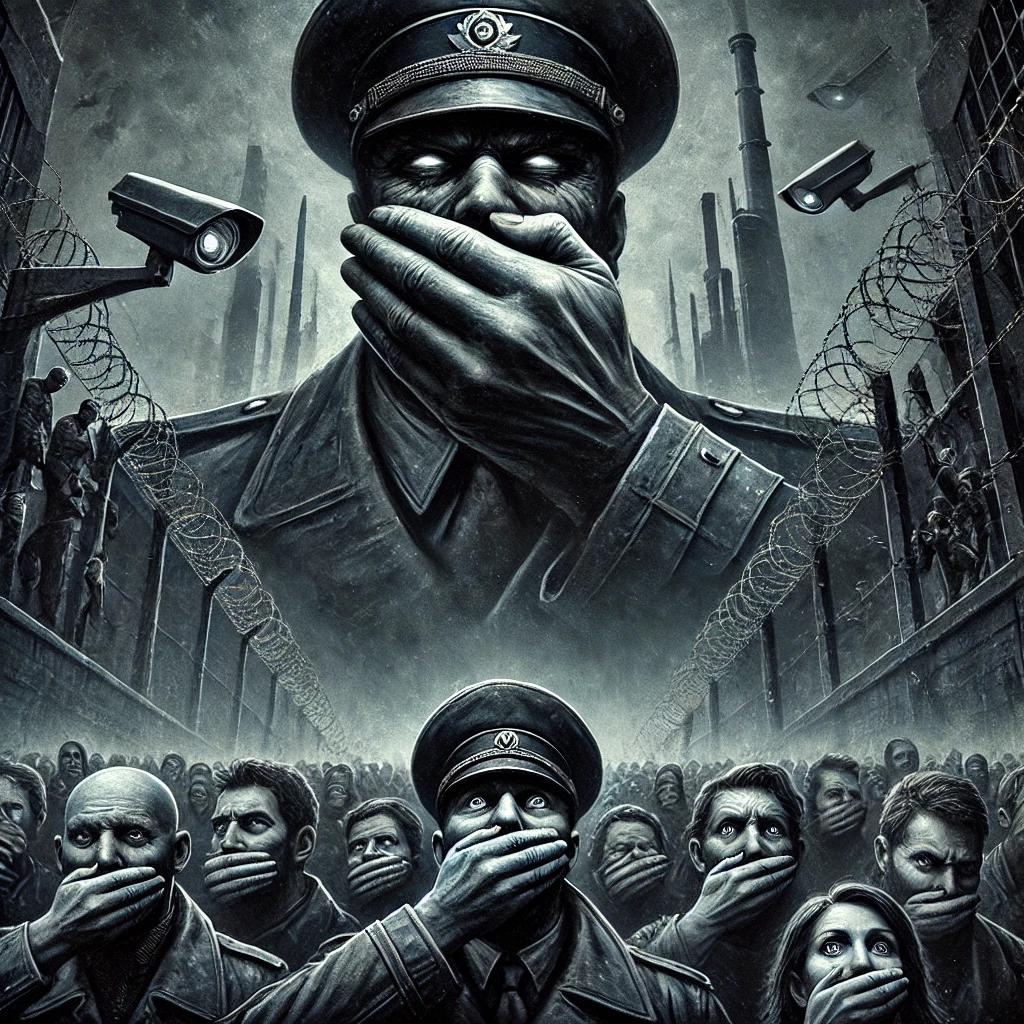
In more recent times, the rise of the internet has transformed the landscape of media censorship. Governments around the world, including China, Russia, and North Korea, have implemented sophisticated systems to control online information. The Chinese government, for instance, employs tens of thousands of censors to monitor social media and remove content deemed politically sensitive. These efforts are aimed at maintaining the ruling party’s grip on power by restricting citizens’ access to free information.
Censorship continues to evolve, with technology playing a central role. Even in countries that traditionally uphold free speech, debates around the role of tech companies in moderating content have raised new concerns. These companies, which operate platforms with billions of users, are increasingly responsible for deciding what information is visible. Governments also pressure them to take down content they find objectionable.
The history of media censorship is a story of power, control, and resistance. While its methods have changed, its purpose remains the same: to shape public opinion and maintain authority.
Why is traditional censorship dangerous and what benefits does it have in comparison with auto-cesorship?
Back in the days in Czechoslovakia, people knew the press was outright lying to them. You must consider every piece of information as a lie, a form of propaganda understood even by those not so intellectually gifted.
Total censorship shares similarities with auto-censorship in that it provides stability to the ruling regime.
It confirms the ruling elites as those who should be in power. It also offers an ideological perspective because every totalitarianism has some ideology.
Some people can be convinced by the censorship (to the ideologic propaganda), however, most people are repelled.
Western democracies have auto-censorship and it is more vicious
Do you think you can write what is behind the political curtain where 98 % of the stuff is really occurring? I will deeply disappoint you.
Tell us what relationship (in the US environment) JP Morgan has with Goldman Sachs? What super-rich family is more inclined to a president? Which multinational lobbyists dictated to this medium what to write? Sorry, no knowledge whatsoever was provided. But we have that knowledge.
Not only that bankers and super-rich families are evidence-based. But other relationships not so proven (lodges, international lobbyists) are derived from these findings.
When you are strong economically (rich), you need politicians to preserve your wealth (by enacting laws, or from your alienated groups) and grow it.
Therefore, the media are connected with the rich as they need to brainwash the ruled population. And they are really successful.
They write about politics. And yes, it is crucial to know at least something, otherwise you will really wake up in a totalitarian regime.
But it is a free, democracy, but people still cannot change anything.
The solution is to have media owned by people (or paid by people) which would investigate behind the curtains and have other media control it (they would control each other). You could read the political process and learn accordingly.
Also, the media should include all parties in it.
Freedom of speech is not only newspapers
Freedom of speech includes the right to express opinions, ideas, and beliefs without government interference. It allows individuals to criticize the government, engage in political debate, share information, create art, and participate in protests. Freedom of speech also theoretically should protect the press’s ability to report on matters of public interest, hold authorities accountable, and cover a wide range of topics. Additionally, it allows for academic freedom, religious expression, and the discussion of controversial subjects. However, it is subject to certain limits, such as prohibitions against hate speech, incitement to violence, defamation, and threats.
Well, do we have it? No way! In my humble opinion, either there is freedom of speech, or there isn’t (limited freedom of speech). In this narrative, Stalin was also a freedom of speech proponent.
Post-Snowden era. They collect all of it
Edward Snowden, a former contractor for the National Security Agency (NSA), leaked classified information in 2013 that exposed the extent of global surveillance programs conducted by the U.S. government, in collaboration with various other countries. He revealed that the NSA was collecting vast amounts of phone records, emails, and internet activity of ordinary citizens, both domestically and internationally, often without their knowledge or consent. Snowden’s disclosures sparked a global debate on privacy, government overreach, and the balance between national security and civil liberties. After the leaks, he fled the U.S. and was granted asylum in Russia, where he continues to live, as he faces charges of espionage and theft of government property in the U.S.
What did we do? We are the sheep
Every single citizen has woken up, contacted his legislative representative, and demanded prompt action. Either you stop it, or I won’t vote for you again!
No, back from the fairy tales. We did nothing. We only accepted this challenge and lost it.
This can, however, get really dangerous. Because if democracy fails (in the US), it fails all around the world and the establishment will know everything.
Why we need to fight against censorship, auto-censorship, and massive surveillance
When there is no flow of ideas and no freedom of speech. There are no new ideas, everything is stalled. No real freethinking brings societal changes into effect.
How can human society function when everything is extremely selective? In terms of classical censorship, there is no question that only a regime coup may relieve the situation.
However, in a democracy where a few super-rich rule, auto-censorship that doesn’t look like censorship retains the status quo. Media write about politics, they publish something while the super-rich are playing chess where money and power win.
Massive surveillance in democracy is something perverted, only describing how little power in fact citizens have. And, of course, when autocracy or totalitarianship wins, they know everything.
Leave a Reply